Organic vineyard spray program: what actually works in the field
TL;DR
- An organic vineyard spray program runs on sulfur, copper, and approved biologicals applied every 7 to 14 days against real disease pressure, not a fixed calendar.
- Use only OMRI-listed or NOP-approved inputs, meet EPA Worker Protection Standard rules, and keep spray records that survive a USDA National Organic Program audit for five years.
- Timing and canopy work beat product switching.
What is an organic vineyard spray program and how is it different from conventional?
An organic vineyard spray program is a schedule of pesticide applications, canopy work, and scouting that uses only materials allowed under the USDA National Organic Program (NOP), codified at 7 CFR Part 205. [1] The allowed and prohibited substances live in the National List at 7 CFR 205.601-205.606. The real difference from a conventional program is not that you spray less. Ask any grower who has run both. Most will tell you they spray more often on organic, because the materials wear off fast and you lose the safety net of synthetic fungicides that kill an infection already underway.
The other difference is paperwork. NOP-certified operations must keep records that prove compliance for five years, including every field application, the product name, EPA registration number, active ingredient, rate, and the specific block. [1] A conventional grower using a restricted-use pesticide carries similar state record-keeping duties. The organic operator carries an extra weight: proving every input was allowed at the moment it went in the tank.
Conventionally, a mildew program might anchor on a DMI fungicide like tebuconazole or myclobutanil, with 14 to 21 day protectant intervals and a few days of kickback after infection. Organically, your anchors are sulfur and copper. Neither has meaningful kickback. So the calendar schedule that forgives a DMI grower falls apart the moment you slip a week behind. Pressure runs the whole program.
Growers new to organic often think they can keep the same frequency and swap products. They usually have a rough first season. The ones who make it treat organic as a systems change: cover crop management to drop humidity, shoot positioning for airflow, and a scouting routine tied to a disease model.
Which materials are approved for organic grape production?
The short answer: check the NOP National List, then confirm the specific product is OMRI-listed or carries a current Organic Materials Review Institute certificate. [2] The categories that matter most in a vineyard spray program break down like this.
Fungicides and bactericides
- Sulfur (elemental): the workhorse for powdery mildew. Allowed with no annotation, meaning no restrictions beyond the label. [1] Wettable and micronized products both exist. Some growers pay more for the smaller particle size to get coverage at lower rates.
- Copper materials (copper hydroxide, copper sulfate, copper octanoate): allowed, but annotated. The NOP requires copper be used in a way that minimizes soil accumulation. [1] Washington State University Extension recommends staying below 6 lbs metallic copper per acre per year wherever you can, though the NOP sets no hard annual cap. [3]
- Hydrogen peroxide and peracetic acid: allowed for disease suppression. A useful rotation partner with sulfur against Botrytis.
- Potassium bicarbonate (Kaligreen, MilStop): allowed. Good contact activity on powdery mildew, short residual.
- Lime sulfur (calcium polysulfide): allowed. Stronger than wettable sulfur, used as a dormant or early-season material. Phytotoxicity in warm weather is a real risk.
- Reynoutria sachalinensis extract (Regalia): a plant defense activator, OMRI-listed, often tank-mixed.
Insecticides and miticides
- Insecticidal soaps and oils (narrow-range oils, neem): allowed. Handy for mites, mealybug crawlers, leafhoppers.
- Kaolin clay (Surround): allowed as a physical barrier. Works on leafhoppers and grape berry moth to a point, though it struggles to coat a dense canopy.
- Spinosad (Entrust SC): allowed. One of the best organic options for grape berry moth and western flower thrips. Resistance management means rotating modes of action, and organic rotation partners are thin, so cap it at 2 to 3 applications per season. [4]
- Bacillus thuringiensis (Bt): allowed. Good on caterpillar pests.
- Pyrethrin (without piperonyl butoxide): allowed. Short residual, use only under real pressure.
Copper accumulation in practice: Cornell's viticulture extension notes that repeated copper over decades builds to phytotoxic levels in vineyard soils, especially where pH is low. [5] If you have old blocks with 30-plus years of conventional copper behind them, run a baseline soil test before you ramp up organic copper.
One more thing. "Natural" does not mean "safe in every condition." Sulfur above 90 degrees F burns many varieties, especially thin-skinned berries like Pinot Noir. Read the label and the forecast before you spray.
How do you build an organic spray schedule around disease pressure and growth stage?
The calendar matters less than the model. Powdery mildew (Erysiphe necator) threatens almost every wine grape region in the US, and its infection periods are well mapped. UC Davis and the UC IPM program publish a powdery mildew risk model tied to daily temperature and leaf wetness, free on the UC IPM website. [6] Cornell's Network for Environment and Weather Applications (NEWA) runs similar models for the northeast. [5] Skip these tools and spray on a fixed calendar, and you have found the single most common way growers waste money on organic inputs.
Here are the growth stages where protection is not optional.
- Budbreak to bloom (EL 4-23): The first six to eight weeks after budbreak carry the highest powdery mildew risk. Young tissue has almost no cuticle and no natural resistance. A 7-day sulfur interval is standard under moderate pressure. Drop to 5 to 7 days under high pressure or after rain above 0.25 inches.
- Bloom (EL 23-26): Botrytis (Botrytis cinerea) becomes the second threat. Skip sulfur within two weeks of bloom on some varieties (phytotoxicity risk on pollen). Potassium bicarbonate, Bacillus subtilis products (Serenade, Double Nickel), and copper rotation work here.
- Berry development to veraison (EL 29-35): Hold your powdery mildew cover. Mildew on berries stays invisible until late season, so growers who relax after bloom pay for it at harvest. Berry skin infections drive off-flavors in wine even at low incidence.
- Post-veraison: Botrytis pressure climbs as clusters tighten and rain arrives. Late-season sulfur needs attention to pre-harvest intervals. Most sulfur labels carry a 1 to 7 day PHI. Copper is usually 0 days, but check the product.
A sample 7-day program for a moderate-pressure western region:
| Growth Stage | Interval | Material | Rate |
|---|---|---|---|
| Budbreak (EL 4-7) | 7 days | Wettable sulfur | 3-5 lb/acre |
| Pre-bloom (EL 12-17) | 7 days | Sulfur + Regalia | 3-5 lb + 1 qt/acre |
| Bloom (EL 23) | 7 days | Potassium bicarbonate + Bt | per label |
| Post-bloom (EL 27-29) | 10 days | Sulfur + copper | 3-4 lb + 0.5-1 lb metallic Cu |
| Berry development (EL 31-33) | 10-14 days | Sulfur | 3-5 lb/acre |
| Pre-harvest | Per PHI | Potassium bicarbonate | per label |
This is a starting point, not a prescription. Adjust for variety susceptibility, canopy density, and whatever your local extension recommends. [3][5][6]
What spray equipment and coverage practices work best for organic materials?
Coverage decides whether an organic program works. Sulfur and potassium bicarbonate are contact materials with zero systemic movement. Uncovered tissue is unprotected tissue. Full stop.
For most vineyards, an air-blast sprayer calibrated to your row spacing and canopy volume is the right rig. Spray volume is where growers slip. Under-spraying shows up in survey data far more than over-spraying. UC Cooperative Extension recommends calibrating to canopy volume with the Tree Row Volume (TRV) method rather than a flat per-acre rate, especially once the canopy fills in after bloom. [6] A dense Zinfandel canopy in week 8 needs more water per acre than a freshly trained Pinot block.
Droplet size is a real problem with sulfur. Too fine and you get drift plus fast evaporation before deposit. Too coarse and coverage drops. Most manufacturers target 200 to 400 micron VMD (volume median diameter) for protectant fungicides. Your nozzles and pressure set that number. An extension sprayer calibration workshop is worth half a day at least once a season.
Timing of application matters more than most growers admit. Sulfur applied in the heat of the day above 85 to 90 degrees F invites leaf burn and phytotoxicity. Spray early, before 9 or 10 AM, or in the evening, so the material deposits and dries before the heat builds. Copper laid down before rain often beats copper applied after, because you want it on the tissue before infection takes hold.
Water pH affects efficacy too. Sulfur and copper products work best at slightly acidic spray water, pH 5.5 to 6.5. Hard water above pH 7.5 cuts activity. A pH adjuster is cheap and worth using if your irrigation water runs alkaline.
What does EPA Worker Protection Standard require for organic vineyard spray applications?
The EPA Worker Protection Standard (WPS), at 40 CFR Part 170, covers every pesticide application in an agricultural setting, organic included. [7] An OMRI listing buys you no exemption. Sulfur, copper, and spinosad all carry pesticide labels with WPS language, and those labels are federal law.
Here is what WPS asks of a vineyard operator.
- Restricted Entry Intervals (REI): The REI is printed on each label. Sulfur carries a 24-hour REI. Copper hydroxide products run 24 to 48 hours. Spinosad (Entrust SC) is 4 hours. No worker enters a treated area until the REI expires, unless they are a PPE-equipped handler or an early-entry worker under the conditions in 40 CFR 170.505. [7]
- Pesticide safety training: Agricultural workers must be trained before working in treated areas, and the training repeats every year. Keep the records. [7]
- Central posting: Application information (product name, EPA registration number, active ingredient, REI start and end times, treated location) goes on the central display for the farm. [7]
- Application exclusion zones: Handlers keep a buffer around workers during application. For low-pressure ground equipment, that buffer is 100 feet. [7]
- Emergency assistance: You must supply emergency medical information and keep decontamination supplies on hand.
The 2015 revised WPS rule (effective January 2017) tightened all of this, adding annual training and the 100-foot exclusion zone for ground equipment. A grower who was fine under the 1995 rule may not be compliant today.
One practical point. Your organic certifier wants spray records that back your NOP compliance, and WPS wants its own overlapping documentation. Keeping both in one field record system is the only sane approach at scale. That is what a tool like VitiScribe is built for: one entry that satisfies the NOP audit trail and the WPS posting requirement without double data entry.
How do you manage powdery mildew specifically in an organic program?
Powdery mildew is the disease that breaks most organic grape programs. Erysiphe necator is an obligate parasite that overwinters as chasmothecia in bark and starts releasing ascospores at budbreak, roughly when the average daily temperature holds above 50 degrees F. [11] Those first primary infections set the population for the whole season. Miss coverage in weeks 1 through 6 after budbreak and you play catch-up until harvest.
Sulfur is still the most reliable material an organic grower has. On a 7-day interval from budbreak through veraison under moderate pressure, it genuinely works. The UC IPM Powdery Mildew Risk Index gives you a numeric score from temperature and hours of leaf wetness. A score above 30 in a single day means high-pressure conditions, and you should be at a 5 to 7 day interval. [6] The model is public and free.
On rotation: there is some evidence that continuous sulfur selection can dull efficacy, though the resistance mechanisms for sulfur are not as well described as for DMI or QoI fungicides. Rotating to potassium bicarbonate or a contact like hydrogen peroxide two or three times a season is reasonable and costs you nothing in protection. Regalia (Reynoutria extract) tank-mixed with sulfur in a couple of applications has shown additive activity in several university trials, though the effect size is modest.
Variety matters enormously. Cabernet Sauvignon, Chardonnay, and Grenache sit on the susceptible end. Marquette, Frontenac, and most USDA and Cornell hybrid releases carry real mildew resistance and run on a much more relaxed interval. If you are in a cool, humid region and losing the mildew fight under organic management, variety selection at the next replant is a real tool.
Canopy management is not a spray substitute, but it changes the math. Shoot positioning, fruit-zone leaf removal after bloom, and hedging to thin the canopy all cut the hours of leaf wetness that feed mildew. Time on canopy work buys you spray interval flexibility, dollar for dollar. Cornell's viticulture extension team has published extensively on this for northeast growers. [5]
How do you control Botrytis and bunch rots organically?
Botrytis cinerea is the second major threat and arguably harder to manage organically than powdery mildew. There is no organic equivalent of a fenhexamid or iprodione application with real kickback. You work entirely preventively.
The strongest strategy is structural: loose-cluster varieties, open canopies, and hard fruit-zone leaf removal after fruit set. Dense clusters and shade build the cool, moist microclimate Botrytis needs. If you grow Pinot Noir in a humid climate, you know exactly what this looks like in a wet August.
On the materials side:
- Bacillus subtilis (Serenade Opti, Double Nickel 55): applied at bloom and at bunch closure, these give meaningful suppression in trials. UC Davis trials show 40 to 60 percent disease reduction under moderate pressure, though protection thins out under high pressure. [6]
- Trichoderma-based products (some OMRI-listed): competitive exclusion on the berry surface. Less grape data than strawberry data, but used in practice.
- Potassium bicarbonate: useful from veraison through harvest as a contact against developing Botrytis in the fruit zone.
- Copper: some Botrytis activity, though it is mainly a bactericide and mildew material in most programs.
The timing windows for Botrytis are bloom (capfall), bunch closure (when berries touch), and pre-harvest. Hit those three with a Bacillus subtilis application and keep the canopy open, and you have done most of what organic management can do.
Botrytis also rides in on harvest damage from grape berry moth. So your insect program and your Botrytis program are linked. Control moth pressure, cut berry entry wounds, and Botrytis incidence drops with it.
What does organic spray program compliance and record-keeping actually require?
Under 7 CFR 205.103, certified organic operations must keep records for five years documenting every practice and material used. [1] For spray applications, your records need to show:
- Date of application
- Field or block identification
- Crop and growth stage
- Product name, manufacturer, and EPA registration number
- Active ingredient(s)
- Rate applied per acre
- Total acres treated
- Applicator name
- Equipment used
- Purpose of application (disease, pest, or specific target)
Your certifier may also ask for purchase invoices for every input, to verify the product was OMRI-listed or otherwise approved at the time of purchase. Keeping receipts and supplier compliance certificates is good practice.
WPS central posting overlaps heavily with the NOP spray log, but the fields differ. WPS central posting needs the REI start and end date and time, which an NOP spray log does not require on its own. Running two separate systems is how gaps happen. The clean setup is a single field application record that captures every NOP field plus the WPS-specific ones. Many growers use a paper logbook in the early years and move to a digital system once the block count passes five or six. A platform built for vineyard compliance like VitiScribe handles both formats and generates the dated, block-level reports that certifiers and state departments of agriculture both expect.
State pesticide record-keeping laws add another layer. California's DPR requires licensed applicators to submit use reports, and agricultural employers carry overlapping duties under the California Code of Regulations. [8] Other states run similar frameworks. If you are not sure what your state wants on top of federal NOP and WPS rules, your state department of agriculture or your certifying agent is the place to ask.
One audit note worth taking to heart. The most common documentation failure in organic vineyard inspections is not using a prohibited material. It is failing to trace one material through a complete chain: purchase receipt, current OMRI certificate, and the spray records showing the rate and block. Build that traceability in from day one.
How do organic spray costs compare to conventional programs?
Honest answer: organic materials usually cost more per application than conventional fungicides, but the comparison is messier than a price table, because organic programs often need more applications per season.
A 2020 UC Cooperative Extension farm cost study for North Coast winegrapes put total pest management costs (materials, labor, and equipment) at roughly $400 to $600 per acre per year for a conventional program. Organic programs in the same region ran $550 to $900 per acre depending on disease pressure and labor rates. [9] Those are 2020 dollars, and costs have risen since. Nobody has perfectly clean comparative data here, because organic and conventional growers differ in many ways beyond inputs, and the price premium on organic fruit is supposed to cover the higher production cost.
Labor is the main cost driver. More applications at shorter intervals means more equipment hours and more tractor time. In California, a tractor driver for pesticide application costs $25 to $40 per hour with overhead. One extra application per block per season across a 50-acre vineyard adds up fast.
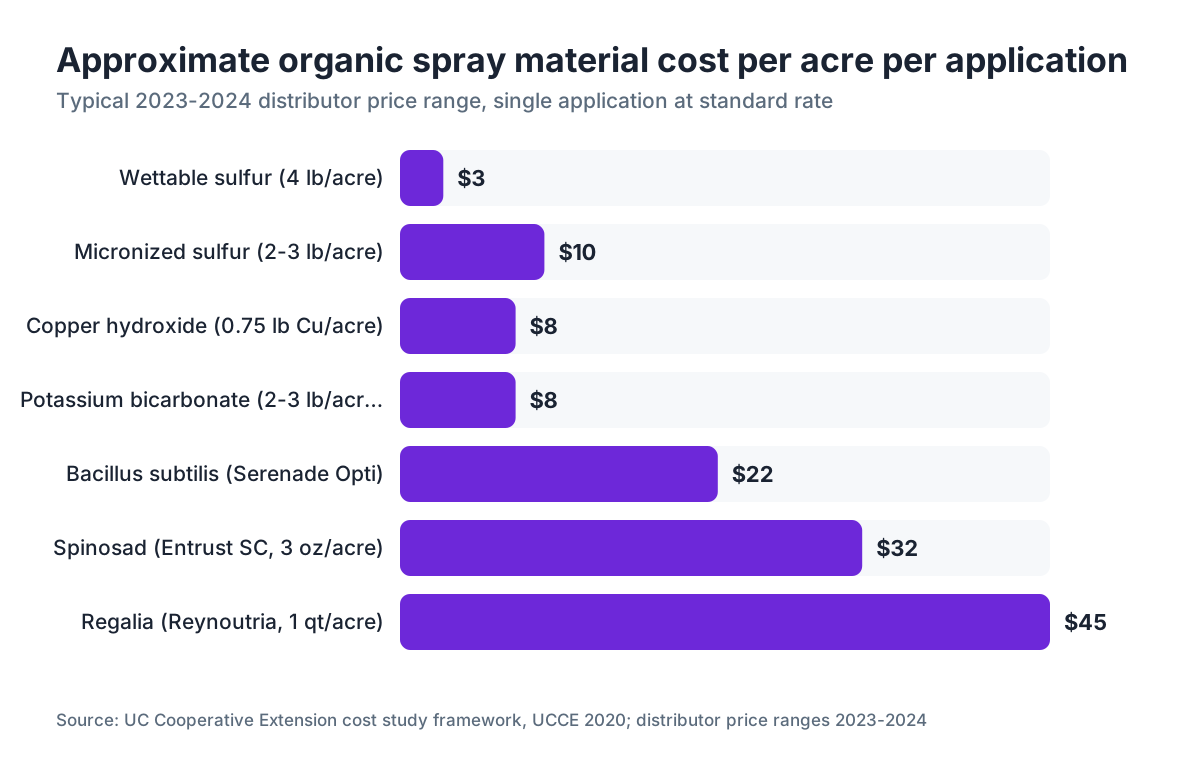
Material cost by category (approximate 2023-2024 ranges from distributor price lists; verify with your local supplier):
| Material | Form | Cost/lb or unit | Typical rate | Cost/acre/application |
|---|---|---|---|---|
| Wettable sulfur (90%) | 50 lb bag | $0.50-0.80/lb | 4 lb/acre | $2-3 |
| Micronized sulfur | 10 lb bag | $3-5/lb | 2-3 lb/acre | $6-15 |
| Copper hydroxide (50%) | 5 lb bag | $8-14/lb metallic Cu | 0.75 lb Cu/acre | $6-10 |
| Potassium bicarbonate | 50 lb bag | $2-4/lb | 2-3 lb/acre | $4-12 |
| Bacillus subtilis (Serenade Opti) | per lb | $20-30/lb | per label | $15-30 |
| Spinosad (Entrust SC) | per oz | $8-12/oz | 2-4 oz/acre | $16-48 |
| Regalia (Reynoutria) | per qt | $35-55/qt | 1 qt/acre | $35-55 |
Sulfur is still cheap. Program cost climbs when you add biologicals and defense activators, which is why most cost-conscious growers keep sulfur as the backbone and rotate the expensive materials into the highest-pressure windows.
What are the best resources for organic vineyard spray program guidance by region?
The regional extension programs are the best starting points, and they cost nothing.
UC Davis / UC IPM (California): The UC IPM Pest Management Guidelines for Grapes are the most thorough public guide for California conditions. They cover every major pest and disease with organic-approved material options, efficacy ratings, and resistance management notes. The powdery mildew risk model lives on the UC IPM website. [6] UC Cooperative Extension farm advisors in each county help with local calibration.
Cornell University (Northeast): Cornell's viticulture extension has specific guides for organic grape production in humid continental climates, where Botrytis and downy mildew pressure run far higher than in the west. The NEWA disease forecasting network is a Cornell-anchored tool that northeastern growers should be using. [5]
Washington State University Extension (Pacific Northwest): WSU publishes the Pacific Northwest Plant Disease Management Handbook, updated every year, with organic options clearly flagged. WSU's viticulture team has also published copper reduction research specific to PNW conditions. [3]
USDA NOP: The official National Organic Program page at USDA's Agricultural Marketing Service publishes the current National List, guidance documents, and the list of accredited certifying agents by state. [1]
OMRI: The Organic Materials Review Institute keeps a searchable database of every OMRI-listed product. [2] Before you buy any input claiming organic approval, search it here. Brand names change, formulations change, and an old certificate does not guarantee the current formulation is still approved.
For a field-level view of vineyard operations more broadly, including how spray programs fit into growing-season management, your certifying agent's annual training is also worth the time. Many certifiers run grower workshops specific to wine grapes.
And for any question about whether a specific product's EPA registration is current and legal in your state, call your state department of agriculture's pesticide regulation division.
What mistakes do organic grape growers most commonly make in their spray programs?
The list is short and it repeats across extension surveys and grower conversations.
Waiting too long to start. The most common mistake. Powdery mildew primary inoculum sits in the vineyard at budbreak. Growers who wait until they see symptoms are already losing. The window for preventive sulfur is the first four to six weeks after budbreak, and missing even two applications there can cost you the season under high pressure.
Spraying on a calendar without a model. A fixed 10-day calendar under-sprays during high-pressure weather and over-sprays during dry stretches. The UC IPM and NEWA models exist to let you make that call on actual infection risk instead of gut feel. Using them is not complicated.
Applying sulfur in the heat. Sulfur above 90 degrees F on thin-skinned varieties causes phytotoxicity that looks like mildew at a glance. Experienced growers stop sulfur by 8 or 9 AM in summer and skip it if the afternoon forecast tops 90.
Under-using canopy management. Some growers treat canopy work and spray work as separate decisions. They are not. Every hour on fruit-zone leaf removal comes back to you as spray interval flexibility and lower materials cost.
Ignoring copper accumulation. Copper is effective and allowed, but soil accumulation is a real environmental concern and, over decades, reaches phytotoxic levels. Track your annual copper load per block and hold below 6 lbs metallic copper per acre per year as a working target. [3]
Documentation gaps. Buying a new product mid-season without pulling the current OMRI certificate, spraying without recording the REI time, or forgetting to post WPS information: each one is a compliance failure that can cost a grower their certification at inspection. The paperwork is not optional.
Frequently asked questions
Can I use sulfur at any growth stage in an organic vineyard spray program?
Sulfur is generally safe from budbreak through about two weeks before harvest, subject to the label's pre-harvest interval (typically 1 to 7 days). The main risk is phytotoxicity: do not apply above 85 to 90 degrees F, and go easy within two weeks of bloom on susceptible varieties. Thin-skinned cultivars like Pinot Noir burn more readily than thicker-skinned Cabernet Sauvignon. Always check the specific product label, which is federal law.
How do I know if a product is approved for certified organic grape production?
Search the OMRI Products List at omri.org or check your certifier's approved input list. A product is allowed if it sits on the NOP National List at 7 CFR 205.601 or carries a current OMRI certificate. Brand names and formulations change, so pull the current certificate every season, more than the first year you use a product. When in doubt, ask your certifying agent before applying, not after.
What is the pre-harvest interval for sulfur in organic vineyards?
Pre-harvest intervals vary by product. Most wettable and micronized sulfur labels carry a 1 to 7 day PHI. Some specialty sulfur products list as few as 0 to 1 days. Always read the specific product label for the exact PHI, because different formulations from different manufacturers carry different intervals. The label is the legal document, and the PHI printed on it is the one that counts.
Does the EPA Worker Protection Standard apply to organic pesticide applications?
Yes. WPS at 40 CFR Part 170 covers every pesticide application on an agricultural establishment, regardless of whether the material is organic-approved. Sulfur carries a 24-hour REI; spinosad (Entrust SC) carries a 4-hour REI. You must post application information at the central display, provide WPS training annually to agricultural workers, and hold application exclusion zones during spraying. Organic certification creates no WPS exemption.
How many copper applications can I make per year in a certified organic vineyard?
The NOP National List allows copper with the annotation that it be used in a way that minimizes soil accumulation. There is no hard numeric federal cap per year. WSU Extension recommends staying below 6 lbs metallic copper per acre per year as a practical limit against soil buildup. Your certifying agent may set tighter local guidance. Track metallic copper pounds applied per block each season, more than the number of applications.
What records do I need to keep for an NOP-certified organic vineyard spray program?
Under 7 CFR 205.103, you need five years of records covering every application: date, field or block ID, product name, EPA registration number, active ingredient, rate, acres treated, applicator name, equipment, and purpose. You also need purchase receipts and current OMRI certificates for every input. Your certifier asks for these at the annual inspection. WPS central posting records are a parallel but overlapping requirement.
Is Bacillus subtilis effective enough to be the main Botrytis material in an organic program?
It is your best organic option for Botrytis, but not a complete solution. UC Davis trials show 40 to 60 percent disease reduction under moderate pressure, which is meaningful but short of the 80 to 90 percent from synthetic fungicides. Apply Bacillus subtilis at bloom and bunch closure, the two most important timing windows. Combine it with canopy management, since open clusters and airflow do more against Botrytis than any material an organic grower can buy.
Can I use Entrust (spinosad) every spray in an organic insect program?
No. Spinosad resistance in key vineyard pests is a documented risk with repeated use. Limit Entrust to 2 to 3 applications per season and rotate to a different mode of action. Organic rotation options include Bt products, pyrethrin, kaolin clay, and insecticidal soaps. The Entrust SC label also restricts total seasonal applications, so read the resistance management section before you build your schedule.
How does powdery mildew resistance to organic fungicides compare to resistance to conventional fungicides?
Sulfur and potassium bicarbonate are contact materials with physical or ionic modes of action, so resistance develops far slower and is less documented than for DMI or QoI fungicides. Some growers report reduced sulfur efficacy in blocks with 20-plus years of continuous use, but the resistance mechanisms for sulfur in Erysiphe necator are not as well characterized as those for sterol demethylation inhibitors. Rotating to potassium bicarbonate or hydrogen peroxide periodically is a reasonable precaution.
What disease forecasting tools are available to help time organic spray applications?
UC IPM's Powdery Mildew Risk Index is the most widely used tool for California growers, free at ipm.ucanr.edu. Cornell's NEWA platform covers the northeast with powdery mildew, Botrytis, and downy mildew models. Both use weather station data to generate infection risk scores you can tie directly to spray timing. Many growers install a simple weather station in the vineyard for site-specific data rather than leaning on the nearest public station.
Do I need a pesticide applicator license to spray organic materials in my own vineyard?
It depends on the state and the product. In California, applying a pesticide as an owner-operator on your own property generally does not require a private applicator license, though certain restricted-use pesticides do. Most organic materials are general-use pesticides and need no license to buy or apply. If you hire a custom applicator, they usually must be licensed. Check your state's department of agriculture for the specific rules where you farm.
How do I manage downy mildew in an organic vineyard program?
Downy mildew (Plasmopara viticola) is the main concern in humid eastern regions and coastal sites. Copper is your primary organic tool and has genuine activity against downy mildew, unlike sulfur, which does little. Apply copper before rain events, when spore dispersal peaks. Cornell and WSU extension both publish downy mildew forecasting models. In California's dry interior, downy mildew pressure runs low enough that most growers treat copper as an optional rotation rather than a program anchor.
What spray intervals should I use for an organic program in a high-pressure year?
In a high-pressure year, run a 5 to 7 day sulfur interval from budbreak through six to eight weeks post-bloom, the standard recommendation from UC IPM and Cornell extension. After bunch closure, if pressure holds, keep 7-day intervals through veraison. Drop to 10 to 14 days only after veraison under lower pressure and dry conditions. A high-pressure year is not the time to stretch intervals for cost; a failed crop costs far more than two extra applications.
Can I spray copper and sulfur together in the same tank mix?
Mixing copper and sulfur in the same tank is generally not recommended and is specifically contraindicated by many product labels, because it can cause phytotoxicity and cut efficacy of both materials. Apply them in separate passes, ideally 48 to 72 hours apart. Some growers alternate copper and sulfur through the post-bloom period when they want activity on both mildew and downy mildew or bacterial targets.
Sources
- USDA Agricultural Marketing Service, National Organic Program, 7 CFR Part 205: NOP regulations at 7 CFR 205.601-205.606 govern allowed and prohibited materials in organic production; records must be kept for five years under 7 CFR 205.103
- Organic Materials Review Institute (OMRI), Products List: OMRI maintains a searchable database of products reviewed and listed as compliant with USDA NOP standards for organic production
- Washington State University Extension, Pacific Northwest Plant Disease Management Handbook: WSU Extension recommends keeping total copper applications below 6 lbs metallic copper per acre per year to minimize soil accumulation
- Corteva Agriscience, Entrust SC Naturalyte Insect Control label: Entrust SC label requires resistance management rotation and limits seasonal applications of spinosad in a given site
- Cornell University, College of Agriculture and Life Sciences, Viticulture and Enology Extension: Cornell extension publishes organic grape production guides for northeast humid climates, including copper accumulation research and NEWA disease forecasting tools
- University of California Agriculture and Natural Resources, UC IPM Pest Management Guidelines: Grape: UC IPM provides the Powdery Mildew Risk Index model, organic-approved material efficacy ratings, and coverage calibration guidance using Tree Row Volume method for California vineyards
- US Environmental Protection Agency, Worker Protection Standard, 40 CFR Part 170: WPS requires pesticide safety training annually, central posting of application information, REI compliance, and 100-foot application exclusion zones for ground equipment; applies to all agricultural pesticide applications including organic materials
- California Department of Pesticide Regulation, Pesticide Use Reporting: California DPR requires licensed pesticide applicators to submit use reports; agricultural employers have overlapping record-keeping obligations under California Code of Regulations
- UC Cooperative Extension, Sample Costs to Establish a Vineyard and Produce Winegrapes, North Coast: 2020 UC Cooperative Extension cost study estimated total pest management costs at $400-600 per acre per year for conventional North Coast winegrape programs and $550-900 for organic programs
- USDA Agricultural Marketing Service, National List of Allowed and Prohibited Substances, 7 CFR 205.601: 7 CFR 205.601 lists elemental sulfur as allowed without annotation for crop production; copper materials are allowed with the annotation requiring use in a manner that minimizes accumulation in the soil
Last updated 2026-07-09