Pesticide spray log template for vineyards: what to record and why

TL;DR
- A vineyard pesticide spray log must record the application date, product name, EPA registration number, target pest, rate, total volume, treated acreage, applicator name, and re-entry interval at minimum.
- EPA Worker Protection Standard (40 CFR Part 170) requires records be kept two years.
- Most states add fields.
- A solid template takes about five minutes per application to fill out correctly.
What fields does a vineyard pesticide spray log legally require?
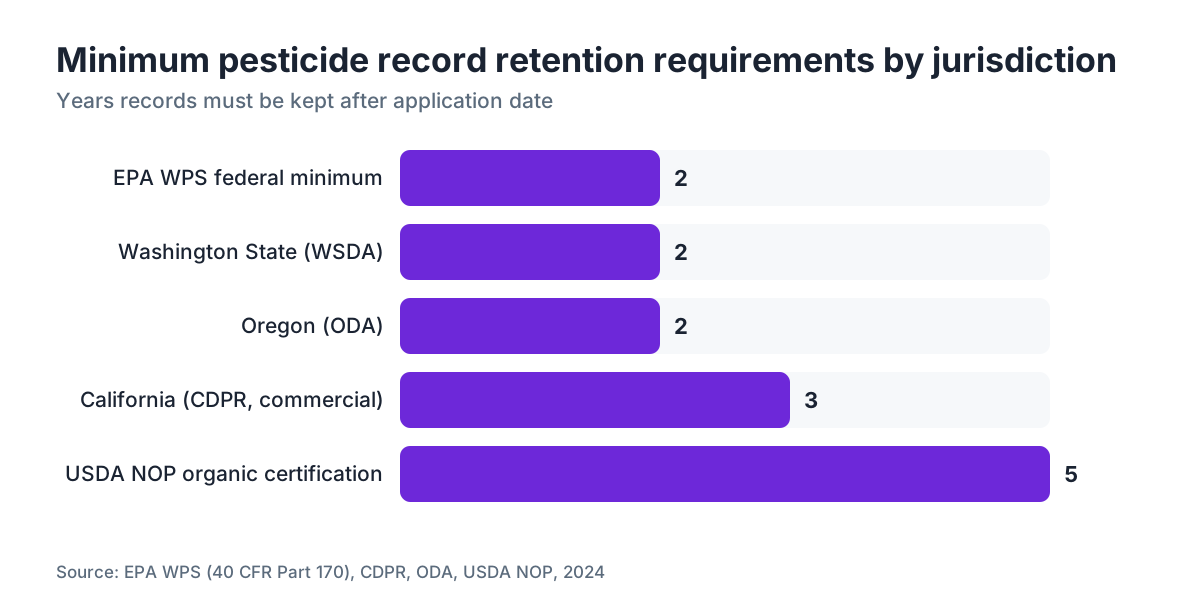
Federal law sets the floor, and it's lower than most growers assume. Under the EPA Worker Protection Standard (40 CFR Part 170), any agricultural employer who uses or supervises the use of a pesticide must keep records that include the product name, EPA registration number, active ingredient(s), location of application, date and time, amount applied, and the re-entry interval (REI) posted for that block. That record has to be accessible to workers, their designated representatives, and inspectors for two years after the application date. [1]
Most state departments of agriculture pile on top of that. California's Department of Pesticide Regulation (CDPR) requires a separate Pesticide Use Report (PUR) submitted monthly to the county agricultural commissioner. That report captures crop type, treated acreage, unit treated, grower ID, and operator information well beyond what the federal WPS form alone demands. [2] Washington State requires licensed commercial applicators to keep records for two years and submit annual reports to WSDA. [3]
The practical minimum field set that covers the federal baseline and satisfies most state auditors looks like this:
| Field | Why it's required |
|---|---|
| Application date and start/end time | WPS baseline; time affects REI calculation |
| Block/vineyard location (legal description or GPS) | WPS + state traceability |
| Crop and growth stage | State PUR filings; efficacy review |
| Product name (label name, not shorthand) | WPS; must match the label |
| EPA registration number | WPS mandatory field |
| Active ingredient(s) and percent | WPS; FQPA residue tracking |
| Formulation type (EC, WP, SC, etc.) | Good practice; helps reorder |
| Application method (airblast, hand gun, drip) | State filings; neighbor notification triggers |
| Dilution rate and carrier volume per acre | Label compliance; IPM records |
| Total product used | State PUR; inventory reconciliation |
| Total acres treated | WPS + state |
| REI in hours | WPS posting requirement |
| PHI in days | Food safety; organic certification |
| Weather at application (temp, wind speed, direction, RH) | Drift liability; label compliance |
| Applicator name and license number | State licensing requirements |
| Supervisor / certified applicator signature | WPS restricted-use product requirement |
| Pest(s) targeted | IPM programs; efficacy tracking |
| Water source used | Some state programs (CAFO overlap zones) |
You don't need all 18 fields for every application. A simple sulfur dust applied by an unlicensed employee under direct supervision has lighter requirements than a restricted-use chlorpyrifos application ever did. But a template that always captures every field costs nothing, and it saves you from reconstructing records the morning an inspector shows up.
One detail people miss: the REI has to appear on the record even if you never send workers back into that block. The rule says the record must reflect what was posted, not what actually happened afterward. [1]
How long do you have to keep vineyard spray records?
The federal WPS floor is two years from the application date. [1] That clock starts on the day of the application, not the end of the season or the calendar year. Miss that distinction and you can purge a record that's technically still live.
Several states go longer. California requires commercial applicators to keep records for three years. [2] Oregon requires two years and also requires growers to report pesticide use data to ODA. [4] If you're certified organic, your certifier almost certainly requires five years of records to match USDA NOP documentation rules. [5]
Here's my honest recommendation: keep everything for five years, full stop. Grape residue complaints, neighbor drift disputes, and food safety investigations can surface years after the fact. Digital storage is basically free now, so the only reason to purge records early is that you're sloppy about organizing them, which is a different problem to solve.
One more thing. The WPS says records must be accessible to workers or their designated representatives within 15 days of a request. [1] If your logs sit in a binder in the cellar office that nobody can find without calling you, that's a compliance gap even when the records technically exist.
What does a downloadable vineyard pesticide spray log template actually look like?
A good template has three logical sections on one page (or a single spreadsheet tab): the header, the application record, and the weather and sign-off block. That's it. Everything else is decoration.
The header captures standing information: vineyard name, physical address, operator name, state license or permit number, and the season. Fill this once per season for a printed pad, or populate it automatically in a spreadsheet.
The application record is a row-per-application table. Columns map directly to the required fields listed in the first section above. In a paper log, you usually get six to eight rows per page. In a spreadsheet, rows are unlimited, and you can sort by product, block, or date instantly, which matters when you're trying to prove you didn't blow past a seasonal application limit.
The weather and sign-off block sits at the bottom of each entry and captures temperature, relative humidity, wind speed, wind direction, and the applicator's printed name and signature. Some templates add a checkbox for "REI placard posted" as a quick reminder.
University extension programs publish solid baseline templates. UC Davis and the UC IPM program publish a pesticide use record form that meets California PUR requirements. [6] Cornell Cooperative Extension offers New York-specific forms that cover DEC requirements. [7] WSU Extension publishes Washington record-keeping guidance with sample forms. [3]
Want a digital approach instead of paper? A spreadsheet with locked header formulas and dropdown validation for common products, application methods, and block names cuts transcription errors sharply. That's the core of what a vineyard record-keeping system does in software form. VitiScribe's spray log module pre-populates EPA registration numbers and REIs from the product database, which drops per-entry time from five minutes to under two. You can test it on a free trial if you're curious. The paper or spreadsheet approach works fine too, as long as you're consistent.
Does a vineyard spray log template work as a Pesticide Use Report (PUR) in California?
No, not directly. California's Pesticide Use Report is a separate, structured submission to the county agricultural commissioner (CAC), due by the 10th of the month following each month in which you made applications. [2] The data fields overlap heavily with a well-designed spray log, but the PUR needs specific CDPR commodity codes, unit-of-measure codes, and applicator license numbers formatted to CDPR standards.
What a good spray log does is make the PUR trivial to complete. If your log already captures product name, EPA reg number, treated acreage, application date, and applicator license number in a consistent format, filling the PUR form (or uploading a CSV to CalAgPermits) takes minutes rather than hours.
Growers who use a licensed pest control operator (PCO) or pest control adviser (PCA) usually hand PUR filing to that operator. But the grower still has to provide the underlying application data and is still liable under WPS for keeping their own records. Two parallel obligations. Neither one substitutes for the other.
CDPR's "Summary of Permit Conditions" for each county spells out any extra county-level requirements, which vary a lot. Napa County has historically run stricter notification requirements than some Central Valley counties because of neighbor density and watercourse proximity. Check your county ag commissioner's current permit conditions before you finalize your template's fields.
What do EPA Worker Protection Standard audits actually check?
WPS audits in vineyards usually come from your state department of agriculture, sometimes alongside an OSHA inspection. The auditor asks to see pesticide application records going back two years, then cross-checks them against purchase invoices, product labels, and any posted REI signs still on the blocks. [1]
The deficiencies EPA and state auditors cite most often in farm settings fall into a short list: missing or incomplete application records, REI not posted at the treated area entry point, failure to provide central posting of pesticide safety information (the WPS safety poster, emergency contact information, and treated area information all have to sit in one central spot workers can reach), and failure to provide records within 15 days of a worker representative request. [1]
Fines for WPS violations vary by state and by how bad the violation is. Civil penalties under FIFRA (which WPS enforcement runs through) can reach $19,107 per violation per day for commercial applicators, though first-offense administrative penalties for record-keeping slips in small operations usually land far lower, in the $500 to $2,500 range, depending on the state and inspector discretion. The EPA's FIFRA enforcement penalty policy sets a matrix based on gravity and good faith. [8]
The single easiest thing you can do to pass an audit: keep your spray log binder (or printed PDF) in the same place every season, tell every employee where it is, and make sure someone other than you knows how to find the REI posting for a block before going in to work. Auditors respond well to evidence of a system, even an imperfect one.
How should a vineyard spray log track restricted-use pesticides differently?
Restricted-use pesticides (RUPs) carry extra record-keeping duties under FIFRA. Any certified applicator who buys or uses a RUP has to keep records of the product name and EPA registration number, the total amount purchased and used, the location of use, and the date. These records must be kept two years and are subject to inspection by federal and state officials. [8]
In a vineyard, the RUPs you're likely to run into include certain organophosphate insecticides (chlorpyrifos, whose agricultural food uses EPA effectively canceled as of 2022), some fungicides, and fumigants used for nematode control. [9] Any time you handle a RUP, flag it clearly in the log entry, because the audit trail for RUP purchases and applications has to reconcile.
The simplest way to handle this is a separate column in your template labeled "RUP" with a yes/no checkbox. At season's end, pull all the RUP rows and verify that purchase invoices match usage totals. Some states require RUP records be kept separate from general pesticide records. Check your state's specific rule.
Organic operations run a different but equally strict set of requirements. The USDA National Organic Program requires that every applied material be on the approved list and that records document why prohibited materials weren't used. Every application record for an organic vineyard needs to note the OMRI or WSDA organic approval status of the product. [5]
What weather data should a vineyard spray log record, and why does it matter?
Most fungicide and insecticide labels spell out application conditions, often a maximum wind speed (usually 10 mph or 15 mph) and sometimes temperature or relative humidity windows. Applying outside those conditions isn't merely ineffective. It's an illegal use of the product, because the label is the law under FIFRA Section 12(a)(2)(G). [8]
For drift liability, wind speed and direction at the time of application is the most defensible data you can hold. If a neighbor claims your mancozeb drifted onto their property on a Tuesday afternoon, your log showing 4 mph wind from the northwest at that hour is your first line of defense.
The minimum weather fields worth capturing:
- Temperature (F)
- Relative humidity (%)
- Wind speed (mph)
- Wind direction (compass bearing or cardinal direction)
- Sky conditions (clear, partly cloudy, overcast)
- Any recent rainfall (yes/no, inches in prior 24 hours)
A handheld weather meter like a Kestrel runs $60 to $250 and is accurate enough for log purposes. Many spray controllers now log GPS position and wind speed automatically if you're running a modern rate controller and GPS unit. If your airblast sprayer can do that, use it and attach the output to your spray record. It beats a handwritten note in any dispute.
UC Davis's IPM program has noted that temperature inversions, common in California valleys during early morning, can push pesticide drift much farther than wind speed alone suggests. Good reason to note sky conditions and time of day carefully. [6]
How does a vineyard spray log support an IPM program and efficacy tracking?
A spray log that captures only compliance fields is useful for audits. One that also captures pest pressure, application timing relative to growth stage, and observed efficacy three to five days later is useful for running your vineyard better. That second log pays for the discipline it takes.
Integrated pest management (IPM) decisions lean on historical records: when you first saw powdery mildew each season, what your cumulative sulfur applications looked like that year, whether your Botrytis problems tracked with particular weather windows or varietal susceptibility. None of that pattern analysis is possible without records that link spray decisions to observed conditions.
Adding two fields to your standard template captures most of it: "pest pressure observed at time of application" (a 1-3 scale, or a short text note) and "7-day post-application observation." That second field takes 30 seconds during your next vineyard walkthrough, and over several seasons it turns your spray log into an efficacy database.
WSU's IPM program for wine grapes recommends recording the reason for each application (scouting threshold reached, calendar spray, preventive) because that context supports pesticide resistance management, which matters more every year as powdery mildew populations show reduced sensitivity to DMI fungicides in some regions. [3]
For vineyards enrolled in sustainability programs like CSWA (California Sustainable Winegrowing Alliance) or Lodi Rules, the spray log is an auditable piece of your annual self-assessment. Both programs track the move away from category 1 and 2 pesticides over time, and your log is the primary evidence. If you're working toward certification, ask the auditor exactly what format they want before the season starts.
Can you use a digital vineyard spray log template instead of paper?
Yes, and most state rules explicitly allow electronic records as long as they can be printed on demand, are backed up, and contain all required fields. The EPA WPS doesn't specify paper. California's CDPR accepts electronic records. Washington WSDA states plainly that records may be kept electronically. [3]
The practical wins of digital logs are real. Sorting by product lets you check seasonal application totals against label limits in seconds. Auto-calculating REI end times kills a common error. Exporting to CSV for PUR filing saves an hour a month. Spraying multiple blocks in a single day with different products? A mobile entry form is faster than paper and less likely to get wet.
The downside of digital-only systems is real too. A power outage, a device failure, or a software subscription lapse during a compliance check is a bad afternoon. Keep a printed backup, at minimum a monthly export to PDF stored somewhere other than the same device. If you're on a web-based system like VitiScribe, confirm that records export in a format you can read without the software, because you don't want to be locked out of your own compliance data.
A free spreadsheet template in Google Sheets or Excel with dropdown validation for products, blocks, and application methods is genuinely enough for a small to mid-size vineyard. The learning curve is low if you already know basic spreadsheet work. The main failure mode is inconsistent naming (is it "Block 5" or "B-5" or "Cab Block East"?) that makes sorting unreliable. Pick your conventions before the season and hold to them.
What makes a vineyard spray log template generator actually useful?
The term "spray log template generator" gets thrown around loosely. At minimum it means a tool that pre-fills standing information (your vineyard name, address, license number, season) so you're not retyping it for every entry. At best it means a system that pulls from a product database, auto-populates REI and PHI from the registered label, suggests the right PUR commodity code, and flags when you're closing in on a seasonal application limit.
The free option: download the UC IPM or Cornell CCE template, add a header row with your farm info as a frozen row, and build a product lookup table on a second tab. That gets you most of the time savings for zero dollars. [6][7]
The paid option earns its keep when you're managing multiple blocks with different application histories, you've got employees entering records on mobile devices in the field, you need PUR-ready CSV exports on demand, or your certifier requires timestamped digital records. At that scale, a spray log system that automates the compliance overhead is worth paying for.
One thing no generator can do for you: make sure the person filling out the log records what actually happened, not what they think you want to see. The value of any spray log system rests entirely on field discipline. A printed form in the cab of the sprayer, filled out right after each tank load, beats a slick digital system entered two days later from memory.
What are the most common spray log mistakes that get vineyards cited?
Cornell Cooperative Extension's field audits and CDPR inspection data point at the same recurring problems. Here they are, roughly in the order they show up.
Missing or wrong EPA registration numbers. People write "Rally 40W" instead of the full registration number (the 3120-113 format). The product name alone doesn't satisfy WPS. [7]
Volume applied not recorded. Plenty of growers record rate per acre but forget total product used. Auditors use total volume to cross-check purchases and flag possible overuse.
Multiple blocks treated, single entry. Spray four blocks in one day with the same tank mix and you still owe a separate record line for each block, because REI posting is block-specific and acreage totals have to be block-specific for PUR filings.
Weather fields left blank. "Nice day" doesn't meet the standard. Wind speed in mph and temperature in degrees F, recorded at the time of application.
REI end time not calculated. The log should show when the REI expires as a specific date and time, more than the number of hours. Workers need to know when they can re-enter, and an inspector will check that your calculated end time matches the hours on the label.
Outdated labels on file. Your log might be flawless, but if the label you have on file is five years old and the product's label has since been amended, you're technically applying under an outdated label. Download current label PDFs from the National Pesticide Information Retrieval System (NPIRS) or CDPR at the start of each season. [10]
Inconsistent applicator identification. If the same person is "J. Smith" in January and "John S." in March, that's a reconciliation problem in an audit. Pick a format and use it.
How do certified organic vineyards handle spray log requirements differently?
Organic vineyards face the same WPS and state record-keeping rules as conventional operations, plus a separate layer from their USDA NOP certifier. The NOP requires the organic system plan document all substances applied to the operation, including allowed pesticides like copper, sulfur, and OMRI-listed botanicals, and that records be kept five years. [5]
The practical difference in your template: add a column for "NOP approval status" showing whether the product is on the National List of Allowed and Prohibited Substances (7 CFR Part 205.601 for crop production). If you're using a material that requires an emergency exemption or a written rationale (like copper at higher rates), note that in the record. [12]
Organic certifiers also want to see you're not exceeding copper application rates that can drive soil accumulation. A log that tracks cumulative copper applied per acre per season is useful for both certification and long-term vineyard health. CDFA's organic program and certifiers like CCOF and Oregon Tilth both audit this.
One field I'd add for organic operations: "spray equipment cleaned since last conventional use." If you custom-spray or share equipment with a conventional neighbor, contamination risk is real, and documenting that you cleaned the sprayer before use is a certifier requirement.
Frequently asked questions
What is the minimum information required on a vineyard pesticide spray log?
Under EPA WPS (40 CFR Part 170), the minimum fields are product name, EPA registration number, active ingredient(s), date and time of application, location treated, amount applied, and re-entry interval. State requirements add to that baseline. California's PUR system requires more, including treated acreage, applicator license number, and CDPR commodity codes. Building a template that captures every field at once is far safer than chasing the minimum.
How long do vineyard spray records have to be kept?
The federal WPS floor is two years from the application date. California requires three years for commercial applicators. Oregon requires two years. USDA NOP certified organic operations must keep records five years. My practical advice: keep everything for five years regardless of state, because drift complaints and food safety investigations can surface long after an application, and digital storage costs almost nothing.
Is a spray log the same as a Pesticide Use Report in California?
No. A spray log is your internal compliance record under WPS. California's Pesticide Use Report (PUR) is a separate monthly submission to your county agricultural commissioner, due by the 10th of the following month. The fields overlap heavily, so a good spray log makes the PUR easy to complete, but you still file the PUR separately. A licensed PCO filing on your behalf does not erase your own WPS record-keeping obligation.
Can I use a spreadsheet or app as my spray log, or does it have to be paper?
Electronic records are explicitly allowed by EPA WPS and most state agencies, including CDPR and WSDA, as long as they print on demand, contain all required fields, and are backed up. A well-structured spreadsheet with dropdown validation works fine for most small to mid-size vineyards. Whatever system you use, export to PDF monthly and store the backup somewhere other than the same device.
Do I need a separate record for each block if I spray multiple blocks in one day?
Yes. WPS requires the treated location be identified specifically, and REI posting obligations are block-specific. California's PUR requires per-block acreage reporting. If you spray four blocks with the same tank mix in one pass, that's four record entries (or four rows in your log). Lumping them into one entry creates an audit problem because acreage totals won't reconcile with your PUR filing.
What wind speed and temperature information should I record in a vineyard spray log?
Record temperature in degrees F, relative humidity as a percentage, wind speed in mph, and wind direction as a compass bearing or cardinal direction at the time of application. Many labels specify maximum wind speeds (commonly 10 or 15 mph) and temperature windows. Applying outside those conditions violates the label, which is a FIFRA violation. A handheld weather meter costs $60 to $250 and takes about 30 seconds to read.
How do restricted-use pesticide records differ from regular spray log entries?
Restricted-use pesticide records carry extra FIFRA requirements: the certified applicator's name and license number must appear on the record, and total amount purchased plus used must reconcile. Some states require RUP records be kept separately. Add a clearly visible RUP flag (a column or checkbox) to your template so you can pull all RUP applications at audit time and match them against purchase invoices.
What does a WPS audit in a vineyard actually check?
Auditors review application records for the past two years, cross-checking against product labels, purchase invoices, and any still-visible REI posting signs. Common deficiencies: missing EPA registration numbers, REI end time not calculated, blank weather fields, and failure to provide records within 15 days of a worker representative request. First-offense administrative penalties for record-keeping failures in small operations typically run $500 to $2,500, though FIFRA civil penalties can reach $19,107 per violation per day.
What extra fields should certified organic vineyards include in their spray log?
Organic operations need the same fields as conventional vineyards plus: NOP approval status of each product, citation to the National List entry (7 CFR Part 205.601) for each material, cumulative copper applied per acre if you use copper fungicides, and documentation that spray equipment was cleaned before use if shared with any conventional operation. USDA NOP requires these records be kept five years. Your certifier audits them during your annual inspection.
Where can I find a free vineyard pesticide spray log template?
UC Davis's UC IPM program publishes a pesticide use record form that meets California PUR requirements. Cornell Cooperative Extension publishes New York-specific forms. WSU Extension provides Washington record-keeping guidance with sample forms. All three are free downloads from their extension websites. You can also build your own in Google Sheets using the required field list from EPA's WPS rule (40 CFR Part 170) as your column headers.
How does a spray log support pesticide resistance management?
A log that records product, mode of action group (FRAC or IRAC code), and application date per block lets you track whether you're rotating modes of action correctly. WSU's IPM program for wine grapes recommends logging the reason for each application (scouting threshold, calendar, preventive) because that context helps spot over-reliance on a single mode of action. Powdery mildew populations in several wine regions already show reduced DMI fungicide sensitivity, so rotation documentation matters.
Do I need to record the pre-harvest interval (PHI) in my spray log?
It's not always a federal WPS requirement, but it's a practical necessity. The PHI tells you the last safe application date before harvest for each product. If your log skips PHI, you go back to the product label every time you plan late-season applications or answer a food safety inquiry. Most state programs and organic certifiers expect PHI documented. Include it as a standard column in your template.
What's the best way to handle a tank mix in the spray log?
Log each product in the tank mix as a separate line item within the same application entry, or use a multi-row approach where date, block, and weather fields carry forward and each product gets its own row. Each product has its own EPA registration number, REI, PHI, and rate, all of which need to appear. The longest REI in the mix governs when workers can re-enter, and your log should note that explicitly.
Can a vineyard manager delegate spray log record-keeping to employees?
Yes, but the certified applicator or agricultural employer stays legally responsible for the accuracy and completeness of records. WPS does not allow responsibility to be delegated away. Train whoever fills out the log on exactly what each field requires, review entries weekly during spray season, and sign off on completed records. An employee's honest but incomplete entry is still your compliance problem.
Sources
- EPA, Agricultural Worker Protection Standard (40 CFR Part 170) overview: WPS requires records of pesticide applications including product name, EPA registration number, active ingredient, location, date/time, amount applied, and REI, kept for two years and accessible to workers within 15 days of request.
- California Department of Pesticide Regulation, Pesticide Use Reporting: California requires monthly Pesticide Use Reports submitted to the county agricultural commissioner by the 10th of the following month, including commodity codes, treated acreage, and applicator license number.
- Washington State University Extension: Washington State requires licensed commercial pesticide applicators to keep records for two years; WSU Extension recommends logging reason for application to support resistance management.
- Oregon Department of Agriculture, Pesticides Program: Oregon requires pesticide use records to be kept for two years and growers to report pesticide use data to the Oregon Department of Agriculture.
- USDA National Organic Program, 7 CFR Part 205: USDA NOP requires organic operations to keep all application records for five years and document that all materials applied appear on the National List of Allowed and Prohibited Substances (7 CFR Part 205.601).
- UC Statewide IPM Program (UC ANR): UC IPM publishes a pesticide use record form meeting California PUR requirements and notes that temperature inversions common in California valleys can cause drift to travel farther than wind speed alone suggests.
- Cornell Cooperative Extension: Cornell CCE publishes New York-specific spray log forms and cites missing or incorrect EPA registration numbers as one of the most common compliance deficiencies found during field audits.
- EPA, Federal Insecticide, Fungicide, and Rodenticide Act (FIFRA) compliance: FIFRA Section 12(a)(2)(G) makes it illegal to use a pesticide inconsistently with its labeling; civil penalties can reach $19,107 per violation per day for commercial applicators under the EPA FIFRA penalty policy.
- EPA, Chlorpyrifos: EPA effectively canceled most agricultural food uses of chlorpyrifos as of 2022 following the 2021 final rule revoking food crop tolerances.
- Purdue University NPIRS (National Pesticide Information Retrieval System): NPIRS provides current registered pesticide label PDFs searchable by EPA registration number, allowing growers to verify they are applying under the most current label version.
- EPA, Restricted Use Products (RUP) recordkeeping: Certified applicators who purchase or use RUPs must keep records of product name, EPA registration number, total amount purchased and used, location of use, and date for two years, subject to federal and state inspection.
- USDA National Organic Program, National List (7 CFR 205.601): The National List (7 CFR Part 205.601) specifies which synthetic and non-synthetic substances are allowed in organic crop production; organic certifiers audit spray records against this list annually.
Last updated 2026-07-09