Grape canopy management: what actually works in the vineyard
TL;DR
- Canopy management in grapes means controlling the size, shape, and density of the leaf zone to balance sunlight, airflow, and fruit exposure.
- Done well, it cuts powdery mildew severity by 30 to 50%, improves color and flavor, and makes every spray application land where it should.
- The four core tasks are shoot positioning, leaf removal, hedging, and shoot thinning, each tied to a specific growth stage.
What is canopy management in wine grapes and why does it matter?
Canopy management is the set of practices a grower uses to shape how a grapevine's shoots, leaves, and clusters occupy space. Looks have nothing to do with it. A well-managed canopy controls the microclimate right at the fruiting zone, which is where disease, ripening, and spray coverage all meet.
Too dense and you get shaded fruit, poor anthocyanin development, elevated malic acid, and powdery mildew pressure that no spray program fully fixes. Too open and you risk sunburn, dehydration, and, in hot climates, high sugar sitting on top of underdeveloped phenolics. The balance point is real, and it moves with the variety.
Researchers at UC Davis have documented that a well-exposed canopy with a leaf layer index (LLI) near 1.0 to 1.5 produces better wine quality than canopies with an LLI above 3.0 [1]. The leaf layer index is just how many leaf layers a horizontal line passes through at the fruiting zone. You measure it with a point-quadrat or estimate it by eye, and it takes about 20 minutes per block.
The economics are straightforward too. Labor for canopy management in the western U.S. typically runs $300 to $700 per acre per season depending on training system and how many passes you make [2]. That sounds steep until you price out the fungicide you save by cutting disease pressure, or the premium you lose when fruit comes in shaded and flat.
What are the main canopy management techniques in grapes?
There are five core operations. Each fixes a different part of the canopy problem, and they don't substitute for each other.
Shoot thinning happens early, usually at 6 to 12 inches of shoot growth, within two to four weeks after budbreak. You strip excess shoots off the head or cordon to hit your target spacing, which for most vinifera on a vertical shoot position (VSP) trellis is 4 to 6 inches between shoots. Leave too many and every job after this one gets harder.
Shoot positioning means getting the canopy up into the trellis wires instead of letting shoots flop and sprawl. On a VSP system you tuck shoots upward into the catch wires. This one task can recover the 15 to 20% interior light loss a messy canopy causes [1].
Leaf removal is pulling leaves in the fruiting zone, usually on the morning-sun side in hot climates, or both sides in cool, humid regions. Timing carries a lot of weight here. Leaf removal at or just before flowering (bloom through fruit set) cuts cluster compactness in varieties like Sauvignon Blanc and Pinot Noir, which pays off in Botrytis control later [3]. Pull leaves after veraison and you barely move berry quality.
Hedging (also called shoot topping or summer pruning) cuts the growing tips to hold canopy height and width in check. Most growers hedge to the top wire on a VSP at around 36 to 42 inches above the fruiting wire. A second pass in late summer is common. Hedging is the most mechanized of the five and has the weakest quality impact if you do it without the others.
Crop adjustment (green harvest) counts as a canopy tool because cluster number sets how much fruit the canopy can ripen. It's the priciest option and the one growers argue about most. More on that later.
How do training systems affect canopy management decisions?
Your training system is the container. Canopy management is what you put inside it, and you can't fully separate the two.
VSP (vertical shoot positioning) dominates cool to moderate climates. Cabernet Sauvignon, Pinot Noir, Chardonnay, Riesling, and most European varieties get trained this way. VSP works well when vine vigor is moderate. On a very high-vigor site, VSP forces extra passes of hedging and leaf pulling just to stop the canopy from collapsing into itself, and the labor bill climbs fast [1].
High-wire systems like Scott Henry, Smart-Dyson, and GDC (Geneva Double Curtain) exist to handle high-vigor vines by splitting the canopy into two curtains. Cornell's viticulture program has published extensively on GDC. Nelson Shaulis designed the system there in the 1960s, and it can double light interception compared to a crowded VSP on a high-vigor site [4]. You pay for that with more trellis hardware and harder mechanical hedging.
Lyre and Sylvos systems open the canopy into a U-shape or a divided hanging curtain. They shine in humid climates where airflow is the main disease driver. Washington State University extension recommends these for higher-vigor Riesling and Gewürztraminer sites in the Columbia Valley where VSP produces canopies too dense to manage [5].
Head-trained, spur-pruned vines, common in old-vine Zinfandel and some Grenache blocks in California, throw a different problem at you. You're managing a three-dimensional bush, not a two-dimensional wall. Leaf removal and shoot positioning happen mostly by hand, which is a big reason old-vine fruit costs what it does.
The honest rule: match your training system to your site's vigor before you budget canopy labor. Retrofitting works, but it costs real money in new posts and wire.
When should you remove leaves, and from which side of the canopy?
Pull basal leaves at or just before flowering through fruit set, typically May to June, and pull from the morning-sun side in hot climates. That timing does the most for cluster looseness and disease control. The science on this has shifted hard in the last 15 years, and early removal now has solid support.
Removing the 1 to 6 leaves closest to the cluster at bloom reduces cluster weight and compactness in several varieties. A trial on Sauvignon Blanc in New Zealand found early leaf removal cut Botrytis incidence by 32% compared to late removal, mostly because the clusters ended up physically looser [3]. Compact clusters trap moisture and build exactly the microclimate Botrytis cinerea wants.
Side matters in hot climates. Pull leaves on the afternoon-sun (west) side of a VSP canopy in California's Central Valley or around Paso Robles and you invite sunburn on the clusters. Morning-sun (east) side removal gives you airflow and light without the solar hammer. In cool climates like Oregon's Willamette Valley or the Finger Lakes in New York, double-sided leaf removal is standard and rarely burns fruit.
Machine leaf removal is now common. Pneumatic pullers work well on VSP at around $60 to $150 per acre per pass, against $200 to $400 per acre for hand labor [2]. You trade away accuracy: machines strip too much in some spots, miss others, and bruise clusters if calibration drifts.
A field rule many consultants use: remove enough leaves that you can see clusters from 18 inches away on the morning-sun side, while keeping 8 to 10 leaves above each cluster on the primary shoot for photosynthesis and berry sizing.
How does canopy management reduce disease pressure and pesticide use?
This is where canopy work pays back in the spray budget, and the link is direct. Powdery mildew (Erysiphe necator) and Botrytis cinerea both thrive in humid, low-light, low-airflow air. A dense canopy builds exactly that inside the fruiting zone.
UC Davis plant pathology research shows that cutting canopy density can lower powdery mildew severity by 30 to 50% independent of the fungicide program [1]. That drop either lets you skip a spray or switch to a cheaper active ingredient.
Spray penetration is the other half. A pesticide that never reaches the cluster is money burned. Cornell extension trials with air-blast sprayers found canopy density predicted coverage at the cluster: open canopies hit 60 to 80% coverage, dense canopies fell to 20 to 40% under identical conditions [4]. That gap explains why some growers spray and spray against powdery mildew and see nothing change. The product never lands.
Under EPA's Worker Protection Standard (WPS), restricted-entry intervals (REIs) and personal protective equipment depend on the specific pesticide applied [6]. Fewer applications means fewer worker exposure events. That matters for your compliance file. If you log spray events and REI windows in a tool like VitiScribe, a season that drops from 10 spray passes to 7 shows up in the summary and is worth documenting for any sustainability certification.
Airflow matters for downy mildew (Plasmopara viticola) too, especially in Eastern U.S. vineyards. WSU extension and Cornell both fold canopy management into downy mildew programs, not as a fungicide replacement but as a real cut in the conditions that favor inoculum [4][5].
What does canopy management actually cost, and is green harvest worth it?
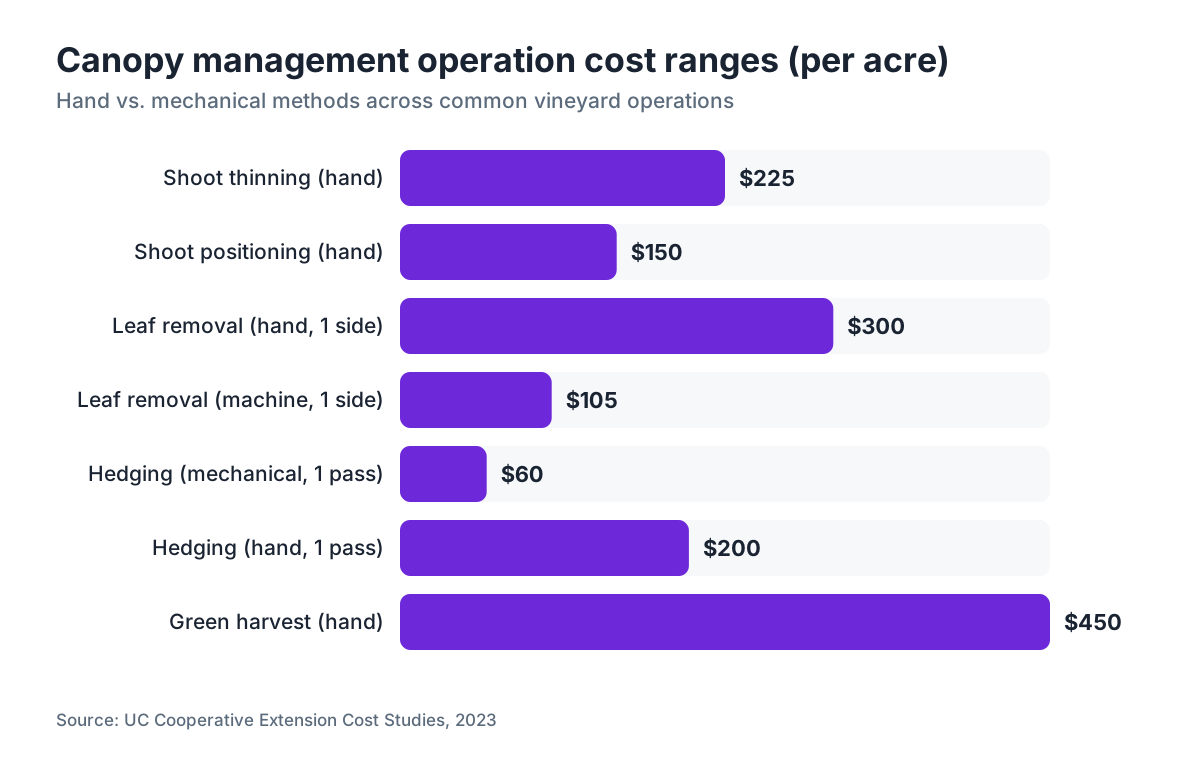
Labor is the dominant cost in every operation except mechanical hedging. Here's a realistic range built from published extension budgets and UC Cooperative Extension cost studies [2]:
| Operation | Method | Cost per Acre |
|---|---|---|
| Shoot thinning | Hand | $150 to $300 |
| Shoot positioning | Hand | $100 to $200 |
| Leaf removal (1 side) | Hand | $200 to $400 |
| Leaf removal (1 side) | Machine | $60 to $150 |
| Hedging (1 pass) | Mechanical | $40 to $80 |
| Hedging (1 pass) | Hand | $150 to $250 |
| Green harvest | Hand | $300 to $600 |
Green harvest is the operation growers fight about. The theory: drop clusters at veraison and the remaining fruit ripens more fully and concentrated. The problem is the evidence is genuinely mixed. Some trials show a measurable quality lift. Others show the vine compensating by slowing ripening, so the clusters left behind don't gain as much as you hoped [1][3]. Nobody has clean data on the break-even between labor spent and premium earned. Most honest consultants will tell you it pencils out for premium-tier fruit (over $2,000 per ton) and is hard to justify for commodity grapes.
The operations with the clearest return are shoot thinning (done early and right, it cuts labor on every pass that follows), leaf removal (it cuts disease cost), and mechanical hedging (cheap, good enough). Those three are the backbone of a sensible program.
Building a season budget? UC Cooperative Extension publishes annual cost-of-production studies by region and variety with canopy labor broken out line by line. Start there [2].
How does canopy management affect wine quality and fruit composition?
The research here is some of the most consistent in viticulture. Light in the fruiting zone drives berry quality more than almost any other canopy variable.
Anthocyanins, the color compounds in red varieties, need light to form. Shaded berries in Cabernet Sauvignon, Merlot, and Syrah build measurably less anthocyanin and make lighter wine [1]. The Kliewer and Smart work out of UC Davis from the 1990s onward established that clusters need roughly 30% of full sunlight for adequate color. That benchmark shows up all over extension materials.
Flavonols and tannins run the same direction. Open-canopy fruit tends toward firmer, more polymerized tannins. Shaded fruit lands with a flatter phenolic profile. Whether that matters depends entirely on what your wine is trying to be.
Whites flip the logic. Too much direct sun on Sauvignon Blanc or Riesling clusters in a warm climate degrades the aromatic compounds (thiols, terpenes) and pushes sugar faster than acid can hold. That's why leaf removal on warm-climate whites often targets the morning-sun side only.
Brix, pH, and titratable acidity all move with the canopy. Shaded fruit ripens later, holds more malic acid, and may never hit target Brix without extra hang time. Open-canopy fruit in a hot climate can sprint to high Brix while pH climbs and acid falls. Canopy management adjusts the pace and character of ripening. It does not override climate. If your site sits at 100-plus degrees in August, no canopy trick makes it cool.
Selling to a winery on a tonnage contract? The composition specs in that contract (Brix, pH, TA) are effectively an order for adequate canopy management. Miss the spec and it costs you.
What do UC Davis, Cornell, and WSU recommend for canopy management?
The three main U.S. viticulture extension programs agree on the fundamentals and split on the details by region.
UC Davis (University of California Cooperative Extension) focuses on California: moderate to high vigor sites, hot inland valleys, coastal fog. Their core advice centers on VSP with aggressive shoot thinning in April, one or two rounds of leaf removal starting at bloom, and mechanical hedging. The Kliewer and Smart research through UC Davis remains the foundational citation for light and fruit quality [1]. UC Davis extension also publishes the most detailed cost-of-production budgets by variety and region in the state [2].
Cornell University's viticulture program aims at the Finger Lakes, Hudson Valley, Lake Erie, and Long Island. Their emphasis is disease, because Eastern conditions punish growers on fungal pressure far worse than the West. Cornell developed the GDC trellis and has published guidance on divided canopies for high-vigor Eastern varieties and hybrids [4]. Their programs tie canopy management into an IPM framework with economic thresholds.
WSU (Washington State University) extension covers the Columbia Valley, Walla Walla, and Yakima Valley. Their guidance accounts for wide diurnal temperature swings and irrigation-driven vigor. WSU calls for more conservative leaf removal in the afternoon zone because of the sunburn risk, and they've published on how deficit irrigation and canopy density interact to shape fruit quality [5].
All three land on the same basics: early shoot thinning to target spacing, some basal leaf removal in the fruiting zone, mechanical hedging to cap canopy height, and training system matched to site vigor. The arguments are about degree and timing, not direction.
If you're building a canopy management training deck, the extension publications from all three programs are free and citeable, and they run from physiology through economics.
What equipment do you actually need for canopy management?
The list depends on your scale and training system. Here's what earns its place.
For hand crews, the essentials are leather gloves, grape shears (Felco and Corona are the common brands, $25 to $60 per pair), and comfortable knee or hip pouches. Nothing fancy. Crew training matters far more than tool brand.
For mechanized hedging, a tractor-mounted hedge trimmer (a topper or shoot topper) is the main buy. New units from Pellenc, Gregoire, or New Holland run $15,000 to $50,000 depending on configuration. Used units are out there and work fine at a fraction of the price. Most contract crews offer hedging at $40 to $80 per acre per pass, which beats ownership for blocks under roughly 30 acres.
Pneumatic leaf removers mount on the tractor or get pulled by hand. Models from Clemens or Oxbo use air pressure to strip basal leaves without a crew. They do their best work on VSP at standard row widths. On irregular or narrow rows they struggle.
A point-quadrat or sunfleck ceptometer is worth owning for a serious operation. These let you measure actual light penetration and leaf layer index. A good ceptometer (the AccuPAR LP-80 is common) costs around $800 to $1,200. If you can't justify that, a trained eye gets you 80% of the way at zero cost.
For record-keeping, whatever you use to log canopy work should timestamp each operation, tie it to the block, and hold crew size and hours. That data feeds your cost analysis and satisfies any third-party audit. VitiScribe handles this at the field level and carries it through to season-end compliance exports.
How do you balance shoot density and leaf area for optimal ripening?
This is the core optimization problem in canopy management, and it has a real answer, though the answer shifts with variety and climate.
The common target for shoot spacing on a VSP trellis is one shoot per 4 to 6 linear inches of cordon, roughly 20 to 30 shoots per meter of row. At that spacing the canopy fills the trellis without shading its own interior. Below it, you've got spare canopy sitting idle and photosynthesis underperforming. Above it, you're shading interior leaves and fruit.
Leaf area to fruit weight ratio is the more precise metric. The target range is about 12 to 20 square centimeters of leaf area per gram of fruit, depending on variety and climate. Ratios below 12 mean the vine carries more crop than the canopy can ripen. Above 20 the vine runs vegetative, and you need canopy management, maybe crop adjustment. This one takes measurement but hands you a physiologically grounded call [1][3].
A simpler field proxy: count clusters per shoot and check that your average lands near your target (usually 1 to 1.5 clusters per shoot for premium production). If shoots average 2 or more and the vine is moderate vigor, either shoot thin earlier next year or change your pruning cuts.
Shoot vigor is the other tell. Internodes longer than 4 to 6 inches signal excessive vigor. Short, tight internodes under 2 inches signal under-vigor or water stress. Neither extreme helps, and both point to something at the root level (irrigation, nutrition, rootstock) that needs attention first.
What compliance and record-keeping requirements tie into canopy management?
Canopy management itself isn't regulated. The activities around it are, and the records matter.
EPA's Worker Protection Standard (40 CFR Part 170) applies to any pesticide application that follows canopy work. Do leaf removal or shoot thinning, then apply a fungicide, and your crew may re-enter the fruiting zone during REI. Under WPS, workers must get pesticide safety training, have access to application information and safety data sheets, and respect posted REI before entry [6]. So the timing of canopy work against your spray schedule is a compliance question as much as an agronomic one.
Organic certification (NOP, 7 CFR Part 205) requires that every material applied is compliant, and an inspector reviews the field records covering spray applications, which connect straight to canopy decisions [7]. If your canopy work cut your spray inputs, document it. It supports your organic system plan.
For sustainability programs like LODI Rules, SIP Certified, or the California Sustainable Winegrowing Alliance (CSWA), canopy management is a scored practice. Documented canopy work (dates, blocks, operations performed, crew hours) earns points and satisfies third-party audits [8].
Any time you spray after canopy work, note the canopy condition on the application record. It justifies application decisions if you're ever audited and supports the IPM documentation some winery buyers now demand from growers.
Frequently asked questions
What is the best timing for leaf removal in wine grapes?
The best timing is at or just before flowering through fruit set, typically May to June depending on your region. Early removal at this stage cuts cluster compactness in varieties like Sauvignon Blanc and Pinot Noir, lowering Botrytis risk later. Post-veraison leaf removal still improves airflow but has a much smaller effect on berry morphology and wine quality.
How does canopy management affect powdery mildew control?
Open canopies remove the humid, shaded microclimate powdery mildew (Erysiphe necator) needs to establish and spread. UC Davis research shows good canopy management can cut powdery mildew severity by 30 to 50% on its own. It also improves spray penetration to clusters, where coverage in dense canopies drops to 20 to 40% of what an open canopy receives under identical conditions.
How many shoots per foot should a VSP-trained vine have?
For vertical shoot positioning (VSP), the standard target is one shoot per 4 to 6 inches of cordon, roughly 6 to 9 shoots per linear foot. This spacing lets the trellis wires hold shoots upright without crowding. Above this density, interior leaf shading rises and canopy management gets progressively more labor intensive to correct.
Does green harvest actually improve wine quality?
The evidence is genuinely mixed. Some trials show measurable gains in anthocyanin and phenolic concentration, but others find the vine compensates by slowing ripening in the remaining clusters, partly offsetting the benefit. Most practitioners agree it pencils out only for premium-tier fruit priced above roughly $2,000 per ton. At commodity pricing, the labor cost ($300 to $600 per acre) is hard to recover.
What is the leaf layer index and how do I measure it?
Leaf layer index (LLI) is the average number of leaf layers a horizontal line passes through when probed across the fruiting zone. A target of 1.0 to 1.5 supports good fruit light exposure. You measure it with a point-quadrat: insert a thin rod horizontally through the canopy at cluster height at 20 or more random points and count leaf contacts per insertion. A ceptometer automates the light measurement version of this.
Can mechanical leaf removal replace hand leaf pulling in wine grapes?
Yes, in most VSP vineyards with standard row spacing. Pneumatic leaf removers cost $60 to $150 per acre per pass versus $200 to $400 for hand labor. The tradeoff is precision: machines are less selective and can bruise clusters or strip too aggressively in spots. They work best on one-sided morning-sun passes. Hand removal still wins for premium blocks or compact-cluster varieties where accuracy matters most.
What is the difference between hedging and shoot thinning?
Shoot thinning removes entire shoots early in the season to hit a target shoot density. Hedging (summer pruning or topping) cuts the growing tips off existing shoots to limit canopy height and lateral growth later. Shoot thinning is the higher-leverage job because it reduces every canopy task that follows. Hedging is cheaper per acre because it's mechanized but has a smaller effect on fruit quality on its own.
How do I know if my canopy is too dense?
The practical signs are interior shading (you can't see clusters from 18 inches away through the canopy), high powdery mildew incidence even with regular spraying, poor spray coverage at the clusters, and delayed or uneven ripening. A leaf layer index above 3.0 at the fruiting zone is the quantitative threshold most cited in UC Davis extension materials. Shoot internodes longer than 6 inches also flag excessive vigor that will make the canopy dense.
What does the EPA Worker Protection Standard require for canopy management crews?
WPS (40 CFR Part 170) requires agricultural workers receive pesticide safety training before or soon after working in areas where pesticides are or have been applied. Canopy crews working after spray applications must respect the restricted-entry interval (REI) posted for the specific pesticide used. Employers must provide access to the pesticide application information and safety data sheets. WPS applies broadly across agricultural employers, with limited exemptions for owners and their immediate family.
Is canopy management different for organic vineyards?
The physical practices are identical. The compliance angle is different. Organic certified vineyards (under USDA NOP, 7 CFR Part 205) lean on canopy management as a primary tool to reduce disease pressure, because the approved fungicide list is shorter and generally less effective than conventional options. Good canopy management in organic production is less optional and more foundational. Inspectors reviewing your organic system plan will look for documented canopy work as IPM evidence.
How does training system choice affect how much canopy management labor I need?
Training system is the biggest single driver of canopy labor cost. High-vigor sites on VSP can need three or more hedging passes plus heavy hand leaf removal to stay manageable. The same site on a divided curtain like GDC or Scott Henry spreads the canopy naturally and often needs less corrective labor per season. Matching training system to site vigor at planting or during renovation is cheaper than paying for labor every year.
What's the right leaf area to crop weight ratio for premium wine grapes?
The target range is roughly 12 to 20 square centimeters of leaf area per gram of fruit. Below 12, the vine carries more crop than the canopy can ripen and fruit quality suffers. Above 20, the vine runs vegetative and makes grassy or dilute fruit. Measuring it takes field work (shoot length and leaf area, plus cluster weights), but it gives you a physiologically grounded basis for shoot thinning and crop adjustment.
Do sustainability certifications require documented canopy management records?
Yes, most major programs do. LODI Rules, SIP Certified, and the California Sustainable Winegrowing Alliance all score canopy management as a documented practice. Auditors expect records with the date, block, specific operation performed, and crew hours. These records also support any winery buyer requiring IPM documentation. Digital field records that tie canopy operations to block IDs and timestamps satisfy these audits most efficiently.
Sources
- UC Davis Viticulture & Enology, Canopy Management and Wine Quality: Leaf layer index near 1.0 to 1.5 produces better fruit quality than LLI above 3.0; open canopies can reduce powdery mildew severity by 30 to 50%; clusters need roughly 30% of full sunlight for adequate anthocyanin development
- UC Cooperative Extension, Sample Cost Studies for Winegrape Production: Canopy management labor costs range from approximately $300 to $700 per acre per season; green harvest runs $300 to $600 per acre; leaf removal by hand runs $200 to $400 per acre
- American Journal of Enology and Viticulture, Early Leaf Removal Effects on Cluster Compactness and Botrytis: Early leaf removal at flowering reduced Botrytis incidence by 32% in Sauvignon Blanc trials compared to late removal; leaf area to fruit weight target is approximately 12 to 20 sq cm per gram of fruit
- Cornell Cooperative Extension, Viticulture and Enology Program: Geneva Double Curtain system was developed at Cornell by Nelson Shaulis and can double light interception compared to crowded VSP on high-vigor sites; open canopies achieve 60 to 80% spray coverage versus 20 to 40% in dense canopies
- EPA, Worker Protection Standard (40 CFR Part 170): WPS requires agricultural workers receive pesticide safety training, have access to application information and SDS, and respect REIs posted for specific pesticides applied in vineyards and other agricultural settings
- USDA Agricultural Marketing Service, National Organic Program (7 CFR Part 205): NOP requires organic system plans documenting materials and practices including pest management; canopy management records support IPM documentation reviewed by accredited certifiers
- California Sustainable Winegrowing Alliance, Sustainable Winegrowing Program: Documented canopy management practices are scored criteria in CSWA sustainability certification audits; records of dates, blocks, and operations performed are required for third-party verification
- UC Davis Viticulture & Enology, Point-Quadrat Method for Canopy Analysis: Point-quadrat method used to measure leaf layer index by inserting a rod through the canopy at cluster height and counting leaf contacts at 20 or more random positions
- UC Cooperative Extension, Integrated Pest Management for Grapes: Canopy management is documented as a primary cultural practice for reducing powdery mildew and Botrytis pressure in California vineyards as part of IPM programs
Last updated 2026-07-09