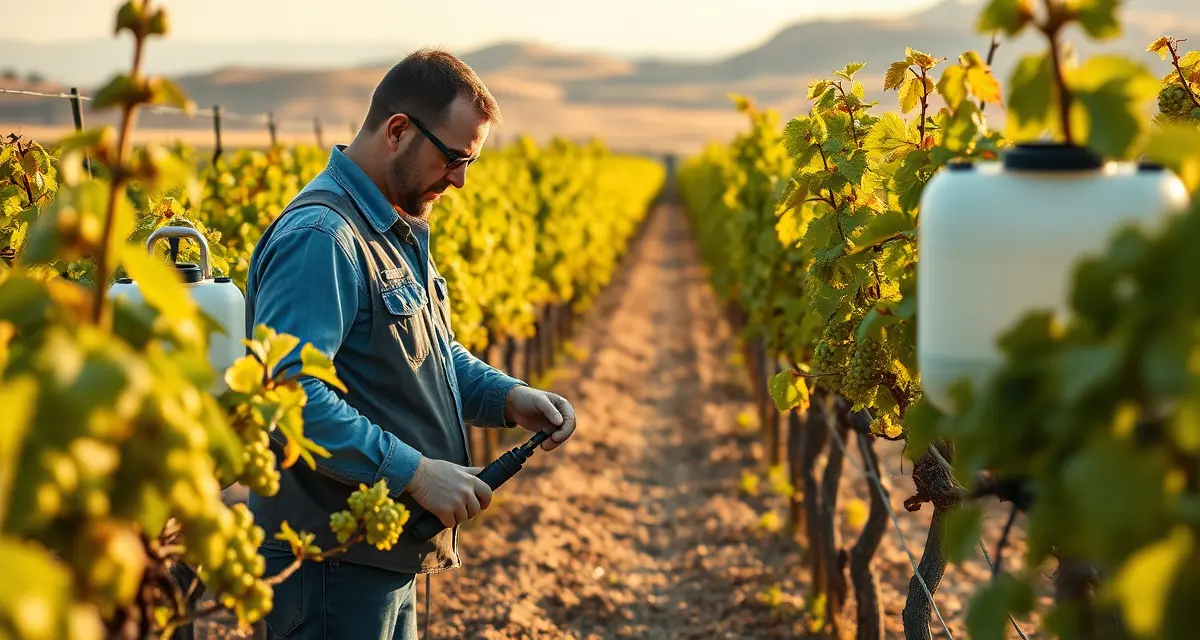
Washington State Vineyard Seasonal Spray Calendar
Washington spray calendars are dominated by powdery mildew risk in the semi-arid Columbia Valley -- that's the fundamental disease management reality that drives Washington's annual spray program design. VitiScribe's Washington weather data adjusts the calendar to Columbia Valley's semi-arid conditions, where the disease pressure profile is unlike either Oregon's wet-spring downy mildew challenge or California's fog-driven coastal program.
This calendar uses Columbia Valley as its primary reference, with notes for Walla Walla and other regions where conditions differ.
TL;DR
- Columbia Valley's semi-arid conditions maintain powdery mildew infection risk despite low humidity -- powdery mildew infects at 40% RH when temperatures are in the 70-90°F optimal range, which describes most of Columbia Valley's summer, so dry conditions are not a signal to relax intervals
- Bloom in June is the most critical spray window -- 7-day intervals are non-negotiable during the 2-3 week flowering period regardless of the dry, apparently low-risk appearance of Columbia Valley summer days
- WSDA requires spray records to be filed within 72 hours of application -- faster than California's 24-hour rule but slower; do not let harvest pressure build a backlog of unfiled records
- Spring wind events in Columbia Valley are notable and require documentation of wind speed and direction in spray records -- applications made in winds above label-specified limits are potential compliance issues
- Spider mites in Columbia Valley can build to damaging levels by July; Agri-Mek's 28-day PHI limits late-season use, so any July miticide application must be evaluated against anticipated harvest date
- Walla Walla operations spanning both Washington and Oregon-side blocks face dual-state compliance requirements -- WSDA for Washington blocks, ODA for Oregon blocks, each with different record retention and filing rules
January - February: Dormant Season
Primary activities:
Dormant oil: Narrow-range horticultural oil applied during late dormant period controls European red mite eggs and overwintering scale. In Columbia Valley's semi-arid climate, European red mite can build notable overwintering populations. Apply before any green tissue shows, typically January through late February.
Trunk disease assessment: Scout during pruning for Eutypa and Botryosphaeria symptoms. Washington's drier climate is less favorable for Eutypa than the wet Pacific Northwest, but trunk diseases are present and warrant assessment.
Pruning wound protection: Apply wound protectants within 24 hours of pruning cuts where Eutypa or Botryosphaeria history exists.
WSDA compliance: All applications require pesticide records maintained per WSDA requirements with 2-year retention.
March - April: Budbreak
Regional timing:
- Columbia Valley: budbreak typically mid-to-late April
- Yakima Valley: similar to Columbia Valley, late April
- Walla Walla: late April to early May
Primary activities:
Powdery mildew program start: Begin at 2-4 inch shoot growth, typically late April. Columbia Valley programs start slightly later than Napa Valley due to later budbreak from colder winters, but disease management priority is equal.
First application: sulfur (4-6 lbs/acre) or DMI fungicide (Rally, Elite). Open with contact protection that covers the flag shoot suppression window.
Dormant copper (optional): Some Columbia Valley growers apply a dormant copper for powdery mildew flag shoot suppression. Less critical here than in Oregon's downy mildew-driven programs, but useful in blocks with prior high pressure.
Mealybug monitoring: Deploy sticky tape traps on vine trunks in blocks with known mealybug history. Begin checking weekly for first-generation crawlers.
Pheromone trap deployment: GBM traps at tight cluster. Columbia Valley has established GBM populations requiring three-generation management.
May: Shoot Elongation
Primary activities:
Powdery mildew -- intensifying program: 7-10 day intervals as shoot growth accelerates. Begin systematic FRAC rotation.
For the FRAC rotation framework that applies to Washington powdery mildew management, see the powdery mildew resistance management guide.
Columbia Valley May conditions: morning humidity (45-65% RH) combined with warming daytime temperatures (70-80°F) creates moderate powdery mildew infection windows through the morning hours. Applications timed to early morning (before 10 AM) provide coverage during these infection windows.
Wind management: Columbia Valley's spring wind events are notable. Monitor wind speed before any application -- spraying in winds above 10 mph creates drift risk and reduced coverage. Document wind speed and direction in spray records for every application.
Mealybug first generation: Monitor crawler emergence via sticky tape. Target Movento (Group 23) application when monitoring shows peak crawler activity.
GBM biofix setting: Set biofix when consistent adult captures occur in pheromone traps.
WSDA compliance note: Records for all applications must include WSDA commercial applicator license number for any restricted-use pesticide applications.
June: Bloom
The most critical spray window of the Washington season.
Primary activities:
Powdery mildew at bloom: 7-day intervals. No exceptions. Bloom is when flower tissue is at peak susceptibility and cluster infections can establish. Columbia Valley's warm, dry conditions during bloom can seem to argue against spraying frequency -- the lack of humidity means infection is less likely, right? Not exactly: powdery mildew can infect in low-humidity conditions when temperatures are in the optimal range (70-90°F), which they are every day in Columbia Valley's June. Don't relax intervals based on dry conditions.
Apply high-efficacy systemics: Quintec (Group 13), Luna products (Group 7), or SDHI products. Reserve Groups 3 and 11 for other windows.
Botrytis first application (premium varieties, Walla Walla): Apply first botrytis fungicide at 50% capfall in tight-cluster premium varieties in Walla Walla where autumn conditions can be wetter.
Insecticide avoidance during bloom: Bee protection is important. Avoid systemic neonicotinoid applications during bloom.
GBM first generation: Apply at 100-150 DD50 from biofix. Altacor (Group 28) or Delegate (Group 5).
July - August: Berry Development and Veraison
Regional timing:
- Columbia Valley: veraison begins late July to early August
- Early varieties (Pinot Gris, Chardonnay, some Riesling): veraison late July
- Late varieties (Cabernet Sauvignon, Syrah): veraison mid-to-late August
Primary activities:
Powdery mildew: Continue on 10-14 day intervals if early-season pressure was controlled. Columbia Valley's summer heat events (105°F+) slow powdery mildew reproductive rates when temperatures stay above 95°F for multiple days, but the days on either side of heat events maintain optimal infection conditions. Don't skip applications immediately before or after heat spikes.
Spider mites: July is the primary spider mite monitoring month in Columbia Valley. Check leaf undersides at 10-25 vines per block. Count pest mites and predatory mites separately. If European red mite or two-spotted spider mite populations are building with low predator presence, apply selective miticide. Note Agri-Mek's 28-day PHI when scheduling late-season miticide applications.
Leafhoppers second generation: Monitor in mid-July. Columbia Valley leafhopper populations can build rapidly during the warm summer. Second-generation counts at 20+ nymphs per leaf warrant action.
GBM second generation: Target at 750-850 DD50 from biofix. Rotate IRAC group from first generation.
Botrytis management (Walla Walla and wetter micro-sites): Continue through veraison in varieties with botrytis risk. Canopy management -- leaf removal -- at berry set reduces cluster zone humidity.
August - September: Veraison Through Harvest
Regional timing:
- Early varieties: harvest late August to mid-September
- Mid varieties (Riesling, Merlot): harvest mid-to-late September
- Late varieties (Cabernet Sauvignon, Cab Franc): harvest October in some years
Primary activities:
PHI management is the dominant concern. Every application decision must be evaluated against PHI and intended harvest date.
Powdery mildew late-season: Use 0-day PHI materials: sulfur, potassium bicarbonate, Pristine (0-day PHI), Flint Extra (0-day PHI), Vivando (0-day PHI). Cluster-stage powdery mildew at harvest creates quality defects -- don't let late-season applications lapse because harvest is approaching.
GBM third generation: Apply at approximately 1,150-1,300 DD50. PHI selection is critical -- diamide products (5-day PHI) and spinosyn products (7-day PHI) are usable close to harvest.
Leafhoppers third generation: Adults are difficult to control and primarily cause cosmetic honeydew deposits on fruit. Assess whether the quality impact warrants treatment.
Harvest clearance documentation: Export block-level PHI clearance reports before any harvest decision. Provide to winery buyers as requested.
WSDA compliance: All September applications require complete records maintained for WSDA inspection availability.
Post-Harvest (October - December)
Primary activities:
Post-harvest dormant copper: Some Columbia Valley growers apply copper at leaf fall for overwintering disease management, though the benefit in Washington's drier climate is less well-established than in wet Pacific Northwest climates.
Annual record review: Export, archive, and review season records. Identify improvement opportunities for the following season. Confirm all WSDA records are complete and properly retained.
Frequently Asked Questions
What are the most critical spray windows in a Washington State vineyard season?
Washington's three most critical spray windows: (1) bloom -- a 7-day interval powdery mildew program during the 2-3 week bloom period is essential for cluster protection in Columbia Valley's warm conditions; (2) veraison through harvest -- continuing the powdery mildew program with appropriate 0-day PHI materials through harvest protects cluster quality in Washington's premium wine market; and (3) spring shoot elongation -- the 4-6 week period from 2-inch shoot growth through bloom represents the highest infection risk window when tightening from 10-14 day to 7-10 day intervals is appropriate.
How does my spray calendar differ between Columbia Valley and Walla Walla?
Walla Walla AVA spans both Washington and Oregon, with somewhat wetter autumn conditions than the core Columbia Valley. This creates modestly higher botrytis pressure in Walla Walla's premium red variety programs (Cabernet Sauvignon, Syrah, Merlot) compared to Columbia Valley blocks further west. Walla Walla growers in Oregon-side blocks additionally face ODA compliance requirements for those specific blocks alongside WSDA requirements for Washington-side blocks. VitiScribe handles dual-state compliance for Walla Walla operations automatically based on block location.
How does VitiScribe adjust spray timing for Washington regional weather?
VitiScribe connects to local weather stations for Columbia Valley, Yakima Valley, and Walla Walla vineyard locations. Powdery mildew infection risk alerts are calibrated to local temperature and humidity conditions -- accounting for Columbia Valley's unique semi-arid conditions rather than applying Oregon or California infection models. Wind speed data from your weather station is captured in spray records automatically. Degree day calculations for GBM use your vineyard's local temperature data for accurate generation timing. WSDA-formatted compliance records export with all required fields for state inspection purposes.
How should a Columbia Valley vineyard manager document a spray application that was delayed 3 days due to sustained wind events above label application restrictions?
The spray record for the delayed application should note both the original planned application window and the reason for delay: wind speed and direction recorded on the days the application was deferred, with a note that label application restrictions were the basis for the delay. The application record itself captures the actual application date, conditions at time of application (wind speed and direction within label limits), and all standard WSDA required fields. A delay documented in this way demonstrates that label compliance was the reason for the timing adjustment, not application neglect. VitiScribe's spray record notes field supports this kind of delay rationale documentation linked to the application entry.
For a Columbia Valley operation with both early-harvest Chardonnay blocks (late August) and late-harvest Cabernet Sauvignon blocks (October), how should the WSDA-required records handle the different PHI windows for the same product applied to both block types in July?
A single July application of a product with a 21-day PHI requires separate PHI compliance evaluation for each block type. For the late-August Chardonnay blocks, the July application date must be checked against the earliest anticipated Chardonnay harvest -- if that date is August 20, an application on July 25 falls within the 21-day PHI window and would be a violation. For October Cabernet blocks, the same July 25 application date clears the 21-day PHI comfortably. WSDA records document each application event and each treated block, so the PHI compliance or violation is visible at the block level. VitiScribe's block-level harvest date entries calculate PHI clearance independently for each block, flagging the Chardonnay conflict while showing Cabernet clearance for the same application date.
What is Washington State Vineyard Seasonal Spray Calendar?
[FAQ_ANSWER_PLACEHOLDER: This answer needs to be generated by AI with specific data, examples, and actionable advice relevant to Washington State Vineyard Seasonal Spray Calendar. Target 50-150 words.]
How much does Washington State Vineyard Seasonal Spray Calendar cost?
[FAQ_ANSWER_PLACEHOLDER: This answer needs to be generated by AI with specific data, examples, and actionable advice relevant to Washington State Vineyard Seasonal Spray Calendar. Target 50-150 words.]
How does Washington State Vineyard Seasonal Spray Calendar work?
[FAQ_ANSWER_PLACEHOLDER: This answer needs to be generated by AI with specific data, examples, and actionable advice relevant to Washington State Vineyard Seasonal Spray Calendar. Target 50-150 words.]
What are the benefits of Washington State Vineyard Seasonal Spray Calendar?
[FAQ_ANSWER_PLACEHOLDER: This answer needs to be generated by AI with specific data, examples, and actionable advice relevant to Washington State Vineyard Seasonal Spray Calendar. Target 50-150 words.]
Who needs Washington State Vineyard Seasonal Spray Calendar?
[FAQ_ANSWER_PLACEHOLDER: This answer needs to be generated by AI with specific data, examples, and actionable advice relevant to Washington State Vineyard Seasonal Spray Calendar. Target 50-150 words.]
How long does Washington State Vineyard Seasonal Spray Calendar take?
[FAQ_ANSWER_PLACEHOLDER: This answer needs to be generated by AI with specific data, examples, and actionable advice relevant to Washington State Vineyard Seasonal Spray Calendar. Target 50-150 words.]
Related Articles
- Washington State Powdery Mildew Spray Schedule for Vineyards
- Spray Log Format Requirements by State: California, Oregon, Washington, New York
- Vineyard Spray Log Generator: State-Specific Templates
Sources
- Washington State Department of Agriculture (WSDA)
- Washington State University Extension
- UC Cooperative Extension Viticulture
- American Vineyard Foundation
- Wine Institute
Get Started with VitiScribe
Columbia Valley's semi-arid conditions create powdery mildew pressure that doesn't match the rainfall-driven models built for Oregon or California -- a program calibrated to local temperature and humidity conditions rather than regional rainfall patterns requires weather integration that connects to Columbia Valley stations, not Pacific Coast ones. VitiScribe's Washington weather station integration tracks local conditions for powdery mildew infection risk alerts, captures wind speed in spray records for label compliance documentation, and generates WSDA-formatted records with all required fields. Try VitiScribe free and map your first Washington season spray calendar by block today.