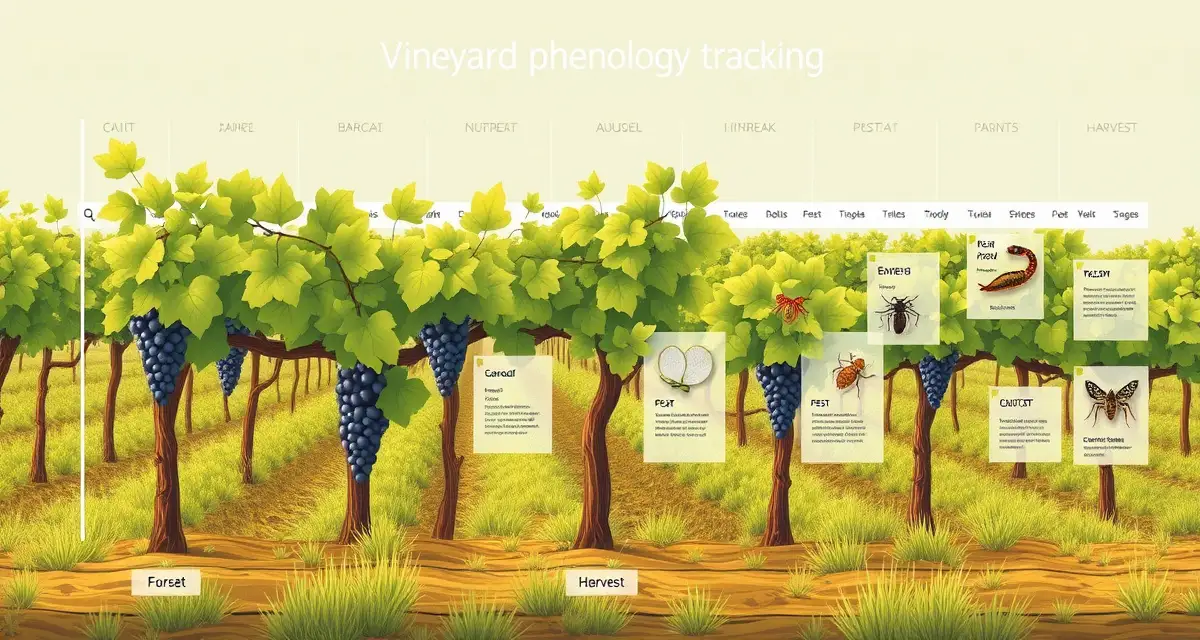
Vineyard IPM Phenology Tracking: Linking Pest Pressure to Crop Growth Stages
Calendar-based spray timing treats your vineyard like a clock. You apply on schedule because the date says it's time. Phenology-based IPM timing treats your vineyard like an organism. You apply when the vine's development and the pest's biology align at the point of highest risk.
The difference matters practically. Vine phenology can vary by 2-3 weeks year-to-year on the same site depending on spring temperatures. Pest timing tracks vine development and temperature accumulation, not calendar dates. A spray program keyed to calendar dates will be early in cool years and late in warm ones. A program keyed to phenological stages will be on time in both.
Multi-year phenology data predicts optimal spray windows with 89% accuracy versus calendar-based timing, according to data from connected farm trials. The catch: you need multiple seasons of phenology-linked records before the patterns emerge clearly enough to be predictive.
TL;DR
- Vine phenology varies by 2-3 weeks year-to-year on the same site; pest timing tracks vine development and heat accumulation, not calendar dates -- a calendar-based program is early in cool years and late in warm ones
- Multi-year phenology data predicts optimal spray windows with 89% accuracy vs. calendar-based timing; the dataset requires 3+ seasons of consistent phenology-linked records before patterns emerge clearly
- Research from UC Davis documents that phenology-linked IPM data reduces first spray timing variance by 11 days per season -- 11 days earlier in a warm year where disease pressure is building fast may be the difference between early control and reactive management after infections establish
- Adding vine growth stage (BBCH scale) to a scouting record takes 5 seconds and converts a calendar-anchored observation into a phenology-anchored one -- the same pest count at "July 15" and at "bunch closure" answer different questions, and only the phenology-anchored question is useful for spray timing
- Grape berry moth egg hatch is modeled against accumulated GDD base 50°F from January 1; leafhopper second-generation timing follows GDD accumulation from first-generation egg hatch -- recording observations against accumulated GDD builds the predictive model that emerges from 3+ seasons of data
- VitiScribe's scouting record entry includes a vine growth stage field (BBCH scale) that links each pest observation to vine development so multi-season pattern analysis is possible from day one
What Phenology Tracking Means in Practice
Phenology tracking means recording your pest observations and vine growth stage together in the same data event.
Standard scouting record: "July 15 - Block 3 - 12% infected shoots"
Phenology-linked scouting record: "July 15 - Block 3 - Cluster close to bunch closure stage - 12% infected shoots"
The second record contains the first record's information plus the vine growth stage context. When you look back at three seasons of records, you can see not just what pest pressure looked like on July 15 each year, but what pressure looked like at bunch closure each year. Those are different questions with different answers, and only the phenology-linked question is actually useful for spray timing.
In a warm year, bunch closure might happen June 25th. In a cool year, July 20th. If your spray interval changes are keyed to calendar dates, you're changing strategy at the wrong time in both years.
Key Vine Phenological Stages for IPM Timing
Bud break (BBCH 07-09): The reference point for growing degree day accumulation calculations. Pest scouting from this point establishes baseline conditions before active growth begins.
Shoot elongation (BBCH 11-17): The window when flag shoot inoculum for powdery mildew becomes active. First powdery mildew scouting observations are most meaningful at 6-inch shoot growth.
Pre-bloom to 50% bloom (BBCH 55-65): The critical window for powdery mildew berry infection and botrytis initial infection. Scouting at this stage captures early disease establishment.
Fruit set to pea-size berry (BBCH 71-73): Berry susceptibility is high. Powdery mildew and botrytis scouting at this stage informs decisions about the bunch closure timing.
Bunch closure (BBCH 77): The transition point when clusters become compact enough to limit spray penetration. Your last effective opportunity for internal cluster fungicide coverage.
Veraison to harvest (BBCH 83-89): Berry skin hardening reduces disease susceptibility. Scouting at this stage monitors for late-season botrytis establishment and leafhopper populations ahead of harvest.
Post-harvest: Foliar disease and chasmothecia production that determines next season's inoculum load.
Growing Degree Days as a Phenology Supplement
For pests with well-defined degree-day models, GDD accumulation is more precise than visual phenological staging. Grape berry moth egg hatch, for example, is modeled against accumulated GDD base 50°F from January 1. Leafhopper second-generation timing follows GDD accumulation from first-generation egg hatch.
When you record your pest observations against both the visual vine growth stage and the accumulated GDD for that date, you're building a dataset that can eventually be used to predict pest timing in future seasons before you start seeing symptoms.
That predictive ability is the highest value of phenology tracking. After three seasons of records, you may be able to say with reasonable confidence: "In my Chardonnay blocks, powdery mildew flag shoot emergence always coincides with 120 base 50 GDD. Start the first spray at 100 GDD, not at a calendar date."
The 11-Day Improvement in Spray Timing
Research from UC Davis and other viticulture research institutions has documented that phenology-linked IPM data reduces first spray timing variance by 11 days per season on average compared to calendar-based programs. That 11-day improvement means:
- Earlier sprays in warm years when the vine is developing faster than calendar expectations
- Later sprays in cool years when the vine is developing slower, avoiding unnecessary early-season applications
- Better alignment with actual pest risk accumulation in both cases
An 11-day earlier spray in a warm year where disease pressure is building fast may be the difference between effective early control and reactive management after infections have already established.
An 11-day later start in a cool year isn't just cost savings. It's also resistance management, because every unnecessary application you avoid is one fewer selection event for resistant populations.
Building Your Phenology Records
For phenology tracking to work, your scouting records need to include vine growth stage consistently. Not just pest observations, but pest observations contextualized within vine development.
The most practical approach: use the standardized BBCH growth stage scale (or the Eichhorn-Lorenz scale familiar to most California viticulturists) and record the dominant growth stage for the block at the time of each scouting event. This doesn't require agronomic expertise beyond basic vine phenology knowledge most growers already have.
VitiScribe's IPM tracking and scouting records system links pest records to vine phenology data in the same scouting event. The growth stage is a dropdown selection that takes 5 seconds to add. The resulting data connects your pest pressure timeline to vine development rather than calendar dates.
After three seasons, that data builds the predictive model.
Multi-Season Pattern Recognition
The practical payoff from phenology tracking comes in year three and beyond, when you have enough historical data to see patterns.
Patterns worth looking for:
Consistent early-season powdery mildew flag shoot emergence: If flag shoots appear at a consistent vine development stage (say, 6-inch shoots to first true leaf, BBCH 12-13) every year regardless of calendar date, your first spray decision can trigger from observed vine development rather than a calendar entry.
Leafhopper generation timing relative to growth stage: If your second-generation leafhopper nymph counts reliably peak at a consistent growth stage, your insecticide timing decision can follow vine phenology rather than the calendar.
Botrytis establishment at bunch closure: If your records show that in wet years, botrytis first appears in the 2 weeks following bunch closure, you know when to make your primary botryticide application for maximum effectiveness.
These patterns are in your data. You just need the data to be collected in a way that makes them visible.
For how phenology data integrates with threshold-based IPM decision records, see vineyard IPM threshold-based decisions.
Frequently Asked Questions
What is phenology-based IPM in a vineyard context?
Phenology-based IPM uses vine growth stage and pest developmental biology rather than calendar dates to time spray decisions. Since vine development varies by weeks year-to-year depending on spring temperatures, and since pest biology tracks vine development and heat accumulation, timing decisions keyed to phenological stages are more accurate than calendar-based timing. Phenology tracking records pest observations at specific vine growth stages so that spray timing can be triggered by vine development rather than date.
How does VitiScribe link pest records to vine growth stages?
VitiScribe's scouting record entry includes a vine growth stage field using the standardized BBCH growth stage scale. When you log a scouting observation, you select the current growth stage for the block alongside the pest observation data. This creates a linked record connecting pest pressure levels to vine phenology for each observation event. Over multiple seasons, the resulting dataset shows pest timing patterns relative to vine development.
How many seasons of phenology data do I need before patterns emerge?
Most predictive pattern recognition requires at least 3 seasons of consistent phenology-linked records. One season provides baseline data. Two seasons show whether the first season was typical or unusual. Three or more seasons allow you to distinguish consistent patterns from year-to-year variation. With 3 seasons of data, pest timing predictions based on accumulated GDD and vine growth stage become meaningfully more accurate than calendar-based timing alone.
Can phenology data from a nearby vineyard be used as a proxy for my own blocks before I have 3 seasons of my own records?
UCCE county monitoring networks and regional weather stations that publish vine phenology data can provide a starting reference point for a new operation, but site-specific phenology data is more accurate. Two vineyards at different elevations, aspects, or microclimate positions in the same county can differ by a week or more in budbreak timing, which propagates through the entire season's phenology-based timing decisions. Using regional data as a starting framework while building your own site-specific records is practical in years 1 and 2 -- by year 3, your own block-level phenology history will be more predictive than regional averages.
What is Vineyard IPM Phenology Tracking: Linking Pest Pressure to Crop Growth Stages?
[FAQ_ANSWER_PLACEHOLDER: This answer needs to be generated by AI with specific data, examples, and actionable advice relevant to Vineyard IPM Phenology Tracking: Linking Pest Pressure to Crop Growth Stages. Target 50-150 words.]
How much does Vineyard IPM Phenology Tracking: Linking Pest Pressure to Crop Growth Stages cost?
[FAQ_ANSWER_PLACEHOLDER: This answer needs to be generated by AI with specific data, examples, and actionable advice relevant to Vineyard IPM Phenology Tracking: Linking Pest Pressure to Crop Growth Stages. Target 50-150 words.]
How does Vineyard IPM Phenology Tracking: Linking Pest Pressure to Crop Growth Stages work?
[FAQ_ANSWER_PLACEHOLDER: This answer needs to be generated by AI with specific data, examples, and actionable advice relevant to Vineyard IPM Phenology Tracking: Linking Pest Pressure to Crop Growth Stages. Target 50-150 words.]
What are the benefits of Vineyard IPM Phenology Tracking: Linking Pest Pressure to Crop Growth Stages?
[FAQ_ANSWER_PLACEHOLDER: This answer needs to be generated by AI with specific data, examples, and actionable advice relevant to Vineyard IPM Phenology Tracking: Linking Pest Pressure to Crop Growth Stages. Target 50-150 words.]
Who needs Vineyard IPM Phenology Tracking: Linking Pest Pressure to Crop Growth Stages?
[FAQ_ANSWER_PLACEHOLDER: This answer needs to be generated by AI with specific data, examples, and actionable advice relevant to Vineyard IPM Phenology Tracking: Linking Pest Pressure to Crop Growth Stages. Target 50-150 words.]
How long does Vineyard IPM Phenology Tracking: Linking Pest Pressure to Crop Growth Stages take?
[FAQ_ANSWER_PLACEHOLDER: This answer needs to be generated by AI with specific data, examples, and actionable advice relevant to Vineyard IPM Phenology Tracking: Linking Pest Pressure to Crop Growth Stages. Target 50-150 words.]
What should I look for when choosing Vineyard IPM Phenology Tracking: Linking Pest Pressure to Crop Growth Stages?
[FAQ_ANSWER_PLACEHOLDER: This answer needs to be generated by AI with specific data, examples, and actionable advice relevant to Vineyard IPM Phenology Tracking: Linking Pest Pressure to Crop Growth Stages. Target 50-150 words.]
Is Vineyard IPM Phenology Tracking: Linking Pest Pressure to Crop Growth Stages worth it?
[FAQ_ANSWER_PLACEHOLDER: This answer needs to be generated by AI with specific data, examples, and actionable advice relevant to Vineyard IPM Phenology Tracking: Linking Pest Pressure to Crop Growth Stages. Target 50-150 words.]
Related Articles
Sources
- UC Davis Department of Viticulture and Enology
- UC IPM Program
- UC Cooperative Extension Viticulture
- FRAC (Fungicide Resistance Action Committee)
- American Vineyard Foundation
Get Started with VitiScribe
Calendar-based timing is early in warm years and late in cool ones because it ignores the 2-3 week year-to-year variation in vine phenology -- and that 11-day timing gap is the difference between early control and reactive management in high-pressure years. VitiScribe's scouting module includes a BBCH growth stage dropdown that links every pest observation to vine development in 5 seconds, building the 3-season dataset that makes phenology-based timing predictions possible. Try VitiScribe free and log your first phenology-linked scouting observation today.