Vineyard management companies: what they do, what they cost, and how to choose one

TL;DR
- Vineyard management companies run day-to-day field operations for owners who can't or won't run crews themselves.
- Work ranges from pruning and spray programs to harvest logistics and compliance filings.
- Full-service contracts typically cost $500 to $1,500 per acre per year, depending on region, vine density, and scope.
- The firm is usually the employer of record, so they carry the labor and pesticide liability too.
What does a vineyard management company actually do?
A vineyard management company runs some or all of the field operations you'd otherwise handle in-house. At the narrow end that's crew scheduling and equipment work. At the wide end the firm becomes your entire viticulture department: hiring and supervising workers, running the annual spray program, writing and keeping required records, sourcing inputs, booking custom harvesters, and getting fruit to a crush pad.
The standard service bundle covers dormant pruning, shoot thinning, leaf removal, canopy management, irrigation scheduling and repairs, a full spray program (fungicides, insecticides, herbicides), fruit sampling, and harvest coordination. Bigger firms bolt on custom farming, new-plant development, vineyard brokerage, and grape marketing.
Here's the part owners miss. In almost every arrangement the management company is the employer of record for the field crew. They hold the workers' compensation policy, run payroll taxes, handle I-9 compliance, and carry liability for the Pesticide Use Reports (PURs) filed with the county agricultural commissioner. That liability shift is a bigger reason owners hire these firms than plain convenience.
Say you inherited a vineyard, bought one as an investment, or planted a few acres next to a hospitality project. Handing operations to a management company usually pencils out better than building the capacity yourself. A full-time viticulturist plus a crew plus equipment is a lot of fixed overhead. A mid-sized firm spreads that cost across many clients and charges you a fraction of it.
How much do vineyard management companies charge?
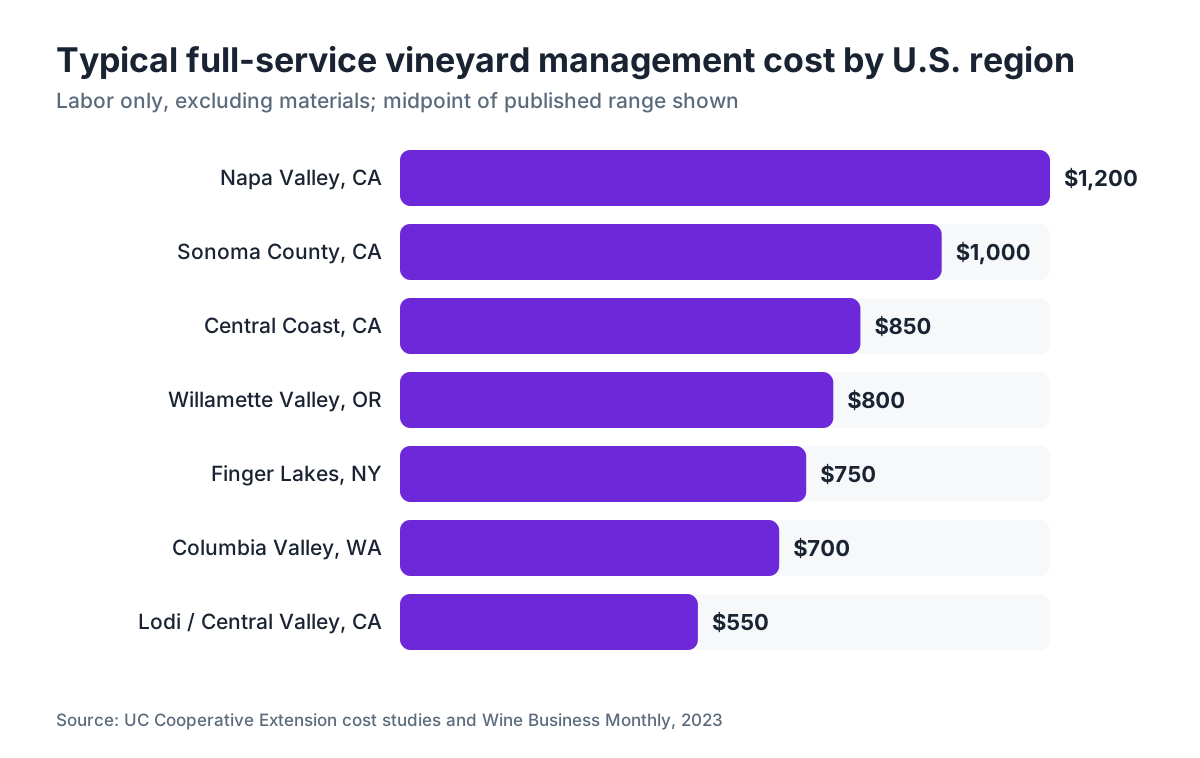
Full-service management runs roughly $500 to $1,500 per acre per year in most U.S. wine regions, and that's labor only. Materials (chemicals, fertilizers, stakes) and big capital jobs like replanting are billed on top [1]. Any single number here is misleading, so treat the range as a starting point, not a quote.
Four things move you within that range.
- Region and wage rates. California's North Coast (Napa, Sonoma) sits at the high end because labor costs more and a lot of the work is on steep ground. Lodi, the Central Valley, and parts of Washington and Oregon come in meaningfully lower.
- Vine density and trellis system. A high-density Pinot Noir block on vertical shoot positioning eats more labor hours than a wide-row Cabernet block on a two-wire trellis. Firms price by the hour of work required, and density is the biggest lever.
- Scope of services. Some contracts carve out irrigation or pest control and bill them separately. Read the service schedule line by line before you compare quotes, or you'll compare numbers that don't mean the same thing.
- Vineyard age and condition. A neglected block with deferred pruning and failing infrastructure costs more to bring back than a well-kept one, at least for the first few years.
Materials usually get billed at cost plus a 10 to 20 percent markup, and that's where volume buyers have a genuine edge. A firm farming 2,000 acres buys fungicide at a price you'll never get on 40.
Some firms quote a flat per-acre fee that wraps labor and materials together. Others bill labor hourly with materials separate. The flat fee is easier to budget. Time-and-materials shows you where the money actually goes. Neither wins on principle. What matters is whether you can audit the invoices.
| Region | Typical full-service range ($/acre/yr, labor only) | Notes |
|---|---|---|
| Napa Valley, CA | $900 to $1,500+ | High labor costs, steep terrain common |
| Sonoma County, CA | $700 to $1,300 | Wide range by AVA and vine type |
| Central Coast, CA | $600 to $1,100 | Paso Robles lower end, SLH higher |
| Willamette Valley, OR | $600 to $1,000 | Dense Pinot blocks push cost up |
| Columbia Valley, WA | $500 to $900 | Larger blocks, flatter terrain |
| Finger Lakes, NY | $550 to $950 | Smaller scale, variable infrastructure |
| Lodi / Central Valley, CA | $400 to $700 | High mechanization, large blocks |
These are estimates drawn from published extension cost studies and industry reporting. Real bids will vary [1][2].
What compliance and legal obligations does a management company handle?
In California, the management company is usually the responsible party for compliance, because it files the Pesticide Use Reports and employs the applicators. That puts the operational liability with the county agricultural commissioner, the California Department of Pesticide Regulation (CDPR), and Cal/OSHA's field sanitation and heat illness rules squarely on the firm [3]. The landowner isn't fully off the hook, but liability follows whoever directs the work.
Federally, the EPA's Worker Protection Standard (WPS) applies to any agricultural establishment where pesticides get used and workers or handlers are employed. Under the 2015 revised rule, the agricultural employer has to provide safety training, post application information at a central location, give access to labeling and safety data sheets, and enforce restricted-entry intervals (REIs) [4]. As employer, the management company carries most of that. But the rule can pull in the landowner too, depending on how your contract reads. Nail the language down before you sign.
Pesticide Use Reports are a California-specific requirement. A restricted material application has to be reported to the county agricultural commissioner within a set window after it's made [3]. Most firms handle PURs as a standard service. If yours doesn't, the penalties can land on you. Ask two direct questions: who files the PURs, and can I see confirmation they've been filed?
Certified organic farming adds a layer. Your management company has to keep a compliant Organic System Plan under the USDA National Organic Program and hold input records your certifier can audit. The Organic Materials Review Institute (OMRI) list is where they'll confirm approved products. Not every firm has done this. Ask how many certified organic acres they currently farm.
Washington State University Extension publishes guidance on pesticide recordkeeping for Washington growers that reads across to what any compliance program needs to capture [5]. Cornell's viticulture program covers New York State DEC reporting the same way for the Northeast [6].
If you run a bonded winery next to a managed vineyard, traceability from vine to tank matters for TTB purposes. The spray records, harvest logs, and lot records your firm generates have to line up with your winery's production records. Paper-based systems at management companies are where that connection tends to break.
How is a vineyard management contract structured?
A standard management contract runs three to five pages minimum and covers scope of services (what's in, what's out), fee structure (flat per-acre, hourly, or hybrid), materials billing, term and termination, liability and indemnification, insurance requirements, record ownership, and sometimes a right of first refusal if you sell the property.
Think hard about term length. Plenty of firms want a three-year minimum, and their reasoning is fair. They spend time building soil programs, training crews on your blocks, and learning your microclimate. A one-year deal doesn't give them room to show results. But locking in three years with a firm you've never worked with is a real bet.
A sensible middle ground is a two-year initial term with automatic one-year renewals and a 90-day written termination notice on either side. That gives the firm runway and gives you a clean exit if it isn't working.
Record ownership earns its own paragraph. The spray records, harvest data, irrigation logs, and soil tests generated during the relationship are your data. They document your land's history and carry real value for future buyers, lenders, and certifiers. Write into the contract that all records are the landowner's property and must be delivered in a usable format within 30 days of termination. Some firms run proprietary software, and that turns into a mess at the split if you didn't spell this out up front.
Insurance should include general liability of at least $1 million per occurrence, workers' compensation at statutory limits, and pollution liability that covers pesticide applications. Ask for certificates naming you as additional insured. A firm without pollution coverage, given what they do all day, is a gap you shouldn't accept.
What questions should you ask when vetting a vineyard management company?
The good firms aren't hard to find in any region. The hard part is telling apart a firm that fits your situation from one that's technically sharp but wrong for you.
Start with references from people you know, not the list the firm hands you. Call vineyard owners in your region whose operations you respect and ask who farms their blocks. If one name comes up three times from sources who don't know each other, that means something.
Here's what to ask in the first meeting.
How many acres do you manage, and how many salaried, full-time, in-field vineyard managers do you have? The ratio tells the story. A firm farming 3,000 acres with two managers is stretched. Expect reactive attention on your blocks, not proactive.
Who is my day-to-day contact, and what's their background? You want the person walking your rows to have viticulture training, more than crew-scheduling skills. UC Davis, WSU, and Cornell run the main programs producing credentialed viticulturists in the U.S. [7][8][9]. A degree from one of those, or equivalent supervised years in your specific region, is a reasonable floor.
Can I see a sample monthly report? Good firms write monthly summaries of work done, inputs applied, and field observations. If they can't show you a real redacted example, that's a signal.
Who files our Pesticide Use Reports, and can I get copies? Non-negotiable. You need a copy of every PUR filed on your property.
What happens if we disagree on a spray decision? This is the real test of the relationship. Do they consult you on timing, or act on their own? Some owners want full control, others want a heads-up after the fact. Know which you are and make the contract reflect it.
How do you keep records, and in what format? Paper notebooks, spreadsheets, and dedicated ag software all live in this industry. If you run a bonded winery or expect audits, you want records that search and export. VitiScribe was built for exactly this: it captures spray records, harvest logs, and compliance documents in an audit-ready format, so you're not trusting that a filing cabinet somewhere holds the right papers.
What's the difference between a vineyard management company and a custom farming agreement?
People use the terms as if they mean the same thing. They don't.
A custom farming agreement means the landowner gives the direction and the contractor supplies labor and equipment on a per-task or per-hour basis. You keep operational control and make the agronomic calls. The custom farmer executes.
A full-service management agreement hands operational control to the firm. They decide, with varying degrees of consultation, when to spray, when to irrigate, how to prune, and when to pick. You pay a management fee and get a report. This is what most people mean by "vineyard management company."
The legal line matters. Under California's farm labor contractor licensing rules, the party that hires and supervises field workers needs a Farm Labor Contractor license or has to work through someone who holds one [3]. Under a true management agreement the firm holds that license. Under a custom farming deal where you're directing the work, the picture gets murky, and the murk is your risk.
For owners with fewer than 40 acres, a hybrid often makes the most sense. The firm handles the compliance-heavy work (spray programs, PURs, crew management) while you handle the lighter tasks like scouting, irrigation tweaks, and harvest timing. That cuts cost and keeps you close to the farming.
The paso robles wineries region shows both models side by side. Large family estates tend to run full management agreements. Smaller east-side producers do more owner-operated farming and bring in specialist contractors for specific jobs.
How do vineyard management companies handle pest and disease programs?
This is core competency. A good firm runs a proactive Integrated Pest Management (IPM) program, not a reactive spray calendar. The difference shows up in your costs, your fruit quality, and your compliance record.
IPM in vineyards means scouting on a schedule, using economic thresholds before spraying, picking the least-toxic material that works, and documenting why each decision was made. UC's Statewide IPM Program publishes the California grape pest management guidelines, the standard reference for California and widely read in other states [10]. WSU Extension has comparable material for the Pacific Northwest [5].
Powdery mildew is the dominant fungal disease in most U.S. wine grape regions, and timing beats everything. The spray program should run off a forecasting model (the UC IPM powdery mildew risk index is one common tool) tied to weather data at or near your vineyard, not a generic regional calendar [10]. Ask your prospective firm which model they use and how they pull the weather data.
Botrytis management near harvest is judgment work, and it moves fruit quality and wine composition directly. A firm that gets it wrong in a wet year can cost you more in lost fruit than the entire annual management fee.
Under the EPA Worker Protection Standard and most state rules, the spray records from every application have to include the product name and EPA registration number, the rate, the date and location, the applicator's name, the REI, and the target pest [4]. If your firm's records don't carry all of those fields every time, you have a compliance gap sitting in a drawer.
What are the risks of hiring a vineyard management company?
The main risk is losing control right when the decisions matter most. A management company is juggling multiple clients. Your 60-acre block is a line on their schedule, and during a compressed harvest window or a disease spike, your block might not get attention at the exact hour it needs it.
Second is cost creep. Time-and-materials contracts especially can produce invoices you can't verify. No detailed monthly report with hours by task and materials receipts means you're trusting the firm's math on faith. That's not a reasonable posture with anyone.
Third is data loss at termination. If the firm holds all your records and the parting goes badly, pulling out a clean, complete, auditable record set is harder than it should be. Contract language fixes this cheaply, but most owners don't think about it until they need the records and can't get them.
Fourth, and it's underrated: the firm's relationship with your winemaker. If the winery has strong opinions on canopy management, picking parameters, or farming approach, those opinions have to be spelled out and written into the contract. The firm is farming to grow grapes. The winemaker is trying to make a specific wine. Those goals usually align. Not always. Someone has to be the tie-breaker, and you want to name them before the disagreement.
For properties that are part of a hospitality or tourism project, like a gervasi vineyard-style destination winery, the firm also has to understand the vineyard is a guest experience, more than a fruit unit. That shifts leaf removal timing, harvest dates visible from a tasting room, and how the canopy looks to a visitor.
Do vineyard management companies also handle vineyard development and new plantings?
Many do, and for owners developing raw land or replanting a tired block, it's often worth it. Site evaluation, soil sampling, variety and clone selection, trellis design, vine sourcing, planting, and establishment farming through the first three to five years before commercial production are all services established firms offer.
Development is capital-heavy. New vineyard establishment in California runs roughly $15,000 to $30,000 per acre all-in for a quality site with good infrastructure, based on UC Cooperative Extension cost studies [1]. The spread reflects land clearing, irrigation complexity, vine spacing, trellis type, and whether you source certified material or own-rooted cuttings. Premium regions with high land costs and dense plantings push higher.
Firms that do development work usually project-manage the whole install, then roll straight into the farming contract. That continuity has value. The crew that planted the vineyard knows which odd-slope block drains where, where the deer pressure is worst, and every quirk in the irrigation system.
Get clear on how development gets billed. The project management fee, the contractor markup on subcontracted work (earthmoving, irrigation install), and the ongoing farming fee during establishment years are three separate cost streams. Get a full pro-forma before you commit a dollar.
For owners of mountain winery or hillside properties with complex terrain, firms with steep-slope development experience are a smaller subset and harder to find. Ask specifically about their steep-site portfolio and where those blocks are.
How do you evaluate a vineyard management company's performance once they're on the job?
This is where owners go passive. They hire the firm, stop walking the blocks, and lean entirely on the monthly report. That's a mistake.
Set measurable benchmarks at the start of the contract. The usual ones: fruit quality at harvest (Brix, pH, TA against targets), yield per acre against budget, spray cost per acre against comparable operations, and pest and disease incident reports. If you're certified organic or chasing certification, audit results are an obvious metric.
Walk the vineyard with your manager at least once a month during the growing season. Not to micromanage, but to stay calibrated. You should be able to spot powdery mildew pressure when you see it, understand why one block's canopy looks different from last year, and ask coherent questions about what's in front of you. UC Davis, WSU, and Cornell all run short courses and extension workshops for owners that build exactly this literacy [7][8][9].
Ask to see the actual Pesticide Use Reports filed with the county, more than the firm's internal records. The PUR is the source-of-truth document for what actually went on your land. In California you can verify PURs through the county agricultural commissioner directly.
For records that stay with you no matter who farms the vineyard, a platform like VitiScribe holds spray applications, scouting observations, harvest data, and compliance documents in one place you own and control. Worth thinking about whether you farm in-house or through a third party.
Review the relationship formally once a year. Sit down with the firm's principal, more than your day-to-day contact, and walk the year's numbers against the benchmarks you set. Good firms welcome it. Firms that resist it are telling you something.
Where are the major vineyard management markets and who are the key players?
California is the biggest market by acres managed, with clusters in Napa Valley, Sonoma County, the Central Coast (paso robles wineries country and Santa Barbara County especially), and Lodi. Washington's Columbia Valley is the second-largest U.S. wine grape region and has a strong management ecosystem built around large estates and investor-owned vineyards.
Oregon's Willamette Valley, the Finger Lakes in New York, and Virginia's wine country each run smaller but active management markets. The dynamics differ. In Willamette, firms often specialize in Pinot Noir and know the region's disease calendar cold. In Virginia the market is younger and the pool of experienced viticulturists is thinner.
By firm type, the market splits three ways. Large regional firms farm thousands of acres across many clients and hold serious purchasing power and crew depth. Mid-size firms typically manage 500 to 2,000 acres and tend to offer more personal service. Single-viticulturist consulting practices sell agronomic guidance rather than crew management, which is a different model entirely.
No reliable public directory of management companies by region exists. But the American Society for Enology and Viticulture (ASEV), the Wine Institute in California, and state wine growers associations keep member directories that include management firms [11][12]. Regional trade press (Wine Business Monthly for California, Wines and Vines for wider coverage) runs periodic surveys of the market.
For investor-owned vineyards paired with destination hospitality, the management model has to account for guest experience. A south coast winery or an allegretto vineyard resort style property needs farming decisions to line up with marketing calendars and guest programming in ways a pure production block never has to.
Frequently asked questions
How much does it cost to hire a vineyard management company?
Full-service vineyard management typically costs $500 to $1,500 per acre per year for labor, not counting materials. Napa and Sonoma sit at the high end; Lodi and the Columbia Valley run lower. Materials like chemicals and fertilizers are usually billed separately at cost plus a 10 to 20 percent markup. Get at least three bids and compare service scope closely before you accept any quote.
What's the difference between vineyard management and custom farming?
Custom farming means the landowner directs the work and a contractor supplies labor and equipment. A full-service management agreement transfers operational control to the firm, which makes agronomic decisions and runs the crews. The legal and liability implications differ, especially around who holds the farm labor contractor license and who files Pesticide Use Reports.
Who is responsible for Pesticide Use Reports when using a management company?
In California, the party that directs pesticide applications is responsible for filing Pesticide Use Reports with the county agricultural commissioner. Under a full management agreement that's typically the firm. Your contract should say so explicitly. Ask for copies of every PUR filed on your property, and verify with the county that the filings are current.
Can a vineyard management company handle organic certification compliance?
Yes, but not every firm has done it. USDA National Organic Program rules require an Organic System Plan, approved input records, and a recordkeeping trail your certifier can audit. Ask any prospective firm how many certified organic acres they currently farm and whether they've been through an NOP audit. Experience in your region and with your certifier matters more than general organic claims.
What insurance should a vineyard management company carry?
At minimum: general liability of at least $1 million per occurrence, workers' compensation at statutory limits, and pollution liability that explicitly covers pesticide applications. Ask for certificates of insurance naming you as additional insured, and confirm coverage is current before work begins. A firm without pollution liability is a real gap given the nature of the work.
How do I keep my vineyard data if I switch management companies?
Your contract should state that all records (spray logs, Pesticide Use Reports, harvest data, irrigation records, soil tests) are the landowner's property and must be delivered in a usable format within 30 days of termination. Get that language in writing before you sign. If the firm uses proprietary software, ask what export formats exist and test the export before you actually need it.
What credentials should I look for in a vineyard manager?
A viticulture and enology degree from UC Davis, WSU, or Cornell is a strong baseline. Equivalent regional experience, five-plus years managing blocks in your appellation, and familiarity with your varietals and disease pressures matter just as much. A Certified Crop Adviser (CCA) credential is relevant too. Ask specifically who walks your vineyard weekly, more than who signs the monthly report.
How many acres can one vineyard manager realistically handle?
It varies, but a full-time viticulturist on a mixed portfolio can handle roughly 300 to 600 acres before service quality slips, depending on block complexity, geographic spread, and shared crew supervision. A firm farming 3,000 acres with three viticulturists puts 1,000 acres on each one. That's thin coverage. Ask the ratio directly and check it against their references.
Does the EPA Worker Protection Standard apply to management companies working in vineyards?
Yes. The EPA's Worker Protection Standard, revised in 2015, requires agricultural employers to provide pesticide safety training, post application information at a central location, enforce restricted-entry intervals, and give access to safety data sheets. As the employer of workers and handlers, the management company carries most WPS obligations. The landowner may also hold obligations depending on contract structure.
What's a reasonable contract term for a vineyard management agreement?
Two to three years for an initial term is common and reasonable. Firms need runway to show results from their programs; one-year deals create too much churn. Build in a 90-day written termination notice on either side and automatic one-year renewals after the initial term. Review performance formally once a year with the firm's principal.
Can a vineyard management company help develop a new vineyard from raw land?
Many can, and it's often worth using one, since they can run the full process from soil sampling through planting and establishment farming. UC Cooperative Extension cost studies put new vineyard establishment in California at roughly $15,000 to $30,000 per acre all-in. The firm typically charges a project management fee on top of contractor costs. Get a full pro-forma before you commit.
How do I find vineyard management companies in my region?
Start with grower association directories: the Wine Institute for California, the Washington Winegrowers Association for Washington, the Oregon Wine Board for Oregon. ASEV membership includes many management firms. Regional trade press like Wine Business Monthly runs periodic market surveys. The most reliable leads come from other owners in your appellation who'll tell you candidly who they'd hire again.
What should a monthly report from a vineyard management company include?
At minimum: a summary of work performed by date and task, inputs applied (product name, rate, application date, target pest, applicator name), hours by crew task, current disease and pest observations, upcoming planned work, and any equipment or infrastructure issues. If the report doesn't carry enough pesticide detail to reconstruct a PUR, that's a compliance gap you need to close.
Sources
- UC Cooperative Extension, Sample Costs to Establish a Vineyard and Produce Wine Grapes: New vineyard establishment in California costs roughly $15,000 to $30,000 per acre all-in; regional management cost ranges are informed by UC extension cost studies.
- Wine Business Monthly, vineyard management market coverage: Per-acre management cost ranges by California region, approximately $500 to $1,500 per acre per year for full-service contracts.
- California Department of Pesticide Regulation, Pesticide Use Reporting: California requires restricted-material pesticide applications to be reported to the county agricultural commissioner; the applicator and employer of record carries this obligation.
- U.S. EPA, Agricultural Worker Protection Standard: The 2015 revised WPS rule requires agricultural employers to provide training, post application information, enforce REIs, and provide access to labeling and safety data sheets, including specific pesticide application record fields.
- Washington State University Extension, Viticulture and Enology: WSU Extension publishes pesticide recordkeeping requirements and pest management guidance applicable to Pacific Northwest vineyards.
- Cornell University College of Agriculture and Life Sciences, Viticulture and Enology: Cornell's viticulture program covers New York State DEC reporting requirements and regional pest management for the Finger Lakes and other NY wine regions.
- UC Davis, Department of Viticulture and Enology: UC Davis offers degree programs and extension courses in viticulture that train credentialed viticulturists for the industry.
- Washington State University, Viticulture and Enology Program: WSU offers degree programs and extension education in viticulture and enology for Pacific Northwest growers.
- Cornell University College of Agriculture and Life Sciences, Viticulture and Enology: Cornell offers short courses and extension workshops for vineyard owners building operational literacy.
- UC Statewide IPM Program (UC IPM), Grape Pest Management Guidelines: UC IPM publishes grape pest management guidelines and powdery mildew risk index models used by California management companies to time fungicide applications.
- American Society for Enology and Viticulture (ASEV): ASEV maintains a member directory that includes vineyard management companies; a recognized professional body for the industry.
- Wine Institute: The Wine Institute's member directory includes vineyard management firms operating in California wine regions.
Last updated 2026-07-10