Vineyard management consulting: what it costs and how to hire right
TL;DR
- Vineyard management consultants advise on viticulture practices, spray programs, compliance, and farm planning.
- Day rates run roughly $500 to $3,000 depending on experience and region.
- You need one when your operation outgrows your in-house expertise or when a persistent problem (disease pressure, poor fruit quality, compliance gaps) isn't resolving.
- The best consultants are former growers, more than academics.
What does a vineyard management consultant actually do?
The job sounds obvious. In practice it covers work that shifts enormously by who you hire and what you need. At the core, a vineyard management consultant evaluates your operation, diagnoses problems, and recommends specific changes to your growing practices, inputs, or systems. That might mean walking your blocks weekly during the growing season, reviewing your spray records for gaps, redesigning your trellis system, or sitting across the table from your bank helping you underwrite a new planting.
Some consultants specialize tightly. A pest management advisor (PMA) in California is a licensed professional specifically qualified to recommend restricted-use pesticides and sign off on your pesticide use reports [1]. A viticultural consultant might focus on canopy management, vine balance, and fruit composition. An operations consultant might touch labor scheduling, equipment procurement, and water use. Very few individuals do all of this well, which is one of the first things you have to get straight before you hire anyone.
On the compliance side, consultants can be genuinely irreplaceable. EPA Worker Protection Standard requirements, state pesticide recordkeeping mandates, water board reporting in California's irrigated lands regulatory program, and sustainability certification audits all require documentation that has to be current, accurate, and retrievable. A single missed field posting or an incorrect pesticide application record can trigger fines or jeopardize your certified status. That's a real cost that good consulting prevents.
The best consultants work themselves toward being less necessary over time. They transfer knowledge to your team, build your internal systems, and only stick around for the problems that genuinely require outside perspective. If a consultant keeps you dependent on them for basic decision-making after two or three seasons, that's a red flag.
When does hiring a vineyard consultant actually make sense?
Not every operation needs one. A grower with twenty years on the same ground, a trusted spray applicator, and a solid extension relationship can run a tight ship without paying outside rates. But there are situations where consulting pays for itself fast.
First planting. If you're putting vines in the ground for the first time, the variety-clone-rootstock decision alone is worth paying a specialist to analyze for your site. Mistakes here cost a decade. UC Cooperative Extension has published variety trial data by region [2], but translating that into your specific soil series, market, and water situation requires someone who has done it before.
Persistent disease or pest problems. If you've had three straight years of Botrytis bunch rot pressure despite a full spray program, something in your canopy management, timing, or product rotation is wrong. Extension publications give you the framework. Walking your blocks with someone who has seen the same problem in fifty other vineyards often cracks it in a single visit.
Compliance pressure. When a water board investigates, an ag commissioner audits your pesticide records, or a buyer's sustainability questionnaire runs fifteen pages deep, you need someone who knows the regulation and can help you respond correctly. This is where hiring a PMA or a compliance specialist separately from your general viticulture consultant often makes sense.
Ownership transitions. When a vineyard changes hands or a winery buys estate fruit blocks, an independent management review gives the new owner an unbiased picture of vine health, deferred maintenance, and realistic input budgets. This is like a home inspection, and it's worth every penny.
What does vineyard consulting cost, and what drives the price?
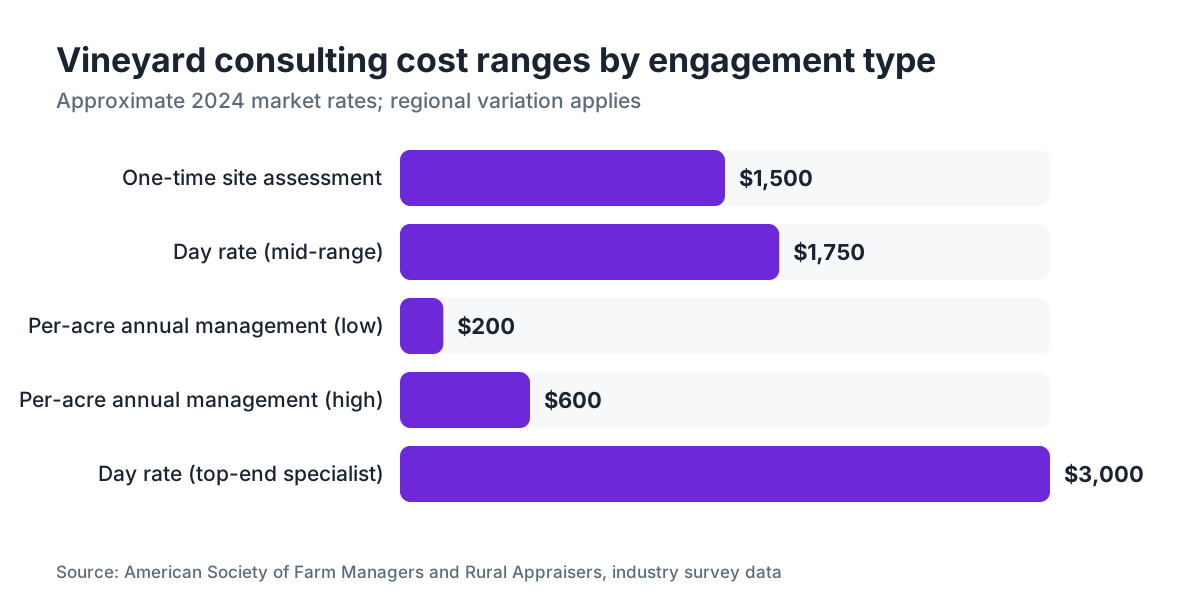
Day rates in 2024 run roughly $500 to $3,000 per day depending on credential level, region, and scope [3]. That spread is wide, and it reflects real differences in what you're buying.
At the lower end, you're typically working with a local consultant who covers your region well but may not have deep credentials in specialized areas like enology integration or water rights. At the upper end, you're paying for recognized specialists, often with academic affiliations or significant publication records, who get called in for complex problems.
Retainer arrangements are common for ongoing vineyard management. A full-service management contract, where the consultant's firm actually runs the farming operation, typically charges a percentage of gross revenue (commonly 7 to 12 percent) or a per-acre fee (often $200 to $600 per acre per year depending on the service level and crop) [3]. These numbers are not from a large published study. They come from industry conversations and regional farm advisor surveys, so treat them as a reasonable planning range rather than a firm benchmark.
Here's what actually drives price variation:
| Factor | Lower cost | Higher cost |
|---|---|---|
| Credential level | General farm advisor | Licensed PMA, PhD viticulturist |
| Region | Rural inland areas | Napa, Sonoma, Willamette Valley |
| Engagement type | One-time site visit | Full-season management contract |
| Specialty required | General viticulture | Water rights, enology integration |
| Vine age/complexity | Young, simple planting | Old vines, multiple varieties |
One thing that surprises new clients: travel time is usually billed. If your consultant drives two hours each way for a weekly block walk, you're paying for that. Clarify this upfront.
For small operations under 20 acres, university extension programs often offer free or low-cost farm advisor consultations before you commit to a paid engagement [2][4]. Use those first.
How do you find and vet a qualified vineyard consultant?
Referrals from growers you respect are still the most reliable starting point. Ask your crush facility, your local farm bureau chapter, or the grower relations team at any winery you sell to. They've seen who performs.
For credentials, in California the relevant license is the Pest Control Adviser (PCA) license issued by the California Department of Food and Agriculture, required to recommend restricted-use pesticides [1]. In Washington and Oregon, the equivalent is a Private Pesticide Applicator or Commercial Pesticide Applicator license through each state's department of agriculture [5]. Certified Crop Advisers (CCAs) through the American Society of Agronomy have passed a standardized knowledge exam and carry continuing education requirements. None of these certifications guarantees good judgment, but their absence should prompt questions.
Ask specifically for references from operations similar to yours in scale, variety mix, and market. A consultant who is excellent on 500-acre Chardonnay blocks in the San Joaquin Valley may have limited value on a 10-acre Cabernet Franc operation in the Finger Lakes. Those are genuinely different agronomic environments.
Get a written scope of work before any money changes hands. It should specify visit frequency, deliverables (written reports, spray recommendations, soil analysis interpretation), response time expectations, and how billing works for travel and lab fees. Vague agreements lead to disputes.
One more thing worth saying plainly: be skeptical of anyone who leads with product sales. Some consultants earn commissions from the ag supply companies whose products they recommend. That's not automatically disqualifying, but you need to know about it, and you should ask directly.
What's the difference between a full-service vineyard management company and an independent consultant?
A full-service vineyard management company takes operational control of your farming. They hire and manage the labor, own or lease the equipment, schedule all field operations, and handle your compliance paperwork. You pay a management fee and sign off on the budget, but the day-to-day decisions happen inside their organization. Companies like this are common in Napa, Sonoma, and Paso Robles, where absentee vineyard ownership is widespread [see /articles/paso-robles-wineries for context on how that market looks on the ground].
An independent consultant advises but doesn't operate. Your labor is your labor, your equipment is your equipment. The consultant tells you what to do and when, checks in during critical periods, and helps you troubleshoot. You retain direct control, which some growers strongly prefer.
The management company model makes sense when you don't live near the vineyard, when the operation is large enough to benefit from their equipment and labor pools, or when you simply don't want to run a farming operation yourself. The independent consultant model makes sense when you have competent crew and just need expert guidance layered on top.
Cost comparison is not straightforward, because the management company is replacing labor costs you'd otherwise carry directly. The real question is whether their efficiency gains and expertise justify their margin on top of those costs. For small blocks under 20 acres, independent consulting usually pencils out better. Above 100 acres with complex operations, full management companies often win on efficiency.
Some operations run both: a management company for field execution and an independent specialist consultant, with no connection to that company, for an objective second opinion on viticulture decisions. Expensive, but not rare on high-value estate vineyards.
What compliance areas do vineyard consultants typically handle?
Compliance is where many growers underestimate what they need. The regulatory landscape is real and has teeth.
EPA Worker Protection Standard (WPS) requires specific protections for agricultural workers and handlers who may be exposed to pesticides [6]. This includes pesticide application records, posting of treated areas, access to safety data sheets, and training requirements. The 2015 revisions to the WPS tightened these requirements, adding central posting requirements and minimum age restrictions for handlers. A good consultant helps you build and audit your WPS compliance systems, more than hand you a checklist.
Pesticide use reporting in California is required for every pesticide application under the Department of Pesticide Regulation's system. Reports go to the county agricultural commissioner monthly and must match your application records exactly [1]. Discrepancies trigger audits. Washington State has similar reporting requirements under the Washington State Department of Agriculture [5].
Water quality is growing in importance. California's State Water Resources Control Board irrigated lands regulatory program requires growers in regulated watersheds to either join a coalition, enroll in an individual order, or demonstrate exemption [7]. What that means operationally varies by county and water body. Many growers first learn they're subject to this requirement from a consultant.
On the sustainability and certification side, programs like California Sustainable Winegrowing (CSW), LIVE certification in Oregon and Washington, and Napa Green all carry their own audit and record requirements. Consultants who work in these markets know how to align your practices with certification criteria without overbuilding your documentation burden.
For operations tracking spray applications, scouting logs, and compliance records across multiple blocks, field record software becomes genuinely useful at a certain scale. VitiScribe is built specifically for this, letting you attach spray records to specific blocks and pull compliance reports without reconstructing them from paper at audit time.
How do university extension programs compare to paid consulting?
Extension programs at UC Davis, Cornell, and Washington State University are genuinely excellent, and most growers underuse them. These are not watered-down resources.
UC Cooperative Extension maintains farm advisors in every major California county with viticulture activity [2]. They hold field days, publish variety trial results, and offer direct phone and email consultation at no cost. The UC Integrated Pest Management program publishes detailed pest management guidelines specific to wine grapes that are updated regularly [8].
Cornell Cooperative Extension runs programs through the College of Agriculture and Life Sciences, with viticulture specialists who cover New York's wine regions [4]. Their work on cold-hardy varieties and disease management in humid climates is particularly good.
WSU Extension's viticulture program covers Washington's production regions and publishes research on varieties suited to the Columbia Basin and surrounding areas [9].
So why pay a consultant when extension is free? A few reasons. Extension advisors carry large caseloads and can't visit your specific blocks as often as your situation may require. They're also appropriately conservative, recommending practices supported by published research rather than the slightly-ahead-of-publication thinking that good private consultants bring. And they have no financial stake in the outcome of your specific operation.
The honest way to use both: lean on extension for knowledge base and free consultation, hire a paid consultant for site-specific problem solving and ongoing management support. These aren't substitutes for each other.
What should a vineyard management consulting contract include?
A verbal agreement is a bad agreement in this business. Written contracts protect both parties and clarify what success looks like.
Scope of services needs to be specific. 'Vineyard consulting' is not a scope. 'Weekly block walks during the growing season from bud break through harvest, written spray recommendations within 48 hours of each visit, soil and tissue analysis interpretation, and attendance at two winery meetings per year' is a scope.
Visit schedule and minimum visit frequency should be explicit. Some contracts specify a minimum number of visits per month; others define visits by growth stage. Both work. What doesn't work is ambiguity that lets either party claim the other didn't hold up their end.
Deliverables: what do you actually receive? Written reports after each visit? A seasonal plan at the start of the year? Spray records in a specified format? Define it.
Billing terms: day rate or retainer, how travel is handled, whether lab fees pass through at cost or with markup, and net payment terms. Net 30 is standard.
Termination clause: either party should be able to exit with reasonable notice (30 to 60 days is common). You don't want to be locked into a contract through harvest if the relationship isn't working.
Liability: what happens if a recommended spray program fails and you lose a significant portion of the crop? This is worth discussing with an attorney before you sign anything that doesn't address it. Consultants typically limit liability to their fees. That's standard, but you should understand it.
Confidentiality: if your consultant works with competing operations in your appellation, it's fair to ask what information they share and how.
How do consultants approach spray program design and pesticide records?
Spray program design is probably the most technically demanding thing most consultants do, and it's where the difference between a generalist and a specialist matters most.
A good spray program starts with a scouting protocol. You need to know what pests and diseases are actually present in your blocks at what levels before you apply anything. The UC IPM guidelines describe monitoring thresholds for key grape pests including grape leafhopper, vine mealybug, and powdery mildew, with specific action thresholds that should drive application timing [8]. Spraying on a calendar schedule without scouting data is expensive and increasingly scrutinized by buyers.
Product selection involves efficacy, resistance management, and regulatory status. A consultant tracking the latest EPA label changes and maximum residue limits for export markets can keep you from making an application that's legal domestically but creates a residue issue in a wine you're trying to sell to a Canadian importer. That's a real scenario that has cost real growers real money.
Pesticide records must, at minimum, include the date, location, product name and EPA registration number, rate applied, target pest or crop, applicator name, and the total acres and amount applied. California's DPR requires this information for every application [1]. Several states have gone further. The EPA WPS requires that this information be available to workers and handlers on request [6].
Record accuracy matters more than record format. A well-organized paper system beats a digital system with incorrect data every time. But digital systems do make retrieval faster, especially when an audit arrives without much notice. If you're managing records across multiple blocks and multiple applicators, a field operations platform that structures this data at the time of application (rather than reconstructed from memory afterward) is worth the investment.
The vineyard fundamentals article has more on setting up block-level record systems from the ground up.
What red flags should you watch for when evaluating consultants?
Some things should make you slow down before signing.
They can't name their other clients in your region, or they actively avoid the question. A consultant who works confidentially across competing operations in a small appellation may be managing conflicts of interest in ways that aren't obvious to you.
They recommend a full spray program overhaul in the first visit before they've seen your scouting data or your historical records. Diagnosis before treatment is basic good practice. Someone who shows up with a product list before understanding your system is likely selling something.
They don't carry or can't show professional liability insurance. This isn't standard in every market, but it's worth asking about on larger engagements.
They're vague about what they'll deliver in writing. If the deliverable is 'my expertise and advice,' that's hard to evaluate and harder to dispute if you feel underserved.
They're unfamiliar with your state's specific compliance requirements. 'I mostly work in California but this should all transfer' is not reassuring when Washington and California have different pesticide reporting systems, different water board structures, and different certification programs.
They quote a price before understanding your operation's complexity. The best consultants ask a lot of questions before naming a number, because the number genuinely depends on what they'll actually need to do.
Trust your crew's judgment too. Your vineyard workers see the blocks every day. A consultant who dismisses their observations or doesn't spend time talking with them is missing information.
How does vineyard management consulting work for small operations and new growers?
Small acreage and new growers face a pricing problem. The advice you need most is often priced for operations that can absorb a $2,000-a-day consultant easily. A 5-acre hobby vineyard can't.
Several real options exist. County farm advisor visits through extension programs are free. Extension-hosted field days and workshops let you get face time with specialists at low cost. Some consultants offer hourly rates for smaller operations, which can make a 2-hour site visit and written recommendation financially accessible.
For new plantings specifically, a one-time site assessment from a qualified consultant before you put any money in the ground is almost always worth paying for. You're making a 25-year infrastructure decision. Getting a second expert set of eyes on your soil survey interpretation, your proposed variety and rootstock selection, and your irrigation design is cheap insurance against expensive mistakes.
Groups of small growers sometimes hire a shared consultant, splitting visit costs across neighboring operations. This works well in established wine regions where operations are geographically close and have similar variety mixes. Your local growers' association or farm bureau chapter may already have something like this in place.
The American Society of Agronomy's Certified Crop Adviser program has a locator tool that can help you find credentialed advisors in your area [10]. That's a reasonable starting point when referrals haven't turned up a good match.
For a picture of how established operations in developed wine regions are structured, looking at places like Gervasi Vineyard or South Coast Winery can give you a sense of what vertically integrated operations eventually build in-house versus what they continue to outsource.
What does the consulting engagement actually look like week to week?
Expectations and reality diverge here more than anywhere else in the client-consultant relationship.
During the growing season, a typical engagement involves site visits at key phenological stages: pre-bud break (dormant pruning evaluation), bud break through bloom (disease and frost risk), fruit set through veraison (canopy management and pest pressure), and the pre-harvest period (maturity monitoring, final spray timing). Some consultants visit weekly; others visit monthly and check in by phone or email between visits. Neither frequency is inherently right. It depends on the problem complexity and your site's history.
After each visit, you should receive something in writing. A good visit report covers what was observed in each block, what action was taken or recommended, what to watch for before the next visit, and any compliance-relevant notes (like recording that a spray recommendation was made on a specific date for a specific product). This paper trail matters.
Off-season work includes reviewing the season's spray records for completeness, helping with certification renewals or audit preparation, participating in planning conversations about upcoming capital decisions (new varieties, irrigation upgrades, equipment), and sometimes representing your operation at industry or regulatory meetings.
Response time for urgent questions matters more than anything. If you discover what looks like a disease outbreak on a Thursday afternoon, you need an answer before the weekend. Ask prospective consultants directly: what's your expected response time for urgent field calls? The honest answer tells you a lot about how they run their practice.
For ongoing operations that want tighter control over their compliance documentation without adding staff, VitiScribe is designed specifically for vineyard field operations and records, letting you log applications, scouting observations, and compliance events at the block level without rebuilding records at the end of the season.
Frequently asked questions
How much does a vineyard management consultant charge per acre?
For full-service management contracts, per-acre fees typically run $200 to $600 per acre per year, depending on service scope, region, and crop value. High-value estate blocks in Napa or Sonoma trend toward the top of that range. For simple advisory-only arrangements, most consultants charge a day rate ($500 to $3,000) rather than a per-acre fee. Always get a written breakdown before agreeing to any structure.
Do I need a licensed pest management advisor or can any consultant recommend spray programs?
In California, recommending restricted-use pesticides legally requires a Pest Control Adviser (PCA) license issued by the California Department of Food and Agriculture. Any consultant signing pesticide use recommendations for restricted-use materials must hold this credential. In Washington and Oregon, similar licensing applies. For general-use pesticides, licensing requirements are less strict, but working with a licensed advisor protects you legally and operationally.
What's the difference between a Certified Crop Adviser and a viticulture consultant?
A Certified Crop Adviser (CCA) has passed a standardized knowledge exam administered by the American Society of Agronomy and maintains continuing education requirements. It's a general credential covering multiple crops. A viticulture consultant is a professional description, not a license. Many good vineyard consultants hold CCA credentials; some hold PCA licenses; some hold both. Neither credential by itself tells you whether someone understands your specific region and variety mix.
Can a vineyard consultant help with organic or biodynamic certification?
Yes, and this is a genuine specialty. Organic certification through a USDA-accredited certifying agent requires a detailed organic system plan, input documentation, and audit compliance. Biodynamic certification through Demeter has additional requirements. Consultants who specialize in organic transition can map your input program against the National Organic Program's allowed materials list and help you build the documentation trail that certification audits require. Not all general viticulture consultants have this experience, so ask directly.
What compliance records do vineyard managers legally have to keep?
At minimum: pesticide application records (date, location, product EPA registration number, rate, target pest, applicator name, acres and amount applied), Worker Protection Standard posting records, and depending on your state and watershed, water quality monitoring or reporting. California requires monthly pesticide use reports to the county agricultural commissioner. Records must typically be retained for at least two years, though some states require three to five. Your state's department of agriculture publishes the specific requirements.
How do I find a vineyard consultant in a region where I have no existing relationships?
Start with your county's UC Cooperative Extension farm advisor, Washington State University Extension, or Cornell Cooperative Extension depending on your state. They often know the private consultants working in the area and can give informal referrals. The American Society of Agronomy has an online CCA locator. Your local farm bureau and grower associations are also reliable sources. Winery grower relations teams usually maintain lists of advisors they trust, and asking them is completely appropriate.
What questions should I ask a vineyard consultant before hiring them?
Ask: What credentials do you hold and are they current? How many operations are you currently advising, and what's the maximum number you take on? Can you provide three references from operations similar to mine in scale and variety? How do you handle conflicts if you advise competing operations in the same appellation? What's your typical response time for urgent field questions? Do you earn any commissions from product sales? What do your written deliverables look like, and can I see a sample report?
Is it worth hiring a consultant if I only have five to ten acres?
For ongoing management, probably not at standard day rates, because the cost-to-benefit math gets tight. But a one-time site assessment before planting or before a major replanting decision is worth paying for regardless of scale. For smaller acreage, lean on free extension resources first, then consider hourly-rate consultants or group arrangements with neighboring growers. Some consultants will also do a single-visit assessment with written report for a fixed fee that's more accessible for small operations.
What's the EPA Worker Protection Standard and how does it affect vineyard operations?
The EPA Worker Protection Standard requires employers to protect agricultural workers and pesticide handlers from pesticide exposure. Key requirements include posting pesticide application information in a central location, providing safety data sheet access, training workers before they enter treated areas, and maintaining specific re-entry intervals after applications. The 2015 rule revision tightened many of these requirements. Violations can result in fines. The full standard is published at EPA.gov and applies to any operation that hires agricultural workers.
Can a vineyard management consultant help with fruit quality problems?
This is one of the most common reasons growers hire consultants, and a good one can make a real difference. Fruit quality issues usually trace back to vine balance, canopy architecture, water stress timing, or harvest timing decisions. A consultant with a strong viticulture background can walk your blocks, pull berry samples, and connect what they observe in the canopy to what you're seeing in the winery. This only works if the consultant has experience with your specific varieties and your regional climate.
How long does a typical vineyard consulting engagement last?
Most ongoing engagements renew annually and run for several seasons if the relationship is working. Problem-specific engagements (addressing a disease outbreak, supporting a replanting decision, preparing for a certification audit) can be as short as one or two visits with a written deliverable. New planting projects often involve an intensive period of two to three years while the vineyard establishes, then transition to lighter advisory roles. There's no standard length; it depends entirely on what you're trying to solve.
How do I evaluate whether a vineyard consultant is actually helping my operation?
Set measurable goals at the start of the engagement: specific disease incidence targets, fruit quality metrics at harvest, compliance audit results, or input cost reduction. Review those against actual outcomes at the end of each season. A consultant who resists setting measurable goals is worth scrutinizing. Also look at whether your crew's knowledge and decision-making is improving. Good consulting transfers understanding; it doesn't just hand down recommendations that nobody on the ground understands.
What's the going rate for a one-time vineyard site assessment?
A one-time site assessment with a written report typically runs $500 to $2,500 depending on property size, the number of varieties and blocks, and the consultant's credentials. Travel is often billed separately. In high-cost regions like Napa Valley or Willamette Valley, expect the upper end of that range. For a pre-purchase or pre-planting assessment on a significant investment, this cost is almost always recovered in better decisions made from the findings.
Do vineyard management companies handle compliance paperwork or is that separate?
Full-service vineyard management companies typically handle compliance documentation as part of their contract, including pesticide use reports, WPS record maintenance, and certification audit preparation. Independent consultants vary. Some include compliance support in their retainer; others charge for it separately or refer you to a specialist. When you're evaluating proposals, ask specifically whether compliance documentation is included and what that looks like in practice.
Sources
- California Department of Pesticide Regulation, Pesticide Use Reporting: California requires licensed Pest Control Advisers for restricted-use pesticide recommendations and monthly pesticide use reports to county agricultural commissioners.
- UC Cooperative Extension, Viticulture and Enology: UC Cooperative Extension maintains county-based farm advisors in major California viticulture regions and publishes variety trial data by region.
- American Society of Farm Managers and Rural Appraisers, Trends in Agricultural Land and Lease Values: Full-service vineyard management contracts are commonly structured as a percentage of gross revenue or per-acre fee; industry survey ranges cited as $200 to $600 per acre per year for management fees.
- Cornell Cooperative Extension, Viticulture and Enology Program: Cornell Cooperative Extension offers viticulture specialist support for New York wine regions with no-cost consultation for growers.
- Washington State Department of Agriculture, Pesticide Management: Washington State requires commercial pesticide applicator or private pesticide applicator licensing for pesticide use and maintains pesticide use reporting requirements.
- U.S. Environmental Protection Agency, Worker Protection Standard: The EPA Worker Protection Standard requires pesticide application records, central posting, safety data sheet access, and worker training; the 2015 revision added minimum age requirements for handlers and tightened central posting rules.
- California State Water Resources Control Board, Irrigated Lands Regulatory Program: California growers in regulated watersheds must enroll in a coalition, obtain an individual order, or demonstrate exemption under the Irrigated Lands Regulatory Program.
- UC Integrated Pest Management Program, Grape Pest Management Guidelines: UC IPM publishes monitoring thresholds and action thresholds for key grape pests including grape leafhopper, vine mealybug, and powdery mildew.
- Washington State University Extension, Viticulture Program: WSU Extension publishes viticulture research on varieties suited to the Columbia Basin and Washington wine regions.
- American Society of Agronomy, Certified Crop Adviser Program: The Certified Crop Adviser credential requires a standardized knowledge exam and continuing education; ASA maintains an online locator for credentialed advisors.
- USDA National Organic Program, Allowed Materials: Organic certification requires a system plan documenting inputs against the National Organic Program's allowed and prohibited materials list, with third-party audit verification.
Last updated 2026-07-09