Vineyard management portal: what it does and how to choose one

TL;DR
- A vineyard management portal is software that pulls field scouting, spray records, worker safety compliance, and harvest data into one system.
- The right one cuts record-keeping time and keeps you audit-ready under EPA's Worker Protection Standard, connecting field crews to the office without double entry.
- The wrong one just adds a subscription fee to your existing chaos.
What does a vineyard management portal actually do?
A vineyard management portal is a shared database for everything that happens in the vineyard. Spray applications, scouting observations, irrigation events, canopy work, harvest weights, cost tracking, compliance records. All of it lives in one place instead of scattered across clipboards, spreadsheets, and someone's memory.
The word "portal" means a user interface that multiple people can reach, and that's the real difference from a spreadsheet. A crew member logs a spray application from a tablet at the end of the row. The manager sees it back at the office. The owner pulls a cost summary at month-end. Nobody rekeys anything.
Most systems organize data by block, variety, or rootstock, because that's how vineyard problems actually show up. You want to know that Block 7 Zinfandel got Quintec at 4 oz per acre on June 12, not that someone sprayed something somewhere. Block-level records are also what regulators and buyers increasingly ask to see.
Here's the honest part. A portal doesn't make decisions for you. It puts the information in front of you fast enough that you can make better ones yourself.
What records does a vineyard portal need to track for compliance?
Compliance is the strongest reason to buy a portal, because the penalties for missing records are real and the audits arrive without warning.
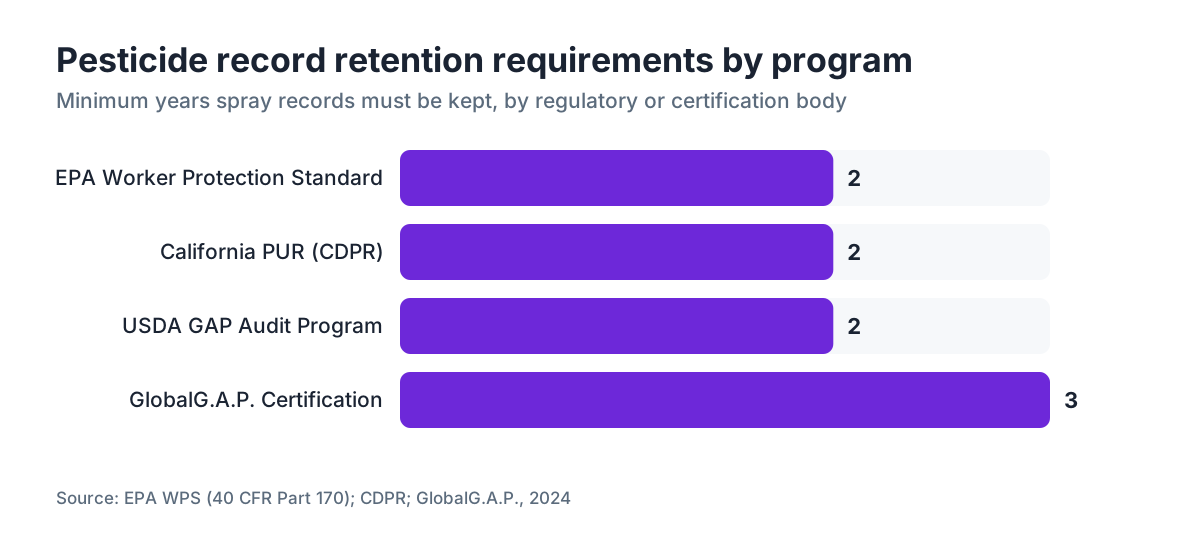
The EPA Worker Protection Standard (WPS), codified at 40 CFR Part 170, requires that pesticide application records stay on file for at least two years and that employees get access to application information within 30 minutes of a request [1]. California, Washington, Oregon, and most other grape-growing states layer their own Pesticide Use Reporting (PUR) rules on top of federal WPS. California requires licensed pest control operators to file monthly pesticide use reports with county agricultural commissioners under California Food and Agriculture Code Section 12981 [2].
A portal built for vineyards should capture, at minimum: the pesticide product name, EPA registration number, target pest, application date, application method, rate per acre, acres treated, operator name and license number, restricted-entry interval (REI), pre-harvest interval (PHI), and the block or field identifier. Miss any of those fields and you can't prove WPS compliance.
Pesticides aren't the whole story. Food safety programs like USDA GAP (Good Agricultural Practices) and GlobalG.A.P. require scouting logs, irrigation records, and worker training documentation [3]. If you sell to grocery chains or large distributors, those buyer audits often hit more often than regulatory ones.
Cornell's cooperative extension program treats integrated pest management (IPM) record-keeping as a prerequisite for responsible pesticide stewardship, not a paperwork afterthought [4]. That framing is right. The records exist because systematic documentation forces systematic thinking.
| Record type | Federal retention minimum | CA state requirement | Common buyer requirement |
|---|---|---|---|
| Pesticide applications | 2 years (WPS) | 2 years (PUR) | 3 years (GlobalG.A.P.) |
| REI/PHI postings | Duration of REI | Duration of REI | N/A |
| Worker WPS training | 2 years | 2 years | N/A |
| Scouting logs | None (federal) | None (state) | 1-3 years (buyer audit) |
| Irrigation records | None (federal) | Varies by water district | 1-3 years (USDA GAP) |
How does a vineyard management portal handle spray records specifically?
Spray records are where most vineyards feel the administrative pain, and where a good portal pays for itself fastest.
A solid spray record module does a few things well. It needs a product database that pulls EPA registration numbers and label data automatically, because nobody should hand-type a 9-digit EPA reg number under field conditions. It should enforce required fields before saving, so a crew member can't submit an incomplete application log by accident. And it should calculate REI and PHI end-dates automatically from the application date, then flag any upcoming harvest that conflicts.
WSU Extension guidance on spray record formats points to the REI end-date calculation as the field most often missed in manual systems [5]. That one omission is what creates liability in a worker injury case.
A few portals now pull from weather station APIs to log temperature, wind speed, and humidity at time of application. That data isn't federally required. It's very useful if a drift complaint comes in from a neighbor, or if a spray fails and you need to know why.
The export function matters as much as the entry function. Your county ag commissioner isn't going to log in to your software. You need to produce a clean printed or PDF spray record on demand. Any portal that makes that hard, or that exports data that doesn't match standard PUR forms, is creating more work than it saves.
What's the difference between a vineyard management portal and general farm management software?
General farm platforms like Granular, Conservis, and Agrivi are built for row crops, and they show it. Their field geometry tools assume rectangular fields. Their spray libraries lean toward corn and soy herbicides. Their reporting templates often don't map cleanly to wine grape compliance forms.
Vineyard-specific software organizes data by block, variety, clone, and rootstock, which is how viticulture actually works. A Cabernet Sauvignon block on 110R behaves differently from one on 3309C, and your records should carry that granularity. Phenology tracking in a vineyard portal follows budburst, flowering, veraison, and harvest, not corn heat units.
That said, general farm software works fine for straightforward record-keeping if you're willing to configure it, and some large multi-crop operations that grow grapes alongside other crops will value the integration with their existing systems more than vineyard-specific features. There's no universal right answer. The question is whether the configuration cost and workflow compromises beat a purpose-built system.
One concrete test. Pull up the spray record export from any candidate system and compare it line by line to your state's Pesticide Use Report form. If they don't match closely, you'll be doing manual data transfer at report time, which defeats the purpose.
What should you look for in a vineyard scouting module?
Scouting is where field observations become usable data, and most portals treat it as an afterthought. That's a mistake.
A useful scouting module lets crews log pest and disease observations at the block level, with GPS coordinates optional but available, and attach photos straight to the record. The photos matter. If you're making a spray decision based on 10% botrytis incidence in a block, timestamped photos from that scouting visit are how you defend the call to a certifier or buyer later.
UC Davis viticulture extension resources stress that threshold-based pest management needs consistent, dateable scouting records to prove thresholds were actually reached before a spray got triggered [6]. Without that documentation, IPM certification is just a label.
Scouting data should feed spray record creation directly. If you log a Grape Leafroll Virus observation, the system shouldn't force you to start a separate spray record from scratch. The block, date, and pest are already known.
Few portals do this connection well. Ask any vendor to walk the workflow from a scouting observation to a completed spray record during the demo. If it takes more than four or five taps, your field crew won't use it consistently.
How much does vineyard management software cost?
Any single number here misleads, so here's an honest range from publicly listed pricing and industry conversations as of mid-2025.
Entry-level systems aimed at small vineyards (under 50 acres) usually run $50 to $150 per month, or sometimes $500 to $1,500 per year. Mid-range platforms with stronger compliance modules and multi-user access typically land between $200 and $500 per month. Enterprise systems with API integrations, custom reporting, and dedicated support can run $1,000 per month or more, often with per-acre pricing on top.
Setup and onboarding fees are a real cost vendors like to downplay. Loading your block data, historical spray records, and product lists into a new system takes time, and some vendors charge $500 to $5,000 for assisted onboarding depending on your complexity.
Hardware gets overlooked. Field-rugged tablets run $300 to $800 each, and if your vineyard has poor cellular coverage, you need a system that works offline and syncs later. Not all do.
The honest ROI question. How many hours a week does your current record-keeping eat, and what's that time worth? A manager earning $65,000 a year who spends 5 hours a week on manual data entry is burning roughly $8,100 a year on that one task. A $2,400-per-year portal that cuts that time by 60% pays for itself in the first few months, on paper. Whether adoption friction and training time eat that savings is a separate question nobody has clean data on.
Does a vineyard portal help with EPA Worker Protection Standard compliance?
Yes, meaningfully, but only if it's set up right.
The EPA Worker Protection Standard at 40 CFR Part 170 has requirements a good portal automates: maintaining a central posting with current pesticide application information, keeping workers out of a treated area during an REI, and handing application records to workers or their representatives within 30 minutes of a request [1]. The 2015 revision to the WPS, effective January 2017, added the Application Exclusion Zone (AEZ) and tightened record-keeping [7].
EPA guidance states that records must include "the product name, EPA registration number, and active ingredient(s)" of the pesticide applied, along with the location and description of the treated area and the date of application [1]. A portal that stores label PDFs linked to each application record satisfies that cleanly.
Worker training documentation is the piece handled worst. WPS requires annual pesticide safety training for agricultural workers and handlers, with records kept for two years. Some portals include a training log module. Others don't. If yours doesn't, a simple spreadsheet linked in the same system works.
State rules often go further than federal WPS. California's Heat Illness Prevention standard under Cal/OSHA Title 8 Section 3395 doesn't live in a pesticide portal at all [8], but a manager juggling several compliance obligations benefits from a system that at least surfaces reminders and links to the relevant requirements, even if it can't store all of them.
Can small vineyards manage compliance without dedicated portal software?
Yes. A well-organized spreadsheet and a consistent filing system can satisfy every legal requirement for a small operation. The law doesn't require software.
What manual systems cost you is time and reliability. A 10-acre hobby vineyard with one operator making a handful of spray applications per year has a fair shot at clean records in a binder. A 200-acre estate with three full-time employees, seasonal workers, a shared-cost spray contractor, and quarterly buyer audits does not, at least not without heavy ongoing effort.
The break-even point sits somewhere in between. It depends on how organized your operation already is, how often you get audited, and what your buyers require. Some vineyards selling exclusively to one winery under a simple contract may never face a formal compliance audit in their entire operating life. Others selling into certified sustainable programs get audited every year.
If you're deciding whether to formalize your systems, VitiScribe offers a free trial of its spray record and compliance module. It's a low-commitment way to test whether a structured system fits your workflow before you commit to a subscription.
If you decide software isn't worth it yet, keep paper spray records with all WPS-required fields, scan them monthly, and store the scans somewhere that isn't your vineyard office. That office will burn down or flood eventually.
How do vineyard portals integrate with winery operations?
Vineyard data and winery data are more connected than most people realize when they're standing on one side of it.
Wineries need to know exactly when grapes were picked, from which block, at what Brix and pH, and with what spray history. That last item matters for label claims (organic, sustainable, Demeter), for state registration, and increasingly for import compliance if the wine sells internationally. The EU sets maximum residue limits (MRLs) for pesticides that differ from US tolerances, and a winery selling into European markets needs clean, exportable spray records from its grape sources.
Most vineyard portals have no native winery integration. They produce records that get manually transferred or exported to a winery management system like InnoVint, Vintrace, or WineDirect. A few vendors have built direct API connections or shared data formats, but it isn't standard.
If you run both a vineyard and a winery under one roof, ask any portal vendor specifically about export formats and whether they already integrate with your winery software. A CSV export that matches your winery system's import template is worth more than a slick interface that outputs in a proprietary format.
For growers supplying multiple wineries, data sharing gets political as much as technical. Some wineries want read access to your portal data directly. Others just want the annual spray summary. Know what your buyers require before you choose a system that might force you to share more than you're comfortable with.
What are the best vineyard management portals available right now?
A handful of systems come up again and again among vineyard managers in the major US wine regions, though the space moves fast and no independent head-to-head benchmark study exists as of mid-2025.
Agworld and Croptracker both have vineyard-focused features and see use in California, Washington, and Oregon. Agworld's strength is agronomist collaboration and spray recommendation workflows. Croptracker leans into compliance and food safety audit trails and shows up more often at operations with formal buyer certification.
Precision agriculture platforms like Trimble Agriculture (formerly AgriData) and John Deere Operations Center have vineyard users too, especially larger estates running precision irrigation or variable-rate equipment. But their interfaces are built around equipment integration, not compliance documentation.
VitiScribe is built specifically for vineyard compliance and field operations, with spray record modules designed around WPS and state PUR requirements. It's a reasonable pick for operations where compliance documentation is the main pain point.
For small vineyards that want a cheap starting point, WSU Extension's freely available IPM record-keeping templates give you a compliant paper system you can digitize into any spreadsheet or simple database [10]. They aren't fancy. They're free and they work.
The honest answer. Demo three or four systems, bring a real scenario from your own operation (a specific spray application, a scouting record, and a compliance report generation), and see which one your crew actually uses. Adoption rate is the only metric that matters.
How should you evaluate and implement a vineyard management portal?
Start with your pain point, not a feature list. If you're shopping because you almost blew a spray record audit, the evaluation should center on compliance workflows. If you're losing track of what happened in which block last season, block-level historical data and search should drive the demo.
Before any vendor demo, write down your current workflow. How does a spray record get created today, who enters it, where does it live, and how would you pull it for an audit? Then watch the vendor replicate that exact workflow in their system. If they can't, or if they want to show you everything else first, that's information.
Get clarity on data portability before you sign anything. You should be able to export your complete data in a readable format (CSV, Excel, PDF) at any time, and especially when you cancel. A vendor who dodges this question is telling you something.
Rollout matters as much as selection. The most common failure mode is buying a system and watching field crews keep using paper because nobody trained them, or because the mobile interface dies in the vineyard's cellular dead zones. Pilot with one block or one season before you commit the whole operation. Fix the workflow problems during the pilot, then expand.
UC Davis and Cornell both publish decision frameworks for technology adoption in farming, and the consistent finding is that adoption rate tracks with how much field-level staff got involved in the selection, not with how sophisticated the software is [11][4]. Let your spray operator use the field app before you buy it.
Frequently asked questions
What records does a vineyard management portal need to keep for EPA compliance?
The EPA Worker Protection Standard (40 CFR Part 170) requires pesticide application records showing the product name, EPA registration number, active ingredients, treated area, and application date, retained for two years. Portals should also store REI and PHI end-dates and produce these records within 30 minutes of a worker request. State rules, especially in California and Washington, add pesticide use reporting on top of federal WPS.
How long do I need to keep vineyard spray records?
Federal WPS requires a minimum of two years for pesticide application records. California's Pesticide Use Reporting law mirrors that two-year minimum. GlobalG.A.P. and many large grocery buyer programs require three years of spray history for audit purposes. If you're in any certified sustainable program, check your certification body's specific retention rules, which often run longer than state and federal minimums.
Can I run a vineyard management portal on a mobile device in the field?
Most current platforms offer mobile apps for iOS and Android. The practical issue is connectivity. Vineyards in mountain or remote areas often have poor cellular signal, so you need a system that works fully offline and syncs when signal returns. Ask vendors directly about offline functionality and what happens to unsaved data if the app crashes mid-entry. Field-rugged tablets with good battery life earn the extra cost.
Do I need separate software for winery operations and vineyard management?
Usually, yes. Winery management systems handle production lots, lab analysis, inventory, and compliance for the winery license, while vineyard portals focus on field records, spray logs, and growing-season data. A few vendors are building tighter integration, but most operations use separate tools and export data between them at harvest. Verify that your vineyard portal can export spray history in a format your winery software can import.
What's a realistic cost for vineyard management software for a 50-acre estate?
For a 50-acre estate, expect $100 to $300 per month for a mid-tier platform with multi-user access and WPS-compliant spray records. Annual plans often carry a 10 to 20 percent discount over monthly billing. Add $200 to $500 for onboarding help if you need to migrate historical records. Field tablets run $300 to $800 per device. Total first-year cost for a simple operation is typically $2,000 to $5,000.
Does vineyard management software help with sustainable certification programs?
Yes, a lot. Certified sustainable programs like CSWA (California Sustainable Winegrowing Alliance), Salmon-Safe, and LIVE (Low Input Viticulture and Enology) all require documented spray records, scouting logs, and sometimes soil and water management records. A portal that generates clean, timestamped audit trails makes certification renewal faster. Ask any certification body for its specific audit checklist before choosing software, then verify the system produces those exact reports.
How does a vineyard portal handle multiple users like a spray operator and vineyard manager?
Most multi-user portals assign role-based permissions. A spray operator might log applications and view REI information but not see financial data. A vineyard manager gets full read and write access. Owners or accountants might get read-only access to cost reports. Good role structure matters for compliance, since you want to know exactly who entered which record. Check whether the system logs edit history, so you can see if a record was changed after the fact.
What's the difference between a vineyard management portal and precision viticulture software?
Vineyard management portals focus on record-keeping, compliance, and operational tracking: spray logs, scouting notes, cost tracking, harvest data. Precision viticulture software focuses on spatial data: NDVI maps, variable-rate application prescriptions, yield mapping, sensor networks. The two overlap on scouting and block-level data but serve different primary users. Operations running variable-rate irrigation or targeted canopy management benefit from precision tools; operations focused on compliance documentation benefit more from a portal.
Can a vineyard management portal help me pass a buyer food safety audit?
It makes passing much easier when set up correctly. USDA GAP and GlobalG.A.P. auditors want traceable, dated records for spray applications, irrigation, scouting observations, and worker training. A portal that timestamps every entry and exports clean audit reports removes most of the last-minute document scrambling before an audit. The key word is traceable. Auditors verify that application records reference specific blocks and that dates make sense against pre-harvest intervals.
Are there free vineyard record-keeping tools I can start with before paying for a portal?
Yes. WSU Extension publishes free IPM record-keeping templates for wine grape operations that satisfy WPS documentation requirements. UC Davis Cooperative Extension has similar resources for California growers. These are paper or spreadsheet-based, not true portals, but they're legally sufficient for small operations and a good way to learn what a portal needs to capture before you pay for one. Both universities post these on their extension websites at no cost.
How do vineyard management portals handle private pesticide applicator license tracking?
Better portals store operator license numbers and expiration dates, then pull that information automatically into spray records. Some send alerts when licenses approach expiration. This matters because WPS records must identify the handler who made the application, and for restricted-use pesticides that handler must be a licensed private or commercial applicator. An expired license attached to a spray record is an immediate compliance problem during an inspection.
What should I do if I fall behind on entering spray records into the portal?
Enter them as accurately as you can from your paper backup, and note clearly that it was a late entry with the actual application date documented. Do not backdate records to look contemporaneous. WPS regulations don't explicitly prohibit late entry, but falsifying the entry date is a separate and more serious problem. If you're consistently behind on data entry, that's a workflow problem worth solving with offline mobile entry before the next season.
Sources
- EPA, Worker Protection Standard for Agricultural Pesticides (40 CFR Part 170): WPS requires pesticide application records be kept for at least two years and provided to workers within 30 minutes of request; records must include product name, EPA registration number, active ingredients, location, and application date.
- California Department of Pesticide Regulation, Pesticide Use Reporting: California Food and Agriculture Code Section 12981 requires licensed pest control operators to file monthly pesticide use reports with county agricultural commissioners.
- USDA Agricultural Marketing Service, Good Agricultural Practices (GAP) Audit Program: USDA GAP certification requires scouting logs, irrigation records, and worker training documentation as part of the audit criteria.
- Cornell University Cooperative Extension, Integrated Pest Management Program: Cornell Extension identifies IPM record-keeping as a prerequisite for responsible pesticide stewardship and notes that adoption of record systems correlates with field-staff involvement in system selection.
- Washington State University Extension, Viticulture and Enology resources: WSU Extension publishes spray record templates for wine grape operations and identifies REI end-date calculation as the most commonly missed field in manual record systems.
- University of California Agriculture and Natural Resources, Cooperative Extension: UC Cooperative Extension emphasizes that threshold-based pest management requires consistent, dateable scouting records to validate that action thresholds were reached before a spray was triggered.
- EPA, Agricultural Worker Protection Standard 2015 revisions: The 2015 WPS revision, effective January 2017, added Application Exclusion Zone (AEZ) requirements and strengthened record-keeping obligations for pesticide handlers.
- California Department of Industrial Relations (Cal/OSHA), Title 8 Section 3395 Heat Illness Prevention: California's Heat Illness Prevention standard under Cal/OSHA Title 8 Section 3395 applies to outdoor agricultural workers and is a distinct compliance obligation from pesticide record-keeping.
- GlobalG.A.P., Integrated Farm Assurance standard: GlobalG.A.P. requires retention of pesticide application records for a minimum of three years, exceeding the federal and California two-year minimum.
- Washington State University Extension: WSU Extension provides free IPM and spray record templates for wine grape producers that satisfy WPS documentation requirements.
- UC Davis Department of Agricultural and Resource Economics: Research at UC Davis finds technology adoption rates in agricultural operations correlate with field-level staff involvement in the selection process, not with software sophistication.
Last updated 2026-07-09