Vineyard pest management: a practical field guide

TL;DR
- Good vineyard pest management runs on three things: scouting against real thresholds, targeted chemistry, and a written IPM plan.
- The three most expensive pests in most regions are powdery mildew, Botrytis bunch rot, and either grape leafhopper (West) or grape berry moth (East).
- Spray timing and records matter as much as product choice.
- UC Davis, Cornell, and WSU publish region-specific threshold data.
- Keep it on your desk.
What pests actually cost vineyards the most money?
Powdery mildew (Erysiphe necator) is the single most expensive grape disease in most of the world's wine regions. Left unmanaged, it can take the whole crop on a susceptible variety, according to UC's Statewide IPM Program [1]. In California's Central Coast and Central Valley, growers routinely budget $150 to $400 per acre per season on fungicides aimed at this one pathogen, depending on variety and pressure.
Botrytis bunch rot comes second in wet years. The culprit is Botrytis cinerea, a generalist that thrives when relative humidity holds above 85% for long stretches during ripening. Tight-clustered varieties like Pinot Noir and Chardonnay can lose 30 to 50 percent of a crop in a bad vintage if you're not managing canopy density alongside fungicide sprays [2].
Insect pests vary hard by geography. In the eastern U.S., grape berry moth (Paralobesia viteana) drives most insecticide spending. In the West, it's grape leafhopper (Erythroneura elegantula and related species). Phylloxera (Daktulosphaira vitifoliae) is the historical heavyweight that redrew the map of global viticulture, but grafted vines on resistant rootstocks handle it at planting rather than season to season.
Mites are the quiet threat. Pacific spider mite (Tetranychus pacificus) and Willamette mite (Eotetranychus willamettei) stay secondary until you hammer their predators with broad-spectrum insecticides, and then they explode. That's the trap growers fall into most: you fix one problem and build a worse one.
What is integrated pest management (IPM) and does it actually work in vineyards?
IPM is a decision-making framework, not a product list. The EPA calls it "an effective and environmentally sensitive approach to pest management that relies on a combination of common-sense practices," leaning on pest biology, economic thresholds, and several control tactics before anyone reaches for a pesticide [3].
In vineyards, IPM works in four tiers. Prevention comes first: variety selection, rootstock choice, vine spacing, trellis design, and cover crop management to hold down humidity. Monitoring is second: weekly scouting through the season, trap networks for moth pests, spore traps for Botrytis or powdery mildew. Third is threshold-based action, where you spray when a pest crosses a defined economic threshold, not when the calendar says to. Fourth is least-toxic-first chemistry: sulfur and copper ahead of synthetic fungicides, selective insecticides ahead of broad-spectrum ones.
Does it work? The data say yes. Research summarized through UC's IPM program shows threshold-driven growers making 30 to 50 percent fewer pesticide applications than calendar sprayers without a meaningful yield hit [1]. The catch is labor. Scouting takes time, and plenty of small operations skip it and slide back to calendar spraying because it feels safer. The math rarely backs that feeling.
WSU Extension's viticulture program has published IPM protocols built for the Pacific Northwest, covering Botrytis, powdery mildew, and leafroller pests with thresholds calibrated to local conditions [4]. Cornell's New York State IPM program does the same for the East, where grape berry moth is the dominant insect pressure [5]. Skip those extension resources and you're building your program from nothing for no reason.
What are the economic thresholds for key vineyard pests?
An economic threshold tells you the point where the cost of treating is finally less than the cost of the damage. That's the whole point of scouting. Without a threshold, you're guessing with a sprayer.
Here are the most-used numbers from published extension sources. None of these are universal. Calibrate to your region and variety.
| Pest | Threshold (action point) | Source |
|---|---|---|
| Grape leafhopper (1st gen.) | 15-20 nymphs per leaf, pre-veraison | UC IPM [1] |
| Grape leafhopper (2nd gen.) | 20 adults per leaf, post-veraison | UC IPM [1] |
| Pacific spider mite | 20-30% leaves infested with motile mites | UC IPM [1] |
| Grape berry moth (GBM) | 5% shoot strikes (1st gen.), 3% cluster strike (2nd gen.) | Cornell IPM [5] |
| Powdery mildew | Any active colony at bud swell through bloom | WSU Extension [4] |
| Botrytis | Environmental risk models + 5% infection at bunch closure | UC Davis [2] |
Powdery mildew has no real threshold in the usual sense. Even low populations at bloom can set up catastrophic fruit infection later. The window from bud swell to about three weeks past bloom is when spores infect flower tissue, and that damage stays invisible until harvest. Most extension sources put you on a 7 to 14 day sulfur or DMI program through that window regardless of visible symptoms [1].
For insects, the threshold idea is cleaner. Grape leafhopper feeding causes stippling that cuts photosynthetic capacity, but vines shrug off moderate populations with no economic yield loss. The UC numbers above mark the point where defoliation starts costing you sugar and fruit quality.
Grape berry moth runs on degree-days. Cornell's Network for Environment and Weather Applications (NEWA) gives you a free online model that flags when each flight peaks in your area, which beats calendar dates by a wide margin [5].
How do you build a vineyard scouting program from scratch?
Start with frequency. Through the growing season, scout at least once a week from bud swell to harvest. Twice a week during bloom and bunch closure is better if your crew can carry it, because those are the two highest-risk windows for both powdery mildew and Botrytis.
Sample size matters. For a 20-acre block, a defensible sample runs 50 to 100 leaves, pulled at random from shoot tips (mites and powdery mildew) and cluster zones (Botrytis and leafhopper nymphs). UC extension guidance describes a standardized transect: enter the block, count every 10th vine, take one leaf from a fixed position [1].
Record what you find. This sounds obvious. Most small operations still keep pest records in their head or in a notebook nobody ever reads back. Without trend data across seasons, you can't catch early pressure building before it hits threshold, and you can't show a defensible basis for a spray decision if an auditor ever asks.
Tools that earn their keep: yellow sticky traps for leafhoppers and thrips, pheromone lure traps for grape berry moth and omnivorous leafroller. Traps don't tell you when to spray. They tell you when adult flights are happening so you can time treatment to the vulnerable life stage.
For disease, a 10x hand lens finds early powdery mildew colonies on leaves just fine. Botrytis scouting is different. You're reading bunch-zone humidity, wound sites, and lateral shoot density more than looking for visible sporulation.
Which fungicides work best against powdery mildew and Botrytis, and how do you avoid resistance?
Sulfur is still the workhorse. It's cheap (roughly $3 to $8 per acre per application depending on formulation and rate), organic-approved, and carries no known resistance in powdery mildew populations because it hits multiple sites at once [1]. The limits: sulfur loses efficacy above 95 to 100 degrees F, and applications within two weeks of an oil spray can burn sensitive varieties.
When pressure runs high, the FRAC Group 3 fungicides (DMIs like tebuconazole and myclobutanil) and FRAC Group 11 (QoIs like azoxystrobin and trifloxystrobin) work well on powdery mildew. Both groups have documented resistance in Erysiphe necator populations in California and the East [2]. The resistance rule that actually holds up: alternate FRAC groups every spray, and never make more than 2 to 3 back-to-back applications of any single mode of action in a season.
Botrytis is messier. Botrytis cinerea develops resistance fast. FRAC Group 2 (benzimidazoles like thiophanate-methyl), Group 7 (SDHIs like boscalid), and Group 17 (anilinopyrimidines like cyprodinil) are the main tools, but resistance to benzimidazoles and SDHIs is already widespread in commercial vineyards [2]. Cornell's Botrytis guidelines push a strict rotation: no more than one application per FRAC group per season, and a heavy tilt toward cultural management (leaf removal, spur thinning) to change the biology instead of chasing it with chemistry.
Fertility matters more than most growers admit. High-nitrogen canopies with dense shoots build exactly the microclimate Botrytis wants. Design the spray program alongside your canopy decisions, not as a bolt-on input.
What insecticides are approved for use in vineyards and when should you use them?
The main insecticide classes in commercial vineyards are organophosphates, pyrethroids, neonicotinoids, insect growth regulators (IGRs), and biologicals like Bacillus thuringiensis (Bt) and spinosad.
For leafhoppers, foliar neonicotinoids (imidacloprid, acetamiprid) work well, but the pollinator concerns are real. EPA's imidacloprid review found the compound poses risk to pollinators at foliar use rates on blooming crops [6]. You're not usually spraying vines at bloom, but drift and residue still count. A practical rule: if your vineyard sits near cover crops in bloom or has wildflowers in the understory, pick pyrethroids or IGRs over neonicotinoids for foliar work.
For grape berry moth, mating disruption with pheromone dispensers is the IPM standard across the eastern U.S. It isn't cheap (around $100 to $175 per acre for dispenser products) but it cuts insecticide use hard and has no resistance concerns. Cornell's data show greater than 80% reduction in berry moth damage versus untreated checks when dispensers go out correctly [5].
Biologicals deserve more attention than they get. Spinosad (from Saccharopolyspora spinosa) hits leafrollers and thrips well, is OMRI-listed, and has low mammalian toxicity. Bt (Bacillus thuringiensis var. kurstaki) handles leafroller larvae if you time it to early instar feeding.
One hard rule: read the label before every application. Under 40 CFR Part 156, the pesticide label is a legal document [7]. An application that contradicts the label isn't a compliance risk. It's a federal violation.
What are the EPA Worker Protection Standard requirements for vineyard spray programs?
The EPA Worker Protection Standard (WPS), at 40 CFR Part 170, applies to any agricultural establishment that uses pesticides and employs workers or handlers [8]. For vineyards, that's nearly everyone.
The WPS pieces vineyard managers miss fall into four buckets.
First, Restricted Entry Intervals (REIs). Every label carries one, from 4 hours (most sulfur products) to 48 hours (many systemic insecticides). Workers can't enter treated areas during the REI without full PPE, and you must post warning signs at field entry points during those periods.
Second, training. Every agricultural worker and handler needs WPS safety training before working in a treated area. Workers need it at least once every 5 years; handlers need it annually. The training must be done by, or at the direction of, the agricultural employer [8].
Third, the Application Exclusion Zone (AEZ). Since the 2015 revision, a mandatory AEZ surrounds application equipment during a spray: 100 feet in all directions for outdoor airblast applications (the standard vineyard rig) when wind runs above 10 mph, and 25 feet when wind is at or below 10 mph [8]. No workers inside the AEZ during spraying.
Fourth, record-keeping. Agricultural employers keep pesticide application records for at least 2 years. Each record needs the product name, EPA registration number, active ingredient, location treated, date and time, rate applied, and the applicator's name.
Keeping those records organized is exactly where a purpose-built system earns its cost. VitiScribe is built around the spray record and WPS documentation workflow, so anything EPA or a state auditor asks for is already structured and ready to export.
State rules stack on top of federal WPS. California's Department of Pesticide Regulation (CDPR) runs among the strictest programs in the country, including Pesticide Use Reporting (PUR) to county agricultural commissioners for any restricted-materials application [9].
How do you manage grapevine diseases like Pierce's disease and leafroll virus, which can't be sprayed?
Not every vineyard problem has a spray answer. The two most destructive grapevine diseases in the U.S. sit squarely in that camp.
Pierce's disease (PD) comes from the bacterium Xylella fastidiosa, spread by the glassy-winged sharpshooter (GWSS) in California and other sharpshooter species elsewhere. It kills vines within 1 to 5 years of infection. There's no cure. Management is entirely about the vector: insecticides to knock down sharpshooter populations near susceptible vines, removal and destruction of infected vines to cut the bacterial reservoir, and planting PD-resistant or PD-tolerant varieties where they exist [1].
Grapevine leafroll disease rides on several mealybug species, mainly vine mealybug (Planococcus ficus) in California. Leafroll viruses (at least 11 are recognized, with GLRaV-3 the most damaging economically) delay ripening, drop Brix, and strip anthocyanin from red varieties. Field studies have put GLRaV-3 losses at roughly 40% yield and 2 to 3 degrees Brix in infected blocks [2]. Management means mealybug control (neonicotinoids as soil drenches or foliar, or spirotetramat as a systemic) plus mandatory roguing of infected vines. Replanting with certified virus-free material is the only way to rebuild a clean block.
Both diseases demand a plan before symptoms show, not after. UC Davis Foundation Plant Services keeps a database of certified disease-free vine material and publishes sanitation protocols for equipment moving between blocks [1].
One more pathogen worth naming: Eutypa lata, the cause of Eutypa dieback, which enters through pruning wounds. The window is narrow. Cuts made during wet weather run the highest risk, and there are registered protectant fungicides (trifloxystrobin, thiophanate-methyl) for fresh wounds, though most growers skip this step and pay for it years later.
What does an organic or low-input vineyard pest management program actually look like?
Organic grape production in the U.S. is a fast-growing segment. The USDA's 2019 Organic Survey counted tens of thousands of acres of certified organic grapes, with California holding the large majority of the national total [10]. An organic label doesn't mean no spraying. It means different chemistry.
The USDA National Organic Program (NOP) allows sulfur and copper as fungicides, Bt and spinosad as insecticides, and kaolin clay as a physical barrier against insects [12]. What it blocks: synthetic fungicides, most synthetic insecticides, and soluble synthetic fertilizers that could disturb soil biology.
Copper is the real constraint on organic fungicide programs. Copper hydroxide and copper octanoate work against downy mildew and carry some bacterial activity, but copper builds up in soil with repeat applications. The EU has moved to a cap of 4 kg copper per hectare per year averaged over 7 years [4]. The U.S. NOP has no numeric cap, but the "use minimum amount" requirement and shifting state guidance are pushing the same direction.
Biological fungicides are widening the organic toolkit. Products built on Bacillus subtilis (Serenade, for one) and Trichoderma species carry registered efficacy claims against Botrytis, though field performance in high-pressure years generally trails synthetic materials. Treat them as tank-mix partners rather than standalone programs and they perform better.
The real edge in organic isn't on the spray side. It's canopy management. Growers who consistently thin shoots hard, pull leaves in the cluster zone, and hold vine vigor down through cover cropping often run lower disease pressure than conventional growers leaning on chemistry to cover for dense canopies.
How do vineyard spray records work and what are you legally required to keep?
This is where compliance bites small operations hardest. Spray record rules come from three overlapping systems: federal WPS (above), state pesticide regulations, and any third-party certification you carry (USDA Organic, Lodi Rules, Fish Friendly Farming, and others).
At the federal level, WPS requires records kept for 2 years and available for inspection [8]. Each record documents the pesticide product name, EPA registration number, active ingredient, amount applied, crop and location, date and time, and the certified applicator's name.
California adds Pesticide Use Reports filed with county agricultural commissioners for restricted-materials applications, on a monthly deadline with its own data fields [9]. Washington's WSDA runs similar requirements for restricted categories [4].
Certifications multiply the fields. Lodi Rules for Sustainable Winegrowing, for example, wants scouting records, threshold justification, and product selection rationale. It asks not only what you sprayed but why.
Most growers start with paper and a spreadsheet. That holds up until you run multiple blocks, multiple applicators, or an audit. A system like VitiScribe structures spray records to satisfy WPS, California PUR, and certification requirements at the same time, so you're not filling out three formats for one application.
One practical note: keep your original pesticide labels. If a question ever comes up about whether an application was label-compliant, the label in force on the day you sprayed is what counts, and labels get revised.
What does region-specific pest pressure look like, and how do you find local data?
Pest pressure in a Willamette Valley block looks almost nothing like Paso Robles or the Finger Lakes. That's why a national spray guide is a mistake, and why the extension resources at your land-grant university are the only sane starting point.
In the Pacific Northwest, powdery mildew and Botrytis dominate, but cool springs give you more early-season timing flexibility than California growers get. WSU Extension's viticulture program at the Prosser campus publishes pest management guides updated yearly with local resistance data and degree-day models tuned to Washington and Oregon [4].
In New York and the wider Northeast, grape berry moth is the dominant insect, and downy mildew (Plasmopara viticola) adds a fungal load western growers rarely see. Cornell's integrated fruit production guidelines cover both, with thresholds and timing set for NY conditions [5].
California splits by sub-region. The San Joaquin Valley brings leafhoppers, spider mites, and heavy powdery mildew pressure. The North Coast adds Botrytis and leafroll-vectoring mealybugs. The Central Coast carries Pierce's disease in some blocks, especially near riparian corridors.
The best free data lives on the university extension platforms: UC IPM Online (ipm.ucanr.edu), Cornell's NEWA (newa.cornell.edu), and WSU's pest management guides. NEWA gives real-time degree-day totals and pest model outputs specific to your location, which is genuinely useful for timing grape berry moth sprays [5].
For Paso Robles specifically, the regional grower community has worked with UC Cooperative Extension to map local pest calendars. Vineyards there are worth studying for how Mediterranean-climate pest management differs from cooler coastal appellations (see our coverage of Paso Robles wineries).
How much does a vineyard pest management program cost per acre per year?
There's no single number, but the range is real and worth knowing before you set a budget. Plan on $200 to $600 per acre per year on materials and application for a conventional program.
UC Cooperative Extension publishes annual cost studies for wine grape production by region, and pesticide costs in those studies run from roughly $200 to $600 per acre per year for a conventional program depending on variety, location, and disease pressure [11]. That covers fungicides, insecticides, miticides, and application, but not the labor cost of scouting.
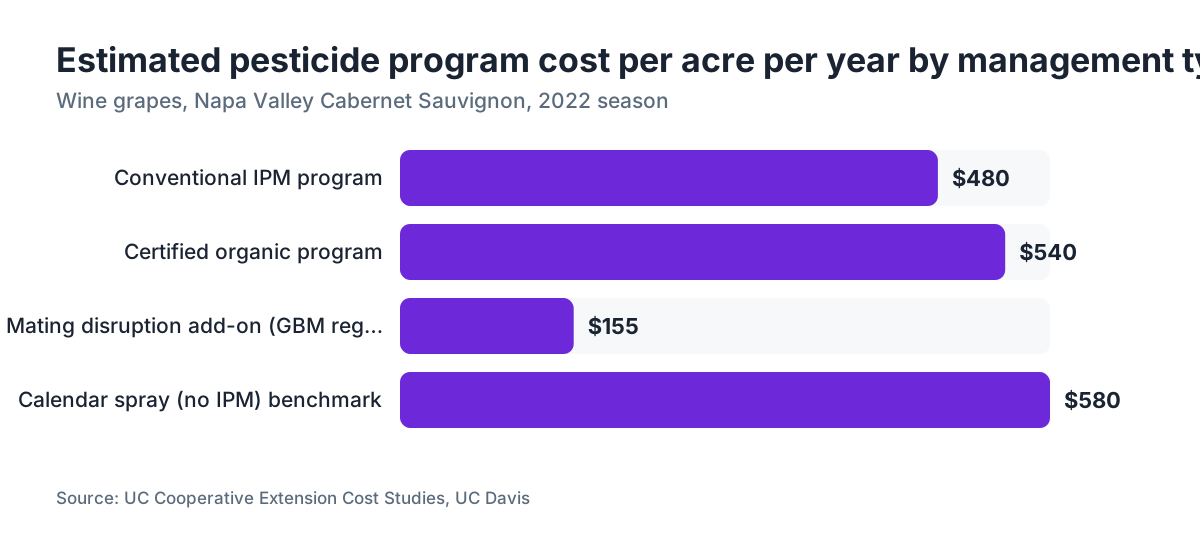
Organic programs often cost more on material inputs (sulfur at higher rates, more frequent passes) and less on restricted-material compliance. A UC cost study for Napa Valley Cabernet Sauvignon shows a conventional spray program near $480 per acre against roughly $540 for a certified organic program, a gap that narrows or flips depending on labor for the extra passes organic demands [11].
Mating disruption for grape berry moth adds $100 to $175 per acre upfront but can cut 3 to 5 insecticide applications over a season. Across three years, most Cornell-region growers find it cost-neutral to slightly positive [5].
Application equipment is a separate, large capital cost. A well-maintained airblast sprayer, calibrated every year, is the baseline. Calibration drives more than efficacy. It drives registration compliance: applying above the labeled rate is a violation, and applying below it can void the efficacy claims your pest management records lean on.
The hidden cost nobody talks about is resistance. A vineyard stuck on the same fungicide FRAC group for a decade may find the product no longer works at any legal rate. Remediation, meaning a jump to higher-cost chemistry and more passes, can add $100 to $200 per acre per season. That's what makes rotation worth following even in a light-pressure year.
Frequently asked questions
What is the most common pest in vineyards?
Powdery mildew (Erysiphe necator) is the most economically significant pest in most wine grape regions worldwide, capable of taking the whole crop on a susceptible variety without management. On the insect side, grape leafhopper dominates western U.S. vineyards while grape berry moth leads in the East. The right answer depends on your region, which is why local extension resources beat generalized pest guides every time.
How often should you scout a vineyard for pests?
At minimum, once a week during the growing season from bud swell through harvest. During bloom and bunch closure, go twice a week, because those windows carry the highest disease infection risk and the shortest window to act. For degree-day-driven pests like grape berry moth, weekly trap checks show you when adult flight peaks so you can time insecticide applications accurately instead of by calendar.
What's the difference between IPM and organic grape growing?
IPM is a decision-making framework that can use conventional chemistry. Organic certification restricts you to an approved materials list but doesn't require scouting or thresholds. The best programs combine both: organic or low-input chemistry chosen inside an IPM threshold framework. Plenty of conventional IPM growers make fewer synthetic applications per season than some certified organic operations, because threshold decisions kill off unnecessary sprays.
What records do I legally need to keep for vineyard pesticide applications?
Federal WPS requires records kept at least 2 years documenting product name, EPA registration number, active ingredient, amount applied, crop and location, date and time, and applicator's name. California additionally requires Pesticide Use Reports filed monthly with the county agricultural commissioner for restricted-materials applications. Organic certifiers and sustainable wine programs want more, including scouting records and threshold justification.
How do you manage powdery mildew resistance in vineyards?
Alternate FRAC groups every application and make no more than 2 to 3 consecutive applications of any single FRAC group per season. Sulfur is your safety net because it carries no known resistance in Erysiphe necator populations. Run your DMI (Group 3) and QoI (Group 11) fungicides as limited rotational partners, not as the backbone. UC and regional resistance monitoring data show where specific FRAC groups are losing field efficacy near you.
What are the Worker Protection Standard requirements for vineyard spray crews?
Every agricultural worker needs WPS safety training before working in treated areas, valid for 5 years. Handlers need annual training. Restricted Entry Intervals on each label must be observed, with warning signs posted. Airblast applications require a 100-foot Application Exclusion Zone when wind exceeds 10 mph, or 25 feet at or below 10 mph. No workers in the AEZ during application. Records stay for 2 years and available for inspection.
Is mating disruption worth the cost for grape berry moth?
In most eastern U.S. vineyards with steady berry moth pressure, yes. Pheromone dispensers run $100 to $175 per acre installed, but Cornell's research shows greater than 80% reduction in berry damage versus untreated vines. Over a season, that typically offsets 3 to 5 insecticide applications. The break-even math is clean in moderate to high-pressure blocks. In blocks with historically low trap catches, the case gets weaker.
Can you manage Pierce's disease with fungicides or insecticides?
No fungicide touches Pierce's disease because it's bacterial, not fungal. Management is vector-based: cutting sharpshooter populations around susceptible vines with insecticides, removing infected vines immediately to eliminate the bacterial reservoir, and planting PD-tolerant varieties on high-risk sites. There is no cure for infected vines. UC Davis's Pierce's disease research and outreach effort publishes current management guidance and tracks resistance in GWSS populations.
What's the best way to reduce Botrytis without more fungicide applications?
Canopy management is the strongest lever you have. Aggressive shoot positioning, leaf removal in the cluster zone at fruit set or just after, and spur thinning to open crowded clusters all cut the humidity and contact conditions Botrytis needs. A low-nitrogen fertility program that limits runaway shoot growth helps too. Fungicides layered on good canopy work far outperform chemistry alone on a dense canopy.
What extension programs have the best vineyard IPM resources?
UC's Statewide IPM Program (UC IPM Online at ipm.ucanr.edu) covers California conditions with the most detailed threshold and chemistry data available. Cornell Cooperative Extension covers the Northeast, with real depth on grape berry moth and downy mildew through the NEWA platform. WSU Extension at Prosser covers the Pacific Northwest. All three publish annual pest management guides with current resistance data and regional spray timing. Start with the one matching your geography.
How do cover crops affect vineyard pest management?
Cover crops cut both ways. They can shelter beneficial predators that suppress mites and leafhoppers, trimming your insecticide needs. But flowering cover crops in bloom during a spray create pollinator exposure risk. Dense cover crops also raise humidity at the vine base, which can push Botrytis pressure up in tight-canopy blocks. The outcome depends on species, mowing timing, and how you fold them into the spray program.
Do vineyard pest management requirements differ for USDA Organic certified operations?
Yes. USDA NOP certification restricts you to materials on the National List of Allowed and Prohibited Substances. For vineyards, that includes sulfur, copper, Bt, spinosad, kaolin clay, and certain biological fungicides. Synthetic fungicides, most synthetic insecticides, and soluble synthetic fertilizers are prohibited. Your spray records must document the organic materials used, and your certifier may require proof you're sourcing certified-organic planting material. WPS and state record rules still apply on top of NOP.
What is the Application Exclusion Zone for vineyard airblast sprayers?
Under the revised EPA Worker Protection Standard, outdoor airblast applications require a 100-foot Application Exclusion Zone in all directions when wind speed is above 10 mph. When wind is at or below 10 mph, the AEZ is 25 feet. No worker other than the handler can be in that zone during application. Failing to maintain the AEZ is a WPS violation enforceable by EPA or the state lead agency.
How should I handle pesticide resistance that's already developed in my vineyard?
First, confirm it through a regional resistance monitoring program rather than assuming it from a spray failure. Product degradation, timing errors, and poor coverage can all look like resistance. If it's confirmed, pull the affected FRAC or mode-of-action group from your program for at least one season. Switch to different modes of action and add cultural practices (canopy management, sanitation) to lower pathogen pressure so you lean on chemistry less. Call your local extension specialist for current regional data.
Sources
- UC IPM Online, UC Statewide IPM Program, University of California: Powdery mildew can cause total crop loss in susceptible varieties without management; UC thresholds for leafhopper and mite pests; sulfur efficacy and heat limitations; scouting sampling protocols; Pierce's disease vector management
- UC Cooperative Extension, UC Davis, Grape Pest Management (3rd ed.): Botrytis bunch rot infection conditions and fungicide resistance patterns; DMI and QoI resistance in Erysiphe necator populations; Botrytis management thresholds; leafroll virus yield and Brix losses
- U.S. EPA, Integrated Pest Management (IPM) Principles: EPA definition of IPM as 'an effective and environmentally sensitive approach to pest management that relies on a combination of common-sense practices'
- Washington State University Extension, Viticulture and Enology: WSU IPM protocols for Pacific Northwest vineyards including Botrytis, powdery mildew, and leafroller thresholds; copper use guidance aligned with EU 4 kg/ha/year cap context; WSDA restricted pesticide record requirements
- Cornell Cooperative Extension, Integrated Pest Management Program: Grape berry moth degree-day thresholds and mating disruption efficacy (greater than 80% damage reduction); Botrytis and downy mildew management for northeastern U.S.; NEWA platform for real-time degree-day models
- U.S. EPA, Imidacloprid Pollinator Risk Assessment: EPA review finding that imidacloprid poses risk to pollinators at foliar use rates on blooming crops
- U.S. EPA, Pesticide Registration and Labeling, 40 CFR Part 156: Under 40 CFR Part 156, the pesticide label is a legal document; applications contradicting the label are federal violations
- U.S. EPA, Worker Protection Standard, 40 CFR Part 170: WPS requirements including REIs, worker and handler training frequencies, Application Exclusion Zone dimensions for airblast sprayers, and 2-year record retention requirement
- California Department of Pesticide Regulation, Pesticide Use Reporting: California requires monthly Pesticide Use Reports to county agricultural commissioners for restricted-materials applications, with specific data fields beyond federal WPS requirements
- USDA National Agricultural Statistics Service, Organic Survey: Tens of thousands of acres of certified organic grapes in the U.S. per the USDA Organic Survey, with California holding the large majority of the national total
- UC Cooperative Extension, Sample Costs to Establish a Vineyard and Produce Wine Grapes, Napa County: UC cost studies show conventional spray programs at approximately $480 per acre and certified organic programs at approximately $540 per acre in Napa Valley Cabernet Sauvignon production; conventional programs run $200 to $600 per acre per year by region
- USDA National Organic Program, National List of Allowed and Prohibited Substances: NOP allows sulfur, copper, Bt, spinosad, and kaolin clay for certified organic vineyards while prohibiting synthetic fungicides and most synthetic insecticides
Last updated 2026-07-09