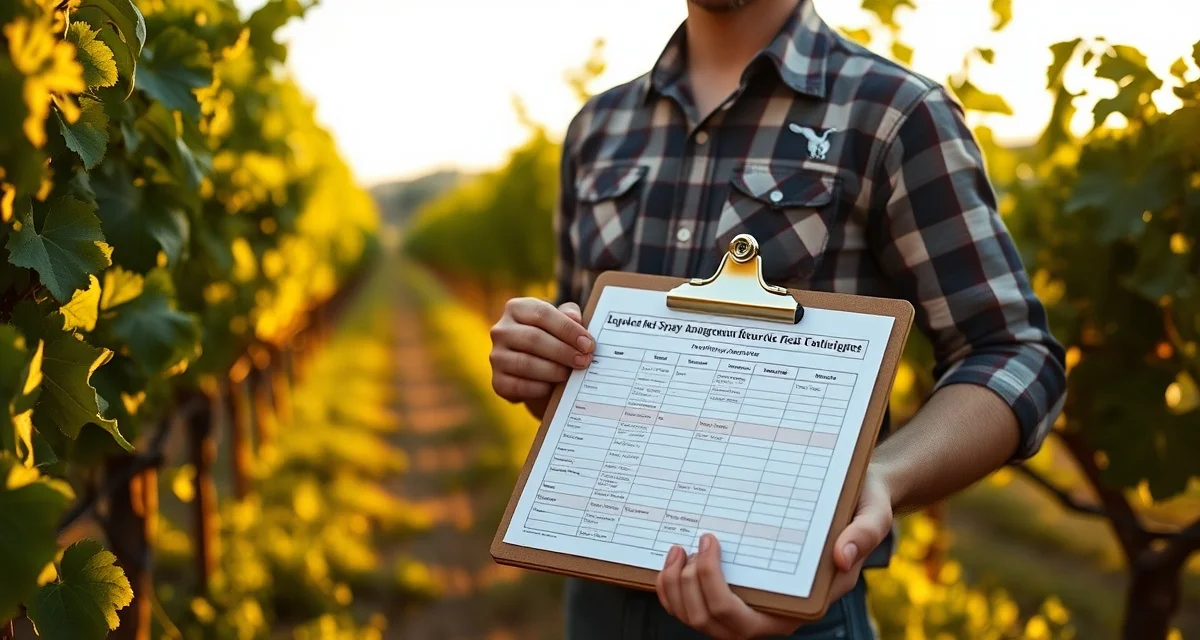
Oregon Vineyard Spray Log Template -- ODA Compliant
Oregon ODA requires restricted use pesticide reports within 7 days of application. This template covers all required fields for compliant Oregon vineyard spray records.
TL;DR
- Oregon ODA requires restricted-use pesticide reports within 7 days of the application date -- the 7-day window is measured from the application date, not the end of the week; an application on Monday the 1st must have a complete record by Monday the 8th; batch record-keeping that slips during vacations or equipment failures can push you outside the window
- Only restricted-use pesticide applications require ODA reporting within 7 days; general-use pesticides (including most sulfur and copper fungicides common in Oregon vineyards) do not require ODA reporting but should be documented for winery buyer and organic certifier requirements
- Oregon ODA requires RUP application records retained for 2 years; CCOF-certified operations require 5-year retention under USDA NOP standards -- plan around the longer certification requirement if you are CCOF-certified
- Oregon distinguishes between certified pesticide applicators and pesticide operators; commercial applicators applying for hire need a commercial license regardless of product classification, while general-use pesticides on your own property do not require a license for personal use
- PHI and REI documentation are not specifically required by ODA but are essential for winery buyer compliance and organic certifier requirements; these should be standard fields in every Oregon vineyard spray record regardless of regulatory mandate
- VitiScribe's Oregon ODA template tracks the 7-day reporting window per application event and flags records approaching the filing deadline, preventing inadvertent late filings during high-activity spray periods
Oregon ODA Required Fields
Applicator Information
- Name and address of certified applicator or pesticide operator
- License or certificate number (current as of application date)
Application Details
- Application date
- Location of application (farm name, property address, or legal description)
- Commodity treated (wine grapes, note variety for your own records)
- Pest(s) treated
- Product name (as it appears on the label)
- EPA registration number
- Total amount of product applied
- Area treated (acres)
- Application method
PHI and REI Documentation (best practice, not required by ODA but essential for compliance)
- PHI from product label
- REI from product label
- PHI completion date
Oregon-Specific Notes
Oregon distinguishes between restricted use and general use pesticides. Only RUP applications require ODA reporting. However, you should maintain records for all pesticide applications, your winery buyer and organic certifier will ask for them.
The 7-day reporting window is measured from the application date. If you apply on Monday the 1st, records must be complete by Monday the 8th. Don't let weekly batch record-keeping put you at the edge of the window, a vacation or equipment failure can push you over.
Using This Template Digitally With VitisScribe
VitisScribe's Oregon ODA template includes all required fields with license number storage for your registered applicators. The 7-day window is tracked per application event. Block GPS coordinates auto-fill the location field.
Pricing starts at $49/month for up to 25 acres, typical for a small Willamette Valley block-level operation.
Related Articles
- Missouri Vineyard Spray Log Template -- MDA Compliant
- New Mexico Vineyard Spray Log Template -- NMDA Compliant
- New York Vineyard Spray Log Template -- DEC Compliant
FAQ
What pesticides require ODA reporting in Oregon vineyards?
Only restricted use pesticides require reporting to ODA within 7 days. General use pesticides, which includes most sulfur and copper fungicides commonly used in Oregon vineyards, don't require ODA reporting but should be documented for your own records and certifier requirements.
Do I need a license to apply all pesticides in Oregon vineyards?
You need an Oregon pesticide applicator certificate or license to apply restricted use pesticides. General use pesticides don't require a license for personal use on your own property, but commercial applicators applying for hire need a commercial license regardless of product classification.
How long must Oregon vineyard spray records be retained?
Oregon ODA requires RUP application records for 2 years. Keep general use records for at least 2 years as well -- your certifier or winery buyer may request them. If you're CCOF-certified, 5 years of records are required.
Can VitiScribe generate Oregon ODA-compliant spray records for Willamette Valley operations?
Yes. VitiScribe's Oregon compliance profile generates ODA-formatted records for all pesticide applications, tracking the 7-day RUP reporting window per application and flagging records approaching the deadline. Willamette Valley block setup includes GPS coordinates that auto-fill the location field for each spray record. The product library pre-populates PHI and REI from label data for all ODA-registered products, covering both the RUP products that require ODA reporting and the general-use fungicides and sulfur applications that don't require ODA reporting but need documentation for winery buyers. For the full Oregon compliance context including ODA reporting and Willamette Valley IPM considerations, see Oregon vineyard management software.
What records do Oregon winery buyers typically require beyond ODA-mandated fields?
Oregon winery buyers sourcing fruit from Willamette Valley and Rogue Valley vineyards frequently require complete spray records for all pesticide applications -- including general-use materials that ODA doesn't require to be reported. Many buyers request spray records covering the full growing season organized by block, with PHI clearance dates confirmed for all products applied within 30 days of harvest. Some buyers with sustainability programs (including Biodynamic, LIVE Certified, or organic sourcing requirements) also require FRAC rotation records showing mode-of-action diversity across the season. VitiScribe's Oregon records can be exported in block-by-block format with PHI clearance status and FRAC rotation summary for buyer submission.
What is Oregon Vineyard Spray Log Template -- ODA Compliant?
[FAQ_ANSWER_PLACEHOLDER: This answer needs to be generated by AI with specific data, examples, and actionable advice relevant to Oregon Vineyard Spray Log Template -- ODA Compliant. Target 50-150 words.]
How much does Oregon Vineyard Spray Log Template -- ODA Compliant cost?
[FAQ_ANSWER_PLACEHOLDER: This answer needs to be generated by AI with specific data, examples, and actionable advice relevant to Oregon Vineyard Spray Log Template -- ODA Compliant. Target 50-150 words.]
How does Oregon Vineyard Spray Log Template -- ODA Compliant work?
[FAQ_ANSWER_PLACEHOLDER: This answer needs to be generated by AI with specific data, examples, and actionable advice relevant to Oregon Vineyard Spray Log Template -- ODA Compliant. Target 50-150 words.]
Sources
- Oregon Department of Agriculture (ODA)
- EPA Worker Protection Standard
- Oregon State University Extension Viticulture
- LIVE (Low Input Viticulture and Enology)
- USDA National Organic Program (NOP)
Get Started with VitiScribe
Oregon's 7-day RUP reporting window is the tightest per-application filing requirement outside California's 24-hour rule -- and unlike California's digital timestamp enforcement, Oregon records can slip past the window during busy spray periods without a tracking system in place. VitiScribe's Oregon ODA template tracks the 7-day window per application event and generates ODA-formatted exports for your full spray log. Try VitiScribe free and file your first Oregon-compliant RUP record today.