Adjuvant addition documentation in vineyard tank mix records

TL;DR
- Every adjuvant added to a vineyard tank mix needs its own record entry: product name, EPA registration number (or exemption status), rate per acre or per 100 gallons, and the date and operator.
- EPA's Worker Protection Standard at 40 CFR Part 170 requires spray records be kept two years.
- Many growers skip adjuvant documentation entirely.
- Those gaps cost you during a state inspection.
Why do adjuvants need to be in your spray records at all?
Most vineyard managers are careful about recording the fungicide or herbicide in a tank mix. The adjuvant, though, gets treated as an afterthought. Something like dish soap or a spray sticker, in the tank but never on the page. That's a compliance gap.
The EPA Worker Protection Standard requires that application records include "each pesticide product applied, including the EPA registration number or the claimed exemption." Adjuvants that carry a pesticidal claim, such as spreader-stickers that explicitly claim enhanced pesticide uptake, almost always carry an EPA registration number and fall under that requirement [1]. Adjuvants that are inert and carry no pesticidal claim, like many crop oils, may be exempt under FIFRA Section 25(b). You still need to know which category your product falls into before you decide to skip recording it.
Beyond EPA minimums, your state department of agriculture may go further. California's Department of Pesticide Regulation requires a separate line entry for each product in a tank mix under county agricultural commissioner reporting rules [2]. Washington's pest management rules echo this. If you operate under a certified crop adviser, or you sell to a winery with third-party certification requirements (CCOF, SCS Global, Lodi Rules), your program standards likely require adjuvant documentation too.
The practical reason is simpler. If a worker has a chemical exposure incident and you can't produce a complete tank mix record, you have no way to show what was in the sprayer. That's a legal liability and a safety problem at the same time.
What information is legally required in a vineyard spray record?
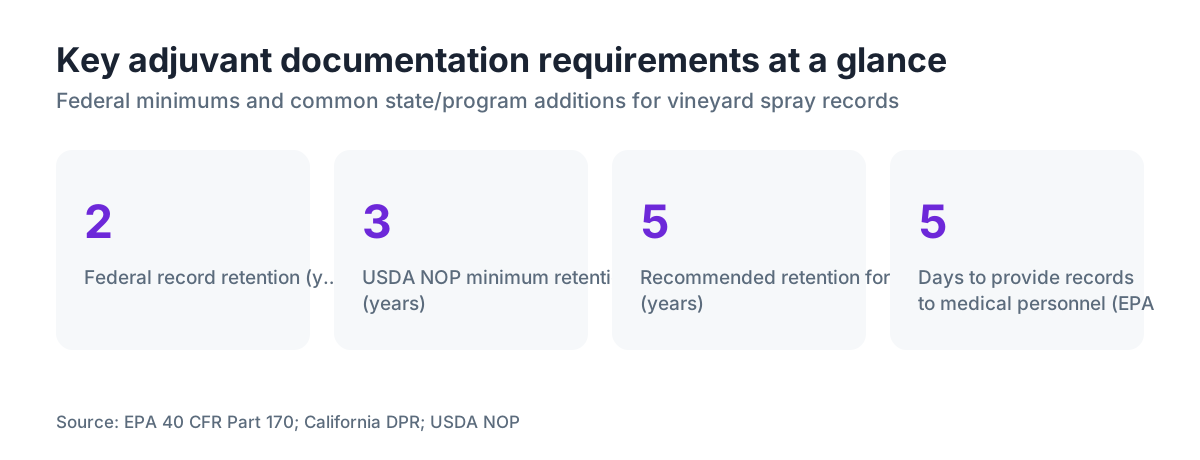
Federal minimum requirements under 40 CFR Part 170 (EPA Worker Protection Standard) apply to any pesticide used in an agricultural setting. For each application you need the date, product name and EPA registration number, rate applied, location (block or field), total amount applied, and the applicator's name [1]. These records must be kept for two years and be available to a treating medical professional within five business days of a request.
For adjuvants specifically, the required fields map like this:
| Field | Registered adjuvant | 25(b)-exempt adjuvant |
|---|---|---|
| Product name | Required | Best practice |
| EPA reg. number | Required | N/A (note exemption) |
| Rate (oz or fl oz / 100 gal, or per acre) | Required | Best practice |
| Lot or batch number | Not federally required | Not required |
| Purpose (spreader, pH modifier, etc.) | Not required | Best practice |
| Operator initials | Required (part of full record) | Required |
California mandates the most detailed records of any state. DPR's county reporting system requires the volume of water used, the acreage treated, and a line item for every product in the tank mix, adjuvants included [2]. WSU's pesticide safety education program similarly recommends recording adjuvant rates as part of a defensible spray log, especially for tree fruit and viticulture operations in the Pacific Northwest [3].
Selling grapes to a premium winery? Check the purchase agreement. Winery buyers increasingly require spray records to include all tank mix components because their own certifications depend on it.
How do you record an adjuvant that has no EPA registration number?
This is where a lot of growers get confused. FIFRA Section 25(b) allows certain minimum-risk pesticide ingredients to be sold without EPA registration. Many adjuvants, crop oils, some pH buffers, and some drift retardants fall into this category [4].
When you use a 25(b)-exempt adjuvant, the right move is to note the exemption status directly in your spray record. Something like "crop oil concentrate, 25(b) exempt, 1 qt / acre." That notation shows an auditor you knew the product's regulatory status. It beats a blank line every time.
For adjuvants that claim no pesticidal activity and are sold purely as inert ingredients (think plain acidifying agents or antifoam agents with no active ingredient), FIFRA generally doesn't require registration. Record the product name and rate anyway. You need that information if there's ever a question about tank residue, worker exposure, or food safety.
One practical check: read the label. If it says "for use as an adjuvant with registered pesticides" and lists an EPA registration number in the format XXXXX-XXXXX, it's a registered product. Record it exactly like you would a fungicide. If there's no EPA number and the label says "inert" or cites 25(b), note that instead.
What are the most common adjuvant documentation mistakes vineyard managers make?
The number one mistake is not recording adjuvants at all. Many spray record templates, including old paper forms passed around between operations, only have fields for the primary pesticide. Growers fill in those fields and figure the job's done.
The second most common mistake is recording the wrong rate. Adjuvant labels give rate as oz per 100 gallons, or as a percentage of total spray volume, or as oz per acre at a given water volume. These are not interchangeable. If your record says "1 quart" with no denominator, it's uninterpretable and nearly useless in an audit or an exposure investigation.
Third: not updating records when a mid-season tank mix change happens. Switch from one spreader-sticker to another because your supplier ran out? That needs to be in the record. A lot of managers write the season's planned inputs in January and never revisit the log when substitutions happen in July.
Fourth, and this one is subtle. Recording the trade name only, without the EPA registration number. Trade names change. Products get reformulated or rebranded. An inspector looking at a record from two years back who sees a product name they can't find in any database has no way to verify what was actually applied. The registration number is the stable identifier.
UC Davis's Integrated Viticulture program has noted in spray record guidance that incomplete adjuvant records are a recurring deficiency in DPR compliance audits, particularly among smaller operations with fewer than 50 acres [5].
How should a tank mix record be structured to include adjuvants properly?
A well-built tank mix record has a header section for the date, block ID, target pest or disease, operator, equipment ID, and weather conditions. Below that is a line-item table where every product in the tank gets its own row.
For each product, the row should capture: product name, EPA registration number (or exempt notation), amount per unit (oz per 100 gal or oz per acre), total amount mixed for that load, and the load volume. If you run multiple loads on the same day in the same block, either record each load separately or note the number of loads and total volume.
A sample line-item table for a tank mix might look like this:
| Product | EPA Reg. # | Rate | Amount this load | Notes |
|---|---|---|---|---|
| Pristine WG (pyraclostrobin/boscalid) | 7969-235 | 14.5 oz / acre | 43.5 oz | Powdery mildew |
| Silwet L-77 | 33197-14 | 0.1% v/v | 12.8 fl oz | Organosilicone spreader |
| Nu-Film-P | 25(b) exempt | 16 fl oz / 100 gal | 8 fl oz | Rainfastness |
| Buffer-pHix | Inert only | 8 fl oz / 100 gal | 4 fl oz | pH 5.5 target |
That structure makes it clear what was in the tank, at what rate, and why. Any auditor, any medical professional, any winery quality manager can read it without calling you.
For paper records, Cornell's viticulture program offers a downloadable spray record template with separate adjuvant lines built in [6]. WSU's tree fruit spray record form, while aimed at a different crop, uses the same structure and adapts easily to vineyard use [3]. For digital records, platforms like VitiScribe let you build a custom tank mix template that requires adjuvant entries before a record can be saved, which kills the "I forgot" problem entirely.
Does documenting adjuvants matter for organic or certified sustainable vineyards?
More than for conventional operations, honestly. Farming under USDA National Organic Program certification means every input applied to a certified field must be on your approved materials list, and your certifier reviews spray records during the annual inspection. An adjuvant that isn't on your approved list, or that you used without recording, can trigger a notice of noncompliance or, in serious cases, loss of certification.
The USDA NOP requires that organic system plans include all materials used in production, including spray adjuvants [7]. Your certifier doesn't just take your word for it. They cross-reference your spray records against your input receipts. Buy a silicone spreader that isn't OMRI-listed, use it on a certified block, and let it show up in your records? That's a problem. Use it and fail to record it? That's a worse problem when it surfaces another way.
Lodi Rules for Sustainable Winegrowing and other third-party programs take a similar position. Their audits look at the completeness of spray records, and incomplete adjuvant documentation counts against your score.
For organic operations, the rule is short. If it went into the tank, it goes in the record. Then verify separately that everything in your records sits on your approved input list before the certifier shows up.
How long do you need to keep adjuvant documentation?
The federal floor is two years. EPA WPS at 40 CFR 170.130(c)(2) requires that application records be retained for two years following the application [1]. That applies to all tank mix components.
Several states go longer. California DPR requires county pesticide use reports and supporting records be kept for two years from the date of application, which matches the federal floor, but individual county agricultural commissioners can request records at any time during an investigation without a time limit [2]. In practice, many California operations keep records for five years.
Farming under USDA NOP? Your certifier will want at least three years of records to verify a transition period or audit ongoing compliance [7]. Some certifiers ask for five.
For a winery purchase agreement, check the contract language. Premium California and Oregon wineries have started including clauses that require grape growers to retain spray records for three years and produce them on request.
The honest answer is five years. Keep everything. Storage is cheap. The cost of not being able to produce a record when someone asks for it is not.
What happens if an adjuvant application isn't recorded and there's a worker exposure incident?
This is where the stakes get real. Under EPA WPS 40 CFR 170.130(d), if a worker or handler is injured or becomes ill from a pesticide exposure, the employer must make application information available to medical personnel treating that person within five business days [10]. The treating physician needs to know what the person was exposed to in order to provide the right care.
If your spray record leaves out the adjuvant and a worker has a skin or respiratory reaction to a surfactant in the mix, the physician is working blind. Some adjuvants, particularly certain organosilicone surfactants, are known dermal and ocular irritants. Omitting them from the record isn't just a paperwork issue.
From a liability standpoint, an incomplete record in the context of a worker injury can be used to demonstrate negligence. Courts and state labor agencies don't require proof that the missing information would have changed the outcome. They look at whether you met your duty to maintain complete records.
California's agricultural labor enforcement history shows that incomplete pesticide records are among the most frequently cited violations in DPR field investigations. Civil penalties for WPS record-keeping failures run from a few hundred dollars per violation for first offenses to several thousand dollars per violation for repeat violations, according to DPR's published penalty schedule [2].
Are there digital tools that make adjuvant documentation easier?
Paper forms work fine if they're built correctly and filled out completely. That second part is where paper fails in practice. A form that doesn't require a value in the adjuvant field doesn't prompt anyone to fill it in.
Digital spray record systems solve this with required fields. Build your tank mix template so the system won't submit a record without at least one adjuvant line, or without marking "no adjuvant used," and you eliminate the most common failure mode. You also get searchability. Want to pull all records where Silwet L-77 was used last season? That's a two-second query instead of flipping through binders.
Look for a system that stores the EPA registration number in a product library so operators don't re-enter it every time. Operator error on registration numbers is common when someone is hand-typing from a label in the field. A product library populated once, with verified numbers, removes that risk.
VitiScribe is built for vineyard compliance record-keeping, with tank mix templates that include adjuvant fields as a standard part of the record structure. If you're managing more than one block or coordinating records across a team, the structured digital format is worth a look. You can start a trial at vitiscribe.com.
For growers not ready to go digital, Cornell's and UC Davis's extension programs both offer downloadable paper templates that include adjuvant documentation sections [5][6].
How do you document adjuvant rates accurately when the label gives different units?
This is a real operational headache. Adjuvant labels express rates in several different ways, and converting between them mid-season while you're calibrating a sprayer isn't always intuitive.
Common rate expressions on adjuvant labels:
- Percentage of total spray volume (e.g., 0.1% v/v)
- Ounces per 100 gallons of spray solution
- Pints or quarts per acre
- Pounds per acre (for dry adjuvants)
The safest approach is to document both the label rate as written and the actual amount added to the tank for that specific load. So if the label says 0.1% v/v and you mixed a 300-gallon load, record "0.1% v/v per label; 38.4 fl oz added to 300-gal load." That gives anyone reading the record enough to verify the rate and reconstruct the exposure concentration if needed.
When a DPR inspector or a winery auditor reviews your spray records, the question they're asking is: could I verify what was in this tank from this record alone? If the answer is yes, your documentation is good. If they'd have to call you and ask clarifying questions, the record needs more detail.
WSU's pesticide safety education program publishes rate conversion references covering the most common adjuvant label formats, worth having posted in your equipment barn [3].
What should you do if you discover past spray records are missing adjuvant documentation?
Don't alter old records. Adding information to a completed spray record after the fact, especially to pass an upcoming audit, creates a worse problem than the original gap. Altered records can constitute falsification of government-required documents under state and federal law.
What you can do is create a supplementary note attached to the original record. Document what you know from other sources: purchase receipts, tank mix worksheets, equipment logs, or the applicator's memory. Date that note accurately (the date you're writing it, not the date of the original application) and attach it to the original. This shows good faith and transparency without touching the underlying record.
Going forward, the fix is structural. Revise your record template to require adjuvant documentation. Train whoever fills out the records on why it matters. If you're using paper, add a checkbox at the bottom of each record: "All tank mix components including adjuvants are recorded above." That small friction point catches the most common oversight.
Facing a DPR inspection or audit with known gaps? Talk to your county agricultural commissioner's office before the inspection if you can. Voluntary disclosure of record-keeping deficiencies is treated more favorably than deficiencies found during inspection, in most states. That's not legal advice, but it's how the ag commissioner system works in practice in California.
Frequently asked questions
Do I have to record adjuvants in my vineyard spray log?
If the adjuvant carries an EPA registration number, yes, federal law under 40 CFR Part 170 requires it. If it's a 25(b)-exempt or inert product, it may not be legally required at the federal level, but California, Washington, and most third-party certification programs require complete tank mix documentation. Best practice is to record every product that goes into the tank, regardless of regulatory category.
What EPA registration number format should I use when recording an adjuvant?
EPA registration numbers follow the format XXXXX-XXXXX (registrant number, then product number), sometimes with a third segment for distributor products. Find it on the product label, usually near the "EPA Reg. No." line. Copy it exactly. That number is the stable identifier linking your record to the specific product formulation, even if the trade name changes over time.
How long do vineyard spray records with adjuvant documentation need to be kept?
The federal minimum under EPA WPS is two years from the date of application. California DPR matches that minimum, but records can be requested during any active investigation. USDA NOP organic certification requires at least three years. Most legal and insurance advisors recommend five years. Storage is inexpensive; not having a record when someone needs it is costly.
Are crop oils and horticultural oils subject to the same documentation rules as fungicides?
It depends on what the product claims on its label. Crop oils sold with a pesticidal efficacy claim (enhanced pesticide penetration, insecticidal activity) typically carry an EPA registration number and must be documented like any other registered pesticide. Plain petroleum-based or plant-based oils sold only as spray carriers with no pesticidal claim may be 25(b)-exempt or unregistered inerts. Check the label for an EPA registration number.
What does a 25(b)-exempt adjuvant mean, and how do I document it?
FIFRA Section 25(b) exempts certain minimum-risk pesticide ingredients from registration requirements. Many adjuvants, including some crop oils and plant-based surfactants, qualify. When you use one, note in your spray record: product name, "25(b) exempt" in place of the EPA registration number, and the rate applied. That notation tells any auditor you knew the product's regulatory status rather than just leaving the field blank.
Can I use the same spray record form for adjuvants and pesticides?
Yes, and that's the recommended approach. Use a single tank mix record with a line-item table where each product in the mix gets its own row. Include product name, EPA registration number or exemption status, rate, and quantity per load. Keeping everything on one record makes it clear what was in the tank for that application, which is what both regulators and medical personnel need.
What happens during a DPR inspection if my adjuvant records are incomplete?
California DPR and county agricultural commissioners can issue a notice of violation for incomplete pesticide use records. Civil penalties for WPS record-keeping violations range from a few hundred dollars for first offenses to several thousand dollars per violation for repeat offenses, according to DPR's published penalty schedule. More practically, incomplete records make it harder to defend yourself if a worker exposure claim is filed.
Do organic vineyard adjuvants have additional documentation requirements?
Yes. Under the USDA National Organic Program, every input applied to a certified field must be listed in your approved organic system plan and verifiable in your spray records. Your certifier cross-references records against your input receipts during annual inspection. If an adjuvant appears in your records but isn't on your approved materials list, that's a noncompliance finding, regardless of whether the product is OMRI-listed.
Should I record the adjuvant lot number or batch number in my spray records?
Federal and most state rules don't require lot numbers for adjuvants. But recording the lot number is good practice if you're farming under a food safety program (like the FSMA Produce Safety Rule), if the product is OMRI-listed and your certifier asks for it, or if you need to track a specific batch due to a quality issue. It takes one second and gives you traceability if a problem surfaces later.
How do I document an adjuvant added mid-application when conditions change?
If you add an adjuvant mid-application (for example, a drift retardant when wind picks up during a second pass), note it as an amendment to the record: time of addition, product, rate, and load number. Some growers add a notes field to their standard record for exactly this kind of change. The key is that the final record reflects what was actually in every load, more than what was planned at the start.
Do winery purchase contracts typically require adjuvant documentation from growers?
Increasingly, yes. Premium winery buyers, particularly those with third-party sustainability or organic certification, include spray record clauses in grape purchase agreements that require complete tank mix documentation including adjuvants. Some contracts specify a retention period of three to five years. Review your purchase agreement's spray record language before the season starts, not after an audit request arrives.
What's the difference between an adjuvant and an inert ingredient for record-keeping purposes?
An adjuvant is any substance added to a pesticide mix to improve performance: spreaders, stickers, penetrants, buffers, drift retardants. An inert ingredient is a component of a pesticide product formulation that has no pesticidal activity. For record-keeping, registered adjuvants (with an EPA number) are treated like registered pesticides. Inerts in a formulation are already covered by the primary pesticide's record. Standalone inert products used as tank additives fall in a gray area; record them anyway.
Sources
- EPA, Worker Protection Standard for Agricultural Pesticides, 40 CFR Part 170: Application records must include each pesticide product's EPA registration number or claimed exemption, and records must be kept for two years.
- California Department of Pesticide Regulation, Pesticide Use Reporting: California DPR requires a line entry for each product in a tank mix, including adjuvants, in county pesticide use reports, and civil penalties for record-keeping violations range from hundreds to thousands of dollars per violation.
- Washington State University, Pesticide Safety Education Program: WSU's pesticide safety program recommends recording adjuvant rates as part of a defensible spray log for tree fruit and viticulture operations, and provides rate conversion references for common adjuvant label formats.
- EPA, FIFRA Section 25(b) Minimum Risk Pesticides: FIFRA Section 25(b) allows certain minimum-risk pesticide ingredients to be sold without EPA registration, covering many adjuvants including some crop oils and plant-based surfactants.
- Cornell University, Grapes and Wine, Cornell CALS: Cornell's viticulture program offers downloadable spray record templates with dedicated adjuvant documentation lines.
- USDA Agricultural Marketing Service, National Organic Program: USDA NOP requires that organic system plans include all materials used in production including spray adjuvants, and certifiers verify spray records against input receipts during annual inspection, requiring at least three years of records.
- EPA, Pesticide Registration: EPA registration numbers follow the format XXXXX-XXXXX (registrant number then product number) and are the stable identifier linking a spray record to a specific product formulation.
- U.S. FDA, Food Safety Modernization Act (FSMA): Food safety programs under FSMA may prompt growers to retain lot numbers and input traceability information beyond what pesticide regulations require.
- EPA, Agricultural Worker Protection Standard, Application Records, 40 CFR 170.130: Under 40 CFR 170.130(d), if a worker is injured from pesticide exposure, the employer must make application information available to treating medical personnel within five business days.
Last updated 2026-07-09