Herbicide application records near vineyard waterways and buffer documentation

TL;DR
- Federal law and most state pesticide codes require certified applicators to log restricted-use applications and keep them for two years.
- Buffer zones near water run from 25 to 300 feet depending on the label and local rules.
- Missing records trigger fines up to $5,500 per day and can cost you your license.
- Here's what to document and what inspectors check.
What federal law requires for pesticide application records near water
The floor is set by two federal frameworks: the EPA's Worker Protection Standard and the Federal Insecticide, Fungicide, and Rodenticide Act. Under FIFRA Section 8, certified applicators must keep records of restricted-use pesticide (RUP) applications for two years. [1] Each record has to show the date, product name, EPA registration number, total amount applied, crop treated, and the name of the certified applicator. States pile stricter rules on top, and most do.
General-use herbicides are different. FIFRA doesn't force federal record-keeping on private applicators for those products. Here's the catch. The product label is a legal document under FIFRA, and nearly every herbicide label with buffer language near water makes that buffer binding the moment you crack the jug. "The label is the law" is the EPA's own shorthand. Ignore a 50-foot waterway buffer printed on the label and you've committed a violation, not entered a gray area.
The 2015 revised WPS also requires that application-specific information be posted at a central location workers can reach, and it has to stay up for 30 days after each application. [2] You might think you're exempt because nobody on your crew mixes, loads, or applies. You're not. The moment someone could enter a treated area, the posting requirement kicks in. Near waterways, where drift and runoff risk climb, inspectors read this record more closely.
One practical note. FIFRA records are open to inspection by the EPA, your state lead agency, and in many states, county agricultural commissioners. Advance notice isn't guaranteed. Keep the file current.
What do state regulations add to federal herbicide buffer requirements?
A lot. California, Washington, and New York, the three biggest grape states, all reach past the FIFRA minimums, and the gaps between them will trip you up if you move product knowledge across state lines.
California goes furthest. The Department of Pesticide Regulation (CDPR) requires that all pesticide use, not only restricted-use products, be reported to the county agricultural commissioner within one month of each application. [3] The report needs the pesticide product, EPA registration number, amount used, acres treated, and application method. For operations near water, the California Department of Fish and Wildlife can invoke Section 1602 of the Fish and Game Code when an application might substantially affect a stream or river bed, which triggers a Streambed Alteration Agreement. That's a separate permit sitting on top of your spray records.
Washington requires certified applicators to keep RUP records for two years under WAC 16-228-1250. [4] The Washington State Department of Agriculture (WSDA) also runs a Pesticides Near Water program that maps "restricted use areas" where extra buffers apply, sometimes running 100 feet or more past what the label demands. If your vineyard sits inside a mapped zone, the WSDA distance overrides the label minimum.
New York is blunter still. Under NYSDEC Part 325 regulations, most herbicides can't be applied within 100 feet of a water body without a permit, no matter what the label says. [5] That's a flat buffer stacked on the EPA registration. Cornell Cooperative Extension has documented that many New York growers didn't know the rule existed until enforcement found them. The distance between label compliance and state compliance is real money.
The practical move: pull your state lead agency's current regulations every season. Labels get amended, state rules shift, and what passed inspection two years ago can fail today.
How do herbicide label buffer zones near water actually work?
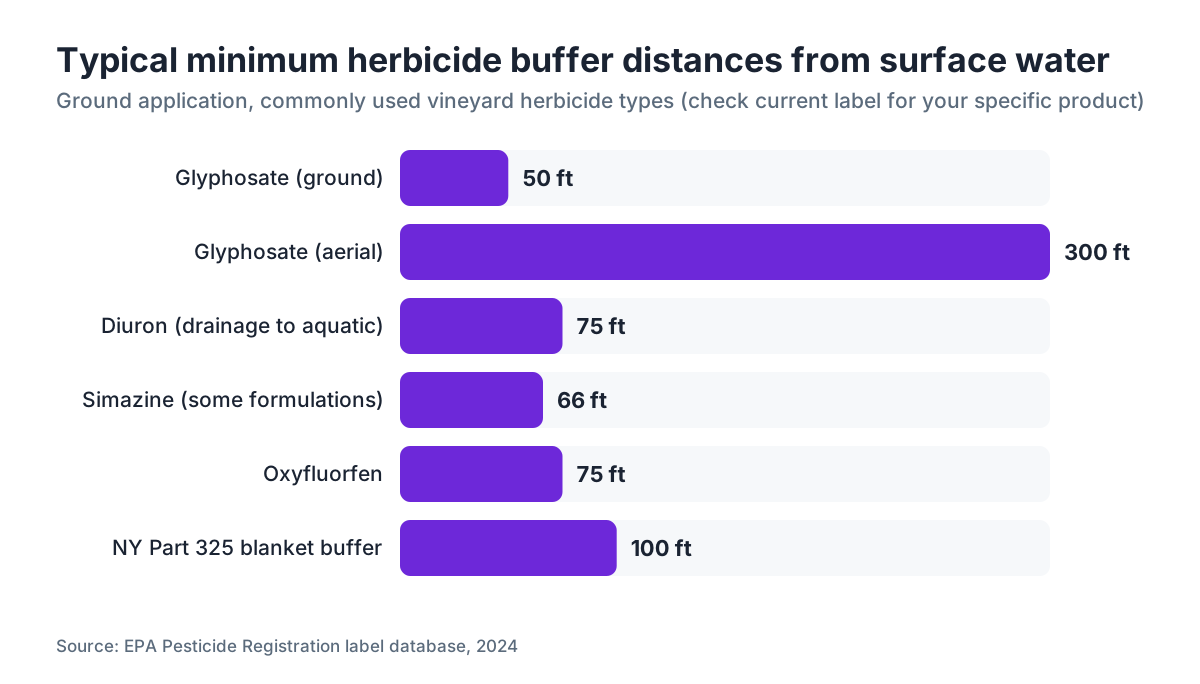
The label buffer is the minimum legal distance between your application and a water body, and it swings hard by product. Glyphosate labels (Roundup Pro, Cornerstone, and the like) usually require a 25 to 50 foot buffer from surface water for ground applications and can demand up to 300 feet for aerial. [6] Diuron labels, common in vineyards, often bar applications within 75 feet of drainage channels that empty into aquatic systems. Simazine, another vineyard staple, carries a 66-foot buffer in some formulations.
Buffers are about more than horizontal distance. Slope matters. On a 10% grade running toward a creek, runoff carries product faster and farther than it does across flat ground. Some labels cut the required buffer if you install a vegetative filter strip of a stated width, and that's exactly where your paperwork doubles. You need records showing the buffer AND records showing the strip meets label specs.
The FIFRA label framework rates aquatic exposure risk in tiers. Products with high aquatic toxicity carry longer buffers and tighter application rules, like no application within a set number of hours before predicted rain. So your spray records have to capture more than where you sprayed. They need the conditions: wind speed and direction, temperature, and whether rain was in the forecast within the label's window.
| Product Type | Typical Ground Application Buffer (Surface Water) | Notes |
|---|---|---|
| Glyphosate (most formulations) | 25-50 ft | Up to 300 ft for aerial |
| Diuron | 75 ft (drainage channels to aquatic systems) | Check specific formulation |
| Simazine | 66 ft (some formulations) | State rules may extend |
| Oxyfluorfen (Goal) | 50-100 ft | High aquatic toxicity tier |
| Flumioxazin (Chateau) | Varies; no runoff conditions | Label requires dry soil at app |
Values compiled from current EPA-registered labels. Always check the specific lot's current label. Registrations get amended.
What does a complete spray record for a waterway-adjacent application actually look like?
Most inspectors work off a checklist, and every gap in your record makes the inspection longer and colder. Here's what a legally sufficient record holds for a waterway-adjacent herbicide application.
Start with the basics every FIFRA RUP record needs: product name and EPA registration number, date of application, location (field ID, GPS coordinates, or block name tied to a map), crop or target site, total area treated, and the name and license number of the certified applicator. [1]
For near-water applications, add these to the same record: the name or designation of the adjacent water body, your measured or estimated distance from the application boundary to the water's edge, the buffer distance the label requires (cite the specific label section), the application method (ground, boom, backpack), equipment calibration date, spray volume per acre, nozzle type and pressure, and wind speed and direction at time of application.
Record the weather too: temperature, relative humidity, and whether a precipitation event was forecast inside the label's pre-rain restriction window. If a vegetative filter strip or other runoff-reduction measure sat between your application area and the water, document its width, species composition, and condition. Take a photo and timestamp it. Photos aren't required under FIFRA, but they close an enforcement conversation faster than anything else in the file.
Last, note whether the application landed in a state-designated restricted area or fell under a permit condition, and attach or reference that permit. Keep all of it in one file, physical or digital, for at least two years, longer if your state says so.
How far from a creek, ditch, or pond do you need to stop applying herbicide?
It depends on three things, and you check all three before you spray.
First, the product label. Buffers run from 25 feet to over 300 feet depending on product and application method. The label is your floor.
Second, your state regulations. California, New York, Washington, Oregon, and others impose blanket prohibitions or enhanced buffers for certain water body types, including irrigation canals, seasonal streams, and drainage ditches that connect to navigable waters. Some states split perennial from ephemeral streams and treat them differently.
Third, any site-specific permit or agreement. If your vineyard sits in a Clean Water Act Section 404 wetlands area, or if you've entered a Farm Bill conservation program like EQIP or a Wetland Reserve Easement, those agreements often set stricter buffers than either the label or state law.
Here's a common trap: drainage ditches. Plenty of growers assume a concrete-lined irrigation ditch isn't a "water body" for buffer purposes. In California and Washington, that assumption is wrong when the ditch connects to a natural water course, even intermittently. The EPA's definition of "Waters of the United States" under the Clean Water Act has moved with recent court rulings, including the 2023 Sackett v. EPA Supreme Court decision, which narrowed the definition for wetlands but left buffers intact for ditches that connect to navigable waters. [7] Get current guidance from your county farm advisor or extension office before you decide a ditch doesn't count.
Coastal California adds one more layer. The Coastal Zone Management Act means applications near seasonal wetlands and lagoons can require Coastal Development Permits, even for routine herbicide use, in some counties.
What records do you need to document vegetative buffer strips and filter strips?
If you're leaning on a vegetative buffer or filter strip to earn a reduced application buffer (some labels allow it), you have to document that the strip actually meets the label's specifications. This is where growers get caught. They have the strip. They have no record proving it qualifies.
At minimum, document the strip with these items: date established or last assessed, width in feet at the narrowest point (labels specify a minimum, usually 25 to 100 feet by product), species present and percent vegetative cover, and any gaps or bare soil. Photos with a tape measure in frame work well.
WSU Extension's guidance on integrated vegetation management recommends checking buffer strip integrity at least once per season and after any significant erosion event. [8] If your strip develops gullies or gaps, the label credit may not apply until you restore it, and your records need to show that you spotted the gap and either fixed it or reverted to the full label buffer.
For NRCS-funded filter strips under EQIP, there are additional practice standards (Practice Standard 393) that spell out seeding rates, species mixes, and maintenance. [9] NRCS runs periodic compliance reviews and expects records showing the strip meets the standard. Those records overlap heavily with what your herbicide file should already hold.
One thing worth doing even though nobody requires it: sketch a simple field map showing block boundaries, water features, buffer zones, and filter strips. Update it when anything changes. A one-page annotated aerial photo does the job. Inspectors who can see you've thought spatially about your buffers tend to move through an inspection faster.
How do you handle record-keeping when a spray crew or PCA is doing the applications?
This is where liability gets tangled. Hire a licensed pest control operator (PCO) or pest control adviser (PCA) to make or recommend applications near water, and you're still the "owner or operator" of the agricultural establishment under FIFRA and EPA regulations. Ensuring the records exist and stay on site is on you.
Most states make the PCO hand you a copy of the application record inside a set timeframe. In California, licensed pest control operators must give the grower a Notice of Right to Inspect application records within five days of application under CCR Title 3. [3] Don't wait for the deadline. Get the record from your applicator the same day when you can.
Using a vineyard management company? Get it in writing that they'll deliver waterway-specific documentation, including measured buffer distances, weather at time of application, and the applicator's license number. A handshake isn't enough when an inspector shows up six months later.
California PCAs must maintain written recommendations for pesticide applications, and those recommendations should carry buffer language when the application sits near water. If your PCA's written recommendation says nothing about waterway buffers, raise it before the spray, not after.
Tools like VitiScribe pull multi-applicator spray records into one ledger with waterway buffer fields built into the entry form. That makes it easier to check your contractor's records against your own site maps before the paperwork ever leaves your hands.
What are the penalties for missing or incomplete herbicide records near water?
They're real and they aren't small. Under FIFRA, civil penalties for record-keeping violations can reach $1,000 per violation for private applicators and $5,500 per violation per day for commercial applicators under current EPA penalty schedules. [1] Repeated or willful violations can draw a criminal referral.
State penalties often run higher. California's CDPR can assess up to $5,000 per violation per day for pesticide record-keeping failures, and repeat violations can suspend or revoke an applicator's license. [3] Washington's WSDA holds similar authority under RCW 17.21.
The deeper cost is a presumption problem. Say an inspector finds a fish kill or herbicide residue in a waterway, and your records show you applied glyphosate 40 feet from that water with no buffer documentation. Arguing compliance after the fact is nearly impossible. The absence of records works against you.
Civil liability is the other jaw of the trap. Growers in California and Oregon have faced nuisance and trespass suits from downstream landowners citing herbicide contamination tied to thin buffers. Plaintiffs' attorneys subpoena the spray records first. When the records are thin or missing, the settlement number climbs.
The cheapest thing you can do is keep good records. That's not hyperbole. An administrative violation backed by clean records showing a good-faith effort is a different conversation than one where you can't produce a single page.
How should you organize and store herbicide application records for inspections?
Two years of records accessible on demand is the federal floor. California requires pesticide use reports for three years. [3] Washington requires two years for RUP records. Build your system around three years and you cover any state that might apply.
Physical binders work. Run a dedicated folder per season, ordered by application date, with a cover sheet listing every waterway-adjacent block and its mapped buffer distance. Keep a running index. When an inspector asks for everything from March through June 2024, you should pull it in under five minutes.
Digital records work too, but watch one thing. Records living on a platform you no longer pay for become records you can't reach. If you use farm management software, export your spray records to PDF at the end of each season and keep the PDFs locally or in a backup cloud folder you control. This is the one place VitiScribe's record export feature is worth a look, because it pulls waterway-specific records by field with buffer distances included in the export.
UC Davis Cooperative Extension recommends storing spray records in the same place as your pesticide safety data sheets and your restricted entry interval (REI) posting records, so one file cabinet or digital folder covers WPS compliance, FIFRA compliance, and state reporting at once. [10] That's good advice. One audit-ready packet per season is easier to keep and easier to defend.
For block maps, hold both the current version and the version that was live during each spray season. Add a drainage feature or widen a buffer strip mid-season, and the version history is what proves what the ground looked like on spray day.
What do buffer documentation requirements look like in common grape-growing regions?
Regional variation runs deep enough that what passes in Napa Valley can be a violation in the Willamette Valley or the Finger Lakes.
In California's North Coast, applications near the Russian River and its tributaries fall under the Sonoma County Agricultural Commissioner's oversight plus State Water Board requirements. The North Coast Regional Water Quality Control Board has issued general NPDES permits for agricultural operations that set specific documentation rules for pesticide applications near waterways, including keeping records of all applications within 200 feet of a stream. [11]
In Washington's Columbia Valley, the WSDA's Pesticides Near Water program maps specific water bodies with enhanced restrictions. The Yakima River basin carries extra restrictions tied to salmon recovery commitments under the Endangered Species Act. Applications near mapped critical habitat can require ESA consultation documentation separate from your spray records. [4]
Oregon runs the Agricultural Water Quality Management Act, which requires growers in designated areas (most of the state's wine country qualifies) to implement management plans that include buffer documentation as part of the plan's verification. The Oregon Department of Agriculture can request your spray records during compliance monitoring. [12]
For New York's Finger Lakes, Cornell Cooperative Extension has published guidance noting that the 100-foot blanket buffer under Part 325 applies to most herbicide applications in vineyard settings, given how close the vines sit to the lakes and their feeder streams. Cornell's guidance suggests measuring and recording buffer distances from the nearest lake shoreline, not only from tributary streams. [5]
The principle holds across all of it. The more sensitive the receiving water, the more documentation depth inspectors expect.
What's the simplest system for staying compliant when spraying near a waterway?
Four steps, done in order, every time.
Step one: before any application near water, pull the current label and find the buffer requirement. Write the number down. If your state or local jurisdiction sets a stricter distance, use that one. Check whether your site falls in any mapped restricted zone.
Step two: measure the distance from your intended application boundary to the nearest water body edge. Do it physically, not by eye. A 100-foot measuring tape costs less than a fine. Record the measurement with the date and field ID. Running GPS on your tractor or ATV? Log the waypoint at the water's edge and at the application stop point.
Step three: during application, record wind speed and direction (a basic anemometer runs $20 to $40), temperature, nozzle type and pressure, and the exact start and finish time. Note anything odd, like gusting wind, unexpected proximity to a drainage inlet, or an equipment malfunction.
Step four: finish the record the same day. Don't let it drift to the end of the week. Memory fades, and a record dated three days after the fact looks fabricated even when it's honest.
The whole thing takes an extra 10 to 15 minutes per application. It's the difference between an inspector closing the clipboard and walking off versus an enforcement notice in the mail. That's the only math that matters.
Frequently asked questions
How long do I have to keep herbicide application records?
Under FIFRA, certified applicators must keep restricted-use pesticide records for two years. California extends this to three years for all pesticide use reports. Washington requires two years. To cover any state that might apply to your operation, keep records for three years as a baseline. Store them where you can produce them on short notice, since inspectors don't always give advance warning.
Does a drainage ditch count as a water body for herbicide buffer purposes?
In most states, yes, if the ditch connects to a natural waterway, even seasonally. California and Washington both treat connected drainage ditches as water bodies for buffer calculation. The 2023 Sackett v. EPA Supreme Court ruling narrowed wetland definitions under the Clean Water Act but did not eliminate buffer requirements for ditches that connect to navigable waters. Check with your county farm advisor for site-specific guidance.
What if my herbicide label says one buffer distance but my state requires a longer one?
Use the longer distance. The label is a federal minimum. State law can impose stricter requirements, and when it does, state law governs. New York's 100-foot blanket buffer under Part 325 is a common example where state rules exceed label requirements. Keep a note in your spray record showing both the label buffer and the state buffer so it's clear you applied the more protective standard.
Do I need to document buffer strips separately from my spray records?
Yes, if you're using a vegetative buffer or filter strip to qualify for a reduced application buffer under a product label. You need records showing the strip's width, percent vegetative cover, species present, and condition at the time of application. A dated photo with a tape measure in frame is strong supporting documentation. WSU Extension recommends assessing buffer strip integrity at least once per season and after erosion events.
What weather conditions do I need to record for a waterway-adjacent herbicide application?
At minimum: wind speed and direction, air temperature, relative humidity, and whether a precipitation event was forecast within the label's pre-rain restriction window. Some product labels, including several diuron and simazine formulations, specifically prohibit application if rain is expected within a set number of hours. Recording forecast conditions at application time protects you if runoff is later detected, since it shows you followed label timing requirements.
Is a certified applicator required to apply herbicides near vineyard waterways?
For restricted-use products, yes. A certified applicator or someone under direct supervision of a certified applicator must make the application, and the certified applicator's license number must appear in the record. For general-use products, certification isn't always federally required, but state rules vary. California, for instance, requires a pest control operator license for commercial applications regardless of the product's use classification.
What happens if my spray contractor applies herbicide too close to a waterway and doesn't tell me?
You, as the grower and landowner, are considered the operator under FIFRA and bear responsibility for applications made on your property. That's why getting written application records from contractors the same day matters. If a contractor's records show an application inside the required buffer and you signed off or failed to review it, the enforcement action can name you. Put buffer documentation requirements in your contracts with applicators.
How do I figure out which water bodies near my vineyard trigger buffer requirements?
Start with your county's GIS maps and the USGS National Hydrography Dataset to identify mapped streams, wetlands, and ponds near your blocks. Then check your state lead agency's restricted area maps: WSDA's Pesticides Near Water program in Washington and CDPR's county agricultural commissioner GIS tools in California both identify enhanced restriction zones. Walk your property boundaries at the start of each season to confirm current conditions, since seasonal channels may appear or shift.
Do organic vineyard herbicide programs still require buffer documentation near water?
Organic-approved herbicides like acetic acid, clove oil, and citric acid products are still pesticides under FIFRA. They still carry EPA registration numbers, still have labels, and those labels may still specify waterway buffers. The obligation to document applications near water applies regardless of whether the product is conventional or OMRI-listed. Check each product's label individually and follow the same documentation steps you'd use for any other herbicide.
What's the penalty for applying herbicide inside a waterway buffer without documentation?
Federal FIFRA civil penalties run up to $1,000 per violation per day for private applicators and $5,500 for commercial applicators. California's CDPR can impose up to $5,000 per violation per day and can suspend or revoke a pesticide applicator's license. Beyond fines, inadequate records sharply increase civil liability exposure if a fish kill or downstream contamination event occurs after the application.
Can GPS coordinates replace a measured distance to a waterway in spray records?
GPS coordinates are strong supporting records, but most regulations are written in feet or meters, not coordinate pairs. Log the GPS waypoints at the application boundary and at the nearest water body edge, then calculate and record the distance in feet. That combination is more defensible than coordinates alone, because an inspector can verify the distance without specialized software. Many farm management apps calculate the distance between two waypoints automatically.
How do Endangered Species Act requirements interact with herbicide buffer documentation near vineyard water?
In areas with ESA-listed aquatic species, EPA-registered labels for some herbicides include ESA protection bulletins that impose additional buffers and application restrictions beyond standard label language. These bulletins are legally binding as part of the label. In Washington's Yakima basin and parts of California's Central Valley, salmon and steelhead listings trigger specific herbicide restrictions. Your spray records should note whether you reviewed and complied with any applicable ESA protection bulletin.
Does the EPA Worker Protection Standard require extra documentation for herbicide applications near water?
The WPS primarily governs worker and handler protection, not waterway buffers directly. But it does require application-specific information, including the product, location, and REI, to be posted at a central location for 30 days after each application. Near waterways, this posting requirement still applies. The WPS records and your pesticide use records should be kept together so a single audit covers both WPS compliance and buffer documentation.
Sources
- EPA, FIFRA Section 8 and Pesticide Record-Keeping Requirements: Certified applicators must keep RUP application records for two years; civil penalties up to $5,500 per violation per day for commercial applicators under current FIFRA penalty schedules
- EPA, Worker Protection Standard for Agricultural Pesticides: 2015 revised WPS requires application-specific information to be posted at a central location for 30 days after each application
- California Department of Pesticide Regulation, Pesticide Use Reporting: California requires all pesticide use to be reported to the county agricultural commissioner within one month; records kept for three years; penalties up to $5,000 per violation per day
- Washington State Department of Agriculture, Pesticides Near Water Program: Washington requires certified applicators to keep RUP records for two years under WAC 16-228-1250; WSDA maps restricted use areas with enhanced buffers
- Cornell Cooperative Extension, Pesticide Management Near Water: New York Part 325 regulations prohibit most herbicide applications within 100 feet of a water body without a permit; Cornell documented widespread grower unawareness of this requirement
- EPA, Pesticide Labels and Label Requirements: Glyphosate labels typically require 25-50 foot buffer from surface water for ground applications, up to 300 feet for aerial; the label is a legally binding document under FIFRA
- U.S. Supreme Court, Sackett v. EPA, 598 U.S. 651 (2023): 2023 Sackett v. EPA narrowed Clean Water Act wetland definitions but did not eliminate buffer requirements for ditches connecting to navigable waters
- Washington State University Extension, Integrated Vegetation Management: WSU Extension recommends assessing buffer strip integrity at least once per season and after any significant erosion event
- UC Davis Cooperative Extension (UC ANR), Pesticide Safety and Compliance Resources: UC Davis Cooperative Extension recommends keeping spray records in the same location as SDS sheets and REI posting records to cover WPS, FIFRA, and state reporting compliance in a single audit-ready packet
- California State Water Resources Control Board, Agricultural Order NPDES Permit: North Coast Regional Water Quality Control Board general NPDES permits for agricultural operations impose documentation requirements for pesticide applications within 200 feet of a stream
- Oregon Department of Agriculture, Agricultural Water Quality Management Program: Oregon's Agricultural Water Quality Management Act requires growers in designated areas to implement management plans with buffer documentation, subject to ODA compliance monitoring
Last updated 2026-07-09