BBCH growth stage codes used in vineyard spray timing records
TL;DR
- BBCH codes are a numbered 0 to 99 scale that describes every grapevine growth stage from dormancy to harvest.
- Vineyard spray records use them to document precisely when a product went on, which satisfies EPA Worker Protection Standard requirements, pesticide label compliance, and state audit trails.
- The most spray-critical window runs from BBCH 09 (bud swell) through BBCH 75 (berry pea size).
What are BBCH growth stage codes and where did they come from?
BBCH codes are a numbered 0 to 99 scale that puts one universal name on every plant growth stage, so a fungicide label reads the same in Napa as it does on the Mosel. BBCH stands for Biologische Bundesanstalt, Bundessortenamt und CHemische Industrie, the German group of research institutions and industry bodies that built the system in the early 1990s. They wanted to kill off a dozen competing crop-specific scales and replace them with one number.
The scale runs 00 to 99. It splits into principal growth stages 0 through 9, each carved into ten secondary stages. For grapevines, the authoritative description sits in the BBCH Monograph published by the Federal Biological Research Centre for Agriculture and Forestry (Biologische Bundesanstalt für Land- und Forstwirtschaft) [1]. A peer-reviewed version covering Vitis vinifera came out in the journal Vitis in 1994, and that's the one university extension guidance usually points to.
You don't need all 100 codes memorized. About 15 to 20 of them cover nearly every spray decision you make in a season.
How does the BBCH scale work for grapevines specifically?
For grapevines, the principal stages track the season from dormant bud to leaf fall. The one-digit secondary code inside each stage is where spray decisions actually turn.
| Principal Stage | Code Range | What's Happening |
|---|---|---|
| Dormancy | 00 to 09 | Bud dormant through bud swell |
| Bud development | 09 to 19 | Woolly bud through green tip showing |
| Shoot development | 11 to 19 | Leaf unfolding through extended shoot |
| Leaf development | 11 to 19 | First through 9+ leaves unfolded |
| Inflorescence emergence | 53 to 59 | Flower clusters visible through fully separate |
| Flowering | 60 to 69 | First flowers open through full bloom |
| Fruit development | 71 to 79 | Berry set through berry near full size |
| Ripening | 81 to 89 | Veraison through fully ripe |
| Senescence | 91 to 97 | Leaf color change through leaf fall |
The secondary codes refine each stage. BBCH 53 means the inflorescence is just visible, still bunched tight. BBCH 57 means individual flowers in the cluster are separating but not yet open. That one-digit gap can decide whether a given fungicide is label-legal to apply [2].
A handful of codes get referenced constantly. BBCH 09 (bud swell) often triggers the first dormant or delayed-dormant spray. BBCH 12 (two leaves unfolded) starts the primary mildew season in most regions. BBCH 57 is the last labeled timing for some systemic fungicides before pollination gets disrupted. BBCH 71 (fruit set, small berries visible) opens the botrytis window. And BBCH 77 to 79 (berry near full size) is often the last spray window before pre-harvest intervals become the binding constraint.
Why do spray records need to show BBCH codes instead of just calendar dates?
A date alone can't prove label compliance, because the vine doesn't run on the calendar. A frost in April can push bud break two to three weeks from one year to the next in the same block. If an inspector sees "applied Pristine on April 22" with no phenological anchor, there's nothing to confirm the application landed inside the labeled staging window. They can only look at the date and guess.
The EPA Worker Protection Standard (WPS), revised most recently in 2015 and codified at 40 CFR Part 170, requires employers to keep pesticide application records including the product applied, the target pest, and information sufficient to determine label compliance [3]. Most state departments of agriculture ask for more. California's DPR requires the crop growth stage at the time of application in the Pesticide Use Report filed for every application [4]. Washington State likewise requires phenological stage documentation for many restricted-use pesticides under WAC 16-228 [5].
BBCH codes clear all of that in a single number. They're unambiguous across languages too, which matters if an out-of-state consultant or an export market auditor ever reads your records.
Here's the other reason. Pesticide labels themselves increasingly speak BBCH. FRAC (Fungicide Resistance Action Committee) guidance references BBCH thresholds directly when it defines resistance management timing windows [12]. If your record says BBCH 57 and the label says do not apply after BBCH 57, the compliance question is answered before anyone asks it.
Which BBCH stages are most critical for fungicide and pesticide applications?
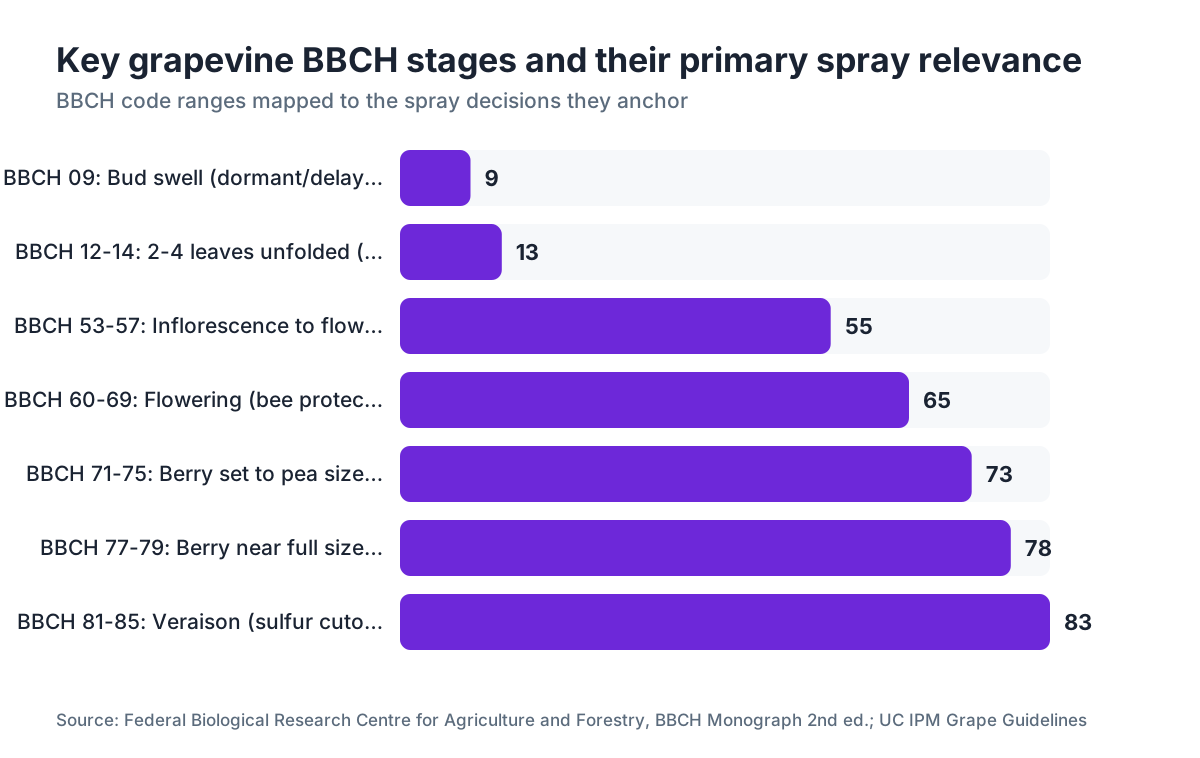
Seven staging windows anchor most spray programs, and knowing them cold saves you from label mistakes. Each one lines up with a product class and a timing restriction that either opens or closes at a specific code.
BBCH 09 (bud swell): First spray window. Oil or sulfur for scale and early mite pressure. Some delayed-dormant materials are only legal before BBCH 09.
BBCH 12 to 14 (two to four leaves unfolded): Powdery mildew primary infection season begins here. Sulfur, potassium bicarbonate, and early systemic fungicides start at BBCH 12 in high-pressure regions. UC IPM guidance recommends starting a powdery mildew program no later than BBCH 14 in most California coastal regions [6].
BBCH 53 to 57 (inflorescence emergence to flower separation): Downy mildew pressure peaks if it stays wet. Botryticides timed here protect emerging flower tissue. This is a key window for SDHI and DMI fungicide rotations per FRAC guidelines.
BBCH 60 to 69 (flowering): Many organophosphate and pyrethroid labels prohibit application during bloom to protect pollinators. An application logged at BBCH 65 with one of those products is a label violation documented in your own paperwork. The code cuts both ways: it proves you stayed out of bloom, or it proves you didn't.
BBCH 71 to 75 (berry set to pea size): Botrytis management window. Bunch architecture products sometimes go on here. This is also when pre-harvest interval (PHI) math starts to matter.
BBCH 77 to 79 (berry near full size): Last practical spray window for most materials before PHI constraints take over. Some residue-sensitive export markets effectively require the last systemic fungicide no later than BBCH 77.
BBCH 81 to 85 (veraison): Sulfur comes out of most programs here to avoid off-aromas. Some labels flatly prohibit sulfur after BBCH 81. Recording this transition matters for product liability defense if a winery later blames sulfur contamination.
How do you accurately determine the BBCH stage in your vineyard blocks?
Walk the block and read the vines, not the calendar. The standard method is at least five to ten vine observations per block, sampled from representative rows and positions. Row ends run warm and advance faster than mid-row vines, so don't stage the whole block off the first panel you reach. Look at five shoots per vine and call the stage that describes most of the shoot tips you see. If you're straddling two stages, record the lower number and note you're at the early end of the transition.
Timing matters. Do your assessments in mid-morning, after the dew lifts but before the heat of the day. Most stages read the same morning or afternoon, but inflorescence observations at BBCH 60 to 65 are cleaner when the flowers are dry.
WSU Extension publishes a photographic grapevine phenology guide that walks through BBCH codes next to real photos [7]. Cornell Cooperative Extension's viticulture program publishes regional phenology tracking tools built on the same framework [8]. If you're new to staging, print one and keep it on the ATV. It's worth the three minutes.
Log your staging observations when you make them, not from memory at the end of the week. A handwritten field log with date, block ID, and BBCH code is legally sufficient. Digital systems that timestamp the entry and tie it to the applicator's signature hold up better in an audit. Tools like VitiScribe let you log BBCH codes straight against each spray record, so the phenological anchor lives inside the application record rather than a separate sheet you have to reconcile later.
How should BBCH codes appear in your spray application records?
A spray record that survives an audit carries eight things at minimum: date, block or field identifier, product name and EPA registration number, application rate, water volume, applicator name, target pest, and BBCH code at time of application. Some states add equipment type and wind speed.
For the BBCH entry, write the code as a two-digit number. BBCH 57, not "57" and not "bloom-ish." If a large block runs variable and you're recording a range, write BBCH 55-57 and note the direction (advancing toward bloom). Vague entries like "pre-bloom" or "bud break" don't map cleanly to the statutory requirement, and they leave interpretive room you don't want an inspector to have.
California's Pesticide Use Report form has a dedicated growth stage field. In states without one, add the BBCH code to the remarks or notes column and keep it there every single time. Consistency is the whole point. An inspector reading five years of records wants the same field used the same way in every entry.
Keep spray records at least two years under the WPS [3]. California requires three years for Pesticide Use Reports [4]. Some crop insurance programs push that to five. File by block, not by calendar month, so any block can be pulled and read chronologically in under two minutes.
What's the difference between BBCH codes and other grapevine phenology scales?
BBCH is the scale that shows up on pesticide labels and in regulatory guidance. The others mostly don't, and that's the difference that decides your records. The main competing scale in older literature is the Eichhorn-Lorenz (E-L) scale, built specifically for grapevines in 1977. It runs from stage 1 (winter dormancy) to stage 47 (end of leaf fall) with 47 discrete stages, some with decimal subdivisions [9]. E-L is finely calibrated for grapevines, and plenty of viticulture researchers still prefer it for that.
The practical catch for spray records is translation. If your fungicide label says do not apply after BBCH 71 and your record shows E-L stage 29, you now have a conversion problem at the worst possible moment. E-L 29 corresponds roughly to BBCH 71, but "roughly" is not a defense.
The Winkler scale is a different animal, a heat accumulation system (degree days) for classifying wine regions, not individual vine phenology [10]. It has no place in a spray record.
Some growers use informal descriptors, like woolly bud, green tip, half-inch green, tight cluster, loose cluster. Those map loosely to BBCH codes and are fine for internal scouting notes. They shouldn't stand as the official phenological anchor in a regulated spray record. Use the number.
How do BBCH codes connect to pesticide label compliance and PHI calculations?
A pesticide label is a legal document, and applying outside the labeled growth stage is a federal violation under FIFRA Section 12(a)(2)(G), no matter how close you thought you were [11]. BBCH codes are increasingly the language labels use to draw those lines. The statute makes it a violation to use a pesticide "in a manner inconsistent with its labeling."
Pre-harvest interval (PHI) math starts from the date of the last application. Your record has to prove the last spray of a given product left enough days before harvest to clear the PHI. Record BBCH 79 for a product with a 14-day PHI, then harvest 10 days later, and that's a violation with the BBCH code sitting in your record as the evidence.
The flip side works in your favor. An application at BBCH 77 that looks close, backed by 18 documented days to harvest, lets you show it went on before berry softening when residue dissipation runs fastest. That's a compliance argument, more than a record-keeping habit.
Some export markets, the EU in particular, hold maximum residue limits (MRLs) tighter than US tolerances. EU importers sometimes ask for spray records as shipment documentation. A record with BBCH-anchored timing gives them what they need to calculate residue dissipation. A record that shows only dates makes their job harder and makes you look sloppy.
Are there regional differences in how BBCH codes are used in US viticulture?
The codes are universal. How states require them in records is not. California is the most prescriptive by a wide margin.
The California Department of Pesticide Regulation's Pesticide Use Report system explicitly asks for crop growth stage, and DPR training materials for agricultural commissioner staff reference BBCH codes [4]. California's mandatory reporting covers essentially every pesticide application by a licensed applicator, which makes it the strictest recordkeeping regime in US agriculture.
Washington State's regulations under WAC 16-228 require phenological stage documentation for restricted-use pesticide records, and WSU Extension's spray guides are written in BBCH language [5][7]. Oregon's ODA also references phenological stages in its pesticide records requirements.
In the East, New York's Department of Environmental Conservation and the Cornell Cooperative Extension viticulture program have both pushed BBCH into their integrated pest management resources over the past decade, though New York's regulatory language stays less explicit than California's [8].
If you farm in a state with looser requirements, record BBCH codes anyway. It takes three seconds to write BBCH 57 on a spray sheet. It can save hours if you ever face an audit, a label violation allegation, or a crop insurance dispute.
What's a practical system for recording BBCH stages across multiple blocks?
One BBCH code can't cover a whole farm. South-facing blocks advance faster than north-facing ones. Early-budding varieties like Chardonnay can sit two full BBCH stages ahead of Cabernet Sauvignon in the same week. If you manage more than a few blocks, tracking that variability is real work, so build a system for it.
Here's one that works. Keep a phenology log with a row per block and a column per scouting date. Update it weekly through the critical BBCH 09 to 75 window, and more often during fast transitions like flowering. When you go to spray, pull the current BBCH reading for each targeted block from the log and copy it into the application record.
Some spray contractors run a simplified three-tier approach: one BBCH code for the earliest block, one for the latest, and a note on any outliers. That's legally sufficient as long as each application record names the specific block it covers.
Digital systems that tie block-level phenology to spray applications are where this is going. VitiScribe was built for this workflow. You log a block's BBCH stage once per scouting visit, then pull it into each spray record for that block without re-typing it. Software or a binder of printed sheets, the logic is identical: scouting record feeds application record, application record names the BBCH code, BBCH code anchors label compliance.
Where can you find official BBCH code references for grapevines?
The primary source is the BBCH Monograph, formally "Growth Stages of Mono- and Dicotyledonous Plants," published by the Federal Biological Research Centre for Agriculture and Forestry in Germany. The second edition (2001) is the version most people cite [1]. It's available as a PDF from several European agricultural ministry sites.
For US practitioners, university extension publications are the most usable references.
UC IPM publishes grape powdery mildew and pest management guidelines with BBCH code references for spray timing decisions [6]. The UC IPM website at ipm.ucanr.edu carries grapevine pest management guidelines tied to growth stages.
WSU Extension's wine grape production guide and annual spray guides use BBCH codes throughout, and include a photographic staging guide [7].
Cornell Cooperative Extension's viticulture program at the New York State Agricultural Experiment Station in Geneva publishes disease and pest management guides with BBCH-referenced timing windows [8].
The EPA's Worker Protection Standard documentation and training materials live at epa.gov/pesticide-worker-safety [3].
For fungicide resistance management, FRAC's annual recommendations by crop are at frac.info and reference BBCH stages for each resistance management window [12]. That's a practical document to keep on hand when you build the seasonal spray program.
Frequently asked questions
What does BBCH stand for?
BBCH stands for Biologische Bundesanstalt, Bundessortenamt und CHemische Industrie, the German group of research and industry organizations that created the unified scale in the early 1990s. The abbreviation stuck even though the scale is now managed internationally and used across dozens of crops worldwide.
What BBCH stage is bud break for grapevines?
Bud break is generally described as BBCH 09 (bud swell clearly visible) through BBCH 11 (first leaf tip visible, what growers call green tip). Some sources use BBCH 07 to 09 for the earlier bud swell phases. Full bud break with the first leaf unfolding is BBCH 11. This window triggers many dormant and delayed-dormant spray programs.
What BBCH stage is full bloom for grapevines?
Full bloom for grapevines is BBCH 65, defined as 50 percent or more of flowers open. The bloom window runs from BBCH 60 (first individual flowers open) through BBCH 69 (end of flowering, petal fall). Most bee protection language on pesticide labels prohibits applications during BBCH 60 to 69. Your records should clearly show applications in this window were avoided if the label required it.
Do pesticide labels actually use BBCH codes in their legal text?
Yes, increasingly. Many European-origin fungicide and insecticide labels registered in the US now specify BBCH codes in the directions for use. FRAC guidance documents reference BBCH thresholds directly. Where a label uses descriptive language like "pre-bloom" instead of a code, mapping that language to the matching BBCH number in your records is good practice and defensible in an audit.
How is BBCH different from the Eichhorn-Lorenz scale?
The Eichhorn-Lorenz (E-L) scale is grapevine-specific with 47 numbered stages and is common in research literature. BBCH is a cross-species scale (00 to 99) that appears on pesticide labels and in regulatory documents. For spray records that must satisfy label compliance and state reporting, BBCH codes are the right choice because they match the language regulators and label writers use.
How often should I record BBCH stages during the growing season?
At minimum, record a BBCH observation for each block every time you spray. For blocks with active disease pressure, or during rapid transitions (BBCH 09 to 75 is the critical window), weekly scouting with a logged BBCH code is standard. During bloom (BBCH 60 to 69), conditions can shift enough in 48 hours to change a spray decision, so more frequent checks pay off.
Can I use one BBCH code for an entire vineyard in my spray records?
Only if your entire vineyard is one block with one variety in similar topographic conditions. In practice, different varieties, aspects, and elevations put blocks at different BBCH stages at the same time. Each application record should name the BBCH code for the specific block being treated. One code farm-wide when blocks differ creates a compliance gap for the most advanced or the most delayed blocks.
How long do I need to keep spray records that include BBCH codes?
Under the EPA Worker Protection Standard (40 CFR Part 170), pesticide application records must be kept at least two years. California requires three years for Pesticide Use Reports. Some crop insurance programs and export market audits effectively require five years. Keep records organized by block and by season so any specific application can be found fast.
What BBCH stage should I record if a block is between two stages?
Record the lower (earlier) BBCH code and note that the block is transitioning toward the next stage. If most shoot tips sit at BBCH 55 but some reach BBCH 57, write BBCH 55-57. That gives an accurate picture without overstating advancement. For compliance, the conservative lower number is usually safer because it shows you didn't push into a restricted timing window.
Does the EPA Worker Protection Standard specifically require BBCH codes in spray records?
The WPS (40 CFR Part 170) requires records sufficient to demonstrate label compliance, but doesn't name BBCH codes. The requirement to prove label compliance is what makes BBCH codes practically necessary, since many labels carry staging-based restrictions. California's DPR Pesticide Use Report goes further with a dedicated growth stage field. Recording BBCH codes satisfies both the federal and state requirements at once.
What is BBCH 57 and why does it appear on so many fungicide labels?
BBCH 57 is the stage when individual flowers in the inflorescence are fully separate but not yet open. It's the last moment before pollination begins, which makes it the cutoff for fungicides that could affect pollen viability or harm pollinators. Many DMI and SDHI fungicide labels set BBCH 57 as the final permitted application before bloom. Recording this stage accurately matters for compliance and resistance management.
Where can I find a free photographic guide to grapevine BBCH stages?
WSU Extension has published a photographic grapevine phenology guide using BBCH codes, available through their viticulture program resources. UC IPM at ipm.ucanr.edu includes staged descriptions for grapevine pests tied to BBCH codes. Cornell Cooperative Extension's Geneva, NY viticulture publications also include BBCH-referenced growth stage guides for eastern varieties. All three are free and printable.
At what BBCH stage should sulfur applications stop to avoid off-aromas in wine?
Most spray programs drop elemental sulfur by BBCH 81 (beginning of veraison) to cut the risk of sulfur residue contributing off-aromas during fermentation. Some winemakers stop earlier, at BBCH 77 to 79 (berry near full size), especially for white varieties. Check your specific product label, since some sulfur formulations carry staging restrictions printed directly on the label.
Sources
- Federal Biological Research Centre for Agriculture and Forestry, BBCH Monograph: Growth Stages of Mono- and Dicotyledonous Plants, 2nd ed.: The authoritative BBCH scale for grapevines (Vitis vinifera) is published by the Federal Biological Research Centre for Agriculture and Forestry (Biologische Bundesanstalt für Land- und Forstwirtschaft) in the BBCH Monograph, second edition, 2001.
- Vitis journal, Lorenz et al. 1994, Phenological growth stages of the grapevine: BBCH 53 through 57 describes the inflorescence emergence and flower separation window for grapevines; the peer-reviewed BBCH grapevine description was published in the journal Vitis in 1994.
- U.S. EPA, Worker Protection Standard, 40 CFR Part 170: The EPA Worker Protection Standard requires employers to maintain pesticide application records including product applied, target pest, and information sufficient to determine label compliance, and records must be kept for a minimum of two years.
- California Department of Pesticide Regulation, Pesticide Use Reporting: California DPR requires the crop growth stage at the time of application in the Pesticide Use Report and requires pesticide use reports to be kept for three years.
- Washington State Legislature, WAC 16-228, Pesticide Application Regulations: Washington State's WAC 16-228 requires phenological stage documentation for restricted-use pesticide application records.
- UC IPM (University of California Agriculture and Natural Resources), Grape Powdery Mildew Management Guidelines: UC IPM guidance recommends beginning a powdery mildew spray program no later than BBCH 14 (four leaves unfolded) in most California coastal wine grape regions.
- Washington State University Extension, Wine Grape Production and Spray Program Guides: WSU Extension's wine grape production guides and annual spray guides use BBCH codes throughout and include a photographic grapevine phenology staging guide.
- Cornell Cooperative Extension, New York State Agricultural Experiment Station, Viticulture Program Publications: Cornell Cooperative Extension's viticulture program publishes disease and pest management guides with BBCH-referenced timing windows for eastern wine grape varieties.
- Eichhorn, K.W. and Lorenz, D.H., 1977, Phänologische Entwicklungsstadien der Rebe, Nachrichtenblatt des Deutschen Pflanzenschutzdienstes: The Eichhorn-Lorenz (E-L) scale, developed in 1977, is a grapevine-specific phenology scale with 47 discrete stages; it predates BBCH and is more common in research literature than on pesticide labels.
- UC IPM / University of California, Winkler heat summation (degree-day) region classification: The Winkler scale is a heat accumulation (degree-day) system for classifying wine grape growing regions, not a phenology scale for individual vine growth stages.
- U.S. EPA, FIFRA Section 12(a)(2)(G), Federal Insecticide, Fungicide, and Rodenticide Act: Applying a pesticide in a manner inconsistent with its labeling is a federal violation under FIFRA Section 12(a)(2)(G).
- Fungicide Resistance Action Committee (FRAC), Annual Recommendations by Crop: FRAC annual resistance management recommendations reference BBCH growth stage thresholds explicitly when defining spray timing windows for each fungicide class.
Last updated 2026-07-09