Assistant vineyard manager: role, pay, and how to land the job

TL;DR
- An assistant vineyard manager runs day-to-day field operations under a vineyard manager: crew supervision, spray records, canopy scheduling, irrigation checks, and compliance paperwork.
- U.S.
- salaries run roughly $42,000 to $72,000 depending on region and property size.
- It's the most common way people reach senior viticulture management, and most vineyard managers held this title first.
What does an assistant vineyard manager actually do?
Almost everything the vineyard manager does, but with less final authority and more hours physically in the rows.
A typical morning might mean walking blocks before 7 a.m. to check for mildew pressure, then briefing a crew of eight on tractor work, then entering spray applications into the compliance log before the details get fuzzy. Afternoons shift to irrigation monitoring, scouting for pest activity, or coordinating with the cellar when fruit maturity decisions are coming fast. The job is physical and administrative at the same time, which is exactly what makes it hard to hire for and easy to burn people out of.
Core responsibilities cluster into a few categories.
Field operations. Scheduling and supervising hand-crew work (pruning, shoot positioning, leaf pulling, harvest), running or overseeing tractor passes, scouting for disease and pest pressure, and making real-time canopy calls when the manager isn't reachable.
Compliance and recordkeeping. Pesticide application records, restricted-entry interval (REI) tracking, equipment calibration logs, and worker safety documentation under the EPA's Worker Protection Standard [1]. In California, Oregon, and Washington this paperwork gets audited. A missing record is a fine, not a warning.
People management. In most operations the assistant vineyard manager is the direct supervisor of field crews. That means handling labor law basics, safety tailgates, and the friction that comes with seasonal agricultural work. Bilingual ability in English and Spanish is a real functional advantage across most U.S. wine regions.
Communication up and down. The assistant is the relay point between field reality and the manager or owner. If a block has a disease problem that will affect harvest timing, the assistant needs to flag it clearly and early. If a crew member is hurt, the assistant is often the first responder and the incident recorder.
What the role is not: a pure equipment operator job, a pure office job, or a winemaking job. People who come in expecting to focus on only one of those usually struggle.
What is the salary range for an assistant vineyard manager?
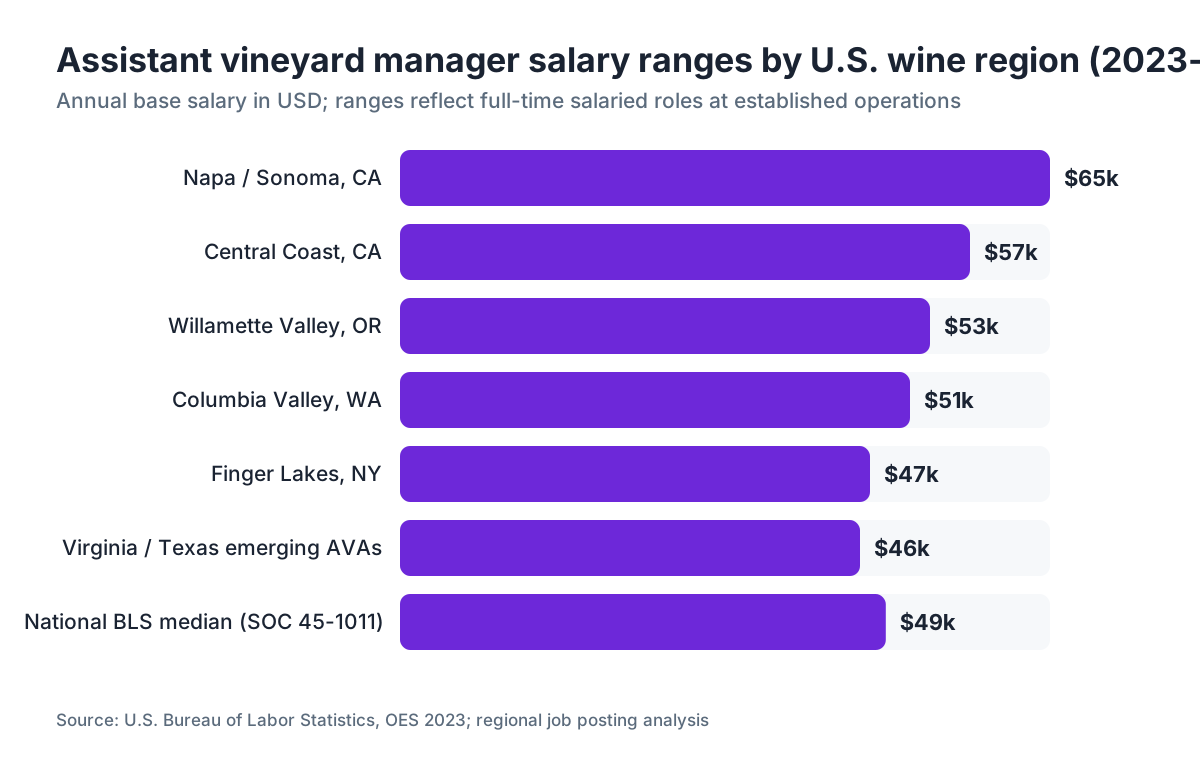
U.S. salaries for assistant vineyard managers run roughly $42,000 to $72,000 per year for full-time salaried positions, with real regional variation [2]. A few numbers worth anchoring to.
The U.S. Bureau of Labor Statistics classifies most vineyard management roles under "First-Line Supervisors of Farming, Fishing, and Forestry Workers" (SOC 45-1011), with a 2023 national median of about $48,580 [2]. That's a floor-ish number for the assistant role at established wineries in high-cost regions like Napa, Sonoma, the Willamette Valley, or the Central Coast.
In Napa and Sonoma, assistant vineyard managers at mid-size estate operations regularly see base salaries of $58,000 to $72,000, sometimes higher at large corporate holdings. Oregon and Washington tend to run $45,000 to $62,000. Smaller AVAs in New York, Virginia, or Texas generally land in the $40,000 to $55,000 band, reflecting both cost of living and property revenue.
Benefits vary a lot. Some estate properties offer housing, which changes the compensation math in a big way. Health insurance is increasingly standard at operations with 10 or more full-time employees. Overtime exposure is real during harvest.
Hourly roles exist too, mostly at large corporate vineyards that treat the position closer to a working foreman. Those run about $22 to $35 an hour.
Nobody has clean, wine-industry-specific pay data broken out by region with a sample size large enough to be definitive. The BLS numbers are the most consistent public benchmark. Job postings on sites like AgHires and Vineyard Jobs USA give you a real-time read on what employers are actually offering in a given region.
What qualifications and education do employers look for?
There's no single required credential. Employers consistently look for hands-on field experience paired with some formal viticulture training.
A two-year or four-year degree in viticulture, enology, plant science, or agricultural management is common among candidates who land assistant manager roles at larger or more prestigious properties. Programs at UC Davis [3], Cornell's College of Agriculture and Life Sciences [4], Washington State University [5], and Fresno State are well-regarded and produce candidates employers recognize by name. Plenty of excellent assistant managers came up through field crews with no degree, picking up skills through extension coursework, industry certifications, and sheer repetition.
Practical experience carries heavy weight. Most postings ask for two to four years of vineyard work before the assistant manager title is realistic. That experience needs to include spray operations (so you understand REI, PHI, and equipment calibration), irrigation systems, and ideally some crew supervisory responsibility.
Certifications that help:
- Pesticide Applicator License. Required to apply or supervise application of restricted-use pesticides in every state. Exams and requirements vary by state, but the license is non-negotiable for anyone touching the spray program [6].
- WSET or CMS credentials. Not required, but understanding wine quality gives context for why vineyard decisions matter.
- First Aid / CPR. Practically necessary given the injury exposure in fieldwork and the remoteness of many vineyard sites.
Spanish language ability shows up on most postings as "preferred." In practice it's close to required where the crew is predominantly Spanish-speaking. A communication breakdown during a spray operation or an injury is not acceptable.
Building toward this role from scratch? The honest path is short: get field hours first, take the pesticide applicator exam as soon as you're eligible, and find an extension program or community college viticulture course to fill the science gaps.
How does the assistant vineyard manager differ from the vineyard manager?
The practical difference is scope and final authority, not a totally different job.
The vineyard manager owns the long-term decisions: variety selection, trellis system changes, replanting schedules, capital equipment purchases, and the vineyard's overall farming philosophy. They carry the relationship with ownership or the winemaking team and answer for quality and cost outcomes across the whole operation.
The assistant vineyard manager executes those decisions daily and makes real-time tactical calls inside them. If the manager set a spray schedule, the assistant makes sure it happens on time, the records are correct, and the crew is trained on the label requirements. If unexpected disease pressure shows up between scheduled treatments, the assistant escalates it with enough context for a fast decision.
In smaller operations (under 50 acres farmed), the line between the two titles blurs a lot. A sole vineyard manager at a small property often carries assistant-level work because there's nobody else. At a large corporate property farming several hundred acres, there may be multiple assistant managers, each responsible for a block range.
The career trajectory is clear. Most vineyard managers were assistant vineyard managers first. Time in the assistant role before moving up seems to run three to six years based on job posting patterns and extension program alumni surveys, though nobody has published a rigorous study on it. You move up when you've shown you can manage people reliably, handle compliance without supervision, and surface problems before they turn into crises.
What does compliance and recordkeeping look like day-to-day?
This is where the role gets unglamorous fast, and it's also where most operations have real gaps.
The EPA Worker Protection Standard (WPS), revised in 2015 with key provisions phased in through 2018, sets baseline requirements for agricultural workers and handlers exposed to pesticides [1]. For an assistant vineyard manager, WPS compliance means making sure workers get required training every year, posting information about pesticide applications in a central location, tracking REIs and keeping workers out of treated areas during them, and holding records that can be produced during an inspection or after an incident.
State agencies add to this. California's Department of Pesticide Regulation requires pesticide use reports within 30 days of each month's applications, and county agricultural commissioners run periodic audits [6]. Oregon and Washington use similar frameworks. Everything has to match: your spray log, your equipment calibration records, and the product label requirements all need to line up.
Beyond pesticides, the assistant vineyard manager often handles irrigation records (water use reporting is increasingly required in drought-stressed western states), equipment maintenance logs, and worker injury records under OSHA.
Here's the practical trap. Most of this recordkeeping happens under time pressure, usually at the end of a long physical day, which is exactly when errors creep in. Operations that scribble on paper and transcribe later have higher error rates than operations that record at the point of application.
That's where a field-side digital tool earns its keep. VitiScribe is built around this problem, letting you record spray applications, REI timers, and calibration data in the field instead of reconstructing them later at a desk. The spray record and compliance module is worth a trial if your current system is a binder in a truck.
For anyone running a vineyard larger than a few dozen acres, the time cost of manual compliance logging is not small, and the audit risk is real.
What is the career path from assistant to full vineyard manager?
Direct, but not automatic.
The assistant vineyard manager role is the primary pipeline for vineyard manager jobs in the U.S. industry. There's no parallel track that bypasses it at most operations. Winemakers occasionally cross over into vineyard management, and agronomists with strong crop science backgrounds sometimes enter at the manager level, but those are exceptions.
The skills that speed up the transition:
Financial literacy. Vineyard managers own the farming budget. If you've never seen a cost-per-ton calculation, or you don't understand how water costs, labor overtime, and chemical inputs push against each other, you're not ready to manage. Ask your current manager to walk you through the budget. Most will.
Decision-making under uncertainty. Viticulture is full of moments where the right answer isn't clear and you have to act anyway. Spray timing, crop load, harvest date. Managers watch how their assistants handle ambiguity. The ones who escalate every decision don't move up. Neither do the ones who make unilateral calls without communicating. The sweet spot is making confident recommendations and being honest about what you don't know.
Regional networking. Vineyard manager positions often fill through word of mouth before they post publicly. Being active in regional wine associations, showing up at the Unified Wine & Grape Symposium, or staying visible in your county farm bureau circle matters more than most people realize.
For formal advancement, WSU Extension [5] and UC Cooperative Extension [3] both run short courses and certificate programs in vineyard management that fill specific gaps. The American Society for Enology and Viticulture (ASEV) offers professional development resources too [8].
How do you supervise vineyard crews effectively?
Crew supervision is where the assistant vineyard manager role either works or falls apart.
Most field crews in California, Oregon, and Washington vineyards are predominantly Spanish-speaking, and many workers carry deep practical vineyard knowledge. The assistant manager who treats experienced pruners or tractor operators as people with real expertise, rather than as labor to be pointed at tasks, gets better outcomes. That's not a soft principle. It shows up in extension research on agricultural workforce retention [4].
Safety briefings (tailgate meetings) are legally required in California before certain types of work and before each new pesticide use period under WPS [1]. They also work. Workers who understand why they're wearing PPE, or why an REI matters, follow the rules more reliably than workers who were just handed a list.
Practical supervision moves that actually help:
Be in the rows during the first passes of any new task. Workers calibrate to the standard you physically show them, not the standard you describe.
Set clear, measurable daily targets. "Finish rows 1 through 40 before lunch" beats "make good progress."
Document incidents and near-misses right away. The paperwork is annoying. The lawsuit is worse.
Know the overtime rules cold. California's agricultural overtime rules changed with AB 1066, phased in between 2019 and 2022, which brought agricultural workers to the same daily thresholds as other industries (over 8 hours in a day, over 40 hours in a week) [7]. Other states differ. Learn yours before harvest season, not during it.
What technical skills does the role require?
The technical range of the assistant vineyard manager role is wider than most outsiders expect.
Pesticide application and calibration. Knowing which fungicide to spray is the easy part. You need to calibrate a sprayer for the correct output rate, adjust nozzle pressure for canopy architecture, and keep equipment records. UC Davis Cooperative Extension publishes practical calibration guides [3].
Irrigation. In most western regions, drip or micro-sprinkler irrigation is standard. The assistant manager reads soil moisture data (tensiometers, capacitance sensors), reads vine water stress signals like shoot tip behavior and leaf color, and knows the hardware well enough to troubleshoot a stuck emitter or a clogged filter.
Disease and pest identification. Powdery mildew, downy mildew, Botrytis, leafroll virus, phylloxera, leafhoppers, mealybugs. You don't need a plant pathology degree, but you need to spot pressure early enough to act. Most university extension programs publish regional pest and disease identification guides worth bookmarking.
Equipment operation. Tractor driving, attachment changes, basic mechanical maintenance. An assistant manager who can't run the equipment can't credibly supervise people who do.
Data interpretation. NDVI maps from drone flights, soil maps, yield monitor data, weather station outputs. These tools are common at mid-size and larger operations now. Reading a spatial data output and tying it to a block management decision is a genuinely useful skill today, not a future one.
Harvest logistics. Picking crew scheduling, bin tracking, communication with the receiving winery or crush facility. During harvest weeks, the assistant manager often runs the logistics for time-sensitive fruit movement.
What do vineyards in different regions expect from this role?
Regional differences in what employers want are real, and worth knowing before you apply.
California's Napa and Sonoma. Expect high standards for compliance documentation given the intensity of DPR oversight, strong expectations for formal viticulture education or equivalent demonstrated experience, and familiarity with CCOF or other organic certification requirements at estate properties. Salary tops out higher here than anywhere else in the U.S.
Oregon's Willamette Valley. Wet springs make disease pressure the dominant concern. Powdery mildew and downy mildew management competence matters more here than irrigation expertise. Smaller family operations are common, so the assistant manager wears more hats and gets more autonomy earlier. The paso robles wineries scene in California's Central Coast runs a different style, with more focus on drought management and heat event response.
Washington State. Large corporate vineyard operations are more common, especially in the Columbia Valley. Assistant managers at those properties may oversee specific blocks of 200-plus acres with multiple crew foremen reporting to them. WSU Extension [5] is the primary research and training resource here, and it's genuinely excellent.
New York's Finger Lakes. Smaller scale, hybrid varieties alongside vinifera, strong expectation of cold hardiness management knowledge. The regional industry has grown fast, and professional management expectations have risen with it.
Texas Hill Country and Virginia. Emerging regions with a mix of sophisticated operations and newer properties still building their practices. A candidate with Napa or Willamette experience competes well here, but the growing conditions demand adaptation.
How do you find and apply for assistant vineyard manager jobs?
The job market for this role is small, relational, and fast once an opening appears.
Posting sites worth watching: AgHires, Vineyard Jobs USA, ASEV job postings [8], and regional wine association job boards (Wine Institute, Oregon Wine Board, Washington Wine). LinkedIn has become a real channel for viticulture roles at this level over the last five years.
But the best positions often fill before they post. The hiring manager's first call goes to someone they know or to a trusted regional contact. So showing up at the Unified Wine & Grape Symposium (Sacramento, each January), regional ASEV chapter events, or county farm bureau meetings does more than teach you things. It generates leads for your own career.
Your resume should front-load concrete field experience: acreage you've managed, tasks you've directly supervised, your pesticide applicator license status, and any software you're fluent in. "Assisted with vineyard operations" is a weak line. "Supervised a 12-person pruning crew across 85 acres of Cabernet Sauvignon and maintained all WPS compliance records for the 2023 season" is what a hiring manager wants to read.
The cover letter should prove regional knowledge. Applying in the Willamette? Show you understand the disease pressure challenges there. Generic applications lose to regionally-aware ones.
References carry more weight here than in most industries. A word from a respected vineyard manager or county farm advisor moves the needle. Build those relationships before you need them.
If you end up managing records for a new operation, VitiScribe offers a free trial for vineyard recordkeeping that helps you demonstrate organized compliance from day one. Employers notice that.
What are the biggest mistakes new assistant vineyard managers make?
Worth being blunt, because the same errors show up over and over.
Underestimating compliance. The spray record isn't a formality. It's a legal document. New assistant managers who let records slip because they're wiped after harvest find out what that costs when an inspection lands or a worker files a complaint.
Reporting without analysis. "There's mildew pressure in block 4" is less useful than "block 4 has early mildew pressure, I think we move the fungicide timing up two days, here's what I saw." Managers want your read, not raw observation.
Ignoring the crew's knowledge. Experienced pruners know things about individual blocks that never made it into any record. Dismissing that because it's informal is a mistake.
Not asking about the budget. You can't make good decisions without knowing the cost implications. If nobody's offered to show you the farming budget, ask.
Changing too much too fast. Your first season in a new role is for learning the operation. The vineyard manager who hired you built those systems for reasons. Some of those reasons are good. Understand them before you suggest changes.
Skipping your own professional development. This role can eat 60-hour weeks in season. It's easy to stop reading, stop attending events, stop taking courses. The assistant managers who move up fastest treat their own learning as non-negotiable, not something they'll get to when things slow down.
Frequently asked questions
How many years of experience do you need to become an assistant vineyard manager?
Most job postings ask for two to four years of vineyard field experience before the assistant manager title is realistic. That experience should include time in spray operations, irrigation management, and some crew supervisory responsibility. A viticulture degree can sometimes offset one year of field experience at employers who value formal education, but hands-on hours are what most hiring managers weigh most heavily.
Is a viticulture degree required to get hired as an assistant vineyard manager?
No, but it helps at larger or more competitive operations. Programs at UC Davis, Cornell, Washington State, and Fresno State are recognized by employers. Many excellent assistant managers came up through field crews and completed extension or community college coursework rather than four-year degrees. A pesticide applicator license and real field experience tend to matter more than the degree itself at smaller operations.
What is the difference between a vineyard foreman and an assistant vineyard manager?
A foreman typically supervises field crew execution of tasks they've been assigned. An assistant vineyard manager makes more independent decisions about what tasks need to happen, manages compliance documentation, communicates up to ownership or management, and holds broader responsibility for the block's condition. At small operations the titles can overlap; at large operations they're distinct levels with different pay and accountability.
Do assistant vineyard managers need a pesticide applicator license?
Yes, in practice. Every state requires a Pesticide Applicator License to apply or directly supervise the application of restricted-use pesticides. The exam and renewal requirements vary by state. In California this is administered by county agricultural commissioners under state oversight. Applying without the license, or supervising unlicensed application, is a compliance violation with real penalty exposure.
What software do vineyard managers use for recordkeeping?
Tools range from Excel and Google Sheets (common at small operations) to dedicated platforms built for vineyard compliance. The key records to manage digitally are spray applications, equipment calibrations, REI timers, and worker safety training documentation. Whatever system you use, the test is whether you can produce any record on demand during an inspection. Paper binders reconstructed after the fact are the most common failure point.
What does the EPA Worker Protection Standard require of vineyard operations?
The WPS requires that agricultural workers and pesticide handlers receive annual safety training, that pesticide application information be posted centrally, that restricted-entry intervals be communicated and enforced, that decontamination supplies be available in the field, and that records be maintained. The 2015 revised WPS strengthened several of these requirements. EPA publishes the full text at epa.gov. Violations can result in fines from state lead agencies.
How does assistant vineyard manager pay compare across U.S. wine regions?
Napa and Sonoma typically pay the most, with base salaries of $58,000 to $72,000 common at mid-size estate operations. Oregon and Washington run $45,000 to $62,000. Smaller or emerging regions like New York, Virginia, and Texas generally fall in the $40,000 to $55,000 range. The BLS median for first-line supervisors in farming occupations nationally was $48,580 in 2023. Housing benefits at estate properties can significantly change the total compensation picture.
What's the hardest part of the assistant vineyard manager job?
The combination of physical and cognitive demands without clean separation. You're walking blocks, running equipment, or supervising crews all day, then you need to produce accurate compliance records and analytical recommendations before tomorrow's work starts. Burnout usually comes from one of two sources: inadequate support from management, or personal difficulty setting limits on the workload during harvest, when everything feels urgent.
Can an assistant vineyard manager move into winemaking?
It's possible but not a natural path. The skill sets overlap at fruit quality and harvest timing decisions, but winemaking requires fermentation science, sensory analysis training, and cellar equipment knowledge that vineyard management doesn't build. Some people do both through supplemental coursework or by working at small operations where roles overlap. More commonly, the path stays in vineyard management toward a full manager or director of viticulture role.
What questions should you ask in an assistant vineyard manager interview?
Ask about the acreage and variety mix you'd manage, how many crew members you'd directly supervise, what the compliance recordkeeping system looks like now, whether pesticide applicator license sponsorship is available if needed, and what the previous person in the role did well or struggled with. Also ask about the manager's philosophy on replanting and variety decisions. The answers reveal a lot about how the operation is actually run.
How important is Spanish language ability for vineyard management roles?
In most California, Oregon, and Washington vineyard operations, it's close to essential. Field crews are predominantly Spanish-speaking, and clear communication during spray operations, safety briefings, and injury situations is not optional. Job postings often list it as preferred, but candidates who speak functional agricultural Spanish are meaningfully more competitive. If you don't have it, invest in it. Agricultural Spanish courses through community colleges or extension programs are a practical option.
What certifications help an assistant vineyard manager advance?
The pesticide applicator license is non-negotiable. Beyond that, a Certified Crop Adviser (CCA) credential from the American Society of Agronomy demonstrates broader agronomic competence. UC Davis Extension and WSU Extension both offer viticulture certificate programs. WSET Level 2 or 3 helps you understand quality context for vineyard decisions. First Aid and CPR certification is practically necessary given the fieldwork environment and should be renewed annually.
What is a realistic timeline to go from assistant to full vineyard manager?
Three to six years is the typical range based on job posting patterns and industry observation, though nobody has published a rigorous study with a large sample. The timeline shortens if you're at an operation that's growing, if you take on budget responsibility early, or if you build a strong regional reputation. It lengthens if the manager above you isn't moving and there are no comparable openings in your region.
Sources
- U.S. EPA, Worker Protection Standard for Agricultural Pesticides: The EPA Worker Protection Standard sets baseline requirements for training, REI enforcement, posting, decontamination, and recordkeeping at agricultural operations including vineyards.
- U.S. Bureau of Labor Statistics, Occupational Employment and Wage Statistics, SOC 45-1011: The BLS reported a 2023 national median annual wage of approximately $48,580 for First-Line Supervisors of Farming, Fishing, and Forestry Workers.
- University of California Agriculture and Natural Resources (UC Cooperative Extension): UC Cooperative Extension publishes viticulture research, sprayer calibration guides, and vineyard management short courses used across California.
- Cornell University College of Agriculture and Life Sciences, Viticulture and Enology Program: Cornell CALS offers viticulture and enology academic programs and extension research relevant to workforce retention and crew management in vineyard operations.
- Washington State University Extension, Viticulture and Enology Program: WSU Extension provides viticulture training, research publications, and certificate programs used across Washington State vineyard operations.
- California Department of Pesticide Regulation, Pesticide Use Reporting: California requires pesticide use reports filed within 30 days of each application month; county agricultural commissioners conduct periodic compliance audits of vineyard spray records.
- California Legislative Information, AB 1066 (2016) agricultural overtime: AB 1066 phased in overtime protections for California agricultural workers between 2019 and 2022, bringing daily overtime thresholds in line with other industries.
- American Society for Enology and Viticulture, Professional Development Resources: ASEV provides professional development, job postings, and regional chapter events relevant to career advancement in viticulture management.
- American Society of Agronomy, Certified Crop Adviser Program: The CCA credential from ASA is a recognized professional certification for crop advisers including those working in viticulture and vineyard management.
- U.S. EPA, Revised Worker Protection Standard Final Rule 2015: The 2015 revised WPS strengthened requirements for annual worker training, REI tracking, and record retention, with key provisions phased in through 2018.
Last updated 2026-07-09