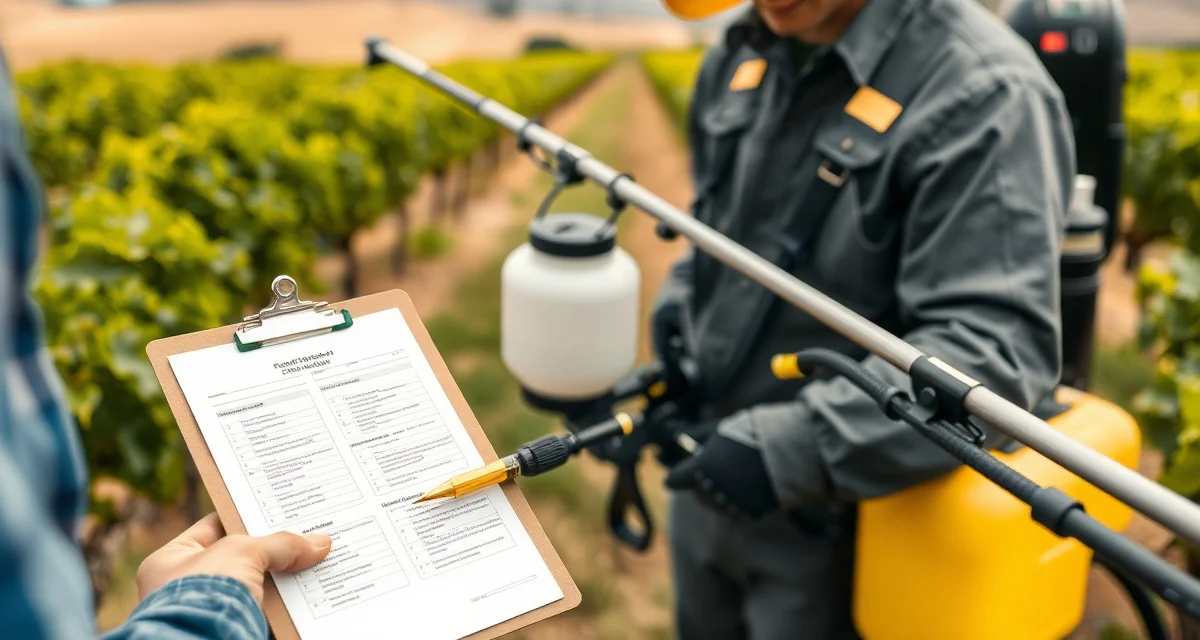
California DPR Spray Record Requirements for Vineyards
California has the most demanding pesticide record-keeping requirements of any wine-producing state. If you're farming grapes in Napa, Sonoma, the Central Valley, or anywhere else in California, you're operating under DPR oversight -- and the 24-hour rule is the one that catches most growers off guard.
TL;DR
- Every pesticide application in a California commercial vineyard must be recorded within 24 hours of application -- the clock runs from when the last row is finished, not from the end of the work week
- "Block 7" is not a legal site description for DPR -- Township/Range/Section or assessor parcel number is required for every spray record
- Missing start or end application times is one of the most common DPR audit failures -- both fields are required on every spray record
- Monthly Pesticide Use Reports (PURs) are due to the county Agricultural Commissioner by the 10th of the following month
- Restricted-use pesticide applications require a valid county permit number on every spray record -- missing it is a violation even when you hold the permit
- California county Agricultural Commissioners can inspect your spray records without prior notice -- records must be producible on demand
You must record every pesticide application within 24 hours of application. Not the next morning. Not at the end of the week. Within 24 hours.
What California DPR Requires on Every Spray Record
The California DPR spray record isn't just a product log. It's a legal document. Every field below is required:
- Operator name -- the business or person making the application
- Permit number -- issued by your county agricultural commissioner
- County where the application occurred
- Commodity -- for vineyards, this is grapes (wine, table, or raisin)
- Crop stage at time of application
- Site location -- legal description or Township/Range/Section
- Acres treated -- not block name alone; actual acres
- Application date
- Application start time and end time
- Product name as it appears on the label
- EPA registration number
- Amount of product used (gallons, pounds, or ounces)
- Amount of concentrate used (for diluted products)
- Unit treated (acres, thousand cubic feet, etc.)
- Target pest(s)
- Application method -- air blast, ground spray, chemigation, etc.
- Applicator name and license number (for restricted use pesticides)
- Equipment used
For restricted use pesticides, you also need the permit condition number referenced on your County Ag Commissioner permit.
The 24-Hour Rule in Practice
Here's how it works in the field: your spray crew finishes the last row of Cabernet in Block 12 at 3:30 p.m. You have until 3:30 p.m. the following day to have that application recorded. Not started -- completed and recorded.
Most growers who fail this requirement don't fail it because they forgot to spray. They fail it because they logged the spray on Thursday when they actually applied on Wednesday. That's a violation.
VitiScribe timestamps spray records at entry and flags any record entered more than 24 hours after the application date you entered. You see the warning before it becomes a problem.
Monthly Pesticide Use Reporting
Beyond your internal spray records, California requires Pesticide Use Reports (PURs) submitted to your county agricultural commissioner monthly. These reports summarize all pesticide applications made during the prior month.
The monthly report format is standardized by DPR. It includes essentially the same fields as your application records, aggregated by product and site.
Deadlines: Monthly reports are due by the 10th of the following month. So your July applications are due to the county by August 10th.
Restricted Use Pesticides (RUPs): These require a permit from the county agricultural commissioner before any application. The permit specifies conditions -- buffer zones, application timing restrictions, notifiable neighbors -- that you must document compliance with.
How County Agricultural Commissioners Work With DPR
DPR sets the rules. County agricultural commissioners (CACs) enforce them locally. Your CAC issues pesticide use permits, receives your monthly reports, and conducts field inspections.
Each county has some discretion in how they implement DPR requirements. Napa County runs a tight ship. Sonoma County's CAC office handles an enormous volume and does routine inspections of commercial operations. If you're farming in a county with intensive agricultural activity, expect inspections.
The CAC can inspect your records without prior notice. You have to produce your spray logs on demand.
Common DPR Audit Failures in Vineyards
From watching other operations go through audits and having been through a few ourselves, here's what gets people:
Missing start/end times: The 24-hour rule sounds simple until you realize you also need both start and end times. A lot of growers log the date and forget the time fields entirely.
Wrong site description: "Block 7" isn't a legal location description. DPR wants Township/Range/Section or a parcel number they can map. Many small vineyard owners don't know their T/R/S off the top of their head.
Acreage discrepancies: If your permit says 18.5 acres in a given block and your spray record says 20 acres, that's a problem. Know your treated acres precisely.
Unlicensed applicators on RUPs: If a restricted use product was applied, the person who applied it must have a valid private or commercial pesticide applicator license. If they don't have one, don't put them on the record -- and don't have them apply RUPs.
No permit number: Every RUP application requires a permit number. Missing it on the spray record is a violation even if you have the permit.
How VitiScribe Handles CA DPR Requirements
VitiScribe's California DPR template has every required field pre-built. You can't submit a spray record without completing the mandatory fields. The system won't let you skip acreage, application time, or permit number.
The monthly PUR export formats directly to DPR's standard reporting format. You review it, confirm it's accurate, and it's ready to submit to your CAC.
VitiScribe also maintains applicator license records so you can verify anyone applying RUPs has a current license before they touch the product. For more on how California DPR compliance records are structured, see California DPR reporting for vineyards.
Step-by-Step: Logging a CA DPR-Compliant Spray Record in VitiScribe
- Open a new spray event in VitiScribe -- from mobile or desktop
- Select the block(s) being treated -- acreage auto-populates from your block setup
- Select product from the library (EPA reg number auto-fills)
- Enter rate -- the system calculates total product used from your block acres
- Select application method and equipment
- Enter start time when you begin; enter end time when you finish
- System timestamps the record and flags it if you're approaching the 24-hour mark
- Assign applicator -- if it's an RUP, the system verifies license status
- Confirm and save -- PHI and REI are auto-calculated and displayed
Total time in field: under 2 minutes per block.
Related Articles
- California DPR Restricted Use Pesticide Records for Vineyards
- CDFA Compliance for California Vineyards: Regulations Beyond DPR
- Federal Pesticide Record Requirements for Vineyards: FIFRA and EPA Compliance
FAQ
What fields does California DPR require on spray records?
California DPR requires: operator name, permit number, county, commodity, crop stage, site location (T/R/S or parcel), acres treated, application date, start and end time, product name and EPA reg number, amount used, unit treated, target pest, application method, equipment, and applicator name/license number for restricted use products. For RUPs, the permit condition number is also required.
Do I need a PCO license to apply pesticides in California vineyards?
You need a private pesticide applicator license to apply restricted use pesticides (RUPs) on property you own, lease, or manage. A commercial pesticide applicator license is required if you apply pesticides for hire. General use pesticides don't require a license, but your application still has to be recorded. If you're hiring a contractor to apply RUPs, verify their commercial license before they start.
How do I submit restricted use pesticide reports in California?
Monthly pesticide use reports go to your county agricultural commissioner by the 10th of the following month. Most counties accept electronic submissions. Some counties have online portals; others still accept PDF or paper. VitiScribe generates the report in DPR's standard format so you can submit it however your county prefers. Contact your local CAC office to confirm their preferred submission method.
What are the penalties for late or incomplete California DPR spray records?
Missing a required field, filing late, or applying an RUP without a valid permit can each generate a DPR citation. Citations for individual violations typically range from $100 for administrative errors to $2,000 or more for unlicensed RUP applications or willful violations. Repeat violations within a compliance period escalate in severity. Multiple citations in a single audit cycle can trigger a formal compliance order requiring corrective action. The most direct way to avoid citations is required-field enforcement at the point of data entry -- which is how VitiScribe's spray record form is structured.
Does the 24-hour record requirement apply to both restricted-use and general-use pesticides in California?
California DPR's 24-hour recording requirement applies to all commercial pesticide applications, including general-use products. The 24-hour window is a recording requirement -- you must have the application documented within 24 hours. The monthly PUR filing is a separate requirement with its own deadline. Some growers confuse the two and believe that timely monthly filing satisfies the 24-hour record requirement. It does not -- the internal record must exist within 24 hours regardless of when the monthly report is filed.
What is California DPR Spray Record Requirements for Vineyards?
[FAQ_ANSWER_PLACEHOLDER: This answer needs to be generated by AI with specific data, examples, and actionable advice relevant to California DPR Spray Record Requirements for Vineyards. Target 50-150 words.]
How much does California DPR Spray Record Requirements for Vineyards cost?
[FAQ_ANSWER_PLACEHOLDER: This answer needs to be generated by AI with specific data, examples, and actionable advice relevant to California DPR Spray Record Requirements for Vineyards. Target 50-150 words.]
How does California DPR Spray Record Requirements for Vineyards work?
[FAQ_ANSWER_PLACEHOLDER: This answer needs to be generated by AI with specific data, examples, and actionable advice relevant to California DPR Spray Record Requirements for Vineyards. Target 50-150 words.]
Sources
- California Department of Pesticide Regulation (CDPR)
- UC Cooperative Extension Viticulture
- Wine Institute
- American Vineyard Foundation
- American Society for Enology and Viticulture (ASEV)
Get Started with VitiScribe
California DPR compliance is built on a foundation of same-day spray record entry -- every field, every application, within 24 hours. VitiScribe's required-field enforcement means you can't accidentally submit an incomplete record, and the 24-hour flag warns you before a late entry becomes a citation. Try VitiScribe free and log your first California-compliant spray record from your phone in the vineyard today.