Canopy and crop management in vineyards: a complete field guide

TL;DR
- Canopy management is the set of practices, shoot thinning, leaf removal, hedging, and crop thinning, that controls how a grapevine fills its trellis, catches sunlight, and sends energy to fruit.
- Done well, it raises sugar, lowers disease pressure, and makes spray programs work.
- Done poorly or skipped, it costs you quality and usually pushes pesticide rates up to compensate.
What is canopy management in fruit crops and why does it matter so much in grapes?
Canopy management is the deliberate shaping of a vine's shoot and leaf architecture to balance vegetative growth against fruit production. In grapevines specifically, the goal is getting enough sunlight into the fruit zone and through the canopy to ripen clusters while keeping humidity low enough to slow fungal disease. Those two goals pull in the same direction.
Grapes are unusual among fruit crops because they're perennial, trained on a fixed trellis, and capable of enormous vigor when soil water and nitrogen are plentiful. A Cabernet Sauvignon vine on a fertile valley floor with drip irrigation can push four to six shoot meters of growth per internode if you let it [1]. That kind of density shades the fruit zone to under 10% of full sunlight, which stops anthocyanin synthesis cold and leaves you with green, herbaceous berries no matter how long you wait.
The reference practitioners reach for first is Richard Smart and Mike Robinson's "Sunlight into Wine" (Winetitles, 1991), which popularized the Point Quadrat Analysis method for measuring canopy density. For a deeper academic treatment, Tony Gould's "Canopy Management of Fruit Crops" covers the physiology behind why leaf area index, light interception, and shoot density interact the way they do. Many of the underlying studies are available through university library portals, though the book itself is the best starting point for practitioners who want the research rather than just the recommendations.
The core insight is simple. A grape cluster needs roughly 30 to 50 moles of photosynthetically active radiation per day to ripen properly, and most dense canopies deliver less than 10 [2]. Everything else in canopy management flows from fixing that one number.
What canopy management practices actually move the needle on grape quality?
Five practices tie consistently to measurable quality gains in the research. Here they are roughly in the order you'd do them across a growing season.
Shoot thinning happens before or just after bloom, when shoots are 15 to 30 cm long. You're pulling excess shoots off the cordon to hit a target density, usually 12 to 18 shoots per meter of canopy row, depending on your system and variety [1]. Too few and you leave yield on the table. Too many and you're paying to manage a problem you could have prevented in May.
Shoot positioning is the mechanical tucking or training of shoots into the trellis wires so they grow upright rather than flopping outward or inward. It sounds tedious. It is. But positioned shoots intercept light individually rather than competing, and they make every downstream operation faster: hedging, spraying, harvest.
Leaf removal in the fruit zone is probably the single most studied practice in viticultural research. UC Davis work going back to the 1990s showed that removing basal leaves on the east or morning-sun side of the canopy reduces botrytis bunch rot incidence by 30 to 50% in susceptible varieties while improving color and tannin structure in red wines [2]. Early leaf removal, before or at bloom, can also reduce cluster compactness in tight-clustered varieties like Pinot Gris and Sangiovese, which itself is a disease-management tool.
Hedging (shoot topping) mechanically terminates shoot tips to stop apical growth and redirect carbohydrates toward the fruit. The timing matters: hedge too early and you get a flush of lateral growth that recreates the canopy density problem within three weeks. Hedge too late and the benefit to fruit ripening is small. Most Napa and Sonoma operations hedge around fruit set, then again as needed through veraison [3].
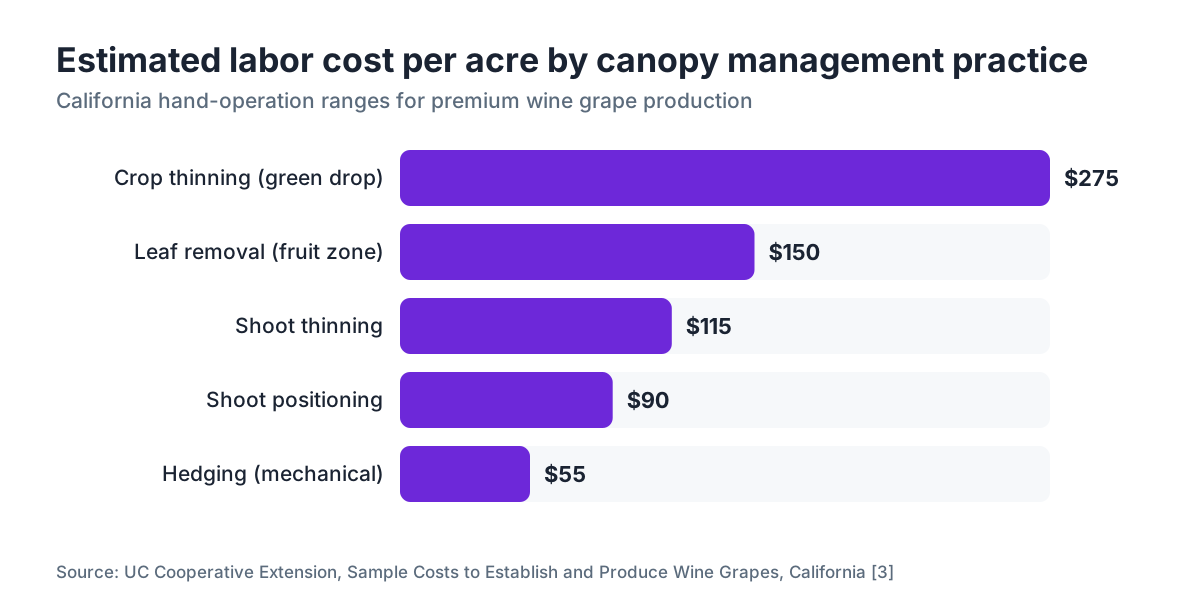
Crop thinning (green drop) removes clusters or cluster halves to reduce yield per vine, concentrating resources in the remaining fruit. This is the most expensive practice on the list, costing 150 to 400 dollars per acre in hand labor depending on your market. The quality response is real but nonlinear: dropping from four tons per acre to two tons per acre doesn't automatically double wine quality. The benefit is most consistent in cool climates and high-vigor sites where the vine is genuinely overloaded.
| Practice | Timing | Labor cost (est., $/acre) | Primary quality benefit |
|---|---|---|---|
| Shoot thinning | Pre-bloom | 80 to 150 | Light penetration, air circulation |
| Shoot positioning | Pre-bloom to bloom | 60 to 120 | Spray coverage, hedging efficiency |
| Leaf removal (fruit zone) | Bloom to fruit set | 100 to 200 | Botrytis reduction, color/tannin |
| Hedging | Fruit set; repeat as needed | 30 to 80 (mech.) | Carbohydrate redirection |
| Crop thinning | Fruit set to veraison | 150 to 400 | Yield concentration |
Labor cost ranges are general estimates for California hand operations. They vary a lot by region, wage rate, and vine spacing [3].
How does canopy density affect your spray program and pesticide efficacy?
This is where canopy management stops being just a quality conversation and becomes a compliance and cost conversation.
A dense canopy defeats spray coverage. When shoots overlap and the fruit zone is buried under three layers of leaves, your sprayer deposits pesticide on the outer canopy surfaces and leaves the cluster zone nearly untreated. You end up either increasing the application rate to compensate, making more passes, or accepting reduced efficacy, all of which cost money or introduce regulatory risk.
WSU Extension work on spray penetration in wine grapes found that canopy density, measured as leaf layer number, is one of the strongest predictors of fungicide performance against powdery mildew [4]. Canopies with more than 3.5 leaf layers at the cluster zone showed 40 to 60% lower deposit coverage at the cluster surface compared to well-managed canopies with 1.5 to 2.5 leaf layers.
This has a direct bearing on your pesticide use records. Under EPA's Worker Protection Standard (WPS), revised 40 CFR Part 170, you're required to maintain accurate records of pesticide applications including the rate applied and the target pest [5]. If you're increasing rates because spray coverage is poor, that's both a cost and a documentation issue. A vineyard with a well-managed canopy often runs fungicide programs at labeled rates and gets better results than a dense-canopy operation trying to compensate with higher rates or more frequent applications.
The practical takeaway: treat your leaf removal and shoot positioning work as pre-season prep for your spray program. Open canopies aren't only about wine quality. They're about making every dollar of your spray budget actually reach the target.
What trellis system should you choose and how does it affect canopy management options?
Your trellis system determines what canopy management is even possible. This is a decision that follows you for 25 years, so it's worth thinking through before the vineyard goes in.
The main divide is between single-canopy systems (vertical shoot positioning, or VSP, being the most common) and divided canopy systems (Scott Henry, Geneva Double Curtain, Lyre, Smart-Dyson). VSP works well at moderate vine spacing and moderate vigor. It's familiar, mechanical hedging is straightforward, and most labor contractors know how to work it. The problem is that VSP has a ceiling: when vigor is high, even aggressive shoot thinning and leaf removal can't open the canopy enough because you're working with a single curtain of shoots.
Divided canopy systems solve the vigor problem by splitting the canopy into two curtains, effectively doubling the surface area exposed to sunlight without planting more vines. Cornell's research at the Geneva station, which is where the Geneva Double Curtain was developed by Nelson Shaulis in the 1960s, showed that divided canopy systems could increase yield per acre by 30 to 100% while maintaining or improving fruit quality in high-vigor sites [6]. The tradeoff is cost: divided systems require more complex trellis infrastructure and some mechanization adaptations.
For most small vineyard operations in premium wine regions, VSP with aggressive canopy management is the right answer. For high-vigor sites on deep soils with significant irrigation, a divided system pays back the installation cost through better fruit quality and lower per-ton management cost over the life of the vineyard.
You can read about real-world trellis decisions at operations like Gervasi Vineyard or Ponte Winery, both of which have documented their vineyard management approaches publicly.
How do you measure canopy density and know when it's actually a problem?
The Point Quadrat Analysis (PQA) method is the practical standard. You insert a thin probe (a knitting needle works fine) horizontally into the canopy at random points along the fruit zone, count how many leaf contacts it makes, and note whether any of those contacts are clusters, gaps, or interior leaves. Repeat 40 to 80 times per block and you get a canopy density score.
Smart and Robinson's targets from "Sunlight into Wine" are still the most widely used benchmarks [1]:
- Leaf layer number: 1.0 to 1.5 is ideal; above 2.5 is too dense
- Gaps (probe passes through with no contact): 20% or more is good
- Interior leaves: less than 10% of contacts
- Cluster exposure: 50% or more of clusters touched on the probe pass
Point quadrat is fast once you've done it a few times. A trained crew member can score a block in under an hour. The data tells you which management intervention you actually need: if leaf layer number is high but gaps are adequate, you may just need to improve shoot positioning. If cluster exposure is low despite decent gaps, leaf removal in the fruit zone is your answer.
Some operations are moving toward photographic or LiDAR canopy assessment, which is faster and generates spatial maps of density variation across a block. The technology is improving, but PQA is still the most accessible method for small to mid-size vineyard operations, and the underlying thresholds hold regardless of how you measure.
When should leaf removal happen and does early versus late timing really matter?
Timing is the variable that most separates effective leaf removal from wasted labor.
The research consensus, built largely from work at UC Davis and from European studies on Pinot Noir and Sauvignon Blanc, is that leaf removal before or at bloom produces the largest effects on cluster architecture and the smallest clusters [2]. Early removal triggers a physiological response that reduces berry set and loosens the rachis, both of which reduce compactness and later botrytis risk. This is particularly useful in tight-clustered varieties.
Leaf removal after fruit set, from pea-size through veraison, is the most common timing in California premium vineyards. You've already lost the cluster architecture benefit, but you still get substantial improvement in spray coverage, air circulation, and fruit zone sunlight. Color and flavor development are measurably better in red varieties when the fruit zone receives direct morning sun for at least part of the day.
Leaf removal after veraison is mostly too late to affect quality, though it can help in wet years by drying the cluster zone and reducing late-season rot.
The honest nuance here: the "right" timing depends on your climate. In hot interior regions, afternoon sun exposure after leaf removal can sunburn fruit, so morning-side leaf removal only is the standard practice. In cool coastal regions, you can often remove leaves on both sides without burn risk. Cornell Extension notes that leaf removal recommendations for New York Finger Lakes conditions differ substantially from California protocols because of the different heat accumulation patterns [6].
Track your leaf removal timing, the side of the canopy you worked, and the weather in the week after. After three seasons you'll have your own data on what timing works in your specific blocks.
How does canopy management affect record-keeping and regulatory compliance?
Canopy management itself isn't a regulated activity, but it directly affects your pesticide records, your water quality obligations, and in some states your certified sustainable viticulture audit scores.
On the pesticide side, a well-documented connection between canopy condition and application decisions helps you justify rate choices in your spray records. If you're running leaf removal before a fungicide application, noting that in your field log gives an auditor context for why your rates are at the lower end of the label range. This matters for operations that sell to wineries with sustainability certification requirements.
California's County Agricultural Commissioner requires pesticide use reports for all restricted-use pesticides and most general-use pesticides applied commercially [7]. Those records need to include the acres treated, application method, and rate. Canopy condition affects all three in practice: dense canopies often require higher rates or more frequent applications, both of which show up in your reports and can attract follow-up questions.
For operations tracking field activities digitally, a tool like VitiScribe can connect your canopy management work orders directly to your spray records, so the leaf removal date and the following fungicide application are linked in the same block-level timeline. That kind of documentation continuity is what auditors and sustainability programs are looking for.
Under the EPA Worker Protection Standard, any laborer doing hand work in a vineyard where a pesticide with a restricted-entry interval (REI) is active must have WPS training and appropriate PPE [5]. Canopy management crews are directly affected: if you're doing leaf removal within the REI of a recent sulfur or fungicide application, your crew needs the training and you need the records to prove it. UC Davis Extension has solid WPS training materials available to growers and crew supervisors [8].
What's the difference between canopy management for wine grapes versus other fruit crops?
The principles in any "canopy management in fruit crops" text apply broadly, but grapevines have some specific features that make the practice more demanding than in most tree fruits.
Apple and pear canopy management focuses heavily on tree form (central leader vs. open center), renewal pruning, and light distribution to color development. The trellis infrastructure in modern high-density apple is actually more expensive per acre than most wine grape trellising, but the canopy geometry is simpler because you're working with a single tree form rather than a perennial vine trained on a cordon.
Stone fruits (peaches, cherries, plums) share some concerns with grapes around botrytis and brown rot, and leaf removal around the fruit cluster is used in commercial cherry production for similar reasons. But the canopy replacement cycle is different: most stone fruit trees replace their fruiting wood more aggressively through pruning than grapevines do.
In tropical and subtropical fruit crops (mango, avocado, citrus), canopy management is more about managing tree size for harvest access and controlling alternate bearing than about light quality in the fruit zone.
For vineyards specifically, the interaction between canopy density, berry microclimate, and wine flavor compounds (particularly the methoxypyrazines in Cabernet and Sauvignon Blanc that produce green pepper character) is more tightly documented than in most other fruit crops. That's why the viticulture literature on canopy management is proportionally larger than in any other fruit crop, and why texts like "Canopy Management of Fruit Crops" are useful but don't fully substitute for grape-specific resources.
For more background on how specific production regions handle canopy challenges in warm climates, the Paso Robles wineries context is worth reading, as is the general vineyard overview.
What does canopy management cost and what return should you expect?
Nobody has a clean, published cost-benefit study that covers the full range of regions, varieties, and management systems. The honest answer is that the economics depend heavily on what you're selling fruit or wine for and what your baseline canopy problems are.
What we have are component costs and some quality-response data. The table in the second section covers labor cost ranges. For a typical 10-acre premium wine grape block in California, a full canopy management program (shoot thinning, shoot positioning, leaf removal, two hedgings, and possible crop thinning) runs 400 to 900 dollars per acre in variable labor costs [3]. That's on top of winter pruning, which is separate.
On the return side, the evidence is clearest for disease management. Reducing botrytis bunch rot incidence by 30 to 50% through leaf removal (the UC Davis finding) translates directly into fewer spray applications or lower rates, less culled fruit at harvest, and better fermentation behavior [2]. In a year with significant botrytis pressure, that alone can exceed the cost of the leaf removal.
For quality-price uplift, the relationship is real but hard to isolate. A winery paying a base of 2,000 dollars per ton for Pinot Noir might pay 2,400 to 2,800 for fruit that consistently hits their brix, pH, and visual cluster quality targets. Canopy management is one input among several that gets you there.
The clearest return on investment case is in high-vigor sites where dense canopies are generating both quality problems and inflated spray costs. Fixing the canopy through a divided trellis conversion or aggressive shoot thinning can reduce fungicide applications by one to two sprays per season while improving fruit quality. That's a real, calculable number you can put in front of a banker or a vineyard owner.
For operations managing multiple blocks with different vigor levels and spray histories, keeping that data organized matters. VitiScribe's block-level record structure is built around exactly this kind of multi-variable tracking, which is why vineyard managers running five or more blocks tend to find it useful at trial.
How do you train new crew members on canopy management techniques?
Training is where canopy management programs fall apart most often. The principle is easy to explain. The execution takes judgment that develops over a season or two.
The most effective approach I've seen combines a short classroom or tailgate session with immediate hands-on demonstration. Show the target before the crew starts a block: a properly shoot-thinned cordon, a correctly leaf-removed fruit zone, a positioned shoot. Then walk the first 10 vines with the crew member and check their work before they move on independently.
For shoot thinning, the common errors are removing the wrong shoots (always keep shoots arising from two-year wood over shoots from older wood), leaving too many, or breaking desirable shoots while pulling unwanted ones. For leaf removal, the error is usually removing too many leaves above the cluster zone (which reduces photosynthesis) while not being aggressive enough in the tight cluster zone itself.
WSU Extension has published illustrated guides for several of these operations that work well as training handouts [4]. UC Davis Cooperative Extension also publishes variety-specific viticulture guidelines with canopy management sections [8]. Cornell's extension program, particularly for cool-climate varieties, has practical guides that are freely available online [6].
Document your training. Under WPS, you need records that show workers received pesticide safety training before working in treated areas [5]. If canopy management crews will work in blocks within re-entry intervals, that training documentation isn't optional. Keep it in the same filing system as your spray records so it's accessible during an inspection.
What are the most common canopy management mistakes that hurt wine quality?
Skipping shoot thinning to save labor cost is probably the most common and the most expensive mistake. You pay for it with every downstream operation: leaf removal takes longer in a dense canopy, hedging is less effective, spray coverage is worse. The shoot thinning labor cost is the cheapest insurance you can buy in the spring.
Doing leaf removal too late is the second. If you're pulling leaves in August on a Pinot Noir block in a cool climate, you've missed most of the berry development window and you're getting marginal benefit on disease control.
Hedging too early and too aggressively triggers lateral shoot growth that recreates canopy density within weeks. A single late-afternoon walk through a block three weeks after hedging will tell you whether you're dealing with this problem. Laterals in the fruit zone that are more than three nodes long need to be managed or you've negated the hedging entirely.
Over-cropping relative to vine capacity is the mistake that's hardest to reverse. A vine carrying more fruit than its leaf area can ripen will delay maturity and produce thin, dilute wine regardless of how well you manage the canopy. Your target crop load (measured as the Ravaz Index, which is fruit weight divided by pruning weight) should generally fall between 5 and 10 for premium wine production, with most varieties performing best in the 6 to 8 range [1]. If you're consistently above 10, you're over-cropped.
One more: managing every block the same way regardless of vigor, variety, or training system. A low-vigor Grenache block on sandy soil needs different shoot density targets than a high-vigor Cabernet Sauvignon on deep clay. Blanket protocols save time in the short run and cost quality in the long run.
Frequently asked questions
What is the Ravaz Index and what's the target range for wine grapes?
The Ravaz Index is fruit weight at harvest divided by dormant pruning weight, both measured per vine. It's a quick way to assess whether a vine is in balance. The general target for premium wine grape production is 5 to 10, with most varieties showing best quality results between 6 and 8. Above 10 indicates over-cropping; below 4 suggests excessive vegetative growth relative to fruit load. Smart and Robinson's 'Sunlight into Wine' remains the main reference for these thresholds.
How many shoots per meter of row should I target when shoot thinning?
Most VSP-trained vineyards target 12 to 18 shoots per meter of canopy, depending on variety and desired yield. Lower-vigor varieties or premium programs often aim for the lower end of that range. High-vigor sites may need to hit 10 to 12 shoots per meter to keep canopy density manageable. Your local UC Davis, Cornell, or WSU extension viticulturist can give region-specific recommendations based on your training system and variety.
Does leaf removal on both sides of the canopy risk sunburn?
Yes, in hot climates or during heat spikes. In California's warm interior valleys, west-side or afternoon-sun-side leaf removal can sunburn fruit, especially in thin-skinned varieties like Pinot Noir and Chardonnay. The standard practice in hot regions is morning-side (east-side) leaf removal only, which opens the canopy and reduces humidity without exposing fruit to peak afternoon radiation. In cool coastal and northern climates, both-side removal is often safe.
What is Point Quadrat Analysis and how do I do it?
Point Quadrat Analysis is a canopy density measurement method developed by Smart and Robinson. You insert a thin probe horizontally into the fruit zone canopy at random points along the row, then record the number of leaf contacts and note gaps, clusters, and interior leaves. Targets are: leaf layer number below 1.5, gaps above 20%, interior leaves below 10%, and cluster exposure above 50%. Repeat 40 to 80 insertions per block for a reliable score.
Is there a good book on canopy management in fruit crops for viticulture reference?
The most cited practitioner reference is Smart and Robinson's 'Sunlight into Wine' (Winetitles, 1991), which covers grapevine canopy specifically. Tony Gould's 'Canopy Management of Fruit Crops' covers broader fruit crop physiology and is useful for understanding the science behind vine behavior. Many university library portals carry PDF access to the underlying research papers. UC Davis, Cornell, and WSU Extension also publish free online viticulture guides covering canopy management in detail.
How does canopy management affect pesticide use and my spray records?
Open, well-managed canopies improve spray penetration to the cluster zone, which means your fungicides and insecticides actually reach the target. Dense canopies force you to increase rates or add applications to compensate, which shows up in your required pesticide use records. California's County Agricultural Commissioner requires detailed pesticide application records. A well-documented canopy management program that precedes spray applications supports your rate justification and helps in sustainability audits.
What does the EPA Worker Protection Standard require for canopy management crews?
Under EPA's revised Worker Protection Standard (40 CFR Part 170), any agricultural worker entering a treated area must receive WPS safety training before they work. Canopy management crews doing hand work in blocks within a pesticide's restricted-entry interval must have current WPS training and appropriate PPE. Employers must maintain training records. The standard applies to all agricultural workers on farms using pesticides, regardless of the specific task they're performing.
When is the best time to do leaf removal for botrytis prevention?
Early leaf removal, at or before bloom, produces the largest reduction in cluster compactness and later botrytis incidence. UC Davis research showed leaf removal timed at or before bloom reduced botrytis bunch rot by 30 to 50% in susceptible varieties. Leaf removal at pea-size through fruit set is the most common California practice and still provides meaningful disease control through improved air circulation and spray coverage. After veraison, the benefit drops significantly.
Can canopy management replace fungicide applications for powdery mildew control?
No, and claiming otherwise would be irresponsible. Canopy management reduces disease pressure by improving air circulation, reducing humidity in the cluster zone, and improving fungicide penetration. WSU research found that dense canopies (more than 3.5 leaf layers at the cluster) reduce deposit coverage at the cluster surface by 40 to 60% compared to well-managed canopies. That means canopy management makes your fungicides work better, not that you can skip them.
How does crop thinning (green drop) interact with canopy management?
Crop thinning and canopy management address the same underlying problem from different angles. A vine carrying too much fruit relative to its leaf area will struggle to ripen regardless of canopy adjustments. Crop thinning reduces the fruit load so existing leaf area can ripen the remaining clusters fully. The two practices work together: open the canopy for light and air quality, then match fruit load to actual leaf area capacity. Skipping one and doing the other gets you partial results.
What's the difference between hedging and topping a grapevine?
Hedging and topping mean the same thing: mechanically cutting shoot tips to terminate apical growth. The terms are used interchangeably in different regions. The practice redirects carbohydrates toward fruit ripening rather than continued vegetative growth. Timing matters more than the specific term. Topping too early triggers lateral shoot regrowth that recreates canopy density within weeks. Most operations hedge around fruit set and repeat as needed, with a final pass before or during veraison.
How many leaf removal passes per season are typical in premium wine grape production?
Most premium wine grape operations do one leaf removal pass in the fruit zone per season, timed between bloom and fruit set. Some operations in botrytis-prone varieties or wet climates do a second pass after hedging to remove lateral growth that has closed the canopy back up. More than two passes is unusual and probably indicates an underlying vigor or training system problem rather than a leaf removal deficiency.
Where can I find free canopy management resources from university extension programs?
UC Davis Cooperative Extension publishes variety-specific viticulture guidelines at their website. Cornell Cooperative Extension's viticulture program covers cool-climate canopy management, particularly for Riesling, Pinot Noir, and hybrid varieties. WSU Extension has published guides on spray penetration and canopy density in Pacific Northwest wine grapes. All three programs offer free downloadable guides, and many run regional workshops where you can work through Point Quadrat Analysis with an extension advisor.
Is mechanical leaf removal as effective as hand leaf removal?
Mechanical leaf removal is faster and cheaper per acre but less precise. Mechanical removal works best on the morning side of uniform, well-positioned canopies. In dense or poorly positioned canopies, mechanical removal often misses leaves in the cluster zone and damages clusters. Hand removal lets crew members selectively open tight cluster areas without disturbing well-positioned fruit. Many operations use mechanical removal for larger, uniform blocks and hand removal in blocks with high botrytis risk or irregular canopy structure.
Sources
- Smart, R. and Robinson, M., 'Sunlight into Wine: A Handbook for Winegrape Canopy Management', Winetitles, 1991: Optimal leaf layer number is 1.0 to 1.5; Ravaz Index target of 5 to 10 for premium wine grapes; shoot density targets of 12 to 18 per meter
- UC Davis Cooperative Extension, Viticulture Research Publications: Early leaf removal reduces botrytis bunch rot incidence by 30 to 50% in susceptible varieties; fruit zone requires 30 to 50 moles PAR per day for proper ripening
- UC Cooperative Extension, Sample Costs to Establish and Produce Wine Grapes, California: Labor cost ranges for canopy management operations in California wine grape production
- Washington State University Extension, Viticulture and Enology Program, Spray Application and Canopy Management: Canopies with more than 3.5 leaf layers at the cluster zone showed 40 to 60% lower fungicide deposit coverage at the cluster surface compared to well-managed canopies
- EPA, Worker Protection Standard, 40 CFR Part 170: WPS requires agricultural workers in treated areas to have safety training and PPE; employers must maintain training records; applies to workers within restricted-entry intervals
- Cornell Cooperative Extension, Viticulture Program, New York State Agricultural Experiment Station: Geneva Double Curtain divided canopy systems increased yield per acre by 30 to 100% while maintaining or improving fruit quality in high-vigor sites; cool-climate leaf removal timing differs from California protocols
- California Department of Pesticide Regulation, Pesticide Use Reporting: California County Agricultural Commissioners require pesticide use reports for restricted-use and most general-use pesticides applied commercially, including rate and acres treated
- UC Cooperative Extension, Sunburn and Leaf Removal in Wine Grapes, Viticulture Notes: West-side or afternoon leaf removal can sunburn fruit in hot climates; morning-side removal is the standard practice in California warm interior valleys; WPS training materials for growers and crew supervisors
Last updated 2026-07-09