Advantages of canopy management in vineyards: what the research actually shows
TL;DR
- Canopy management is the deliberate control of shoot, leaf, and fruit position in a vine.
- It moves sunlight and air through the canopy, which raises sugar and phenolic ripeness, cuts fungal disease, and makes sprays land where they should.
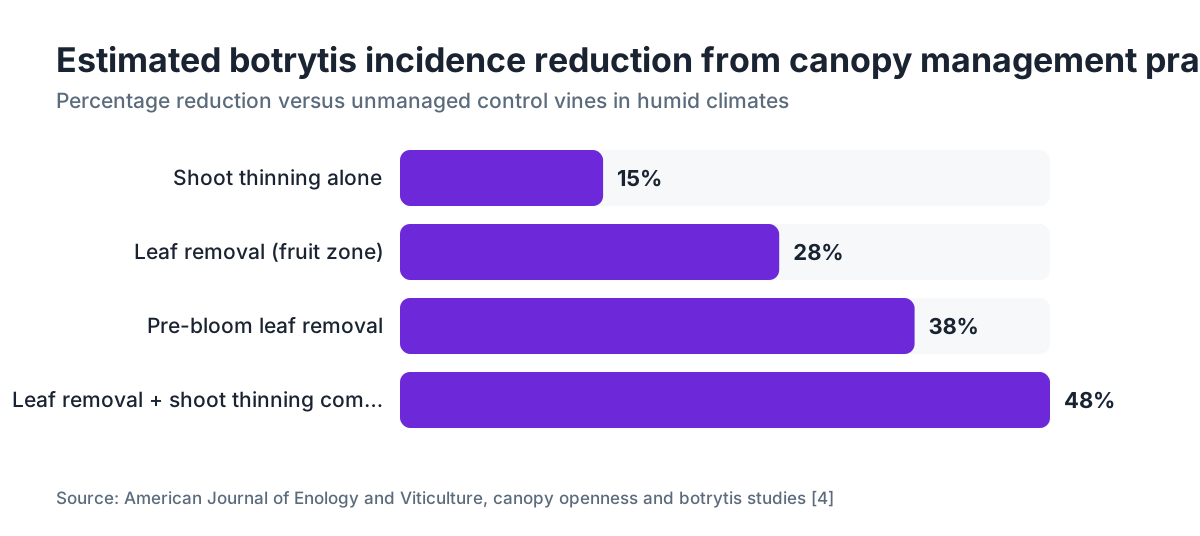
- University trials show 1 to 3 Brix gains and botrytis reductions of 30 to 50 percent when shoot spacing and leaf removal are done on time.
What is canopy management in viticulture, and why does it matter?
Canopy management is how you control the way a grapevine fills the space you gave it: shoot positioning, leaf removal, hedging, shoot thinning, and sometimes fruit-zone netting or tucking. The goal is simple. You want sunlight and air moving through the vine, not sitting on the outside while the interior rots.
Vines get vigorous fast when the site lets them. Fertile soil, irrigation, and warm nights push shoots hard. Left alone, that growth builds a wall of leaves where humidity climbs, fungal spores germinate, and the grapes that will become your wine sit in the shade. Shaded berries ripen unevenly, hold less sugar, and keep more malic acid. Their skins run thinner too, with lower anthocyanin and tannin, which matters a lot if you're growing reds [1].
The research goes back decades. Richard Smart and Mike Robinson's 1991 book "Sunlight into Wine" pulled together field data from several continents showing canopy microclimate is one of the strongest predictors of wine quality a grower can touch [7]. The concept has been refined since. The core finding holds: a well-managed canopy is one of the most direct quality levers you have.
How does canopy management improve fruit quality and Brix?
Light drives photosynthesis, and in grapes it also drives the chemistry that decides quality. Clusters that catch direct morning sun (filtered, not the scorching afternoon kind) build more sugar, more anthocyanin, and better aroma precursors than shaded clusters. UC Davis viticulture research shows that moving a fruit zone from shaded to well-lit can add 1 to 3 Brix under comparable irrigation and nutrition [1].
Leaf removal is the clearest example. Pull 2 to 4 basal leaves off the east-facing side of a north-south row between fruit set and veraison, and you get better air movement and light without much sunburn in most California and Pacific Northwest climates. Cornell extension work shows early leaf removal, from pre-bloom to fruit set, also loosens clusters, which cuts botrytis later in the season [2].
Shoot spacing matters just as much. When shoots overlap, the interior leaves stop pulling their weight for photosynthesis. Washington State University extension puts the target at 3 to 4 inches between shoots at the cordon to hold canopy density down [3]. Hit that spacing and you improve more than light. You improve spray penetration, which we'll come back to.
Brix is the headline number. The quality effects run wider. Phenolic ripeness, aroma development, and pH all respond to canopy microclimate. A vine that ripens evenly because the whole cluster sees light is easy to pick at the right moment. A vine where the inside clusters trail the outside ones by two weeks forces an ugly harvest call.
What effect does canopy management have on fungal disease pressure?
This is where the economic case gets concrete fast. Botrytis cinerea, powdery mildew (Erysiphe necator), and downy mildew (Plasmopara viticola) all want the same thing: high humidity, dead air, and leaf tissue that stays wet. A dense canopy builds exactly that inside the vine.
Studies in the American Journal of Enology and Viticulture find that opening the canopy through leaf removal and shoot thinning cuts botrytis incidence by 30 to 50 percent versus unmanaged control vines in humid climates [4]. That is not a small number. In a bad botrytis year, crop losses run past 30 percent of yield in varieties like Pinot noir and Gewürztraminer. Halving disease incidence with a cultural practice almost always beats spraying your way out after the fact.
Powdery mildew responds too. The pathogen needs living green tissue and shade to set up. Open canopies dry faster after rain and dew, which shortens the infection window. This won't retire your fungicide program, but it can trim the number of applications and sharpen coverage when you do spray.
For growers under the EPA Worker Protection Standard [5], fewer spray events pays off on compliance. Every application triggers a re-entry interval, record-keeping, and worker notification. The WPS requires that workers stay out of treated areas during the REI and that employers keep application records, so anything that cuts spray frequency cuts compliance hours right along with it.
How does canopy management make pesticide programs more effective?
Spray coverage is one of the quietest variables in vineyard disease control and one of the most important. It doesn't matter what product you bought if it never reaches the fruit zone.
A dense canopy is a physical wall. Air-blast output bounces off the outer leaves and never gets to the inner clusters. WSU researchers who measured spray deposition in dense versus open canopies found canopy density is a primary driver of how well any pesticide reaches its target [3]. An open, vertically positioned canopy can double effective deposition versus an unmanaged one on the same sprayer setup.
That carries a cost angle. If coverage jumps with better canopy work, you may be able to cut spray volume or concentration and hold the same efficacy. Copper, sulfur, and synthetic fungicides are real dollars per acre, so that efficiency counts. Copper in particular carries cumulative soil-load concerns, and EPA restricts total copper rates in certain organic programs [6].
For growers logging applications, and every commercial grower has to under state pesticide rules and the WPS where it applies, better canopy management leaves a cleaner paper trail because you intervene less. Record-keeping tools like VitiScribe let you track spray timing against canopy milestones, so you can see over several seasons whether your leaf-removal dates line up with fewer fungicide passes.
What are the specific canopy management practices and when should each be done?
There isn't one canopy management practice. It's a toolkit, and the right mix depends on your variety, training system, climate, and quality goals. Here's what each one does and when it earns its place.
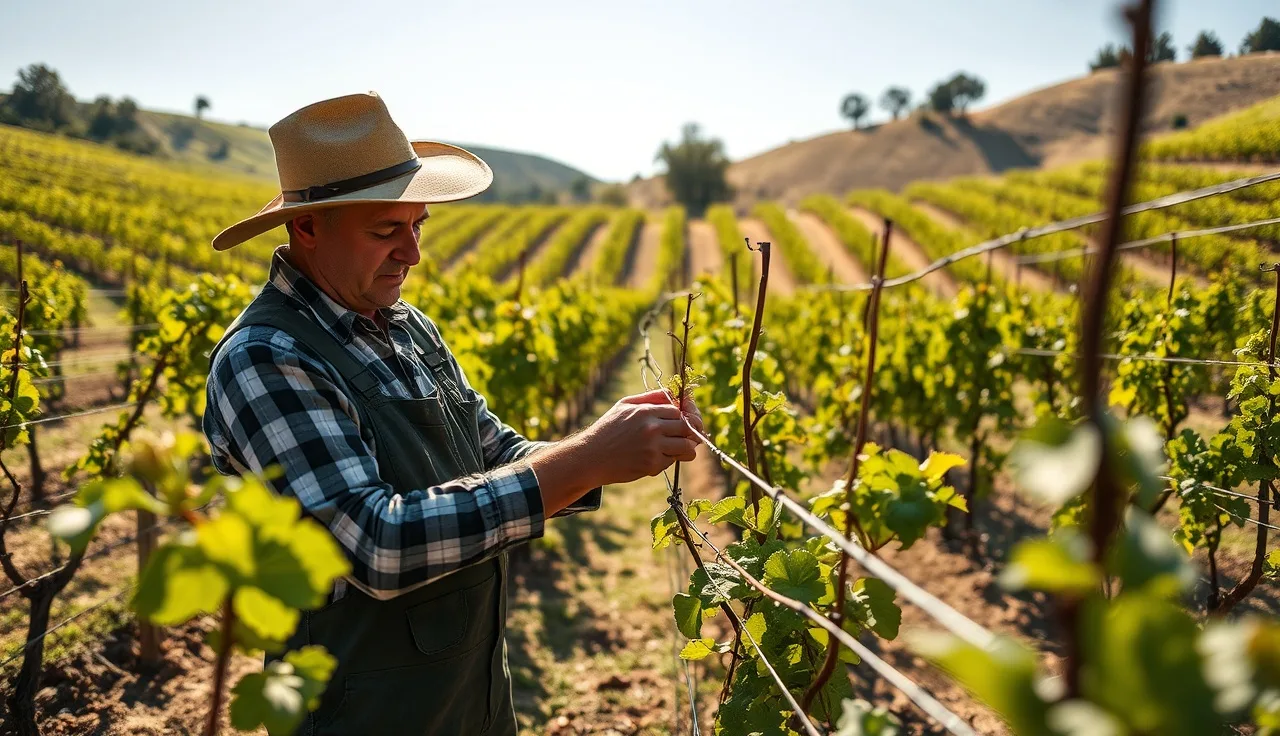
Shoot positioning happens early, usually at 8 to 12 inch shoots, before they harden. You tuck shoots up into the trellis wires so they grow vertically instead of flopping. This is foundational. Almost everything else works better once shoots are positioned.
Shoot thinning strips excess shoots off the cordon, usually leaving one shoot per bud position or pulling doubles. Do it at 4 to 8 inch shoot length. WSU extension targets 3 to 4 inches of spacing between shoots at the cordon [3]. Thinning cuts crop load when you pair it with cluster thinning, and it opens the canopy before density becomes a problem.
Leaf removal in the fruit zone has the deepest research behind it. Pull 2 to 4 basal leaves on the shaded or morning-sun side between fruit set and veraison, and you've got a well-established quality driver. Pre-bloom leaf removal is more aggressive; Cornell research shows it loosens clusters and drops botrytis risk, but it can cut yield if you go too early or too hard [2]. The tradeoff is real and worth understanding before you do it.
Hedging (shoot topping) cuts the tips off shoots that climbed above the trellis. You do it for equipment clearance and to shed shoot weight, and it usually repeats two to three times a season on high-vigor sites. It doesn't open the interior, but it drops overall leaf area and vigor.
Suckering pulls shoots off the trunk and below-ground wood. It's mostly vine health and training, but keeping trunks clean also cuts disease inoculum sitting in old wood.
| Practice | Timing | Primary Benefit | Caution |
|---|---|---|---|
| Shoot positioning | 8 to 12 inch shoot length | Canopy openness, spray access | Do before shoots harden |
| Shoot thinning | 4 to 8 inch shoot length | Reduces density, crop load | Can reduce yield |
| Leaf removal (fruit zone) | Fruit set to veraison | Light, air, disease reduction | Sunburn risk in hot climates |
| Pre-bloom leaf removal | Pre-bloom | Cluster loosening, botrytis | Yield reduction risk |
| Hedging | Repeated, midsummer | Vigor control | Doesn't open interior |
| Suckering | Early season | Vine health, disease inoculum | Labor cost |
Does canopy management actually save money, or is it just more labor cost?
Honest answer: it adds labor in the short run and saves money on inputs and crop losses over time. The labor math is real and you shouldn't wave it away.
Shoot positioning and leaf removal in a commercial block run 8 to 20 hours per acre depending on vine density, training system, and how far behind the canopy got before you started. At $18 to 25 per hour for skilled vineyard labor (a rough California and Pacific Northwest range as of 2024, with real variation by region and season), that's $150 to 500 per acre for those two tasks alone. Shoot thinning stacks on more.
What comes back: fewer fungicide passes (often 1 to 3 per season), lower botrytis crop-loss risk, and fruit quality that can move contract price or cellar outcomes. Cornell extension frames the disease benefit as especially strong in humid eastern regions, where botrytis and downy mildew pressure runs high enough that cultural control shows measurable ROI [2].
For small wineries crushing their own fruit, the quality upside is harder to price, but it's there. Evenly ripened grapes with better phenolic development make better wine with less intervention in the cellar. That isn't a marketing line. It's what winemakers report when they compare managed and unmanaged blocks side by side.
For growers selling to a winery, many contracts now carry quality incentives tied to Brix, pH, or intake scores. If better canopy work adds 1.5 Brix and bumps your contract tier, that lands straight in revenue per ton.
How does canopy management interact with irrigation and vine vigor?
Canopy management doesn't work in isolation. The biggest wall most growers hit is that rich soil and generous water grow vines that regrow their canopy almost as fast as you manage it. You can hedge and leaf-strip all season and still stare at a dense, shaded canopy in August if the vine is pushing too hard.
Vine balance, the ratio of leaf area to crop load, is the idea underneath all of this. UC Davis researchers have long used the Ravaz Index (yield in pounds per vine divided by pruning weight in pounds) as a proxy, with values between 3 and 7 generally read as balanced for most wine grapes [1]. Outside that range, a vine either carries too much fruit for its leaf area (stressed, underdeveloped fruit) or too much leaf area for its fruit (shaded, unripe clusters).
If your vines run hot on vigor year after year, canopy work alone won't fix it. You may need to look at rootstock, irrigation volume, cover-crop competition, or nitrogen. Canopy work gets far easier and more effective once vigor fits the site. Try to manage a wildly vigorous vine through thinning and leaf removal alone and you're spending a lot of money on a job that keeps undoing itself.
Cover crops help here. A well-established perennial grass in the row middles competes with the vine for water and nitrogen, pulling vigor down without any permanent infrastructure change. The tradeoff is spring frost risk and the work of mowing or managing the crop itself.
What does canopy management look like for different training systems?
Training system changes everything. What works on a vertical shoot positioning (VSP) trellis with a single cordon is not what you'd do on a Scott Henry, a Geneva Double Curtain (GDC), or a sprawl system.
VSP is the most common setup in premium regions, and it's where most of the leaf-removal and shoot-spacing research was done. The principles are settled. You're managing a single vertical curtain of shoots toward clear spacing (3 to 4 inches), an open fruit zone, and a hedge height that keeps the canopy from folding over.
GDC and Scott Henry split the canopy into two curtains. They handle high-vigor sites better because you've got more trellis surface to fill. Two curtains cost more labor and demand separate attention to each one. The payoff is more tons per acre held in balance on a vigorous site.
Sprawl and minimal-pruning systems run a different philosophy: skip individual shoot control, let the vine fill the space, and lean on heavy crop load to self-regulate vigor. These work in some warm, dry, low-disease climates. They're a poor fit for humid regions or premium production where individual cluster quality decides the wine.
If you manage a vineyard that spans several training systems or varieties, keeping practice records by block and system is the only way to know what's actually working. One canopy calendar applied across every training system is wrong for at least some of your blocks.
How do you track and document canopy management for compliance purposes?
Canopy management itself isn't federally regulated the way pesticide applications are. But it ties into compliance two ways.
First, in an organic or sustainable certification program, your canopy practices may get reviewed as part of your crop management plan. Certifiers want to see cultural practices reducing disease pressure, more than inputs doing all the work. Documented leaf-removal dates and timing are evidence of that.
Second, and more practical day to day, canopy timing sets spray timing. Many growers peg fungicide applications to canopy milestones: bud swell, shoot emergence, pre-bloom. If your canopy records are patchy or missing, you can't look back and judge whether your spray program was well timed or whether earlier canopy work could have let you drop a pass.
Under the EPA Worker Protection Standard [5], all pesticide application records must be kept for two years and made available to workers and inspectors. Canopy work doesn't trigger WPS record-keeping, but the sprays canopy work reduces do. Keeping canopy tasks next to spray records in one system makes the relationship between the two visible.
Vineyard record-keeping tools, including VitiScribe, let you log canopy tasks by block with dates and crew, then read them against spray records. That's the kind of integrated log a certifier or auditor wants to see. It's also just useful for your own planning year to year.
What do university extension programs say about the best practices for canopy management?
UC Davis, Cornell, and Washington State University all publish canopy management guidance, and they agree on the fundamentals with regional differences in emphasis.
UC Davis, through the Department of Viticulture and Enology, builds its framework around the Ravaz Index and vine balance, and recommends shoot spacing, fruit-zone leaf removal, and careful irrigation as the core practices [1]. Their Pinot noir work in Carneros and Chardonnay work in Napa show up widely in both research and extension.
Cornell extension, covering New York and the northeast, leans harder on disease benefits because of the humidity and pressure in those climates. Their pre-bloom leaf-removal research has been especially influential, showing cluster loosening cuts botrytis in Riesling and other compact-cluster varieties [2]. Cornell's Lake Erie and Finger Lakes field work goes back decades and stands among the most rigorous data available for cold-climate viticulture [9].
WSU extension covers Washington and the Columbia Valley, where a dry climate means lower disease pressure but irrigation runs the show. Their recommendations put shoot spacing and positioning first and note that irrigation interacts strongly with vigor and canopy density [3][10].
All three agree there's no single prescription across every variety, climate, and training system. Extension bulletins from these programs are free and worth reading for your region. UC IPM's grape pest management guidelines cover how canopy openness reduces conditions favorable to powdery mildew and botrytis, and they're a good companion read [8].
What are common canopy management mistakes and how do you avoid them?
The most common mistake is doing the work too late. Leaf removal in August helps air movement a little, but the window where it shapes cluster set, compactness, and early berry development is already shut. Same with positioning: try to tuck shoots that are already four feet long and half lignified, and you're fighting the vine instead of steering it.
Second most common: doing the same thing in every block no matter the vigor. High-vigor blocks need aggressive early intervention. Low-vigor blocks might need almost no leaf removal to keep enough leaf area for photosynthesis. One uniform practice across a mixed vineyard shortchanges some blocks and over-treats others.
Sunburn is a real risk, especially in warm climates and on the afternoon-sun side of the row. Strip leaves off the west face of a north-south row in a hot valley and you can burn varieties like Cabernet Sauvignon and Grenache where skins run thin. Most extension guidance says remove from the morning-sun (east) side in hot climates, or go lighter and accept slightly less air movement rather than risk berry damage [1].
Over-hedging is its own trap. Repeated heavy hedging forces secondary growth from lateral buds. Those secondaries are leafy, soft, and often rebuild the exact dense, shaded canopy you were trying to avoid. Hedging is necessary for practical reasons, but as a quality tool it has diminishing returns.
Last one: not recording what you did means you can't learn from it. If you did aggressive pre-bloom leaf removal in block 7 this year and saw lower botrytis than usual, you need that written down to decide whether to repeat it. Memory is not a field management system.
Frequently asked questions
What is the main advantage of canopy management in a vineyard?
The main advantage is moving light and air through the vine, which raises fruit quality (better Brix, phenolics, and aroma), cuts fungal disease incidence by 30 to 50 percent in humid climates, and improves spray coverage. All of these lead to better wine and lower input costs over time. Research from UC Davis, Cornell, and WSU consistently backs these findings.
How much can canopy management increase Brix?
UC Davis viticulture research documents gains of 1 to 3 Brix when moving from a shaded to a well-lit fruit zone, assuming irrigation and nutrition are otherwise comparable. The actual gain depends on variety, climate, and how shaded the canopy was before you intervened. Varieties with compact clusters or naturally high vigor tend to show the largest response to opening the canopy.
Does canopy management reduce the need for fungicide sprays?
Yes. An open canopy dries faster after rain and dew, which shortens the infection window for botrytis, powdery mildew, and downy mildew. Studies in the American Journal of Enology and Viticulture find 30 to 50 percent reductions in botrytis incidence with improved canopy openness. Fewer applications also lighten the compliance load under the EPA Worker Protection Standard.
When is the best time to do leaf removal in the vineyard?
The most research-supported window runs from fruit set to veraison. Earlier timing, pre-bloom to fruit set, adds the benefit of looser cluster architecture in compact varieties like Riesling and Pinot noir. Cornell extension research shows pre-bloom leaf removal reduces cluster compactness and later botrytis. Very late leaf removal, after veraison, has minimal quality impact.
What is the Ravaz Index and how does it relate to canopy management?
The Ravaz Index is yield in pounds per vine divided by pruning weight in pounds. UC Davis viticulture researchers use values between 3 and 7 as a general marker of vine balance. A very high Ravaz Index means too much fruit for the leaf area; a very low one means too much vegetative growth. Canopy practices like shoot thinning move both terms of the ratio.
How does shoot spacing affect canopy quality?
WSU extension recommends 3 to 4 inches between shoots at the cordon. Tighter spacing means overlapping shoots, shaded interior leaves, and poor air and spray penetration. Hitting target spacing through shoot thinning early, at 4 to 8 inch shoot length, is far easier and more effective than trying to open the canopy later once shoots have hardened.
Can canopy management cause sunburn on grapes?
Yes, especially in hot climates and on the afternoon-sun (west) side of north-south rows. UC Davis extension recommends leaf removal on the morning-sun (east) side in warm regions to cut sunburn risk while still gaining air circulation. Thin-skinned varieties like Grenache and some Pinot noir clones are more prone to it. Moderate leaf removal beats aggressive removal in high-heat zones.
Does canopy management work differently on different grape varieties?
Yes. Compact-cluster varieties like Riesling, Pinot noir, and Gewürztraminer show the biggest disease response to opening the canopy because their cluster shape traps moisture. Loose-cluster varieties like Grenache carry less botrytis risk to begin with. High-vigor varieties like Cabernet Sauvignon usually need more aggressive canopy work to reach the same openness as naturally moderate-vigor vines.
What training systems benefit most from active canopy management?
VSP (vertical shoot positioning) benefits most directly and has the most published research behind specific practices. High-vigor sites on Geneva Double Curtain or Scott Henry have more trellis surface to spread the canopy, which can lower the intensity of work needed. Sprawl and minimal-pruning systems intentionally skip individual canopy control, so most of these practices don't apply.
Do I need to document canopy management practices for organic certification?
Certification bodies review your overall crop management plan, and documented canopy work shows you're using cultural practices to reduce disease pressure rather than leaning only on inputs. Canopy management itself isn't regulated under the EPA WPS, but the spray records that canopy work reduces are. Keeping both together helps during audits and makes your own year-over-year analysis far more useful.
How does irrigation interact with canopy management?
Irrigation drives vigor, and high vigor makes canopy management harder. A vine with excess water and nitrogen pushes vegetative growth so fast it overruns leaf removal and positioning within weeks. Matching irrigation to actual vine water need, and using cover crops to compete for soil moisture in row middles, cuts the canopy workload. Canopy work alone can't solve a vigor problem rooted in irrigation or soil fertility.
What are the labor costs of canopy management per acre?
Shoot positioning and leaf removal together typically run 8 to 20 hours per acre depending on vine density, training system, and vine condition. At vineyard labor rates of roughly $18 to 25 per hour in California and the Pacific Northwest (rates vary by region and season), that's $150 to 500 per acre for those two tasks. Shoot thinning and suckering add more. The cost is real, weighed against reduced spray costs and crop-loss risk.
Sources
- UC Davis Department of Viticulture and Enology, Canopy Management Overview: Moving from a shaded to a well-lit fruit zone can add 1 to 3 Brix; Ravaz Index of 3 to 7 indicates vine balance; sunburn risk from over-aggressive leaf removal on west-facing side
- Cornell Cooperative Extension, Viticulture Program, Canopy Management and Leaf Removal Guidance: Pre-bloom leaf removal reduces cluster compactness and botrytis incidence in compact-cluster varieties; canopy management ROI is particularly high in humid eastern wine regions
- Washington State University Extension, Viticulture and Enology, Canopy Management Recommendations: Shoots should be spaced 3 to 4 inches apart at the cordon; canopy density is a primary driver of spray deposition effectiveness
- American Journal of Enology and Viticulture, studies on canopy openness and botrytis incidence: Improving canopy openness through leaf removal and shoot thinning can reduce botrytis incidence by 30 to 50% compared to unmanaged control vines in humid climates
- EPA, Agricultural Worker Protection Standard: WPS requires that workers not enter treated areas during REI periods and that employers maintain pesticide application records; records must be kept for two years
- EPA, Pesticides program (copper registration and use restrictions): EPA has restrictions on total copper application rates in certain organic programs due to cumulative soil load concerns
- Smart, R. and Robinson, M. (1991). Sunlight into Wine: A Handbook for Winegrape Canopy Management. Winetitles, Adelaide.: Canopy microclimate is one of the strongest predictors of wine quality; field data from multiple continents documented in foundational reference text
- UC Integrated Pest Management, Grape Pest Management Guidelines: Canopy management practices that improve air circulation and light penetration reduce favorable conditions for powdery mildew and botrytis establishment
- Cornell Cooperative Extension, Finger Lakes research, botrytis management in vineyards: Leaf removal and canopy opening documented to reduce botrytis incidence significantly in Riesling and compact-cluster varieties in northeast US humid climates
- WSU Extension, irrigation and canopy vigor management in Washington vineyards: Irrigation practices interact strongly with vine vigor and canopy density; matching irrigation to actual vine water need reduces canopy management burden
Last updated 2026-07-09