Canopy management in wine grapes: what actually works
TL;DR
- Canopy management covers every call you make on shoot positioning, leaf removal, hedging, and crop load from budbreak through veraison.
- Done right, it puts sunlight on the fruit, moves air through the vine, and lets your sprays reach the cluster.
- Done poorly, it drops your wine quality and hands you disease pressure.
- The single biggest lever is cluster sunlight exposure, which drives sugar, color, and green-flavor levels.
What is canopy management in wine grapes?
Canopy management is the set of practices you use to control the size, shape, and density of a grapevine's shoot and leaf zone. It runs from how you tuck shoots into the wire after budbreak to how hard you hedge in July. The goal never changes: get sunlight into the fruit zone, move air through the canopy, and make your sprays actually reach the target.
The idea got its rigorous treatment in the 1980s. Viticulture researcher Richard Smart built a framework he called "canopy microclimate," and his argument was blunt: most quality problems in New World vineyards trace back to too much canopy shade, not variety or climate [1]. His logic holds up. A dense canopy traps humidity, raises disease pressure, shades clusters, and stunts berry color and tannin. Nobody in the field argues with that anymore.
Here's the plain version. The vine grows shoots. Shoots carry leaves. Leaves catch sunlight and move water. That leaf zone is where all the vine's photosynthesis happens, and it's where the fruit hangs. How you manage that space decides how much of the vine's energy goes into fruit versus wood and leaves.
Why does canopy management affect wine quality?
Cluster sunlight exposure is the biggest lever you have. Shaded berries build less sugar, make less anthocyanin (the pigment behind red wine color), and hold more methoxypyrazines, the compounds behind green, vegetal flavors [2]. UC's viticulture guidance consistently ties dense-canopy shading to lower fruit maturity and weaker color in reds [11].
Airflow matters almost as much. A closed canopy builds the humidity pocket where Botrytis cinerea and powdery mildew thrive. Opening the canopy doesn't retire your spray program, but it makes every fungicide pass work harder because the product reaches the cluster instead of dying on the outer leaves. Washington State University extension work shows that cutting interior leaf layers from four or more down to one or two improves penetration and can lower the rate needed for the same disease control [3].
Crop load ties it together. Too many clusters on a vine with a given leaf area, and the vine can't ripen what it's carrying. The standard measure is the Ravaz Index: pounds of fruit per pound of dormant cane prunings. A balanced vine usually lands between 5:1 and 10:1 [1]. Under 5, you're leaving money in the row. Over 10, you're stressing the vine and diluting quality.
What are the main canopy management techniques and when do you do them?
| Technique | Timing | Primary Goal |
|---|---|---|
| Shoot thinning | 2-6 inch shoot length | Reduce shoot density, set spacing |
| Shoot positioning | 6-12 inch shoot length | Direct canopy into wire system |
| Suckering | Early spring through 6 in. | Remove basal and trunk shoots |
| Leaf removal (lower zone) | Pre-bloom to fruit set | Expose clusters, improve airflow |
| Hedging / topping | Post-bloom through veraison | Limit apical growth, redirect energy |
| Lateral shoot removal | Ongoing, post-hedge | Reduce interior shade |
| Crop thinning / green harvest | Pea size to veraison | Balance load to vine capacity |
Shoot thinning comes first. You walk the rows when shoots are a few inches long and pull the doubles, triples, and misplaced shoots at the node. This sets the density for everything downstream. Skip it and you spend the rest of the season fixing a crowded canopy.
Leaf removal in the cluster zone is the most studied single move. Cornell research on Finger Lakes Riesling found that pulling leaves in the cluster zone before bloom (early leaf removal) cut cluster weight and improved berry color compared to leaf removal at fruit set and to no leaf removal at all [4]. The tradeoff is frost. In short-season regions, stripping leaves early exposes clusters to late spring frosts.
Hedging keeps the canopy from outgrowing the wire, pushes photosynthate toward the fruit, and opens the rows for workers and sprayers. Most managers hedge two to four times a season depending on vigor. Hedging after veraison mostly cuts back growth that won't touch this year's crop anyway.
Lateral shoot removal is underrated. Hedge the vine and the laterals grow back fast, rebuilding the exact shade you just cleared. Pulling laterals from the inner canopy, especially in high-vigor blocks, is slow work but it holds.
Green harvest, or cluster thinning, is the priciest technique per ton removed. You're paying labor to drop fruit on the ground. It makes sense in high-yield years on quality blocks, or when the vine flat-out can't ripen its load.
How does trellis system choice affect canopy management options?
Your trellis sets the ceiling on what canopy management can do. A vertical shoot positioning (VSP) system with two foliage wires can be held to a tight one- to two-leaf-layer canopy with disciplined positioning and hedging. A head-trained, sprawling vine on a dry-farmed system grows a fundamentally different canopy, and VSP techniques don't map onto it.
High-wire systems like Scott Henry or the Geneva Double Curtain (GDC) split the canopy vertically or horizontally, exposing more leaf area without piling on shoot density per foot of row. They earn their keep on high-vigor sites where a VSP canopy goes hopelessly dense. The cost is more trellis money upfront and more complex labor at positioning.
On genuinely high-vigor sites, WSU Extension points growers toward Scott Henry or similar divided systems instead of trying to tame vigor through rootstock or deficit irrigation alone, because vigor cuts usually don't clear the shading fast enough [3].
Row orientation matters too. East-west rows give both canopy faces roughly even sun. North-south rows create a sun side and a shade side in most Northern Hemisphere sites. Neither wins across the board, but the orientation should tell you where to focus leaf removal and how to set shoot density.
What does canopy management actually cost in labor and time?
This is where a lot of extension material goes vague, so here are the working numbers, with the honest caveat that they swing hard by region, vine spacing, and labor market.
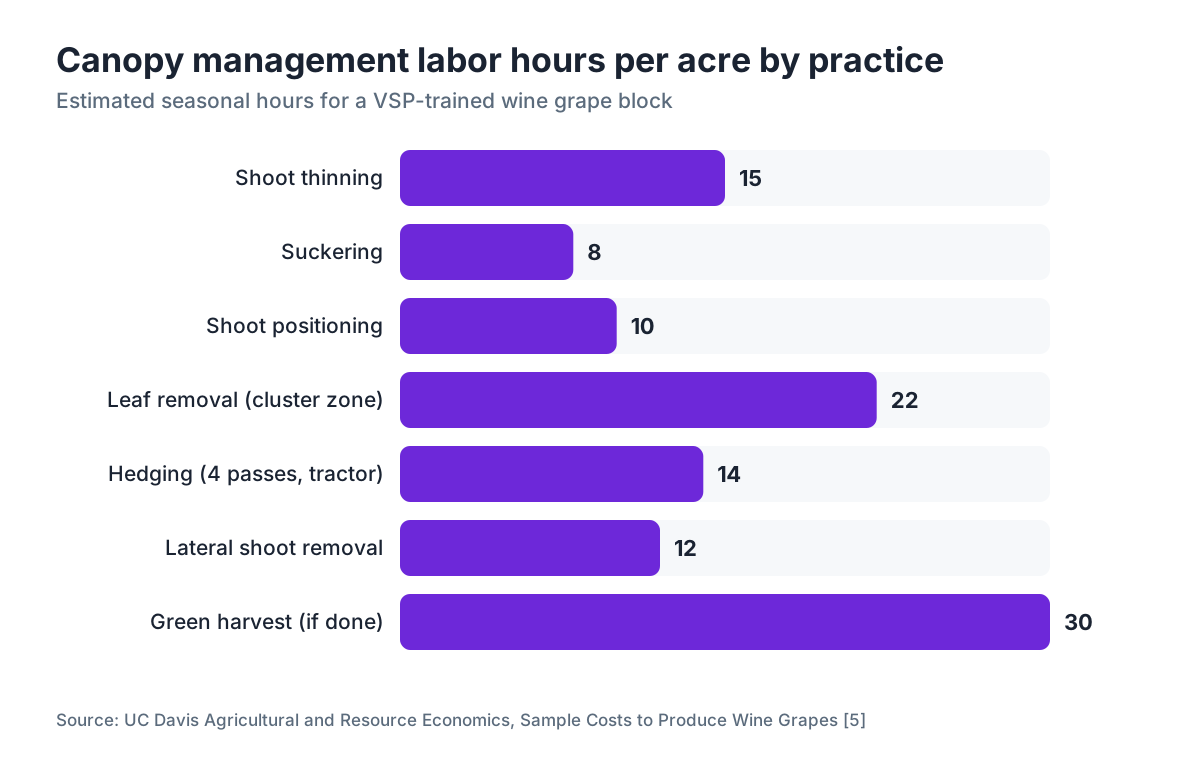
Shoot thinning runs roughly 10 to 20 hours per acre in a well-spaced VSP block. Cluster-zone leaf removal is 15 to 30 hours per acre depending on canopy density and whether you make one pass or two. Hedging is 2 to 5 hours per acre per pass on a tractor with a hedger (much more by hand). Green harvest can top 30 hours per acre when you're dropping a real chunk of the crop.
Add it up. A full canopy program across a season runs somewhere between 40 and 100 hours per acre in human labor, not counting tractor time [5]. At California's 2024 agricultural minimum wage of $16.50 per hour for small employers (higher in some counties), that's roughly $660 to $1,650 per acre in labor before any equipment cost [6].
Mechanical leaf removers have gotten good. A pneumatic leaf remover attachment cuts leaf-removal labor hard, but the capital runs $15,000 to $40,000 depending on configuration. For an operation under 20 acres, hand labor usually still wins per acre once you fold in equipment amortization and the precision you lose on irregular canopies.
If you track this work by block, practice, and date, a digital field record saves real time at season's end when you need to reconstruct what happened and when. VitiScribe is built for that kind of vineyard record-keeping, with spray records, canopy work logs, and compliance documents in one place.
How do you know if your canopy is too dense?
Richard Smart's point quadrat method is still the most widely taught diagnostic. You push a probe into the canopy at random points along the row and record whether each point hits a leaf, a gap, or fruit. A balanced canopy shows interior light at or above 20% and fewer than two interior leaf layers on average [1]. More than that means you have a shading problem.
You don't need gear for a rough read. Walk the rows mid-morning and look into the vine. If you can't see daylight through it from one side to the other, it's probably too dense. Reach into the cluster zone at noon, and if your hand comes out wet with dew, the airflow is inadequate.
Berry color is another field tell. Pull an interior cluster and hold it against an exposed cluster off the same vine. If the interior fruit is noticeably lighter in reds, or carries more green berries at veraison, shading is real.
Harvest data helps too. A steady pattern of lower Brix in certain blocks, high titratable acidity at harvest, or high malic acid can all point to shade-limited ripening, though those can also come from late-season timing or cool temperatures.
If you want to get systematic, a PAR (photosynthetically active radiation) meter gives you quantitative light readings inside the canopy. Cornell's grape program has published threshold values keyed to varietal and wine style [4].
What is the right way to do leaf removal, and does it differ by variety?
Leaf removal in the cluster zone (roughly the bottom 12 to 18 inches of the shoot, where clusters hang) is the most direct way to improve cluster exposure without touching your trellis. When you do it and how hard depends heavily on variety, climate, and wine style.
For reds in warm climates, pulling three to four leaves per shoot on the cluster-facing side before or just after bloom is a sound starting point. Early leaf removal (pre-bloom) tends to shrink cluster size and loosen bunch structure, which helps Botrytis resistance a lot. That's well-documented across varieties in European trials and confirmed in Cornell work on Riesling and Cabernet Franc [4].
Whites run differently, especially aromatic varieties like Riesling, Sauvignon Blanc, and Gewurztraminer. Direct cluster exposure in hot climates can drive berry temperatures high enough to burn off aromatic compounds. There, partial leaf removal, or removing leaves on the shaded side and leaving cover on the afternoon-sun side, works better.
Botrytis-prone compact-clustered varieties like Pinot Noir, Gewurztraminer, and Riesling get the most out of early aggressive leaf removal, because bunch compactness is the main rot driver, and shrinking cluster size pre-bloom loosens the bunch enough to matter.
Varieties with naturally open, loose clusters, like many Southern Rhone reds, return less from leaf removal. The main gain there is heat in the cluster zone, and that only helps in cool climates.
How does canopy management interact with your spray program and worker safety?
A well-managed canopy makes spraying more effective and safer for the crew. Coverage studies keep showing that dense canopies intercept most of the material before it reaches the cluster zone. Spray a four-layer wall of leaves and the product hits the outer layer while the fruit stays unprotected [3].
Opening the canopy before your first fungicide passes is worth it. The alternative is bumping rate or frequency to make up for poor penetration, which costs money and raises worker exposure.
The EPA Worker Protection Standard (WPS), revised in 2015 and effective January 2017, sets the rules for pesticide safety training, restricted-entry intervals (REIs), and worker notification. Under the WPS, workers can't enter treated areas until the REI expires and any required personal protective equipment is available [7]. A canopy that's easy to work in, with clear sightlines and access, cuts the odds of a worker wandering back into a treated block by mistake.
States stack requirements on top of the federal WPS. California's Department of Pesticide Regulation requires that applications be recorded within 30 days and reported monthly to the county agricultural commissioner [8]. Records have to carry the product, EPA registration number, rate, acres treated, target pest, and application date. Missing these records is one of the most common compliance violations in California wine grape production.
If your canopy crew includes any employees, the WPS training rules cover them. The current WPS requires pesticide safety training every year for agricultural workers and handlers, and you have to keep records of that training [7].
For the wider picture of field operations at well-run properties, the vineyard overview walks through the operation from soil to harvest.
Does canopy management differ in organic or biodynamic vineyards?
The physical work is identical. Shoot thinning, leaf removal, and hedging behave the same whether you're certified organic or conventional. The choices matter more in organic systems, though, because your fungicide toolkit is narrow.
Organic growers lean on sulfur and copper fungicides, both of which lose efficacy under heavy disease pressure in a dense canopy [9]. Copper carries a cumulative soil-loading concern under USDA National Organic Program rules, and the EU has been tightening copper limits for years (currently 4 kg/ha/year averaged over 7 years in the EU, though USDA NOP sets no matching explicit annual cap) [9]. So an organic grower with a dense canopy and high Botrytis pressure has few outs when the season turns.
The practical read: organic viticulture puts a higher premium on getting canopy management right early. Pre-bloom leaf removal and hard shoot thinning aren't optional in organic systems in humid climates. They're the first line of disease control.
Biodynamic operations follow the same logic, plus preparation applications (like horn silica, preparation 501) that some practitioners believe improve canopy light use. The peer-reviewed evidence for that specific claim is thin.
How do you balance vigor, water, and canopy size across a whole block?
Vigor is never uniform. Anyone who's walked the same block year after year knows some vines always push harder, and the pattern tends to follow soil variability, irrigation zone lines, or rootstock differences.
Rootstock choice at planting is the primary long-term lever on vigor. High-vigor rootstocks like 110R or 1103P drive the scion hard and build big canopies. Low-vigor stocks like 3309C or Riparia Gloire hold shoot growth back. If you're replanting, matching rootstock vigor to your site's fertility and intended trellis is the most effective canopy decision you'll ever make, and you make it exactly once.
Mid-row cover crops compete with the vine for water and nitrogen and can pull excess vigor down on fertile sites. UC Davis cover crop research in Napa Valley found that permanent grass cover crops lowered vine midday stem water potential and shoot growth length on high-fertility sites without hurting fruit quality at moderate deficit levels [10].
Irrigation ties straight to canopy size. Vines under mild water stress grow shorter internodes, slower shoots, and less leaf area. Regulated deficit irrigation (RDI), holding water back during specific phenological windows, is a widely used vigor tool. The catch is that deficit stress during flowering or fruit set can cut cluster set, and stress during rapid berry growth can shrink berries in ways that scramble your yield projection.
On a mountain winery or hillside site, steep slopes often build a natural vigor gradient from the bottom of the slope to the top, which forces block-by-block decisions instead of one uniform program.
What does current research say about mechanization and AI in canopy management?
Mechanized shoot thinning and leaf removal have been commercial for years. Pneumatic leaf removers using air jets or rotating fingers are standard kit on larger operations across California, Washington, and the major European regions. They shine on uniform VSP canopies with consistent shoot positioning and stumble on head-trained or irregular canopies.
Robotics and computer vision for canopy work are an active research area, with projects at UC Davis, Cornell, and several European institutions. Nobody has a fully commercial shoot-thinning robot yet as of early 2025, but prototypes can spot and remove shoots with decent accuracy under controlled conditions. The wall is real-vineyard variability: mixed vine ages, uneven canopy density, and the dexterity it takes to tuck shoots into wires without breaking them.
Multispectral drone imaging for canopy density mapping works now. NDVI (Normalized Difference Vegetation Index) maps from drone flights flag high-vigor zones inside a block where intervention pays off most. Several commercial services offer it, and some large operations have brought it in-house. The data earns its keep by aiming labor at the right rows, not by making the qualitative calls for you.
For record-keeping, date-stamped field logs by block are what you need for both quality tracking and any certification audit. Which blocks got leaf removal, when, and how many passes is exactly the data that VitiScribe organizes automatically, so you're not rebuilding it from handwritten notes in October.
Regions like Paso Robles wineries and South Coast Winery in Southern California are testing mechanized canopy work against the high and climbing cost of California farm labor.
How should you document canopy management for compliance and certification?
Documentation needs vary by program. For standard commercial production with no certification, you mainly need records to satisfy pesticide reporting rules (if any canopy work sits close in time to a pesticide application) and your own internal quality tracking.
For sustainability certifications (California Sustainable Winegrowing Alliance, Lodi Rules, LIVE in Oregon, and others), canopy practices are usually part of the scorecard. You'll show what you did, in which blocks, and on what dates. A farm-plan narrative, field logs, or digital records satisfy most programs.
For USDA certified organic, your Organic System Plan (OSP) has to describe your canopy management approach and how it supports pest and disease management without prohibited materials. The National Organic Program doesn't mandate specific canopy practices, but inspectors look for consistency between what you describe and what your field records show [9].
For any program that pays a premium tied to quality metrics, canopy records become part of showing due diligence. In a year where quality falls short, records proving you finished leaf removal, shoot thinning, and hedging on schedule are your best evidence that the culprit was weather, not management.
Keep records by block and by practice, more than by date. "Did leaf removal on June 14" tells you less than "Block 3A, Cabernet Sauvignon, leaf removal cluster zone, east side, 2 leaves per shoot, June 14." That specificity is what lets you actually learn from one season to the next.
Frequently asked questions
When should I start canopy management in the season?
Start with shoot thinning as soon as shoots are long enough to identify clearly, usually at 2 to 6 inches. Suckering overlaps that window. The earlier you set shoot density and position, the less corrective work the rest of the season demands. Late canopy management always costs more labor because you're fighting established growth instead of directing new growth.
How many leaf layers is too many in a grapevine canopy?
Richard Smart's point quadrat research found that more than two interior leaf layers creates real shading, and more than three is tied to poor fruit color, elevated methoxypyrazines, and disease problems. A balanced VSP canopy has one to two interior leaf layers and lets at least 20% of light reach the interior. Most commercial operations use a visual check rather than formal measurement.
Does leaf removal on the east or west side of the canopy matter?
Yes. In warm climates, pulling leaves on the east (morning-sun) side of a north-south row exposes clusters to gentler morning light and dodges the intense afternoon heat on the west side, which can cause sunburn. In cool climates, afternoon exposure on the west side can help ripening. Climate and varietal heat sensitivity should drive which side you prioritize.
What is the Ravaz Index and how do I use it?
The Ravaz Index is the ratio of fruit weight at harvest to cane pruning weight taken the following dormant season. A ratio between 5:1 and 10:1 is generally balanced. Below 5, the vine is too vigorous for its crop load. Above 10, the vine is overcropped and likely stressed. It works best as a multi-year trend, not a single-season diagnostic, because pruning weights lag by a full year.
Can mechanical leaf removers replace hand leaf removal?
On uniform VSP-trained blocks, pneumatic leaf removers do a credible job and cut labor sharply, often 60 to 70% fewer hours than hand removal. They struggle on head-trained vines, older vines with irregular shoot placement, or where the cluster zone is inconsistent. They also remove leaves less selectively than a skilled hand worker, which is fine sometimes and too aggressive other times.
How does canopy management affect Botrytis risk specifically?
Dense canopies raise humidity in the cluster zone and cut airflow, building conditions where Botrytis cinerea spores germinate easily. Compact-clustered varieties like Pinot Noir and Riesling are especially exposed. Early pre-bloom leaf removal loosens cluster structure and drops humidity at the cluster. Cornell research showed early leaf removal cut Botrytis incidence in Riesling more than leaf removal at fruit set, and far more than no leaf removal.
Does shoot positioning really matter if I'm just going to hedge anyway?
Yes, because positioning before shoots harden sets the spacing for the whole season. Shoots tucked inside the wire trellis grow into a more uniform, less tangled canopy that hedges cleanly. Shoots that curl and cross early build a tangled interior that neither hedging nor leaf removal fully fixes. The 15 minutes per acre spent positioning at 6 to 12 inches saves two to three times that labor later.
What are the EPA Worker Protection Standard requirements for canopy work near recent pesticide applications?
The EPA WPS (revised 2015) requires that workers stay out of fields during a restricted-entry interval (REI) after pesticide application unless wearing specified PPE. REIs vary by product, from 4 hours to several days. Workers must get annual safety training and have access to safety data sheets. Canopy crews doing thinning or leaf removal should always check the application log before entering any block. See EPA.gov for current WPS requirements.
How do I manage canopy in a high-vigor site without changing the trellis system?
Your main tools are harder shoot thinning to cut density, more frequent hedging (every 2 to 3 weeks versus monthly), mid-row cover crops to compete for water and nitrogen, and regulated deficit irrigation. None of these fully replaces a divided-canopy trellis on a genuinely high-vigor site, but they can pull a moderately vigorous block into acceptable balance. If you've fought the same vine for five years, trellis modification is probably cheaper over a 10-year horizon.
How many times per season should I hedge?
Two to four times is typical for most wine grape vineyards on a VSP system, with the first hedging around bloom or just after. Higher-vigor blocks or warmer climates with longer seasons may need five or six passes. After veraison, the returns drop fast because the vine is done with most vegetative growth. Late-season hedging mostly removes growth that no longer touches current-year fruit.
Is green harvest (crop thinning) worth the cost?
It depends entirely on the block and the year. In a high-yield year on a block chasing premium quality, dropping clusters to rebalance the vine can lift Brix, color, and flavor concentration meaningfully. The math only works if the quality premium on the remaining fruit beats the thinning labor plus the lost revenue from dropped fruit. For commodity-priced fruit contracts, green harvest almost never pencils out.
How do I document canopy management for an organic certification audit?
Your Organic System Plan should describe your general canopy approach and explain how it supports your pest and disease strategy. Field logs should record the specific practice, block, date, and any materials used (sulfur, copper, and so on). Inspectors compare your OSP description against your field records, so consistency matters more than volume. Digital record systems with timestamped entries are easier to defend than handwritten notes rebuilt after the fact.
What's the difference between shoot thinning and suckering?
Shoot thinning removes excess shoots from the spur or cane positions in the fruiting zone, setting shoot density along the cordon. Suckering removes shoots from below the graft union, from the trunk, and from the base of the vine that would burn energy without carrying fruit. Both happen in the same early-season window, but they hit different parts of the vine. Suckering is non-negotiable; shoot thinning is where you make the density call.
Sources
- Smart, R. & Robinson, M. Sunlight into Wine: A Handbook for Winegrape Canopy Management. Winetitles, 1991: Balanced vine Ravaz Index falls between 5:1 and 10:1; interior canopy light at or above 20% and fewer than two interior leaf layers indicates a balanced canopy
- USDA Agricultural Research Service, grape and wine quality research: Shaded clusters in dense canopies accumulate less sugar, produce fewer anthocyanins, and higher methoxypyrazine levels in red varietals
- Washington State University Viticulture and Enology, WSU Extension: Reducing interior canopy leaf layers from four or more to one or two improves fungicide penetration and can reduce rates needed for equivalent disease control; divided canopy systems recommended for high-vigor sites
- Cornell CALS, Grapes program and Finger Lakes Grape Program: Early pre-bloom leaf removal on Riesling reduced cluster weight and improved berry color versus later leaf removal; early leaf removal also reduced Botrytis incidence more than leaf removal at fruit set
- UC Davis Agricultural and Resource Economics, Sample Costs to Produce Wine Grapes: Total seasonal canopy management labor runs approximately 40 to 100 hours per acre depending on vine system and intensity of practices
- State of California Department of Industrial Relations, Minimum Wage: California 2024 agricultural minimum wage is $16.50 per hour for small employers; some counties have higher local minimums
- U.S. EPA, Agricultural Worker Protection Standard: EPA WPS revised 2015, effective January 2017: requires annual pesticide safety training for agricultural workers and handlers, restricted-entry intervals enforced, records of training must be kept
- California Department of Pesticide Regulation, Pesticide Use Reporting: California requires pesticide applications to be recorded and reported monthly to the county agricultural commissioner, including product, EPA registration number, rate, acres treated, target pest, and application date
- USDA National Organic Program, Agricultural Marketing Service: Organic System Plan must describe canopy management approach; copper-based fungicides are allowed under NOP but subject to restrictions; USDA NOP does not set an explicit annual copper loading limit equivalent to EU rules
- UC Davis Department of Viticulture and Enology, cover crop research in California vineyards: Permanent grass cover crops in mid-row reduced vine midday stem water potential and shoot growth on high-fertility Napa Valley sites without reducing fruit quality at moderate deficit irrigation levels
- UC Statewide Integrated Pest Management Program, Grape Pest Management Guidelines: Canopy density and airflow are primary cultural factors influencing powdery mildew and Botrytis severity in wine grapes; dense-canopy shading reduces fruit maturity and color, and leaf removal and shoot thinning are recommended as part of IPM programs
Last updated 2026-07-09