Canopy management software: what it actually does and whether you need it

TL;DR
- Canopy management software digitizes vineyard scouting notes, spray records, weather data, and canopy assessments in one place.
- The best platforms link field observations to compliance outputs automatically.
- Expect to pay $500 to $4,000 per year depending on acreage and features.
- Free tools from UC IPM and WSU cover basic disease modeling if budget is tight.
What does canopy management software actually do in a vineyard?
Canopy management software is a field data platform that replaces paper scouting sheets, scattered spreadsheets, and mental notes with a structured digital record tied to specific blocks, rows, or GPS coordinates. It captures what you see in the canopy, when you saw it, and what you did about it. That means shoot counts, leaf layer assessments, fruit zone light penetration, disease pressure notes, and the spray or cultural decisions that followed.
The better platforms go further. They pull in weather station data on their own, flag disease risk thresholds from models like UC IPM's grape risk models or WSU's Decision Aid System [1][2], and generate the spray application records that California's DPR, Washington's WSDA, or your USDA GAP auditor will want to see. That link between field observation and compliance output is what separates a real canopy tool from a fancy notebook.
Smaller operations often ask whether they need dedicated software at all. Under 20 acres with one employee? A well-built spreadsheet and a printed spray log might genuinely be enough. But once you're tracking multiple blocks, hiring seasonal workers who log their own observations, or facing annual pesticide records audits, software pays for itself in avoided errors and time. Nobody has clean data on the exact break-even acreage. Most extension advisors put it somewhere around 25 to 40 planted acres, though that depends heavily on crop complexity and your compliance load.
What features should canopy management software have?
Canopy software features fall into three tiers: the non-negotiables, the nice-to-haves, and the things vendors oversell.
Non-negotiables
Spray record logging that captures the EPA Worker Protection Standard (WPS) required fields is table stakes [3]. That means applicator name, date, time, product name, EPA registration number, target pest, application rate, REI (restricted entry interval), PHI (pre-harvest interval), and the treated block or field. The EPA WPS rule, updated in 2015 and enforced under 40 CFR Part 170, requires that pesticide application records be kept for two years and be available for inspection [3]. Software that can't export a clean, WPS-compliant log is not worth your money.
Block mapping matters too. You need to assign every scouting event and every spray event to a defined block, more than a free-text note. Ideally that's GPS-bounded so a new employee can find it.
Offline functionality is genuinely important in vineyard settings. Cell coverage in most wine regions is spotty. If the app needs a live connection to save a scouting note, your crew reverts to paper by week three.
Nice-to-haves
Weather integration that pulls from a station within a mile or two of your blocks can automate the temperature and relative humidity fields in your disease risk log. This matters for models like the UC IPM powdery mildew risk index, which uses degree-day accumulations from a reference date [1]. Entering that by hand every day is tedious and error-prone.
Photo capture tied to a GPS pin helps when you flag an odd symptom and share it with your PCA or a UC Cooperative Extension advisor. Most modern platforms include it, but check that photos store with the record, not as a separate camera roll.
Season-over-season comparison at the block level. Looking at last year's Botrytis pressure notes against this year's canopy density in the same view is genuinely useful for planning leaf-pull timing.
Oversold features
Drone integration is a marketing hook more than a practical tool for most operations right now. The analysis layers most platforms offer don't add much beyond what a good scout walking the rows gives you, and the licensing and flight logistics pile on real overhead. Revisit this in a few years.
AI yield prediction is similarly premature in most commercial tools. The models need multiyear block-level data to get accurate, and most small wineries don't have the historical input to make them work.
| Feature | Must-have | Nice-to-have | Usually oversold |
|---|---|---|---|
| WPS-compliant spray log export | Yes | ||
| Offline data entry | Yes | ||
| Block-level GPS mapping | Yes | ||
| Weather station integration | Yes | ||
| Photo capture with record | Yes | ||
| Season comparison views | Yes | ||
| Drone imagery analysis | Yes | ||
| AI yield prediction | Yes |
How does canopy management software support EPA and state pesticide compliance?
Pesticide recordkeeping is where canopy management software earns its cost most directly. The EPA Worker Protection Standard at 40 CFR Part 170 requires that application records be maintained for two years and include specific fields for each spray event [3]. State rules layer on top. California's DPR requires a Pesticide Use Report (PUR) submitted monthly to the county agricultural commissioner, with fields that partially overlap but don't identically match federal WPS fields [4]. Washington's WSDA requires similar records under WAC 16-228 [5].
Good software handles these as parallel outputs from a single data entry event. You log the application once, and the system produces both a WPS-compliant record and a pre-formatted PUR or state equivalent. That sounds simple, but it means the vendor has to maintain a current pesticide product database with EPA registration numbers, REIs, and PHIs, and update it as label changes happen. Ask any vendor you're evaluating how often their product database updates and who maintains it.
The EPA WPS also requires that workers be informed of pesticide applications, including posting at the treated area or a central location [3]. Some platforms include a notification or posting workflow, which is worth having if you're managing a crew.
Worker safety recordkeeping under WPS is inspected by state lead agencies, not EPA directly. In California that's CDFA and the county ag commissioner. In Washington it's WSDA. Fines for recordkeeping violations run from a few hundred to several thousand dollars per violation depending on severity and history. Getting this wrong on paper is the same as getting it wrong in software, so understand exactly what the software generates before you rely on it.
What do UC Davis, Cornell, and WSU say about canopy assessment and data needs?
The three main university extension programs that produce practical vineyard canopy guidance have different emphases, and knowing those differences helps you judge which software features matter.
UC Davis Cooperative Extension has published extensively on the Point Quadrat method for canopy assessment, which involves inserting a probe into the canopy at measured intervals and recording whether it contacts leaf, fruit, or air [6]. This generates an Interior Leaf Proportion (ILP) and a Leaf Layer Number (LLN) for each block. Software that supports a structured Point Quadrat entry form (probe position, contact type, block, date, scout) is directly useful for UC Davis-aligned canopy work. The UC IPM program also maintains disease models tied to weather data that integrate well with software pulling from local weather stations [1].
Cornell's viticulture program, especially work from the Lake Erie and Finger Lakes regions, emphasizes balanced pruning and disease pressure management for high-humidity canopies [7]. Their extension publications focus heavily on Botrytis and downy mildew in wetter climates. Software that captures fruit zone relative humidity and tracks disease spray timing against phenology fits Cornell-aligned operations.
WSU's Center for Precision and Automated Agricultural Systems (CPAAS) has done the most extension work on tying sensor data to canopy management decisions [2]. Their Decision Aid System (DAS) covers multiple disease and pest models and is free to access. Some commercial platforms integrate DAS outputs directly, which is worth asking about if you're in the Pacific Northwest. WSU's Viticulture and Enology program also publishes practical canopy guides specific to Eastern Washington conditions [2].
None of these programs formally endorses specific commercial software. What they offer is a framework for what data you should be collecting. The right software makes collecting that data easier, not different.
How much does canopy management software cost, and what's the pricing structure?
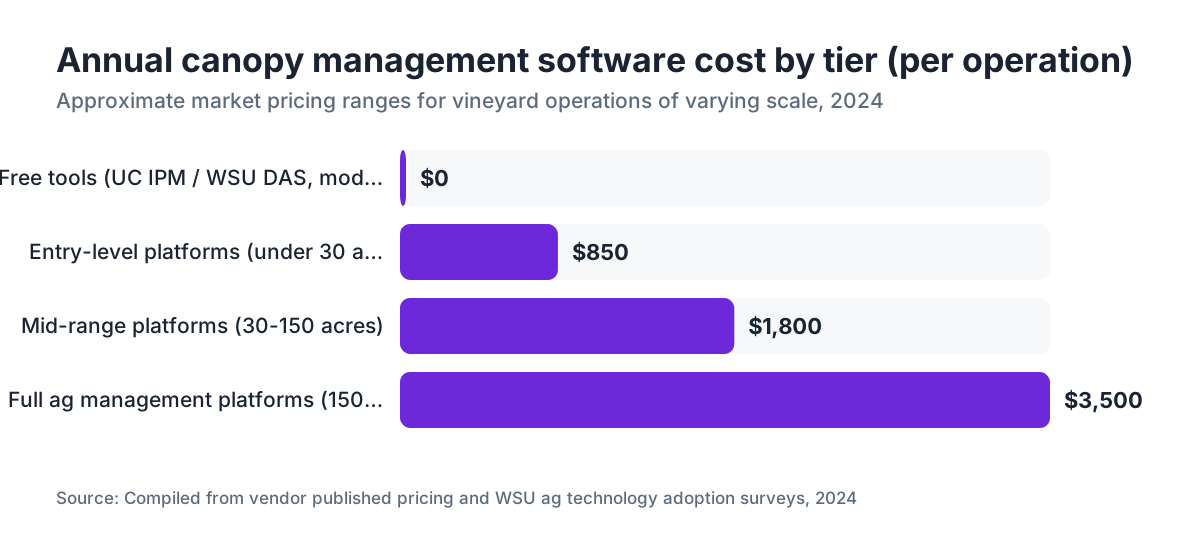
Pricing across the category runs from free to around $4,000 per year for a small-to-medium operation. Here's how the tiers break down honestly.
Free and low-cost options exist but take work. WSU's Decision Aid System is free and covers disease and pest models with good Pacific Northwest calibration [2]. UC IPM's online tools are also free and include degree-day calculators and risk models [1]. These aren't full canopy platforms. They're modeling tools. You'd still need a separate system for spray records and scouting logs.
Entry-level commercial platforms (roughly $500 to $1,200 per year) usually offer block mapping, scouting note entry, spray logging, and basic reporting. They cover up to a set acreage or block count and charge more above that. Offline functionality and WPS compliance quality vary a lot at this tier, so ask about both specifically before committing.
Mid-range platforms ($1,200 to $2,500 per year) add weather station integration, better compliance exports, photo capture, and some season comparison. This is where most vineyard managers with 30 to 150 acres land.
Full ag management platforms ($2,500 to $4,000-plus per year) cover vineyard, orchard, row crop, and often add equipment tracking, labor management, and accounting integrations. The vineyard-specific canopy features are often less refined than dedicated wine industry tools, but the operational breadth can justify the cost if you run a diversified farm.
Most vendors price by acre, by block, or by user seat. Per-acre pricing is most common and usually runs $8 to $25 per acre per year at the mid tier. Get quotes for your exact situation. The math matters.
How do you actually use canopy management software during the growing season?
Setup matters as much as daily use. Before budbreak, every block should be defined in the system with its variety, acreage, trellis system, row orientation, and the irrigation and weather station it maps to. Bring in a new platform mid-season and you'll spend real time here, probably 4 to 8 hours for a 50-acre operation with 10 to 15 blocks.
Early season (budbreak through bloom) is mostly phenology tracking. Log budbreak date, shoot counts per vine in sample rows, and first sign of disease pressure. This data feeds the degree-day models for spray timing. If your platform integrates with a disease model, this is when that integration starts paying off.
Bloom through veraison is the busy stretch. You log spray applications after each event, record canopy scouting assessments (Point Quadrat or visual density scores depending on your method), and track leaf-pull and shoot positioning block by block. WPS posting and recordkeeping obligations run hottest here, since you're spraying often.
After veraison and through harvest, the focus shifts to disease monitoring and PHI compliance. PHI (pre-harvest interval) violations are a real legal exposure. Applying a product inside its PHI before harvest can get your fruit rejected and trigger regulatory action. Good software flags when a spray event falls within the PHI window given your intended harvest date. Set your harvest estimates early enough for that to work.
Growers who sell to several wineries, like many in Paso Robles wineries supply chains, need to export a clean spray record by block for each buyer. Software handles that far better than spreadsheets.
Post-harvest, archive the season's records and do a block-by-block review. Comparing where disease pressure hit hardest against your canopy density scores takes an hour in software and half a day in spreadsheets.
Can canopy management software integrate with vineyard weather stations and disease models?
Yes, and this is one of the most useful things the software does, though quality varies widely.
The basic version is a manual weather import. You download a CSV from your weather station and upload it. Better than nothing, but it removes the automation that makes models useful in-season.
The better version is a direct API connection to common vineyard weather station brands (Onset HOBO, Pessl Instruments, Davis Instruments, Campbell Scientific) that pulls temperature, RH, leaf wetness, and rainfall automatically. With that feed, the platform runs continuous degree-day accumulations from your chosen biofix date and flags when a disease risk threshold gets crossed.
WSU's Decision Aid System is the widest free source of calibrated models for Pacific Northwest conditions [2]. UC IPM's models cover California conditions well [1]. A few commercial platforms have negotiated direct integrations with one or both. Ask vendors which models are built in and how they're calibrated, because a powdery mildew model tuned for Napa Valley gives wrong answers in the Willamette Valley.
Cornell's Network for Environment and Weather Applications (NEWA) provides free weather-based IPM tools calibrated for the Northeast, including grape disease models [7]. Some platforms pull from NEWA for growers in New York, Pennsylvania, and Michigan.
If your current software integrates with no disease model at all, that's a fair reason to switch or supplement with one of the free tools. Running spray decisions without a model isn't wrong, but you're leaving efficiency on the table, either spraying too often or missing a risk window.
What should you look for in canopy management software if you're a small winery or independent grower?
Small operations have different priorities than large estate wineries. For a 15 to 50 acre independent, these matter most.
Simplicity of daily use. If your vineyard manager (or you) has to open a manual to log a spray event, the software gets abandoned. Spray log entry should take under two minutes once setup is done.
Mobile usability in the field. Test the app on the actual phone or tablet your crew will use, in sunlight, with gloves on if that's realistic. Plenty of platforms look great on a laptop demo and are miserable in a vineyard row.
Compliance output quality. Export a sample WPS record and a sample state pesticide report before you commit. Check that every required field populates correctly. This is the thing most vendors skip in a demo because it's unglamorous.
Pricing that makes sense at small scale. A platform built for 500-acre operations is expensive and overpowered for 30 acres. Look for a tier designed for smaller operations or a per-acre rate that doesn't punish you for being small.
Run a vineyard alongside winery production and the link between field records and cellar or sales records can matter. Some platforms connect with winery management software, though those integrations are often shallower than vendors suggest. Verify with a live demo.
VitiScribe, for what it's worth, targets exactly this segment: smaller operations that need compliance-ready records without paying enterprise prices. Put it on your comparison list alongside the better-known platforms, but evaluate any tool against your own needs and don't take my word for it.
One honest caveat. Nobody has run a rigorous independent comparison of canopy platforms for small vineyards with published outcome data. The closest are extension surveys like the WSU ag technology adoption work [2], which tracks tool use but not comparative quality. You're mostly going on peer recommendations and your own trial period.
How does canopy management software handle scouting and pest records under California and Washington rules?
California and Washington both have pesticide recordkeeping rules that go beyond federal WPS minimums, and software needs to handle both.
In California, any grower using a restricted materials permit must file a Pesticide Use Report (PUR) with the county agricultural commissioner within 30 days of the end of the month in which the application occurred [4]. The DPR maintains the required format and field list. Software that can't produce a PUR-formatted export forces you to reenter data by hand into the DPR system, which costs time and invites errors.
California also requires a licensed Pest Control Advisor (PCA) recommendation for certain restricted materials. Software that logs which PCA authorized a spray event, and can produce that documentation on demand, covers a common audit request from county commissioners.
Washington State requires pesticide application records under WAC 16-228 for commercial operations, with the same two-year retention and similar field requirements [5]. Washington also has specific rules for applications near waterways under the Clean Water Act, and some platforms include buffer zone flagging tied to block GPS coordinates and water feature layers.
Oregon's pesticide recordkeeping rules under OAR 603-057 follow a similar structure but differ in some fields and reporting timelines. If you operate across state lines, verify that your software's compliance exports are configured for each state separately.
Scouting records for pest thresholds (as opposed to spray applications) aren't federally mandated, but most third-party food safety programs require them, including USDA GAP certification [8]. Good software captures scouting events with pest identification, count or severity rating, and the economic threshold comparison that drove the spray or no-spray decision.
What are the common implementation mistakes vineyard managers make with canopy software?
The most common mistake is skipping block setup. Managers download the app, start logging sprays before properly defining blocks, and end up with records attached to a free-text note like "upper cab block" that means nothing to an auditor or a new employee six months later. Spend the time on block definitions before you log anything else.
The second mistake is treating software as a backup to paper rather than a replacement. Running parallel systems doubles the work and usually leaves neither system complete. Pick one and train your crew on it. If you're worried about data loss, the fix is a platform with reliable cloud backup, not a paper duplicate.
Third: not updating product labels in the platform. If your software's pesticide database shows an old REI or PHI for a product whose label got updated, every record from that point is potentially inaccurate. Ask vendors how label changes reach users, and check your critical products against the current EPA label each season [9].
Fourth: buying features you won't use. A full-featured platform with drone integration and AI yield modeling that your crew touches only for spray logs is expensive software for what could be a $600-a-year problem. Be honest about what you'll actually use.
Fifth: not training seasonal workers. If your spray applicators aren't logging applications themselves in the field, someone is rebuilding records after the fact from memory or paper scraps. That's how errors get into the record. WPS requires records kept at application time. Reconstruction after the fact is a compliance risk.
Is there free canopy management software worth using?
Yes, with clear limits.
WSU's Decision Aid System (DAS) is genuinely useful for disease and pest modeling in the Pacific Northwest and it's free [2]. It's not a full canopy platform. It doesn't do spray recordkeeping or scouting logs. But for the modeling piece it's as good as most commercial tools.
UC IPM's online tools cover California conditions well and include degree-day models, disease risk tools, and pest identification guides [1]. Same limit: modeling only, not a records platform.
Cornell's NEWA is comparable for the Northeast [7].
For actual records management at zero cost, you're looking at Google Sheets or Excel with a well-designed template. UC Cooperative Extension has published spray record templates that meet California PUR requirements. Searching your county's UCCE office website usually turns one up. The honest trade-off: a spreadsheet needs manual discipline that software automates. Errors creep in. Audits are harder. But for a 10 to 15 acre operation with one person running everything, a good spreadsheet is a defensible choice.
Above that scale, the time savings of purpose-built software, measured in hours per season not minutes per week, usually justify a $500 to $1,500 annual cost. That's the honest math.
Frequently asked questions
How long does it take to set up canopy management software for a 50-acre vineyard?
Plan on 6 to 10 hours of initial setup: defining blocks with GPS boundaries, entering variety and trellis data, connecting a weather station if the platform supports it, and configuring your pesticide product list. Most platforms also include a 1 to 2 hour onboarding call. After setup, daily logging for spray events takes 5 to 10 minutes per application.
Does canopy management software replace a Pest Control Advisor in California?
No. California law requires a licensed PCA to recommend restricted materials pesticides under Food and Agricultural Code Section 11901 et seq. Software can log which PCA authorized a spray and store that documentation, but it doesn't replace the advisory role. Some platforms let PCAs log recommendations directly into the system, which is a useful workflow integration.
What spray record fields are required by the EPA Worker Protection Standard?
Under 40 CFR Part 170, required fields for each application include product name, EPA registration number, active ingredient(s), date and time of application, location treated, size of area treated, applicator name and certification number (if applicable), and the target pest. Records must be kept for two years and made available for inspection by authorized officials.
Can canopy management software generate California Pesticide Use Reports automatically?
The better platforms produce a pre-formatted PUR export that you submit to the county ag commissioner. This requires the platform to maintain a current DPR product database. Verify with any vendor that their PUR export includes all required fields: site code, commodity, acres planted, acres treated, product, amount applied, and applicator information. Some platforms still require manual field-by-field entry in the DPR system.
What's the Point Quadrat method and can I track it in software?
Point Quadrat analysis, developed by Smart and Robinson and extended by UC Davis extension, involves inserting a thin probe into the canopy at regular intervals and recording whether it contacts a leaf, fruit cluster, or passes through air. This generates Interior Leaf Proportion and Leaf Layer Number scores per block. Any scouting log that lets you define a custom entry form can track it, though few platforms have it built in as a native form.
How does WSU's Decision Aid System differ from commercial canopy management software?
WSU's DAS is a free, web-based disease and pest modeling tool calibrated for Pacific Northwest conditions. It runs models for powdery mildew, Botrytis, leafroll virus vectors, and other pests using weather data you enter or connect. It doesn't do spray recordkeeping, block mapping, scouting logs, or compliance exports. Commercial platforms often integrate DAS model outputs but add those recordkeeping layers on top.
What's the pre-harvest interval and how should software handle it?
The PHI is the minimum number of days required between the last pesticide application and harvest, as stated on the product label. Applying within the PHI is a federal violation under FIFRA and can get fruit rejected. Good software lets you set a target harvest date per block and flags any spray entry that would fall within the PHI window for that product, warning you before you apply rather than after.
Does canopy management software work offline in areas with no cell service?
It depends entirely on the platform. Most modern platforms offer an offline mode that queues data locally and syncs when you regain connection. The thing to verify is whether photo capture and GPS logging work offline, more than text entry. Test it before buying: put your phone in airplane mode, create a mock scouting record with a photo, and confirm it syncs correctly when you reconnect.
How do I share spray records with a winery that buys my grapes?
Most platforms let you export records as a PDF or CSV filtered by block, date range, and product. For winery buyers who require a full-season spray history before crush, a PDF export per block is usually enough. Some larger buyers are starting to require specific formats, so ask your buyer what they want before selecting software. A platform that generates a clean, filtered export in five minutes saves real time at harvest.
Can I use canopy management software for USDA GAP certification records?
Yes, if the platform captures the right fields. USDA GAP certification under the GAP audit program requires documentation of spray applications, water source testing, worker hygiene training, and scouting records that document the rationale for spray decisions [8]. Software that logs scouting observations alongside spray events, and produces both in an exportable format, directly supports a GAP audit. Check that your specific auditor's checklist maps to what the software captures.
What's the difference between canopy management software and a full farm management platform?
Canopy management software focuses on vineyard field data: scouting, spray records, canopy assessments, disease risk, and compliance exports. Full farm management platforms (like Granular, Conservis, or AgriWebb) add equipment tracking, labor management, financial records, and multi-crop support. The vineyard-specific depth is usually better in dedicated tools; the operational breadth is better in farm management platforms. Choose based on your actual workflow, not the longer feature list.
How often do pesticide product databases in canopy software get updated?
This varies by vendor and is an underasked question. EPA label changes take effect when registered and can alter REIs, PHIs, or use patterns. Vendors that maintain their own database update it on their own schedule, sometimes quarterly, sometimes annually. A vendor that crowdsources label data from users is faster but less reliable. Ask specifically: who maintains your pesticide database, how often does it update, and what happens when a label change affects an active product.
Is there canopy management software designed specifically for small vineyards under 25 acres?
A few platforms tier their pricing to make entry-level plans accessible at small scale, typically under $600 per year for operations under 25 acres. The things to verify at that price point: offline functionality, WPS-compliant spray log exports, and real customer support. Some low-cost platforms are self-serve only, which is fine if you're technically comfortable but frustrating during a compliance audit when you need help fast.
Can canopy management software help with worker training documentation required by the WPS?
Some platforms include a worker training log that records which workers received WPS safety training, on what date, and which trainer delivered it. The EPA WPS requires that agricultural workers and handlers receive safety training before working in treated areas, and that training records be kept [3]. A platform with this feature keeps the documentation alongside application records, which simplifies any inspection. Not all platforms include it, so ask specifically.
Sources
- UC IPM (University of California Agriculture and Natural Resources), UC IPM Pest Management Guidelines: Grape: UC IPM maintains degree-day calculators and disease risk models calibrated for California grape production conditions
- Washington State University Extension, Decision Aid System (DAS) for Pest Management: WSU's free Decision Aid System provides disease and pest models calibrated for Pacific Northwest vineyards including powdery mildew, Botrytis, and leafroll vector monitoring
- U.S. EPA, Worker Protection Standard (WPS) 40 CFR Part 170: EPA WPS requires pesticide application records including product name, EPA registration number, date, location, applicator name, REI, and PHI, retained for two years and available for inspection
- California Department of Pesticide Regulation (CDPR), Pesticide Use Reporting: California DPR requires growers using restricted materials to file a Pesticide Use Report with the county agricultural commissioner within 30 days of the end of the month of application
- Washington State Department of Agriculture (WSDA), Pesticide Management Division, WAC 16-228: Washington's WSDA requires commercial pesticide application records under WAC 16-228 with similar two-year retention and field requirements as federal WPS
- UC Cooperative Extension, Sunlight and Canopy Management in Grapevines (UCCE Viticulture Publications): UC Davis Cooperative Extension has published the Point Quadrat canopy assessment method measuring Interior Leaf Proportion and Leaf Layer Number as standard canopy evaluation metrics
- Cornell University, Network for Environment and Weather Applications (NEWA), Grape Disease Models: Cornell's NEWA provides free weather-based IPM tools calibrated for Northeast grape production including Botrytis, downy mildew, and powdery mildew risk models
- USDA Agricultural Marketing Service, Good Agricultural Practices (GAP) Audit Program: USDA GAP certification requires documentation of spray applications, scouting records that support spray decisions, water source testing, and worker hygiene training
- U.S. EPA, National Pesticide Information Retrieval System (NPIRS) and Label Database: EPA registers pesticide label changes that can alter REI, PHI, and use pattern requirements; current registered labels are the legal standard regardless of what printed labels say
- California Department of Pesticide Regulation, Pest Control Adviser Licensing Requirements, Food and Agricultural Code Section 11901: California law requires a licensed Pest Control Advisor to recommend restricted materials pesticides under Food and Agricultural Code Section 11901 et seq.
Last updated 2026-07-10