Canopy management in vineyards: the complete practical guide

TL;DR
- Canopy management is the set of practices (shoot thinning, hedging, leaf removal, shoot positioning, and green harvest) used to control grapevine vigor, improve fruit quality, and reduce disease pressure.
- Done well, it shifts a vine from producing shade and vegetative growth into producing evenly ripened, disease-free fruit.
- Most operations run 20 to 60 labor hours per acre depending on variety, trellis system, and goals.
What is canopy management and why does it matter so much?
Canopy management is everything you do between bud break and harvest to control how a grapevine grows its shoots and leaves. That includes shoot thinning, shoot positioning, hedging, leaf removal in the fruit zone, lateral removal, and green harvest (dropping clusters to reduce crop load). The goal is simple to say and hard to execute: enough leaf area to ripen fruit, not so much that you create a dark, humid, disease-prone mess.
The reason it matters starts with light. Grapes need roughly 800 to 1,200 micromoles of photons per square meter per second hitting the cluster zone to achieve good color, flavor compound accumulation, and sugar development [1]. A dense, unmanaged canopy cuts interior light interception to as low as 2 to 5 percent of full sunlight. That's not enough. You get thin color in red varieties, herbaceous flavors from excess methoxypyrazines, poor set the following year (because next year's buds are differentiating right now), and conditions that favor Botrytis and powdery mildew.
The economic stakes are real. A 2015 study from Washington State University found that canopy management practices directly affected fruit composition scores and, by extension, the price per ton growers could negotiate. The relationship between canopy microclimate and fruit quality has been documented extensively by Dr. Richard Smart's work and the follow-on research at Cornell's Geneva station and UC Davis's Department of Viticulture and Enology [2].
For a small winery owner doing their own farming, canopy work is the single highest-leverage field activity after pruning. Get it right and you spend less on fungicides, less time sorting at the crusher, and less money buying acid.
For more on how vineyard design choices feed into canopy outcomes, see our vineyard overview.
What are the main canopy management techniques and when should you do them?
There are six core practices. Each has a timing window. Miss it and you're either doing nothing useful or doing damage.
Shoot thinning happens at 3 to 6 inches of shoot growth, typically 4 to 6 weeks after bud break. You remove shoots from the renewal zone that are crowding the cordon, any double-shoots coming from a single node, and non-count shoots from the trunk and older wood. Target shoot density varies by system, but most bilateral cordon systems in moderate climates aim for 3 to 6 shoots per foot of row, depending on vigor [3]. This is the single best investment of early-season labor. It's cheap because shoots are small and come off fast, and it shapes the rest of the season.
Shoot positioning follows shoot thinning. You tuck shoots into the trellis wires so they grow upright (or in the intended direction for your system), then move the catch wires up to hold them. Do it before shoots get long enough to flop and tangle. In most cane-pruned systems this is 12 to 18 inch shoots; in vertical shoot positioning (VSP) systems you lift catch wires progressively through late spring.
Leaf removal in the fruit zone is where a lot of the disease management happens. Removing leaves around the cluster zone improves air circulation, sunlight penetration, and pesticide coverage. Timing is debated. Early leaf removal (around bloom) in some varieties (notably Pinot Noir and Riesling) reduces cluster compactness through photoperiod effects and can significantly cut Botrytis pressure later. UC Davis trials have shown that pre-bloom leaf removal reduces cluster weight and compactness in Pinot Noir by 20 to 40 percent compared to post-bloom leaf removal [4]. Post-bloom leaf removal is safer for yield but still dramatically improves air circulation.
Hedging (topping) controls shoot tips that have grown past the top wire. Most growers hedge when shoots extend 6 to 12 inches above the top catch wire. You want to leave enough leaf area to ripen the fruit. A rule of thumb from Smart and Robinson's "Sunlight into Wine" (1991) is roughly 10 to 15 healthy mature leaves per shoot, which at standard VSP spacing means a canopy wall roughly 12 to 18 inches wide and 3 feet tall. Don't hedge too hard too early; you'll stimulate lateral growth and end up with more work.
Lateral shoot removal or tipping deals with lateral shoots that emerge from the primary shoot nodes. In high-vigor sites they can double canopy density. You can remove them entirely, tip them at one or two leaves, or in some systems leave them to provide leaf area if the primary canopy is too thin.
Green harvest (crop thinning) drops whole clusters, usually at or just after veraison, to reduce yield and concentrate flavor. There's real debate about the efficacy of late green harvest on quality; the consensus from multiple trials is that green harvest done before veraison has more impact on final sugar and phenolic accumulation than the same work done after. Cornell Cooperative Extension recommends targeting crop thinning before veraison for measurable quality gains [5].
How do you decide the right canopy management system for your vineyard?
The starting point is vigor. High-vigor sites with deep soils, high water holding capacity, or irrigation push excessive vegetative growth. Low-vigor sites on shallow, rocky, or well-drained soils with limited water can barely fill their canopy. The system has to match the site.
Vertical Shoot Positioning (VSP) is the dominant trellis system in premium wine regions. It works well on low-to-moderate vigor sites. On high-vigor sites it collapses into a wall of overlapping shoots within three weeks of bud break, and no amount of summer labor keeps up. If you're fighting that battle every year, consider a divided canopy system.
Divided canopy systems (Geneva Double Curtain, Scott Henry, Lyre) were developed specifically for high-vigor situations. They increase the fruiting surface and expose more of the canopy to sunlight without requiring lower vine spacing. WSU Extension has a clear breakdown of how these systems affect yield and quality in high-vigor Washington vineyards [6]. The tradeoff is more complex trellis infrastructure and higher management intensity.
For moderate-vigor sites where VSP is working but you want more fruit exposure, the simplest intervention is adjusting row orientation (if you're replanting), row spacing, and vine spacing within the row. Wider spacing per vine means each vine carries more fruit, which by itself reduces vegetative expression because the vine is spending more resources on ripening rather than growing shoots.
Climate matters too. In warm regions (think Paso Robles or Napa Valley floor), growers sometimes want some canopy shade on the afternoon side of the row to avoid sunburn and to moderate berry temperature during heat events. That's the opposite problem from cool, humid regions where you want maximum air circulation and sun exposure. The right answer in Burgundy is wrong in the San Joaquin Valley.
Other factors: variety (Cabernet Sauvignon tolerates and often benefits from more leaf removal than Grenache, which sunburns easily), rootstock (high-vigor rootstocks like 110R push more canopy than 101-14), and irrigation management (deficit irrigation during early shoot growth reduces vigor; heavy pre-bloom irrigation maximizes it).
For a look at how established estate vineyards in different climates handle these tradeoffs, the paso robles wineries and mountain winery pages give a sense of what real operations deal with across different site conditions.
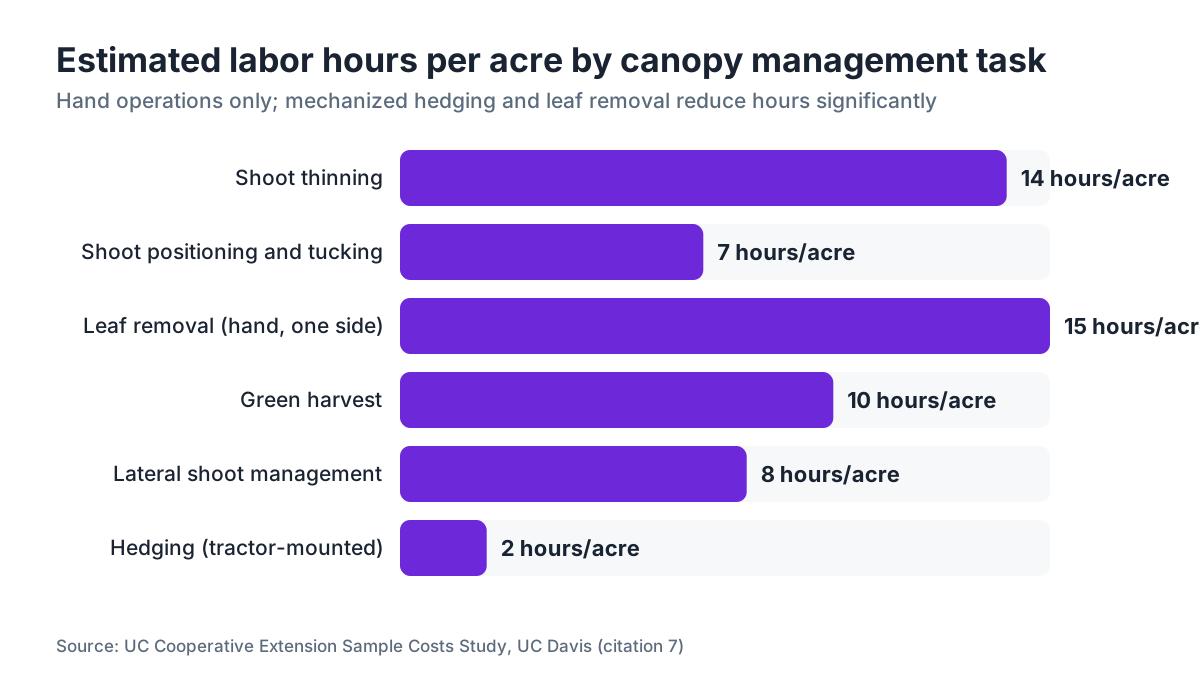
How much labor does canopy management actually take, and what does it cost?
Labor is where this conversation gets very practical. The numbers vary widely by operation, region, trellis system, and how much of it you mechanize, but here are honest ranges.
Shoot thinning runs roughly 8 to 20 hours per acre for hand work. It's on the low end if you have a clean, low-vigor VSP block and a trained crew. It's on the high end if you have a high-vigor, tangled block where shoots are already 12 inches long because you got rained out for two weeks.
Shoot positioning and tucking runs 4 to 10 hours per acre, depending on whether your catch wires are working and how many passes you make.
Leaf removal by hand runs 10 to 20 hours per acre for a single-sided pass, more for bilateral. Mechanical leaf removal with a compressed-air or impeller machine cuts that to 1 to 3 hours per acre but requires an investment in equipment (roughly $8,000 to $25,000 for a tractor-mounted unit, new, as of 2024 pricing).
Hedging is almost always mechanical. A tractor-mounted hedger runs 1 to 3 hours per acre per pass, and most operations hedge 2 to 4 times per season.
Total canopy management labor across a season runs roughly 20 to 60 hours per acre for hand operations, with the high end representing high-vigor, intensively managed blocks. At $18 to $22 per hour for vineyard labor (the common range in California as of 2024, noting that rates vary significantly by state and county), that's $360 to $1,320 per acre in labor alone [7]. UC Cooperative Extension's sample vineyard budgets for North Coast California place total canopy management costs (labor plus equipment) at roughly $600 to $1,200 per acre annually, which matches what growers report from the field.
Mechanization changes the math. If you can afford a good leaf removal machine and a hedger, your per-acre cost drops and you get more consistency. The ROI on a leaf removal machine is usually justified by year three or four on a 20-plus acre block.
Tracking these hours by operation and block is where field record-keeping software earns its keep. VitiScribe was built for exactly this: logging crew hours per task per block so you can actually see whether your shoot thinning investment is reducing your leaf removal time three weeks later.
What is the canopy management to fruit quality relationship, and what does the science say?
The relationship is well-established. Richard Smart and Mike Robinson's work in New Zealand in the 1980s and their 1991 book "Sunlight into Wine" laid the foundation that most current viticulture builds on. The core finding: interior canopy leaves operate at a net carbon deficit once they're shaded below about 15 to 20 percent of full sunlight, meaning they're consuming stored carbohydrates rather than making them [1].
For red varieties, the anthocyanin and tannin relationship with light is direct. Cluster zone light interception below 30 percent of ambient reduces color density and total phenolics. UC Davis research on Cabernet Sauvignon showed that canopy treatments improving cluster light exposure increased berry skin anthocyanin content by 15 to 30 percent compared to control vines with dense canopies [4].
For white varieties, particularly aromatic varieties, the relationship between canopy temperature and volatile compound development is important. Riesling terpene accumulation is temperature-sensitive; overheated berries from excess sun exposure lose aromatics. That's the argument for leaving more canopy on south-facing Riesling blocks in hot climates.
Methoxypyrazines (the bell pepper compound in Cabernet Sauvignon and Sauvignon Blanc) are the most commonly cited reason to do serious leaf removal. These compounds degrade with light and temperature. A cluster in full shade at 60°F ambient accumulates far more methoxypyrazines than a cluster in 50 percent sunlight at 70°F. The degradation is photolytic. Leaf removal accelerates it. Cornell research at the Geneva station documented this relationship in Sauvignon Blanc and Cabernet Franc trials [2].
Botrytis resistance is the disease argument. Dense canopies retain moisture, slow drying after rain, and create a microclimate where relative humidity stays above 85 to 90 percent for hours longer than an open canopy. Botrytis cinerea spore germination requires free water or relative humidity above 90 percent for several hours [8]. This is not theoretical. It's why Riesling and Pinot Noir growers in rainy years who skipped leaf removal pay for it at harvest.
What are the best canopy management practices for disease prevention?
Disease management and canopy management are the same conversation. Every fungicide application you make works better on an open canopy. Every hour of leaf removal is an hour you're reducing Botrytis, powdery mildew, and bunch rots simultaneously.
For powdery mildew (Erysiphe necator), the mechanism is air circulation and spray penetration. The pathogen overwinters in the bark and produces primary spores that infect young tissue. A dense canopy means your early-season protectant sprays never reach the interior clusters. You're protecting the outside and leaving the inside unsprayed. Leaf removal at or before bloom, combined with good shoot positioning, dramatically improves this.
For Botrytis cinerea, cluster architecture matters as much as canopy density. Tight-clustered varieties (Pinot Noir, Riesling, Gewurztraminer, Grenache) are inherently more susceptible because berries touch and create anaerobic pockets where the pathogen thrives without competition. Leaf removal reduces humidity but doesn't fix a biologically compact cluster. Pre-bloom leaf removal, as noted above, can reduce cluster compactness in some varieties. That's a genuine mechanical intervention on a biological problem.
Powdery mildew requires you to be inside the 7-to-14-day spray window almost without exception in susceptible regions. No amount of leaf removal substitutes for a proper spray program in inoculum-heavy environments. But an open canopy means your sulfur or DMI fungicide actually reaches the target surface [9].
When doing leaf removal or any chemical application, EPA Worker Protection Standard (WPS) requirements apply. Under 40 CFR Part 170, workers must receive WPS training, and restricted entry intervals (REIs) must be posted and communicated. Leaf removal done within an REI window after a spray application requires the same protective equipment as the application itself [10]. This is an area where compliance records matter: document your spray dates, your REIs, and your canopy work dates so you can show no overlap.
How does canopy management affect next year's crop?
This is the part growers sometimes forget. The work you do this season on canopy is directly shaping next year's yield.
Bud fruitfulness, meaning the number of clusters a bud will produce the following year, is determined during the current season. Buds differentiate into either vegetative or fruiting meristems during a window that in most regions runs from around bloom through veraison. Light is the primary driver of fruitfulness. A bud sitting in shade throughout summer will be less fruitful next year. A bud in good light (above 30 percent ambient) will carry more clusters.
This creates a compounding effect in high-vigor blocks. You don't thin shoots, the buds stay shaded, next year's fruitfulness drops, now you have fewer clusters to manage vigor through crop load, the vine goes even more vegetative, and the problem gets worse. WSU Extension's viticulture resources document this bud fruitfulness and light relationship clearly [6].
Carbohydrate reserve storage is the other mechanism. Vines store starch in their roots and permanent wood through late summer and fall. That reserve powers bud burst and early shoot growth the following spring before the vine's own leaf area is sufficient for photosynthesis. A vine that ran a dense, inefficient canopy all season makes less stored starch. It starts the following year with less energy, which means weaker shoots and delayed establishment.
The practical implication: canopy management done late (after veraison) does almost nothing for next year's bud fruitfulness. The window is closed. You might get some marginal improvement in berry ripening for the current year, but the investment-to-return ratio is poor. Do it early.
What does good canopy management look like from a compliance and record-keeping standpoint?
In states with right-to-farm and pesticide reporting requirements, canopy management itself doesn't generate a compliance form the way a spray application does. But it connects to compliance in two direct ways.
First, canopy work determines pesticide efficacy and thus your spray program frequency and dose. A well-documented canopy management log (dates, crew hours, operations performed, blocks covered) supports your IPM (Integrated Pest Management) records. Some state programs that require Pest Management Plans ask you to document cultural practices as part of justifying reduced chemical inputs [9].
Second, canopy work done while pesticide residues are still active triggers WPS requirements. Under 40 CFR Part 170, workers entering treated areas during an REI must have specific PPE and employers must follow specific notification requirements. The EPA revised the WPS in 2015, strengthening requirements around application exclusion zones, emergency assistance, and record-keeping. Specifically, employers must keep records of WPS training for each worker for two years [10].
A practical system: log each canopy operation with the block, date, crew names or worker IDs, hours, and task. Cross-reference against your spray log for the same block. If there's an REI overlap, it should be visible immediately. Paper-based systems work but require consistent discipline. Digital field logs make this cross-reference automatic.
This is exactly the kind of record VitiScribe handles in its block-level operations log, where spray records and canopy work for the same block appear on the same timeline.
What are common canopy management mistakes and how do you fix them?
The most expensive mistake is timing. Every canopy task has a window. Shoot thinning done at 12 to 18 inches of shoot growth instead of 4 to 6 inches costs two to three times more labor because the shoots are bigger and tangled. Leaf removal done after berry set instead of at bloom doesn't reduce cluster compactness at all. Hedging done once in June and ignored after that means laterals refill the canopy by July and you've accomplished almost nothing.
The second mistake is over-hedging. Growers who see a tall, leafy canopy want to cut it down. But aggressive topping stimulates lateral growth, and lateral leaves are physiologically younger and therefore more active in photosynthesis. You end up with a bushier canopy than you started with, and now it's August and you don't have time to fix it. Hedge enough to keep machinery clearance and shoot tip competition under control, not to make the vineyard look tidy.
The third mistake is uniform treatment across non-uniform blocks. Real vineyards have vigor variation within a block. The low end of the slope is different from the high end. The heavy soil patch in the middle is different from the edge rows. Treating the whole block identically means you're over-managing some vines and under-managing others. Even a rough zone map based on visual observation (shoot length, internode length, leaf size) lets you prioritize where to spend labor first.
The fourth mistake is skipping early leaf removal because of sunburn fear. Yes, sunburn is real in hot climates. But growers in warm regions with legitimate sun-exposure concerns can do morning-side leaf removal only, leaving the afternoon shade intact. This is a common practice in Paso Robles and parts of Napa.
Finally: don't let shoot thinning slide because the crew is busy with something else. Nothing downstream in canopy management is as cost-effective as getting shoot density right in May.
How does mechanization change the labor math on canopy management?
Mechanization doesn't replace judgment. It scales execution.
Hedging has been mechanized for 40-plus years. Most commercial operations in California, Washington, and Oregon use tractor-mounted reciprocating blade hedgers. A single operator can hedge 10 to 15 acres per day depending on terrain and row length. The machine doesn't make better decisions than a skilled pruner, but for basic shoot tip control it's good enough and the labor savings are real.
Mechanical leaf removal is the area seeing the most development. Compressed-air machines use bursts of air to blow leaves off the cluster zone without touching the clusters. Impeller machines use rotating paddles. Both work best when shoots are positioned properly in the canopy first, because a tangled canopy defeats any machine. Leaf removal machines from companies like Clemens, Collard, and FAO Elettronica (the major European brands available in North America) range from roughly $10,000 to $30,000 for complete tractor-mounted units. Labor savings of 15 to 25 hours per acre (replacing hand work) generate payback on a 30-acre-plus block within two to four seasons.
Mechanical shoot thinning is harder. Some operations use early-season hedging passes below the cordon to knock off suckers, but true selective shoot thinning requires a human hand for most commercial systems. Robotic vision-and-cut systems exist in research trials at UC Davis and other institutions but are not commercially available at scale as of 2025 [11].
Green harvest is almost always hand work. You need someone looking at each cluster, evaluating uniformity and bunch size, making decisions. It's not amenable to mechanization in premium vineyards.
The honest calculation: on a block below 15 to 20 acres, mechanical leaf removal and hedging save time but the capital cost is hard to justify unless you're running custom work for neighbors. Contract custom operators who own leaf removal machines can be a practical alternative; they exist in most established wine regions.
What do UC Davis, Cornell, and WSU say are the key canopy management principles?
These three institutions have produced most of the North American applied research on canopy management, and their recommendations converge more than they differ.
UC Davis's viticulture program, building on Smart's framework, consistently emphasizes the "balanced pruning" concept: matching the amount of retained wood (measured as pruning weight per vine) to the canopy capacity appropriate for the site. The practical tool is the Ravaz Index, which is the ratio of fruit weight to pruning weight. A ratio of 3 to 10 is considered balanced; below 3 is over-cropped or under-vigorous; above 10 is over-vigorous relative to crop load [4]. UC Davis extension materials recommend measuring Ravaz Index annually as a diagnostic.
Cornell Cooperative Extension's work at the Geneva, New York station has focused heavily on the humid climate challenges of the Northeast: Botrytis pressure, downy and powdery mildew, and the economics of canopy work relative to spray programs. Their key contribution is documenting the fungicide penetration improvement from leaf removal, showing that well-timed leaf removal reduces fungicide application frequency needed to achieve the same disease control level [2].
WSU Extension's viticulture team, working primarily in Eastern Washington's high-vigor, irrigation-managed environment, has produced clear guidance on trellis system choice and shoot density for high-vigor sites. Their research documents how the Geneva Double Curtain and Scott Henry systems, applied to high-vigor Columbia Valley sites, can achieve fruit quality targets that VSP cannot on the same soil [6].
All three institutions agree on one thing: the best canopy management system is the one that's actually executed consistently and on time. A theoretically superior system that gets executed late or incompletely every year loses to a simpler system done well.
What does a canopy management calendar look like season by season?
This is region-dependent, but the following table reflects the sequence for a mid-latitude wine region (California North Coast, Oregon Willamette, Washington Columbia Valley) with VSP training. Adjust timing for your bud break date.
| Phenological Stage | Approximate Calendar Range | Canopy Tasks |
|---|---|---|
| Bud swell to bud burst | March to early April | Inspect trellis, confirm catch wire positioning |
| 2 to 4 inch shoot growth | April | Begin sucker removal from trunk |
| 4 to 6 inch shoot growth | Late April to early May | Shoot thinning (most important window) |
| 6 to 12 inch shoots, pre-bloom | May | First leaf removal pass in fruit zone (timing for compactness reduction); shoot positioning begins |
| Bloom to fruit set | Late May to June | Shoot positioning, move catch wires; second leaf removal pass if needed |
| Post-set, berry pea-size | June | First hedging pass when shoots exceed top wire by 6 to 12 inches |
| Berry development | June to July | Second hedging pass; lateral management |
| Veraison | July to August | Green harvest if needed (must be pre-veraison for maximum effect); final hedging |
| Post-veraison to harvest | August to September | Monitor canopy for late-season disease; minimal intervention |
This calendar represents a minimum intervention sequence. High-vigor blocks will need additional passes. The shoot thinning window is the one you must not miss; everything else can slide a week, but late shoot thinning costs exponentially more labor and delivers less benefit.
Frequently asked questions
How many leaves per shoot do grapevines need to ripen fruit properly?
The commonly cited benchmark from Richard Smart and Mike Robinson's research is 10 to 15 healthy mature leaves per shoot. In a standard VSP system, that translates to a canopy wall roughly 3 feet tall. Below 10 leaves per shoot, you risk under-ripening, especially in cool climates. Above 15 leaves in a dense canopy, many of those leaves are shaded and operating at a net carbon deficit rather than contributing to ripening.
When is the best time to do leaf removal for disease prevention?
Pre-bloom or at bloom gives you the most benefit. That timing can reduce cluster compactness in some varieties by 20 to 40 percent (UC Davis data on Pinot Noir) and gives the cluster zone more air and spray penetration all season. Post-bloom leaf removal still improves air circulation significantly but doesn't affect cluster architecture. Either timing is better than no removal. In cool, wet climates, do not skip this step.
What is the Ravaz Index and how do you use it?
The Ravaz Index is fruit weight divided by pruning weight for the same vine. A ratio of 3 to 10 indicates a balanced vine. Below 3 means the vine is over-cropped or under-vigorous. Above 10 means the vine is too vigorous relative to its fruit load. UC Davis recommends measuring it annually as a diagnostic for whether your canopy and crop load management are in balance. Weigh a pruning sample and the fruit from the same vines at harvest.
Does green harvest actually improve wine quality, and when should you do it?
The evidence is mixed but leans toward yes, with a timing caveat. Green harvest done before veraison consistently shows measurable improvement in berry ripening, sugar accumulation, and phenolic development in trials at Cornell and UC Davis. Green harvest done after veraison shows much smaller and less consistent effects. The berry is already committed to its ripening trajectory. If you're going to drop fruit, do it early, ideally at pea-size or just after fruit set.
How do you manage canopy in a high-vigor vineyard without switching trellis systems?
Short answer: it's hard. Long answer: you can improve outcomes without retrelissing by tightening shoot density targets through aggressive shoot thinning, using deficit irrigation during early shoot growth to reduce vigor, adjusting pruning levels to increase crop load (more clusters per vine means less vegetative expression), and doing multiple leaf removal passes. But a genuinely high-vigor site on deep soils will keep fighting you. At some point, divided canopy systems are the honest solution.
What PPE and WPS compliance is required during canopy work after a spray application?
Under EPA Worker Protection Standard (40 CFR Part 170), workers entering a treated area during a restricted entry interval (REI) must wear the PPE specified on the pesticide label for the applied product, typically including chemical-resistant gloves, long sleeves, and eye protection. Employers must post REIs at the treated area, provide access to emergency assistance information, and keep WPS training records for at least two years. Canopy work scheduled within an REI window triggers these requirements.
How much does mechanical leaf removal equipment cost and is it worth it?
Tractor-mounted mechanical leaf removal machines (compressed-air or impeller type) range from roughly $10,000 to $30,000 new as of 2024 pricing. They replace 15 to 25 hours per acre of hand labor per pass. At $18 to $22 per hour for vineyard labor, the payback period on a 30-plus acre block is typically two to four seasons. Below about 15 to 20 acres, the capital cost is harder to justify; custom operators owning these machines exist in most established wine regions.
What is shoot positioning and does it actually make a difference?
Shoot positioning is physically orienting growing shoots into the trellis system (typically upright in VSP) and lifting the catch wires to hold them. It matters because unpositioned shoots flop, overlap, and shade each other immediately. Positioned shoots grow parallel, allowing air movement and light penetration between them. It also makes every subsequent canopy task (hedging, leaf removal, spraying) faster and more effective. Do it when shoots are 10 to 18 inches long, before they're tangled.
Can you do canopy management in organic viticulture the same way as conventional?
Yes, the physical practices (shoot thinning, leaf removal, hedging, positioning, green harvest) are identical. The difference is downstream: because organic programs rely more on sulfur and copper fungicides, and those products have lower residual activity than some synthetic DMIs, having an open canopy with good spray penetration matters even more in organic blocks. Organic growers generally need to be more aggressive with leaf removal because their fungicide arsenal is narrower.
What is the difference between shoot thinning and hedging?
Shoot thinning removes entire shoots at their base, done early in the season to establish the right number of shoots per foot of cordon. Hedging (topping) removes the growing tips of shoots that have extended above the trellis, done multiple times through the season to control shoot length. Shoot thinning shapes the canopy's structure; hedging controls its height. Both are necessary in most systems, but shoot thinning is the higher-leverage practice.
How does row orientation affect canopy management?
North-south row orientation maximizes light interception on both sides of the canopy throughout the day, generally considered the optimum for quality in most regions. East-west rows concentrate afternoon sun on one side and can cause sunburn in hot climates. In sloped vineyards, across-slope orientation often wins on erosion control and equipment access, sometimes at a cost to light distribution. If you're designing a new block, north-south is the default unless slope or prevailing wind argues otherwise.
How do I know if my canopy is too dense?
Several diagnostic signals: more than one layer of overlapping leaves in the fruit zone, fewer than 10 percent dappled light spots on the vineyard floor at midday, interior leaf yellowing from shading, shoots flopping and tangling without staying in wires, and persistent humidity in the cluster zone after rain. A simpler check from Smart's "point quadrat" method: insert a wire into the canopy at random points and count the number of leaf layers it passes through. More than 1.5 average layers means the canopy is too dense.
Does canopy management affect wine price or just fruit quality?
Indirectly yes. Fruit quality scores, brix, pH, TA, and phenolic maturity assessments at delivery all affect price per ton in most contract structures. Washington State University research documented a direct relationship between canopy management intensity, fruit composition scores, and negotiated prices. The mechanism is quality, not marketing. Better canopy work produces fruit that scores better at the crush pad, and better-scoring fruit commands higher prices in the market.
What records should I keep for canopy management operations?
At minimum: block ID, date, operation (shoot thinning, leaf removal, hedging, etc.), crew hours, and any notes on conditions or observations. Cross-reference against your spray log for the same block to flag any potential REI overlaps. If you're in an IPM program or seeking a sustainable farming certification, canopy work records support your cultural practice documentation. Some certifications (Lodi Rules, LIVE, SIP Certified) specifically ask for records of canopy management decisions as part of pest management evidence.
Sources
- Smart, R.E. (1985). Principles of Grapevine Canopy Microclimate Manipulation with Implications for Yield and Quality. American Journal of Enology and Viticulture, 36(3), 230-239.: Interior canopy leaves operate at a net carbon deficit below approximately 15-20% of full sunlight; clusters require 800-1200 micromoles photons/m2/s for quality ripening.
- Cornell Cooperative Extension, Viticulture and Enology Program, Geneva NY: Leaf removal timing and canopy management effects on Botrytis, methoxypyrazines, and fungicide penetration in Northeast vineyards.
- UC Cooperative Extension, Napa County, Vineyard Management Practices: Target shoot density of 3 to 6 shoots per foot of cordon for bilateral VSP systems in moderate-vigor California vineyards.
- UC Davis Department of Viticulture and Enology, canopy management and fruit composition research: Pre-bloom leaf removal reduces Pinot Noir cluster weight and compactness 20-40%; improved cluster light exposure increased Cabernet Sauvignon skin anthocyanin 15-30%; Ravaz Index of 3-10 considered balanced.
- Cornell Cooperative Extension, Green Harvest Timing Recommendations for New York Vineyards: Green harvest performed before veraison produces measurable quality gains; post-veraison green harvest shows much smaller and less consistent effects on sugar accumulation and phenolics.
- Washington State University Viticulture and Enology Extension: Trellis system choice and shoot density guidance for high-vigor Columbia Valley sites; Geneva Double Curtain and Scott Henry systems; bud fruitfulness and light relationship.
- University of California Agricultural Issues Center, Sample Costs to Establish and Produce Winegrapes, North Coast Region: Total canopy management costs (labor plus equipment) approximately $600 to $1,200 per acre annually in North Coast California; prevailing vineyard labor rate $18-$22 per hour.
- UC Davis Integrated Pest Management Program, Botrytis Bunch Rot of Grape: Botrytis cinerea spore germination requires free water or relative humidity above 90 percent sustained for several hours; dense canopies extend these conditions well past open-canopy conditions after rain.
- California Department of Pesticide Regulation, Integrated Pest Management and Cultural Practices Documentation: State IPM programs require documentation of cultural practices including canopy management as part of pest management plans; canopy work records support reduced chemical input justification.
- U.S. EPA, Worker Protection Standard for Agricultural Pesticides, 40 CFR Part 170: WPS requires workers entering treated areas during REI to wear label-specified PPE; employers must maintain WPS training records for at least two years; requirements strengthened in 2015 revision.
- UC Davis Department of Viticulture and Enology, vineyard mechanization and robotics research: Robotic vision-and-cut shoot thinning systems remain in research trials and are not commercially available at scale as of 2025.
- Smart, R. and Robinson, M. (1991). Sunlight into Wine: A Handbook for Winegrape Canopy Management. Winetitles, Adelaide.: Foundational framework for canopy microclimate and fruit quality; point quadrat method for measuring canopy density; 10-15 leaves per shoot and 1.5 average leaf layers as benchmarks.
Last updated 2026-07-09