CCOF audit preparation checklist for organic vineyard spray records

TL;DR
- CCOF auditors review spray records for operator identity, product name, EPA registration number, application rate, field location, date, and pest target.
- Every input must appear on CCOF's approved materials list or have a prior approval letter on file.
- Records must be kept at least five years.
- Missing any single field can trigger a Notice of Noncompliance.
What does a CCOF auditor actually look at during an organic vineyard inspection?
CCOF runs an annual on-site inspection for every certified operation, and the inspector's job is simple: compare what you said you'd do in your Organic System Plan (OSP) against what you actually did in the field. For a vineyard, that comparison lives almost entirely in your spray records.
The auditor pulls your spray application log and cross-references it against three things: the materials list you filed with your OSP, the National Organic Program (NOP) regulations at 7 CFR Part 205, and any certification letters or material approval decisions CCOF issued to you during the season [1]. If a product shows up in the log but not on your approved materials list, you get a noncompliance finding. It doesn't matter whether the product is inherently allowed under the NOP. The list is the list.
Beyond the log, inspectors check that your field maps match the blocks in your records, that buffer zones between certified and non-certified land are documented, and that purchased inputs arrived with a valid product label or Safety Data Sheet on file before first use. A small vineyard audit usually runs two to five hours on site, though the document review stretches longer when records are a mess.
Here's what a lot of growers miss. CCOF inspectors are trained to look for drift and contamination risk. If a neighboring conventional block got a synthetic pesticide and your records don't show a buffer or a residue-test response, that becomes its own line of questioning. Your paperwork proves two things: what you used, and how you managed the risk of what your neighbors used.
What fields are required in every organic vineyard spray record?
The NOP at 7 CFR 205.103 requires certified operators to keep records that "fully disclose all activities and transactions of the certified operation" and to retain them for five years [1]. CCOF builds on that floor. Every single spray application entry needs the fields below.
| Required Field | Notes |
|---|---|
| Date of application | Exact calendar date, not a range |
| Operator name | Person who actually applied, more than the farm name |
| Field or block ID | Must match OSP field map |
| Crop | Variety-level detail helps but species is the minimum |
| Pest, disease, or weed target | Be specific: "Botrytis cinerea," not "fungal disease" |
| Product name | Exactly as printed on the label |
| EPA registration number | Required for any registered pesticide |
| Active ingredient(s) | List all |
| Application rate | Units per acre or per volume of water, as labeled |
| Total quantity applied | Gallons or pounds actually mixed and used |
| Application method | Airblast, handgun, backpack, drone, etc. |
| Equipment used | Sprayer ID or description |
| Acres treated | |
| Pre-harvest interval observed | Date crop is eligible for harvest post-application |
Use a custom spray blend? Every component needs its own EPA number and rate listed. "Tank mix" as a shorthand entry is a guaranteed noncompliance flag.
Washington State University's extension work on organic farming recommends adding a lot number or batch number column so you can trace a specific container of sulfur or copper back to its purchase invoice if a residue question ever comes up [2]. The NOP doesn't require it. But it has saved growers in residue investigations where the product itself was suspected of being adulterated. Keep the column. It takes two seconds to fill.
Which spray materials are allowed and which are prohibited in CCOF-certified vineyards?
Allowed and prohibited materials live in the National List at 7 CFR 205.601 (synthetic substances allowed) and 205.602 (prohibited natural substances) [1]. For any California vineyard, the practical starting point is CCOF's Materials Review program, which evaluates commercial products against the National List and keeps a searchable database.
For fungal disease, the main spray pressure in most California vineyards, these materials are broadly allowed under the NOP when used per label:
- Elemental sulfur (7 CFR 205.601(i)(6))
- Copper-based fungicides, subject to the copper-accumulation limit
- Potassium bicarbonate
- Neem oil
- Lime sulfur
- Bacillus subtilis and other microbial products approved by CCOF
Copper deserves real attention. The NOP requires copper-based materials to be used "in a manner that minimizes accumulation of copper in the soil" [1]. CCOF will ask for your cumulative copper application records across multiple years. If you're pushing hard on metallic copper equivalent per acre in a cool, wet Pinot Noir block, you need to document that no alternatives were practical.
Prohibited synthetic fungicides cover nearly every DMI (demethylation inhibitor), strobilurin, and SDHI that conventional vineyards lean on. Mancozeb is out. Chlorothalonil is out. Glyphosate for undervine weed control is absolutely out [1].
Some materials sit in a grey area. Certain adjuvants, spreader-stickers, and pH modifiers carry synthetic ingredients that aren't on the National List. CCOF requires pre-approval before you use them. A product sold at the farm store with "organic" or "natural" on the label is not automatically NOP-compliant. Pull the CCOF-approved materials list, or submit the product to CCOF's materials review before the season starts [3].
UC Cooperative Extension has published guidance on copper reduction for organic wine grapes, covering kaolin clay and canopy management as ways to cut total copper load while holding disease in check [4].
How do you document a spray application to satisfy both CCOF and the EPA Worker Protection Standard?
Good news: the EPA Agricultural Worker Protection Standard (WPS) at 40 CFR Part 170 requires a central-location posting of pesticide application information within 24 hours of application, and most of those fields overlap directly with your organic spray log [5]. You're filling out the same information twice, or once if you build a single form that satisfies both.
The WPS central-location posting requires product name, EPA registration number, active ingredient, location of the treated area, date of application, restricted-entry interval (REI), and the applicator's name [5]. Your organic log needs all of that plus application rate, acres treated, and pest target.
Where they split: WPS doesn't require you to prove the material was NOP-compliant, and your organic log doesn't need the emergency contact information the WPS posting does. Keep both records. They answer to different rules and different inspectors.
Cornell Cooperative Extension's WPS guidance for small farms describes a combined log-and-posting template that cuts paperwork without losing compliance [6]. The catch is placement: the WPS posting has to be physically accessible to workers at the central location, while your organic spray log is a retained business record. Print or post a copy; keep the master log secure.
One workflow that holds up. Fill the spray log in the field the day of application, even a paper field card. Post the WPS notice at the shop that same afternoon. Transfer the entry to your master record system within 48 hours. Never let records sit more than a week unfiled. Audit season is a bad time to reconstruct a whole season from memory and phone photos of spray jugs.
What is the five-year record retention rule and what form can records take?
7 CFR 205.103(b) requires records to be retained for at least five years beyond their creation [1]. CCOF's certification agreement mirrors that. The five-year clock starts from the date of the record, not from the end of the certification year.
Records can be paper or electronic. CCOF mandates no specific format. What CCOF does require: records must be legible, organized by operation and by year, and available for inspection within 24 hours of a request. Digital records need to produce a printed or clearly readable version on short notice.
A common trap. Growers who switch from paper to software mid-season sometimes end up with records in two formats for the same year. That's fine, as long as you document the transition date and preserve both sets. An auditor who sees a gap in the digital log and no explanation assumes the gap is undocumented activity.
Manage multiple blocks or lease parcels from different landowners? Each parcel under the certified operation needs its own records. The operator of record, not the landowner, holds responsibility for keeping those records under the NOP [1].
Software built for vineyard record-keeping, like VitiScribe, can export audit-ready spray logs in formats that map straight to CCOF's required fields. The value isn't the software. It's the habit of logging every spray event the day it happens instead of reconstructing it later.
How should you prepare your Organic System Plan (OSP) and materials list before the inspection?
The OSP is your certification's backbone. It describes every field, every material you plan to use, your pest management strategy, and your record-keeping system. CCOF requires you to update the OSP any time there's a material change to your operation, which includes adding a new spray material mid-season [3].
Before your inspection:
- Pull your current OSP from CCOF's MyCCOF portal and print the materials list.
- Go through your spray log entry by entry. Every product in the log should appear in the OSP materials list.
- For any product that isn't on the list, find the CCOF approval letter or email authorizing it. No letter means a problem to fix before the auditor arrives.
- Confirm each product's EPA registration number in your log matches the number on the actual label you have on file. Label changes happen, and a mismatch draws questions.
- Review your field maps. If you replanted, removed, or modified a block since your last OSP update, update the map first.
CCOF's Certification Handbook, available through their website, walks through the OSP amendment process [3]. Submitting an amendment to add a material after you already used it beats an unexplained log entry. An after-the-fact amendment tells the auditor you caught the issue and fixed it. An unexplained entry with no amendment says you didn't know the rules applied.
Build the habit: submit OSP amendments within 48 hours of deciding to use a new material, before you spray it. That's the right sequence. The NOP requires prior approval for any deviation from the OSP, not retroactive disclosure [1].
What are the most common spray-record deficiencies that cause CCOF noncompliance findings?
Pull from CCOF's compliance guidance and the audit-training materials extension specialists publish, and the recurring problems land on a short list.
Missing EPA registration numbers. The single most common gap. Growers write a product name and skip the number, especially for exempt products like elemental sulfur. Even if a product is exempt from EPA registration under FIFRA, if it carries a registration number, that number goes in the log.
Vague pest or target descriptions. "Disease" or "insects" doesn't tell an auditor whether you responded to verified pressure or sprayed preventively. Write "Erysiphe necator (powdery mildew), observed at 10% leaf incidence on June 14."
Rate inconsistencies. The log says 4 pounds of sulfur per acre. The label maximum is 3 pounds per acre. That's a label violation and a possible noncompliance. Every logged rate has to fall within labeled use rates.
Undocumented drift events. If a neighbor sprayed a synthetic and there's any chance of drift into your certified blocks, document your response: date you noticed, what you saw, whether you called the neighbor, whether you ordered a residue test. Silence in the record reads as indifference.
Expired product labels on file. Labels get revised. That 2019 label in your file cabinet may not match the current registered use pattern. Keep current labels.
Gaps between purchase records and use records. Auditors sometimes ask for input invoices alongside the spray log. Buy 50 pounds of potassium bicarbonate but log only 20? The auditor asks where the other 30 went.
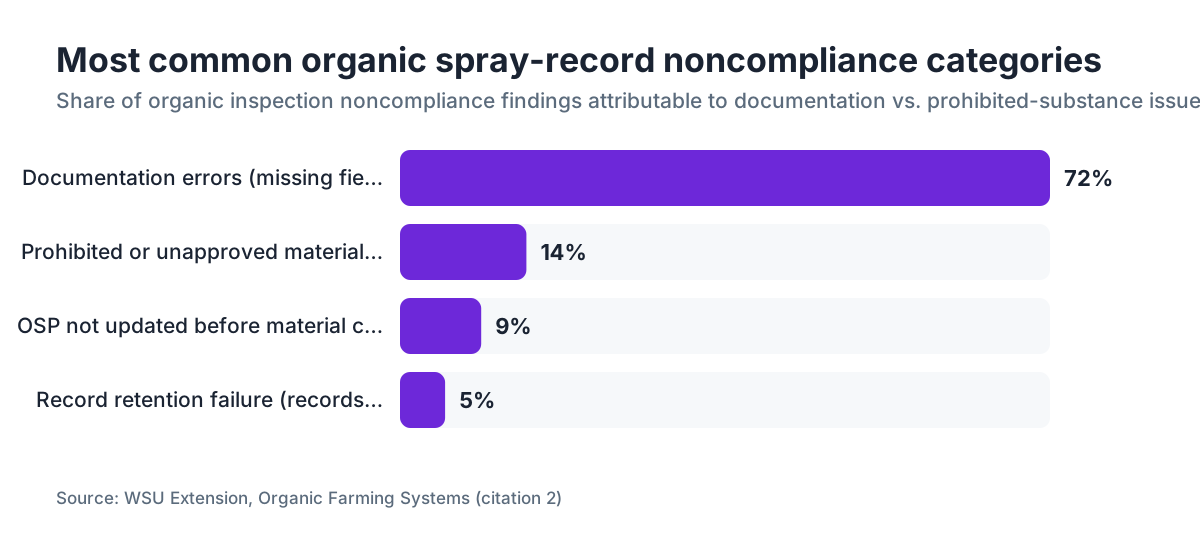
WSU's organic systems training materials note that most noncompliance findings at annual inspections are documentation errors, not actual prohibited-substance use [2]. The product was fine. The record was incomplete. That's fixable, and fixing it before the auditor shows up is always the better path.
What documents should be physically ready on inspection day?
Lay these out before the inspector arrives. Nothing signals disorganization faster than hunting for documents while an auditor waits.
| Document | Where it lives | Minimum years on hand |
|---|---|---|
| Complete spray application log, current year | Farm records / software export | Current season |
| Complete spray logs, prior years | Farm records / software export | 5 years |
| OSP with current materials list | MyCCOF portal printout | Current approved version |
| CCOF materials approval letters | Email or paper file | All active materials |
| Product labels for every input used | File folder or binder | Current labels |
| Purchase invoices for inputs | Accounting or farm file | 5 years |
| Field maps with block IDs | OSP attachment | Current approved version |
| Seed purchase records (non-GMO documentation) | Farm records | 5 years |
| Harvest records | Farm records | 5 years |
| WPS central-location posting copies | Farm records | 2 years (WPS requirement) [5] |
| Buffer zone documentation | OSP or field notes | Current |
| Equipment cleaning records | Farm records | Current season |
Equipment cleaning records trip up a lot of growers. If your airblast sprayer also runs a non-certified block, a common setup on diversified properties, you need a written cleaning protocol and documentation that it was followed before the sprayer returned to the certified vineyard. The NOP addresses commingling and contamination prevention at 7 CFR 205.272 [1]. An undocumented shared sprayer is a real liability.
Keep records digitally? Export a PDF of the full season's spray log two weeks before your expected inspection window and review it yourself. You'll catch errors you missed while entering data one row at a time.
How does CCOF handle noncompliance findings related to spray records, and what can you do about it?
CCOF's noncompliance process runs in tiers. A minor documentation gap, say a missing EPA registration number on one entry, usually draws a Notice of Noncompliance (NON) with a corrective-action response due in a set window, typically 30 days [3]. You correct the record, explain the error, describe the process change that stops it from recurring, and CCOF closes the finding.
Serious issues, like using a prohibited material or falsifying records, can lead to suspension or revocation of certification. Suspension runs through a different corrective process and may carry a waiting period before reinstatement. Falsification can bring civil penalties, because the USDA National Organic Program is a federal program under 7 CFR Part 205 [1].
Get a noncompliance notice and disagree with it? CCOF's certification agreement includes an appeal process, and the NOP provides for appeals to the USDA's National Organic Program directly. These processes exist, but they take time, and the burden sits on the operator to show compliance.
The practical advice: respond to every noncompliance notice in writing, on time, with specifics. "I will be more careful" carries far less weight than "I updated my spray log template to make the EPA registration number a mandatory field and entered the correct numbers for the two entries that were missing. The updated log is attached." Show the corrective action. Don't just promise it.
What's the best way to build a spray record system that survives audits year after year?
Growers who pass audits cleanly every year share one habit: they record applications the same day they happen, every time, no exceptions. The format matters far less than the consistency.
A paper field card transcribed to a master log weekly works. A spreadsheet works. A purpose-built platform like VitiScribe works and has the edge of structuring data entry so required fields can't be skipped. Pick the system that fits how you actually work in the field, not the fanciest option on the market.
Build a pre-season materials review into your annual calendar. Every January or February, before you order inputs for the coming season, run your planned materials list past CCOF's approved materials database. Submit amendments for any new products before they arrive on the farm. That's one hour a year, and it kills the scenario where you spray something mid-June and realize in October you never got approval.
UC Cooperative Extension's organic viticulture work recommends a seasonal checklist: pre-season OSP review, mid-season log audit (check your own records at bloom and veraison), and a pre-inspection self-audit four to six weeks before your expected inspection date [4]. Three review points a year, about two hours each, and you'll find your own errors before an auditor does.
For a vineyard at 20 acres or more with multiple varieties and blocks, assign record-keeping to one named person rather than leaving it a shared task. Shared tasks get dropped. Named responsibility gets done.
Are there differences in spray record requirements for transition-period vineyards versus fully certified ones?
Yes, and this is where growers sometimes assume the rules go easy during the 36-month transition period. They don't.
The NOP's three-year transition rule at 7 CFR 205.202 requires that land have no prohibited substances applied for 36 months before the first organic harvest [1]. CCOF expects records during transition that prove it, which means your transition spray log has to meet the same standard as a certified operation's log. You're building the evidence that your transition period was clean.
Can't produce transition-period spray records because you didn't start keeping them until you decided to certify? CCOF may require a longer documented period, affidavits from previous operators, or soil residue testing. Affidavits get accepted, but they're weaker evidence than actual records. Soil tests can detect persistent-pesticide residues and can work in your favor if they come back clean, but they don't replace records.
Converting blocks from conventional production on an existing certified property? CCOF requires the transition blocks be clearly identified in the OSP and that spray records separate certified blocks from transition blocks. Commingling records for the two is a common and avoidable error.
Frequently asked questions
How far back do CCOF spray records need to go?
The NOP at 7 CFR 205.103(b) requires records to be kept at least five years from the date of creation. CCOF's certification agreement mirrors this. In practice, bring records from the current season and the prior four years to any inspection. For transition-period documentation, you may need records going back 36 months before your first certified harvest, which can extend beyond the standard five-year window.
Does CCOF have its own approved materials list, or do I just follow the USDA National List?
Both apply. The USDA National List at 7 CFR 205.601 and 205.602 sets the federal floor of what's allowed or prohibited. CCOF's Materials Review program then evaluates specific commercial products against that list. A material may be on the National List while a particular formulation contains inert ingredients that aren't NOP-compliant. Verify the specific product through CCOF's materials database before use, more than the active ingredient category.
What happens if I accidentally use a non-approved spray material in my certified vineyard?
Disclose it to CCOF immediately. Self-reporting a prohibited-substance incident before an inspector finds it gets treated differently than a discovered violation. CCOF will likely issue a noncompliance finding and may require a corrective action plan. In serious cases, the affected crop can't be sold as certified organic. Voluntary disclosure usually produces better outcomes than discovered violations, and the NOP treats willful falsification far more seriously than honest mistakes.
Can I use a generic spreadsheet for spray records, or does it have to be farm management software?
A spreadsheet is fine. The NOP and CCOF don't require specific software. What matters is that records are legible, organized, include all required fields, and can be produced within 24 hours of an inspector's request. Many growers use a simple spreadsheet template with locked column headers matching required fields. The advantage of purpose-built software is that required fields can be made mandatory, so you can't skip one.
Does the EPA Worker Protection Standard spray record overlap with what CCOF requires?
Largely yes. The WPS at 40 CFR Part 170 requires operator name, product name, EPA registration number, active ingredient, treated area location, application date, and restricted-entry interval posted at a central location within 24 hours of application. Your organic spray log needs all of those plus application rate, acres treated, pest target, and equipment used. A single combined form can satisfy both if it includes every field from each.
Is there a copper use limit in CCOF-certified vineyards, and how do I document it?
Yes. The NOP requires copper-based materials to be used in a way that minimizes soil accumulation, and CCOF holds applications to what's necessary for plant disease control. Keep a running annual total of metallic copper equivalent applied per acre per block. Document the disease pressure that justified each application. Auditors reviewing copper use want the quantity records and evidence that use was responsive to actual pest pressure.
What records do I need for an organic spray application made by a hired custom applicator?
The certified operator, meaning you, is responsible for the records no matter who applied. Require your custom applicator to provide a written application record at the time of service with all required NOP fields: product name, EPA registration number, rate, method, date, and block. Never accept an invoice with just a product name and a price as the only documentation. Verify the material was on your CCOF-approved materials list before authorizing the application.
How should I document a spray application made in response to a neighbor's conventional pesticide drift?
Document the date you observed potential drift, what you saw (dead bees, visible residue, smell), what the neighboring crop was and what they were reportedly applying, what buffer measures were in place, and any response steps such as contacting the neighbor or submitting tissue or soil samples for residue testing. Include the lab results if you sampled. This protects you if the auditor asks about contamination risk and shows you took the threat seriously.
Do I need spray records for sulfur applications for mite control, more than disease?
Yes. Every pesticide application in a certified operation requires a full log entry regardless of purpose. Elemental sulfur used as a miticide gets the same treatment as sulfur used as a fungicide: date, block, rate, acres, operator, pest target, EPA registration number if applicable. The target changes from powdery mildew to Pacific spider mite, but the record requirements are identical.
How do I handle a spray record for a tank mix with multiple products?
Each component of the tank mix needs its own line in the record, or at minimum its own row in a combined entry that clearly attributes the rate and EPA registration number to each individual product. Writing "tank mix" as a single entry with no component breakdown is a guaranteed noncompliance finding. List each product separately, note that it was part of a tank mix applied on the same date to the same block, and document the individual rates.
What's the difference between a CCOF Notice of Noncompliance and a suspension?
A Notice of Noncompliance is a formal finding of a specific violation that requires a written corrective action response, typically within 30 days. It doesn't immediately affect your certification status. A suspension removes your certified status for a period and requires a more substantial corrective process before reinstatement. Suspensions usually follow serious or repeated violations. Most documentation errors draw a NON with a corrective action requirement rather than suspension.
Can I keep spray records on my phone, and will CCOF accept that format?
CCOF accepts electronic records in any format as long as they're legible, complete, and can be produced within 24 hours of a request. Records kept on a phone app are fine if you can export or print them. The practical risk is data loss if you don't back up regularly. Any electronic record system should have a backup stored somewhere other than the device you use in the field. A weekly export to a cloud folder or a laptop covers that.
WSU and UC extension both publish organic viticulture guides. Which is more relevant for California vineyards?
Both are worth reading. UC Cooperative Extension's organic viticulture materials are more specific to California conditions, California-registered products, and California Department of Pesticide Regulation requirements that layer on top of the NOP. WSU's organic systems resources are stronger on the NOP compliance framework and record-keeping generally. Use UC guidance for product selection and pest management, WSU for the federal compliance structure and audit prep.
How often does CCOF conduct unannounced inspections of organic vineyards?
CCOF conducts at least one announced annual inspection for every certified operation. Unannounced inspections can happen when there's a complaint, a residue test failure, or a reason to verify a specific claim. The NOP at 7 CFR 205.403 authorizes certifiers to conduct unannounced inspections at any time. The best prep for a surprise visit is keeping records current within 48 hours, so they're always ready no matter when someone shows up.
Sources
- USDA Agricultural Marketing Service, National Organic Program Regulations (7 CFR Part 205): NOP requirements for allowed and prohibited materials, record retention of five years, OSP requirements, transition period, and contamination prevention (7 CFR 205.103, 205.201, 205.202, 205.272, 205.601, 205.602)
- Washington State University Extension: Recommendation to include lot/batch numbers in spray records for input traceability; most noncompliance findings at organic inspections are documentation errors rather than prohibited-substance use
- CCOF Certification Services, Certification Handbook: OSP amendment requirements before using new materials, CCOF materials review and approval process, and noncompliance response timeframes
- University of California Agriculture and Natural Resources, Cooperative Extension: Seasonal three-point self-audit approach for organic vineyards; copper reduction strategies using kaolin clay and canopy management for California wine grapes
- EPA, Agricultural Worker Protection Standard (40 CFR Part 170): WPS central-location posting requirements including product name, EPA registration number, active ingredient, treated area, application date, REI, and applicator name within 24 hours of application; two-year record retention
- Cornell Cooperative Extension: Combined log-and-posting template approach to reduce documentation burden while meeting both WPS and organic record requirements
- USDA National Organic Program, Program Handbook (Instruction and Guidance documents): Guidance on how certifying agents evaluate material inputs against the National List; requirement for prior approval before deviation from the OSP
- California Department of Pesticide Regulation: California requirement that pesticide applications comply with the label as a legal document; EPA registration number requirements for registered pesticides used in California
- USDA Agricultural Marketing Service, National Organic Program (7 CFR 205.403): NOP at 7 CFR 205.403 authorizes certifiers to conduct unannounced inspections at any time; annual inspection requirement for all certified operations
- University of California Agriculture and Natural Resources, Integrated Pest Management Program: Copper accumulation considerations and disease management guidance for organic vineyards in California; demonstrating disease-pressure justification for copper applications
Last updated 2026-07-10