What happens if vineyard spray records are incomplete during a compliance audit

TL;DR
- Missing or incomplete vineyard spray records can bring civil penalties from a few hundred dollars to $10,000 or more per violation under California, Washington, and federal pesticide law.
- Auditors from county agricultural commissioners or EPA-authorized state agencies check specific data fields on every application.
- Gaps in restricted-use pesticide logs carry the heaviest consequences.
- Fix records before inspection season, not during it.
What do compliance auditors actually look for in vineyard spray records?
Auditors are not hunting for drama. They work from a checklist, and that checklist comes largely from state pesticide use reporting rules and the federal Worker Protection Standard. On every application entry they want the product name and EPA registration number, application date and time, target pest, location or field ID, total area treated, application method, equipment used, and the name of the licensed applicator. California regulations under the Food and Agricultural Code require the pesticide use report to reach the county agricultural commissioner within seven days of application for most pesticides, and within thirty days for certain categories. [1]
Restricted-use pesticides get extra scrutiny. Under 40 CFR Part 171 and state implementing rules, any restricted-use pesticide application must be supervised by a certified applicator, and the record has to show who that person was and their license number. [2] Blank field, guaranteed problem, no matter how clean the rest of the log looks.
The Worker Protection Standard adds another layer. Under 40 CFR Part 170, agricultural employers must keep records of pesticide applications for at least two years, including the product label safety data, the re-entry interval (REI), and evidence that workers were notified of applications and REIs before entering treated areas. [3] Auditors from the EPA or a state ag agency can request those records at any time. Two years is the federal floor. Some states require longer.
Here's something people miss. Auditors sometimes cross-reference your spray records against purchase receipts or dealer sales records. If you bought ten gallons of a product and your log only accounts for six, someone is going to ask where the other four went.
What are the actual penalties for incomplete or missing spray records?
Penalties vary by state and by which law you violated, but the ranges are real and they are not trivial.
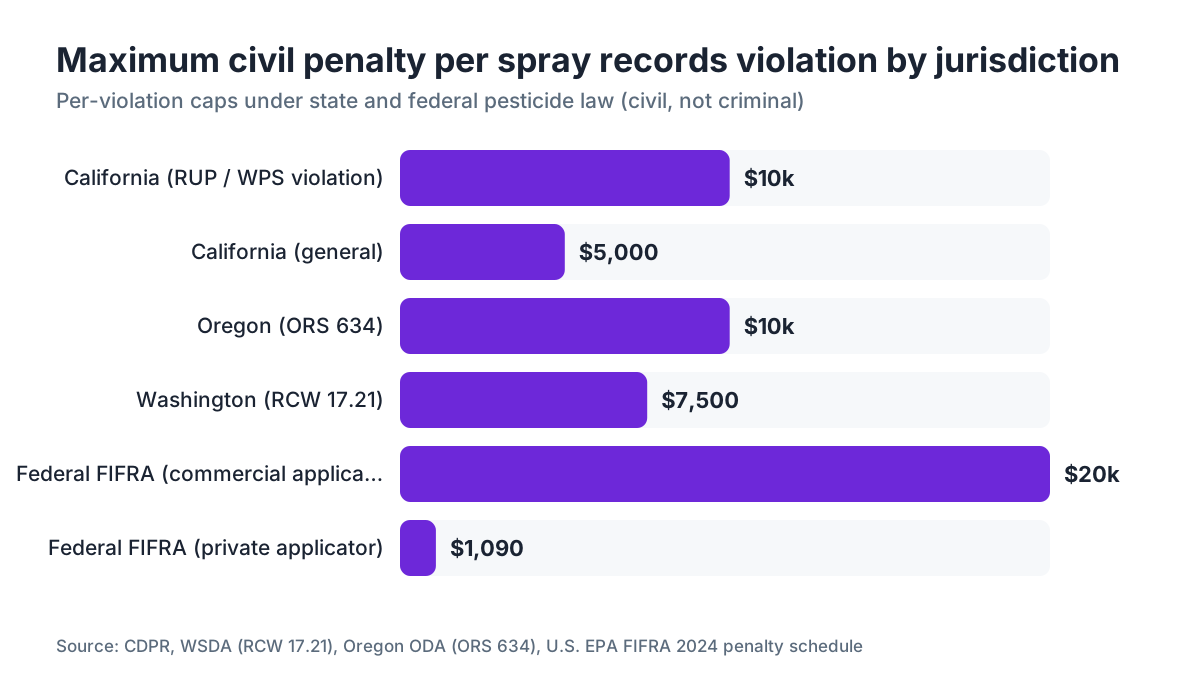
In California, the Department of Pesticide Regulation (CDPR) can assess civil penalties up to $5,000 per violation per day for pesticide use reporting failures. [1] For violations involving restricted-use pesticides or worker safety provisions, penalties can reach $10,000 per violation. Willful violations escalate further and can bring criminal referrals.
Washington operates under RCW 17.21, the Washington Pesticide Control Act. Civil penalties there can reach $7,500 per violation, and the state can suspend or revoke a pesticide applicator's license for recordkeeping failures. [4] WSU Extension's pesticide safety education program makes the point that a license suspension hurts a vineyard far more than a fine, because it can halt every restricted-use pesticide application until the license comes back. [5]
At the federal level, FIFRA (the Federal Insecticide, Fungicide, and Rodenticide Act) authorizes EPA to impose penalties up to $19,717 per violation for certified applicators and up to $1,090 per violation for private applicators, adjusted periodically for inflation under the Federal Civil Penalties Inflation Adjustment Act. [6] The EPA's 2024 FIFRA penalty schedule sets the adjustment factors auditors use to decide where in the range a violation lands.
Money is only part of it. Regulators can place a pesticide use restriction notice on a property, require remediation monitoring, or refer a case to the county DA. Organic-certified vineyards face a separate and immediate risk: a single undocumented application of a prohibited material can trigger decertification, which means losing organic premiums for the year and possibly the next three, depending on certifier rules.
| Jurisdiction | Max civil penalty per violation | Authority |
|---|---|---|
| California | $5,000 (general) / $10,000 (RUP / WPS) | CDPR / Food & Ag Code |
| Washington State | $7,500 | RCW 17.21 |
| Oregon | $10,000 | ORS 634 |
| Federal (FIFRA) commercial | $19,717 | 40 CFR Part 22 / EPA 2024 |
| Federal (FIFRA) private | $1,090 | 40 CFR Part 22 / EPA 2024 |
Which specific record fields trigger the most violations?
Four fields generate the most findings during inspections, based on state ag commissioner enforcement reports and extension guidance from UC Davis and Cornell.
First: missing or incorrect EPA registration numbers. Plenty of people write the product name but skip the reg number. That number is how regulators confirm which label version was in effect on application day. [7]
Second: no re-entry interval documented for the WPS log. The federal WPS requires more than knowing the REI. You have to record it and post it. [3] If your spray record says the REI is twelve hours but the actual product label says twenty-four, that discrepancy alone can be a violation.
Third: unsigned or undated records. Some growers fill records in at the end of the week, or honestly, the end of the month. Auditors can tell. The date on the spray record has to match the actual application date, not the date you got around to the paperwork.
Fourth: missing applicator license numbers for restricted-use pesticides. Cornell's pesticide management program hammers this point for the northeastern states, where custom applicator work is common. If you hire someone to spray and their license number isn't in your record, your record is incomplete even if they have documentation on their end. [8]
The REI and field re-entry notification pieces surprise a lot of small owner-operators who think of spray records as a purely agronomic log. The WPS layer makes it a worker safety document too, and that comes with federal enforcement behind it.
How far back can auditors go, and how long must you keep records?
The federal WPS floor is two years. [3] California's pesticide use reporting rules require you to keep copies of pesticide use reports for at least two years from the application date. [1] Washington requires three years for commercial applicator records under WAC 16-228. [4]
Auditors can and do request records for the full retention period during an inspection. Audited in 2025? They can ask for everything back to 2023 under a two-year rule, or 2022 under a three-year rule, depending on your state. This matters because pest pressure and spray timing records from three seasons ago get compared against current crop protection reports to spot patterns, fill-in-the-blank entries, or impossibly round numbers.
Organic certifiers run on their own timeline. The USDA National Organic Program requires records be kept for five years. [9] If your vineyard is dual-certified (organic and GAP, for instance), you satisfy the longer of the two windows.
One practical note. Electronic records with automatic timestamps are much harder to dispute than handwritten logs. When an auditor sees a paper log where every entry sits in the same pen and the ink hasn't faded at all, they notice.
What is the difference between an incomplete record and a missing record?
This distinction shapes how violations get classified and how penalties get sized.
An incomplete record exists but lacks required fields. An auditor finding a form with the product name and date but no EPA reg number or applicator license is looking at an incomplete record. These often get classified as paperwork violations, and a first-time finding may result in a Notice of Warning rather than an immediate fine, especially for a private applicator with no prior history.
A missing record means no documentation exists for an application that can be verified through other evidence. Purchase receipts, tank-mix invoices, or a neighbor's drift complaint can all point to an application that happened. If you can't produce any record, regulators treat it differently. In California, failing to submit a required pesticide use report is a separate offense from submitting an inaccurate one. [1]
Regulators also separate records that were never created from records that got lost or destroyed. "I had a flood in the barn" is not a complete defense, but it changes the conversation from willful non-compliance to negligence, which usually carries lower penalties.
If you find gaps before an audit, the honest move is to reconstruct what you can from purchase records, weather data, crop logs, and memory, label those entries clearly as reconstructed estimates, and note when you created them. Auditors respond better to disclosed gaps than to discovered ones.
What happens step by step during a spray records audit?
Most vineyard spray record audits in the western states run through county agricultural commissioners (CACs) in California or state departments of agriculture elsewhere. Here is the typical sequence.
First, the inspector requests records, either on-site or by written notice. In California, inspectors have authority to enter and inspect agricultural property during normal business hours without prior notice under Food and Agricultural Code Section 11455. [1] In practice, most CAC inspectors call ahead.
Second, they compare your spray logs against your restricted-use pesticide purchase permits. California requires a written permit from the county agricultural commissioner before you buy or use any restricted-use pesticide, and purchases get logged at the dealer level. [1] The commissioner's office already has the purchase data before anyone walks in your door.
Third, they examine the physical condition of your records: timestamps, signatures, consistency of handwriting or data entry, whether REI notices went up.
Fourth, if they find deficiencies, they issue a Notice of Warning (first-time, minor), a Notice of Violation with a penalty assessment, or a Stop-Use Order if they believe ongoing harm is occurring. You typically have thirty days to respond or request an informal hearing.
Fifth, if you contest a penalty, there is an administrative hearing through the state department. Lose there, and civil court is next. Most growers settle at the informal hearing stage.
The whole process, from inspection to resolution, commonly takes three to six months. The paperwork load during that window is heavy.
Can you fix incomplete spray records before or during an audit?
Before an audit: yes, and you should. Walk your logs at least once a year and fill in any gaps you can verify from source documents. Mark reconstructed entries as such. This isn't falsifying records. It's completing them with disclosed uncertainty, which is defensible.
During an audit the rules get narrow. You cannot add information to a record in front of an auditor and claim it was always there. You can hand over supplemental documentation, like purchase receipts or tank calibration logs, that supports existing entries. You can explain gaps verbally and in writing. What you cannot do is alter records once an inspection has begun. That turns a paperwork violation into a possible falsification charge, which is a different and much worse situation.
A tool like VitiScribe, which auto-timestamps entries and logs who made edits and when, removes the argument about whether a record was created contemporaneously. Auditors like audit trails.
After an audit that finds deficiencies, regulators often give you a corrective action period, sometimes thirty to ninety days, to stand up a compliant recordkeeping system. Show up to that follow-up with a documented new process and your outcome improves a lot.
Cornell Cooperative Extension's pesticide management resources suggest running your own internal audit at least once per season, checking that every application has an applicator license number, an EPA reg number, and a documented REI for any product with a re-entry interval over four hours. [8]
Does organic certification add extra recordkeeping requirements?
Yes, and the requirements stack on top of state pesticide reporting rules instead of replacing them.
The USDA National Organic Program (NOP) requires certified operations to maintain an Organic System Plan and keep records sufficient to demonstrate compliance with NOP standards. That covers every input used in the vineyard: approved materials, compost sources, cover crop seed treatments, and any emergency off-label materials used under USDA's exemption process. Records must be kept for five years. [9]
Certifiers, which are USDA-accredited third-party organizations, run their own annual inspections. If they find spray records that don't match your Organic System Plan inputs list, or if you can't document that a material was NOP-approved at the time of use, they can issue a Notice of Noncompliance. Fail to resolve that notice and your organic certificate can be suspended.
The overlap between organic certification and state pesticide reporting creates a paperwork redundancy that frustrates a lot of small growers. Your state wants a pesticide use report within seven days. Your certifier wants records kept for five years in a format that matches your OSP. The two systems don't talk to each other, so double-entry is the current reality for most operations unless you use a recordkeeping system that exports to both formats.
For vineyards chasing both organic certification and GAP (Good Agricultural Practices) audit coverage, the retention overlap is five years across all categories.
What do WSU, UC Davis, and Cornell Extension recommend for staying compliant?
These three university programs have the most developed pesticide safety and recordkeeping guidance for wine grape production in the U.S., and their recommendations line up on a few practical points.
WSU Extension's pesticide safety education materials, developed through their PSES program, make the case that the easiest compliance mistake to avoid is the late entry. Record each application within twenty-four hours while the details are fresh. Washington's rule allows submission within monthly reporting windows, but waiting that long to write anything down is exactly where errors creep in. [5]
UC Davis Cooperative Extension, through its Integrated Pest Management (IPM) program, provides spray record templates with all California DPR-required fields. The UC IPM program specifically recommends logging the PHI (pre-harvest interval) alongside the REI on every entry, because PHI violations during harvest are a separate and serious food safety issue distinct from the worker protection issue. [7] A product with a thirty-day PHI applied fourteen days before harvest is both a spray records problem and a potential residue problem.
Cornell Cooperative Extension's Pesticide Management Education Program (PMEP) focuses hard on the applicator license documentation requirement. In states where hiring custom spray contractors is common, vineyard owners still carry responsibility for verifying and retaining the contractor's license information in their own records. [8] Relying on the contractor's records doesn't satisfy your obligation.
All three programs recommend annual self-audits, and all three provide free field-ready record templates. Download them and compare against your current forms before your next county inspection.
What's the real cost of a spray records violation, including indirect losses?
The direct penalty number gets the attention. The indirect costs often run higher.
If a Stop-Use Order lands on your restricted-use pesticides, you may lose the ability to treat powdery mildew, Botrytis, or other economically damaging pests during critical spray windows. Miss a single botryticide application in a humid year and you can see a five to fifteen percent crop loss. On a fifty-acre vineyard producing Pinot Noir at $3,000 per ton, that's real money. Nobody has clean industry-wide data on average crop loss from compliance-driven spray disruptions, but the math on even one missed application is straightforward.
For operations selling to large wineries under formal supply contracts, a pesticide compliance violation can trigger a contract review clause. Some winery contracts now explicitly require proof of pesticide compliance records as part of annual grower qualification. A finding that reaches public regulatory records can damage those relationships.
Legal and consulting fees during an administrative hearing typically run $2,000 to $10,000 depending on complexity and whether you hire an agricultural attorney. That's separate from any penalty.
Then there's time. A compliance response pulls hours of management time away from field operations. During harvest, that opportunity cost is brutal.
The honest summary: a first-time, minor incomplete-record finding might cost you a $500 to $2,000 penalty plus a few hours of paperwork. A pattern of violations with a restricted-use pesticide component, in California, can realistically clear $50,000 in combined penalties and costs.
How can vineyard managers build a spray recordkeeping system that holds up to inspection?
The system that survives an audit has three properties. It captures required data fields at the time of application. It stores records so that timestamps and access logs stay intact. And it makes retrieval fast enough that an auditor asking for three years of records doesn't send you on a three-hour hunt through a filing cabinet.
Paper works if the discipline is there, but it has two structural weaknesses. It depends entirely on the person spraying to fill in every field immediately. And it's hard to cross-reference. If a CAC auditor wants every application of a specific product across three years, a paper log means a manual page-by-page review.
Digital systems, including purpose-built vineyard record platforms like VitiScribe, create searchable, timestamped entries you can filter by product, field block, date range, or applicator. When an auditor requests a specific subset of records, you generate a report in minutes instead of hours.
Whatever system you use, the minimum fields for every entry are: application date and time, crop and location (block-level is ideal), product name, EPA registration number, amount of product applied and dilution rate, total area treated, target pest, application method and equipment, pre-harvest interval (PHI), re-entry interval (REI), applicator name and license number (for restricted-use products), and any posted field notification details required by WPS. [3][7]
Review every entry the morning after application while you can still catch omissions. Assign one person the monthly completeness check. Archive records in at least two places: a local backup and a cloud or off-site copy. Barn fires and server failures are not compliance excuses, but they happen often enough that the risk is real.
For operations in California, confirm that your pesticide use reports are actually reaching the county agricultural commissioner within the required window. A submitted report the county has no record of receiving gets treated the same as one never submitted.
Frequently asked questions
How far back can a county agricultural commissioner audit your spray records?
In California, pesticide use records must be kept at least two years, and commissioners can request the full two-year window. Washington requires three years under WAC 16-228. Organic-certified operations must keep records for five years under the USDA National Organic Program. Auditors routinely request the full retention period, more than recent seasons.
What is the penalty for not filing a pesticide use report in California?
California's Department of Pesticide Regulation can assess civil penalties up to $5,000 per violation per day for failing to file required pesticide use reports. Violations involving restricted-use pesticides or Worker Protection Standard provisions can reach $10,000 per violation. Criminal referrals are possible for willful, repeat failures.
Does a Worker Protection Standard violation show up in spray record audits?
Yes. Under 40 CFR Part 170, agricultural employers must keep WPS records for at least two years, covering re-entry intervals, worker notification, and pesticide application information. These get reviewed during both EPA-led and state ag department inspections. Missing REI documentation is one of the most common WPS findings in vineyard operations.
Can you reconstruct spray records after the fact without it being considered falsification?
You can reconstruct records from verifiable source documents like purchase receipts, tank-mix invoices, or weather logs, as long as you clearly label the entries as reconstructed estimates with the date you created them. That is defensible in an administrative hearing. What you cannot do is alter records mid-audit or present reconstructed entries as original contemporaneous records.
Are restricted-use pesticide records treated differently than general-use records?
Yes. Restricted-use pesticides require the record to include the certified applicator's license number and proof of authorization. In California, buying a restricted-use pesticide requires a permit from the county agricultural commissioner, and that purchase is logged at the dealer level. Auditors cross-reference your spray logs against those dealer purchase records.
What records does the federal Worker Protection Standard require vineyards to keep?
Under 40 CFR Part 170, agricultural employers must retain records for at least two years covering each pesticide application (product, location, date, rate), the re-entry interval, field posting or oral warning details, and evidence that workers were informed of applications and REIs before field entry. Records must be available for inspection by EPA or authorized state agencies.
Does an organic vineyard have different spray recordkeeping requirements?
Organic-certified vineyards must meet both state pesticide reporting rules and USDA National Organic Program recordkeeping requirements. The NOP requires records be kept for five years and cover every input, approved or otherwise, used in the operation. A spray record discrepancy can trigger a Notice of Noncompliance from your certifier and potentially suspend your organic certificate.
What happens if your pesticide applicator's records differ from the vineyard's own records?
Both parties are independently responsible for their own recordkeeping. A discrepancy between your logs and a custom applicator's logs raises questions that auditors will pursue. Vineyard owners cannot rely on a contractor's records to satisfy their own obligation under state pesticide reporting rules or the federal WPS.
What is a Notice of Warning versus a Notice of Violation in a pesticide audit?
A Notice of Warning is typically issued for first-time, minor paperwork deficiencies where no harm occurred and the operator has no prior compliance history. It carries no penalty but requires corrective action. A Notice of Violation includes a penalty assessment and triggers a formal response window, usually thirty days, before escalation to an administrative hearing.
Does FIFRA apply to small private vineyard operations or just commercial applicators?
FIFRA applies to both commercial and private applicators, but penalty levels differ a lot. Under EPA's 2024 FIFRA penalty schedule, commercial applicators face penalties up to $19,717 per violation, while private applicators face up to $1,090 per violation. Private applicators still face full state-level penalties under state pesticide control acts on top of that.
What pre-harvest interval records do you need to keep in your spray log?
Recording the PHI is not always required by state spray record rules, but it's strongly recommended and is required by most GAP audit standards. UC Davis IPM guidance specifically recommends logging the PHI alongside the REI on every entry. A PHI violation found during post-harvest residue testing creates a separate legal and market problem that a documented spray record helps you defend against.
How do auditors verify that a spray record is accurate and not filled in after the fact?
Auditors look at internal consistency: pen and ink uniformity across entries, whether dates line up with weather records (nobody sprays during a rainstorm), and whether volumes used match purchase quantities. Electronic systems with automatic timestamps are more defensible because audit logs show when each entry was created. Cross-referencing dealer sales records against your logs is also standard practice.
Can a spray records violation affect your relationship with a winery buyer?
It can. Many large winery supply contracts now include annual grower compliance verification clauses, and a pesticide violation that enters public regulatory records can trigger a contract review. Organic premium contracts are especially exposed, since a decertification event directly affects the contracted product classification.
What's the fastest way to get spray records into compliance before an inspection?
Pull every application record from the past two to three years and check each one against a field checklist: EPA reg number, application date, applicator license number, REI, target pest, area treated, and application method. Fill gaps from purchase receipts and label documents, note them as reconstructed entries, and add any missing PHI and REI fields. Run this check quarterly going forward.
Sources
- California Department of Pesticide Regulation, Pesticide Use Reporting: California requires pesticide use reports filed with the county agricultural commissioner within seven days of application for most pesticides; civil penalties up to $5,000 per violation per day, up to $10,000 for RUP or WPS violations; records retained at least two years; restricted-use pesticide purchase requires a written permit from the CAC
- U.S. EPA, Pesticide Worker Safety (40 CFR Part 171 certification): Restricted-use pesticide applications must be supervised by a certified applicator; applicator's license number must appear in application records
- U.S. EPA, Agricultural Worker Protection Standard (40 CFR Part 170): Agricultural employers must keep WPS pesticide application records for at least two years covering product applied, location, date, rate, re-entry interval, and worker notification details
- Washington State Department of Agriculture (RCW 17.21 / WAC 16-228): Washington civil penalties up to $7,500 per violation under RCW 17.21; commercial applicator records must be kept three years under WAC 16-228; license suspension possible for recordkeeping failures
- Washington State University, Pesticide Education Program: WSU Extension recommends recording each application within 24 hours; notes that license suspension is more operationally disruptive than a fine because it halts all restricted-use pesticide applications
- U.S. EPA, Pesticides Enforcement and FIFRA Civil Penalty Policy: FIFRA authorizes EPA to impose penalties up to $19,717 per violation for commercial applicators and up to $1,090 per violation for private applicators, adjusted for inflation under the Federal Civil Penalties Inflation Adjustment Act; 2024 penalty schedule in effect
- UC Davis, UC Statewide Integrated Pest Management Program: UC Davis IPM recommends logging pre-harvest interval alongside the REI on every spray record entry; provides California DPR-compliant spray record templates including EPA registration number field
- Cornell University, Pesticide Management Education Program (PMEP): Cornell PMEP emphasizes that vineyard owners must retain the applicator license number for any custom spray contractor in their own records; the contractor's records do not satisfy the owner's obligation; recommends annual internal audits checking every entry for EPA reg number, REI, and license number
- USDA Agricultural Marketing Service, National Organic Program (7 CFR Part 205): USDA National Organic Program requires certified operations to keep records for five years sufficient to demonstrate compliance with NOP standards, covering all inputs used in the operation
- U.S. EPA, Pesticide Registration (FIFRA overview): FIFRA governs the registration, sale, distribution, and use of pesticides in the United States and applies to both commercial and private applicators
- Oregon Department of Agriculture, Pesticides Program (ORS 634): Oregon maximum civil penalty is $10,000 per violation under ORS 634 for pesticide law violations including recordkeeping failures
Last updated 2026-07-09