Cover crop seeding and termination records for vineyard floor management

TL;DR
- Vineyard cover crop records should capture species seeded, seeding date, seeding rate, termination method, termination date, and any herbicide or tillage equipment used.
- California, Oregon, and Washington all reference these records in organic certification, pesticide reporting, and water quality frameworks.
- A clean log protects you at audit and tells you what actually worked last season.
Why do cover crop records matter for vineyard compliance?
Regulators ask for them, certifiers require them, and your own agronomic memory depends on them.
Organic certifiers under the USDA National Organic Program (7 CFR Part 205) require producers to document every input and practice that touches the land, including cover crop species, seeding dates, and termination methods [1]. If you terminate a cover crop with an herbicide, even a contact product like acetic acid, that application falls under California's pesticide use reporting rules and, in most cases, the EPA Worker Protection Standard [2]. So you need a separate pesticide application record tied to the termination event.
Water quality programs watch vineyard floor management more closely every year. California's Agricultural Order under the State Water Resources Control Board requires growers in regulated areas to document practices that manage runoff and erosion, and cover crop records are part of that evidence trail [3]. Washington's Voluntary Stewardship Program uses floor management records to verify that enrolled growers hit their erosion targets [4].
Say you answer to none of those programs right now. The records still pay you back. Nobody remembers in March what seed mix they drilled in October, at what rate, in which row middles. The vineyard that keeps good notes is the vineyard that improves.
What exactly should a cover crop seeding record include?
A seeding record needs seven core fields to hold up at audit and mean something agronomically.
| Field | What to capture | Example |
|---|---|---|
| Block/row ID | Your internal block name and which rows (every row, alternating, headland only) | Block 4, alternating middles |
| Seeding date | Actual date seed went in the ground | Oct 14, 2024 |
| Species and variety | Every species in the mix by common and botanical name | Crimson clover (Trifolium incarnatum), cereal rye (Secale cereale) |
| Seeding rate | Pounds of pure live seed per acre for each species | Clover 8 lb/ac, rye 40 lb/ac |
| Seed source/lot | Supplier name, lot number, germination percentage from tag | Pacific Coast Seed, Lot 24-CR-07, 94% germ |
| Application method | Drill, broadcast, aerial, hand seeding | 7-inch drill, 2-inch depth |
| Operator | Who did the work | J. Morales |
The seed lot column is the one people skip and regret. If you get a poor stand and want to know why, or a certifier questions whether the seed was organically produced, the lot number is your only thread back to the supplier's paperwork.
For organic certification, NOP Rule 205.201 requires a farm plan that includes "a description of the practices and procedures to be performed and maintained, including the frequency with which they will be performed" [1]. A seeding record is how you prove the plan actually happened.
What should a cover crop termination record capture?
Record the termination date, the method, the equipment or product, the growth stage at termination, and the operator. If you used an herbicide, that event needs its own pesticide application record too. Termination is where most record systems fall apart, because the method decides which extra regulatory frameworks kick in.
For a chemical burndown, log the EPA registration number, rate, target use, REI, and applicator license number alongside the termination note [2]. For mowing or tillage, the record is short: date, equipment, setting (mow height or disk depth), and operator. But write it down.
Why does the growth stage matter? Cornell Cooperative Extension research shows that termination timing relative to growth stage changes nitrogen release and weed suppression carryover [5]. Terminating cereal rye at Zadoks 57 (anthesis) versus Zadoks 45 (boot) tells you something real about your blocks. Too early leaves nitrogen tied up longer. Too late lets seeds set and volunteer next year.
Auditors have rejected floor management plans because the grower had documentation of intent but nothing showing when practices actually occurred. Intent is not a record.
If you use a contact burndown, even an organic-approved material like acetic acid or clove oil, that product still requires a pesticide use report in California under Food and Agricultural Code Section 12979 [9]. The termination record and the pesticide application record should cross-reference each other by date and block ID.
How do organic certification rules affect what you record?
Under the USDA NOP, cover crops count as a soil-building practice, not an input, so they don't need product approval the way compost or spray materials do. The documentation requirement is still real.
NOP Rule 205.103 requires certified operations to "maintain records for not less than 5 years beyond their creation" [1]. Your seeding and termination records fall under that. Five years is longer than most growers plan for, and a paper log left in a spray rig glovebox rarely survives that long.
Your certifier's inspector looks for three things: seed source documentation proving the seed carried no prohibited treatment, evidence that termination methods matched your organic system plan, and continuity between what the plan says and what your records show happened.
Here's a common gap. A grower writes a system plan that says "cover crops terminated by mowing," then reaches for a herbicide in a wet year when no equipment can get in. That deviation has to be documented as a change and communicated to your certifier before you do it, if at all possible, not after the audit. The record-keeping miss usually costs you more than the practice change itself.
Which cover crop species and mixes work best in vineyard row middles?
It depends on your climate, soil, and goals, but some patterns hold across regions.
UC Davis Cooperative Extension recommends legume-grass mixes for most California vineyards, with the ratio tuned to whether you want nitrogen fixation or biomass as the main benefit [6]. A 70/30 grass-to-legume ratio by weight favors biomass and weed suppression. A 50/50 ratio brings more nitrogen credit but can lodge and create mowing headaches.
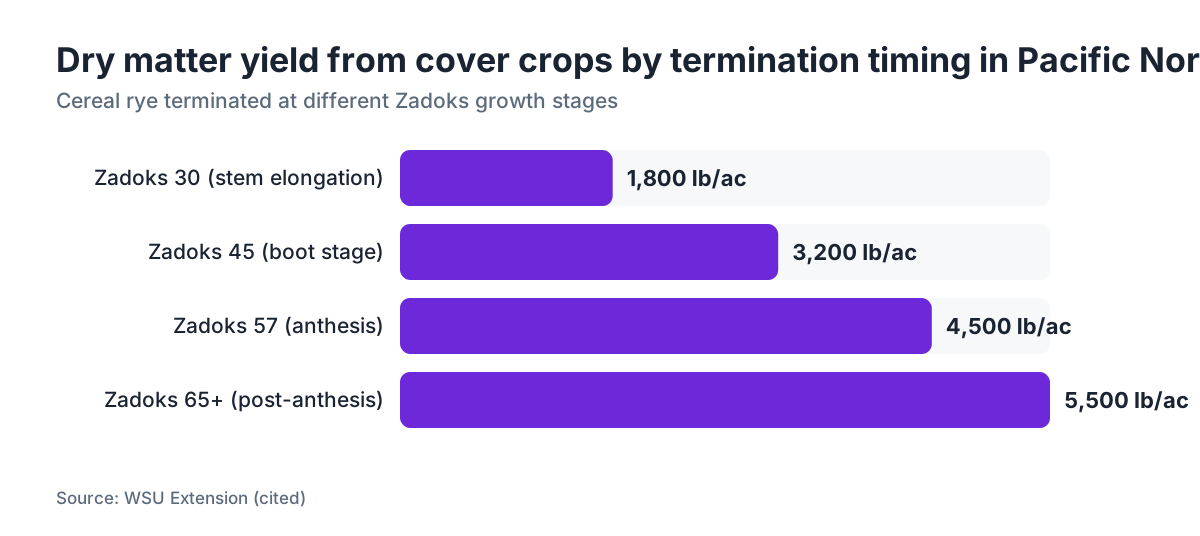
WSU Extension data shows cereal rye terminated at Zadoks 65 or later produces roughly 4,000 to 6,000 lb of dry matter per acre in Pacific Northwest vineyards, which cuts evaporative water loss from the soil surface [4]. That matters if you're managing vine water stress.
Here are common mixes by region:
| Region | Common mix | Notes |
|---|---|---|
| California (North Coast) | Blando brome + rose clover | Low growing, reseeds itself |
| California (Central Valley) | Merced rye + subterranean clover | Manages dust, reseeds |
| Pacific Northwest | Cereal rye + hairy vetch | High biomass, winter hardy |
| Eastern US (Finger Lakes) | Winter rye + crimson clover | Cornell-recommended for erosion |
| Southwest (dry climate) | Native fescue blend | Low water demand |
What goes in the record should match the seed tag, not what you meant to order. Mixes drift between years as suppliers reformulate. Check the tag every time.
If your vineyard sits in a region with big rainfall swings, add a column for establishment quality (a simple 1 to 5 rating at 30 days post-seeding). It pays off fast when you're explaining a patchy stand or justifying a re-seed to a certifier.
How should you store and organize these records?
The format matters less than the habit. A paper logbook in a weatherproof binder at the shop, updated every operation, beats a slick cloud database touched once a year.
Digital records do carry real advantages. You can search across years, attach photos of stand establishment or termination timing, and export data for annual reports without retyping. California's CDFA and most organic certifiers accept digital records, though some want the operator's signature, which usually means a signed PDF or a printed-and-signed form scanned back in.
A folder structure by block and year works like this:
- 2024 / Block 4 / 2024-10-14 seeding record (PDF)
- 2024 / Block 4 / 2024-10-14 seed lot documentation (photo of tag)
- 2025 / Block 4 / 2025-03-22 termination record (PDF)
- 2025 / Block 4 / 2025-03-22 pesticide application record if applicable (PDF)
Back up off-site or to the cloud. Losing five years of records in a shop fire is not a theoretical risk in wine country.
VitiScribe is built around vineyard record-keeping workflows like this one, with linked seeding and termination events that auto-fill block IDs and flag when a pesticide record is required based on the termination method you pick. If you run multiple blocks across multiple years, that auto-flagging is worth a look. There's a free trial at vitiscribe.com.
What do water quality and erosion control programs require?
California's Irrigated Lands Regulatory Program (ILRP), run by the State Water Resources Control Board, requires growers in certain regions to file annual reports documenting practices that reduce erosion and nutrient runoff [3]. Cover crop records are the main evidence that floor management practices are in place.
The exact requirements vary by coalition or individual waiver, but the general expectation is that you can show dates, species, and management events for your vineyard floor. Inspectors have started asking for multi-year records to confirm practices are steady, rather than staged the year before an inspection.
In Oregon, the Department of Agriculture's Agricultural Water Quality Management program runs on the same logic: farm plans reference cover crop practices, and records back the plan [7]. Washington's Voluntary Stewardship Program, coordinated by county conservation districts, uses practice documentation as the basis for cost-share payments, so those records carry direct dollar value [4].
Cornell Cooperative Extension notes that the Finger Lakes and Hudson Valley in New York face rising pressure from watershed groups and voluntary programs that ask for floor management logs, especially on sloped vineyards above water bodies [5]. Erosion on a 15 percent slope in the Finger Lakes is a real problem, and cover crops are the main tool. The records prove you used it.
How do EPA Worker Protection Standard rules apply to cover crop termination?
The EPA Worker Protection Standard (WPS), codified at 40 CFR Part 170, applies any time a pesticide is applied where agricultural workers or handlers might be exposed [2]. Use an herbicide to terminate a cover crop, and the WPS kicks in.
The core obligations: post application information (product, REI, location, date) on a WPS-compliant pesticide safety display at a central location, train any handler who applies the material, and keep people out of the treated area during the REI. For most contact herbicides used in cover crop termination, the REI is 12 hours, but check the label. The label is a legal document.
The WPS was rewritten in 2015 with new requirements for application exclusion zones and handler training [2]. One piece that catches people: if you hire a licensed applicator or a commercial applicator to do the termination, you as the agricultural employer still hold WPS responsibilities for your own workers who might enter the treated area afterward.
For non-chemical termination (mowing, rolling, disking), the WPS does not apply. You still need the termination record for certification and water quality purposes, and your equipment operators should be logged for general farm liability reasons.
EPA's Pesticide Worker Safety page has the current rule text and compliance guides, including Spanish-language materials, which helps if your crew speaks Spanish as a first language [2].
What's a realistic record-keeping workflow for a small vineyard?
For a vineyard under 20 acres with one or two people running operations, the simplest system that actually gets used beats the most sophisticated system that gets abandoned.
Here's a workflow that holds up.
Seeding day: one person seeds, one logs. The logger fills a pre-printed form or a phone app with block, date, species, seeding rate, seed lot number, method, and operator. Seed bag tags get stapled to the form or photographed and filed. Five minutes.
Thirty days later: do a stand assessment. Walk the block, estimate percent cover, note gaps or problem areas. Ten minutes, and it gives you information you'll actually use.
Termination day: fill in the companion termination form. If you used a herbicide, fill in a separate pesticide application record at the same time. Cross-reference the two by date and block ID. File together.
End of season: review records for all blocks, note deviations from your farm plan, update your certifier if needed. Archive the year in a labeled folder or binder.
That's the whole system. It costs about two hours of setup to design and roughly 20 minutes per block per season to run. The certifier visit that goes smoothly because your records are complete saves you four times that in stress and follow-up email.
Run 50 acres or more across multiple blocks with rotating cover crop programs, and digital record-keeping tied to block maps starts earning its keep. Pulling up a block's three-year seeding history in 30 seconds before a certifier visit is genuinely useful.
How do you handle records when you skip a cover crop year or change your program?
Gaps in cover crop practice need documentation just as clear as the practice itself. A certifier or water quality inspector who finds no seeding record for a block in a given year will ask about it. If you left a written note explaining why (drought, late harvest, equipment failure, a decision to leave native vegetation), you're fine. Silence looks like missing records.
For organic certification, a change in species or termination method that wasn't in your approved system plan needs a plan amendment before you implement it. Email your certifier, explain the change and why, and keep their written acknowledgment with your records. This is a five-minute task people routinely skip, and it's the source of most avoidable non-conformity findings.
For water quality reporting, if the annual template asks for cover crop practices and you didn't seed a block, write "bare soil management" or "managed fallow" and describe what you did instead. Regulators are generally reasonable about this when the explanation is there. They want a pattern of intentional management, not perfect adherence to one specific practice.
WSU Extension recommends a short cover crop program evaluation at the end of each season: what was seeded, what established, how termination went, and what you'd change [4]. That narrative, even two paragraphs, is more useful to you and to auditors than a bare log with no context.
What are the common record-keeping mistakes that cause audit problems?
The same four mistakes come up again and again.
First, pesticide application records for herbicide termination go missing or disconnect from the cover crop record. The termination happened, but there's no application record, or the application record exists and cites a different block ID or date. Regulators read that as incomplete documentation of a regulated activity.
Second, seed lot documentation is absent. The seeding record shows a species and rate, but there's no way to verify the seed was organically produced or untreated. Certifiers issue a corrective action because they can't confirm the input was compliant.
Third, records exist for seeding but not termination. Growers often treat seeding as the formal event and termination as routine chores. For organic certification and water quality programs, the full event cycle matters.
Fourth, records get stored all over the place: some years in a binder, some in a phone app, some in email, nothing labeled or retrievable under pressure. An audit is a bad time to dig through two-year-old text messages to find when you mowed Block 7.
The fix for all four is one simple, consistent form covering both events, stored in one place, updated the day of the operation. Not the week after. The day of.
VitiScribe's compliance module targets this exact gap, linking cover crop events to their required companion records automatically, so a herbicide termination entry prompts you to complete the pesticide application record in the same workflow. That guardrail is worth something when you're running 15 blocks in the middle of a busy season.
Frequently asked questions
How long do I need to keep vineyard cover crop records?
Under the USDA National Organic Program (7 CFR 205.103), certified organic operations must keep records for at least 5 years from their creation. California's ILRP water quality program similarly expects multi-year records at inspection. Even if you're not certified organic, keeping records for 5 years is a practical standard that covers most audit windows.
Do I need a pesticide application record if I mow or disk my cover crop?
No. Mechanical termination (mowing, rolling, disking, or hand pulling) is not a pesticide application, so the EPA Worker Protection Standard and state pesticide reporting don't apply. You still need a termination record for organic certification and floor management documentation, but it's a simple field operations log, not a regulated pesticide record.
What's the minimum a cover crop seeding record needs to include for organic certification?
At minimum: block identification, seeding date, species and variety names, seeding rate per acre, seed source with lot number and germination percentage, application method, and operator name. You also keep the seed lot documentation (the bag tag or supplier invoice) showing the seed carried no prohibited treatment.
Can I use a spreadsheet for my cover crop records, or do certifiers require a specific form?
Most certifiers accept spreadsheets, PDFs, or paper forms as long as the required data fields are present and the records are signed or attributed to a responsible party. There's no mandated national form. What matters is that records are complete, legible, stored for 5 years, and retrievable on short notice. Check with your specific certifier for formatting preferences.
Do California vineyards have to report cover crop termination herbicide use to the county ag commissioner?
Yes. Under California Food and Agricultural Code Section 12979, all commercial pesticide use, including herbicides used to terminate cover crops, must be reported to the county agricultural commissioner monthly. This applies whether you apply it yourself or hire a licensed pest control operator. The report includes the product, registration number, acreage, date, and site.
What cover crop termination timing does UC Davis recommend for California vineyards?
UC Davis Cooperative Extension research on California vineyards generally recommends terminating cover crops between 50 and 80 percent bloom to maximize nitrogen release from legumes while limiting competition with vines for early-season water. Exact timing shifts with species, vine phenology, and your water situation. The UC Davis Viticulture and Enology department publishes guidelines for North Coast and Central Valley conditions.
How do I document a cover crop I didn't plant, meaning volunteer or native vegetation I'm managing?
Document it as managed native or volunteer vegetation, with the date you decided to retain it, a species description (even 'mixed native grasses' works), and any management events (mowing dates, heights, equipment). Organic certifiers and most water quality programs accept managed native vegetation as a floor management practice, but they want to see it's intentional and documented, rather than neglected.
Does the EPA Worker Protection Standard require me to notify workers before I spray herbicide to terminate a cover crop?
Yes. Under 40 CFR Part 170, you must post application-specific information at a central location before applying any WPS-covered pesticide, including herbicides used in cover crop termination. This includes product name, REI, location, and application date. Workers cannot enter the treated area during the REI. The revised WPS also requires annual safety training for all agricultural workers.
Can seeding and termination records be combined into one document for the same block?
Yes, and it's often cleaner that way. A block-level cover crop log with seeding fields on one side and termination fields on the other, filed by block and crop year, is easy to audit and easy to update. The one exception: if termination involved a pesticide, that event needs its own pesticide application record, cross-referenced to the termination log by date and block ID.
What does WSU Extension recommend for cover crop record-keeping in Pacific Northwest vineyards?
WSU Extension recommends that Pacific Northwest vineyard managers record the seeding and termination events plus a post-establishment assessment at 30 to 45 days (percent cover, species mix observed, problem areas) and a post-termination note on residue quantity and quality. This level of detail supports both conservation program reporting and on-farm decisions across seasons.
Are there cost-share programs that pay me to keep cover crop records?
USDA's Environmental Quality Incentives Program (EQIP) and Conservation Stewardship Program (CSP) both pay for cover crop practices in vineyards, and they require practice documentation as a condition of payment. Washington's Voluntary Stewardship Program provides similar county-level cost sharing. The record-keeping for these programs largely overlaps with organic certification, so one system covers multiple programs.
Do I need to record cover crops in vineyard headlands separately from row middles?
Best practice, yes. Headlands often carry different species mixes, timing, or erosion goals than row middles. If your headland is seeded to a permanent erosion control mix and your row middles rotate annually, they should be separate records. Certifiers and water quality inspectors treat headlands as a distinct management zone, and mixed records create confusion at audit.
What happens if I miss a record and get audited?
It depends on the program. Under NOP organic certification, a missing record usually triggers a corrective action request, not immediate decertification, unless the gap is part of a pattern. For California pesticide reporting, missing a monthly application report can bring a fine from the county ag commissioner. For EQIP, missing documentation can withhold payment for the practice. Reconstructing records afterward with contemporaneous evidence (invoices, photos, operator statements) is acceptable in some cases.
Sources
- USDA Agricultural Marketing Service, National Organic Program Rule (7 CFR Part 205): NOP Rule 205.103 requires certified operations to maintain records for not less than 5 years beyond their creation; 205.201 requires a farm plan describing practices and their frequency.
- US EPA, Pesticide Worker Safety and the Worker Protection Standard (40 CFR Part 170): The EPA Worker Protection Standard requires posting application-specific information and restricting entry during the REI when pesticides including herbicides are applied.
- California State Water Resources Control Board: California's Irrigated Lands Regulatory Program requires growers in regulated areas to document floor management practices including cover crops to demonstrate erosion and runoff reduction.
- Washington State University Extension: WSU Extension data shows cereal rye terminated at Zadoks 65 or later produces 4,000 to 6,000 lb dry matter per acre in Pacific Northwest vineyards, reducing evaporative water loss; WSU recommends post-establishment and post-termination assessments in records.
- Cornell Cooperative Extension: Cornell Extension research shows termination timing relative to growth stage affects nitrogen release and weed suppression carryover from cover crops.
- University of California Agriculture and Natural Resources (UC ANR): UC Davis Cooperative Extension recommends legume-grass mixes for California vineyards, with 70/30 grass-to-legume ratios for biomass/weed suppression and 50/50 ratios for nitrogen credit.
- Oregon Department of Agriculture: Oregon's Agricultural Water Quality Management program requires farm plans referencing cover crop practices with supporting records.
- California Department of Pesticide Regulation: California Food and Agricultural Code Section 12979 requires all commercial pesticide use including herbicides for cover crop termination to be reported monthly to the county agricultural commissioner.
- USDA National Agricultural Statistics Service: NASS survey data on cover crop adoption rates by crop type and region, referenced for context on vineyard adoption trends.
Last updated 2026-07-09