Pre-emergent herbicide timing records for vineyard floor management
TL;DR
- Federal law requires records for restricted-use pesticide applications to be kept at least two years, and most state ag departments require the same for every application.
- For vineyard pre-emergents, the fields that actually earn their keep are application date, product and EPA Reg.
- No., field location, rate, and the soil temperature or rainfall data that proves your timing window was right.
Why do pre-emergent herbicide records matter more than other spray records?
Most spray records exist to prove you applied a product correctly. Pre-emergent records do something else. They're the only way to reconstruct whether your timing was right, and with pre-emergents timing is almost the whole game. Spray too early, before a rain event, and you lose efficacy before a single weed germinates. Spray too late, after germination has started, and you've thrown away the product and the season. A record that captures nothing but the date and rate misses the point entirely.
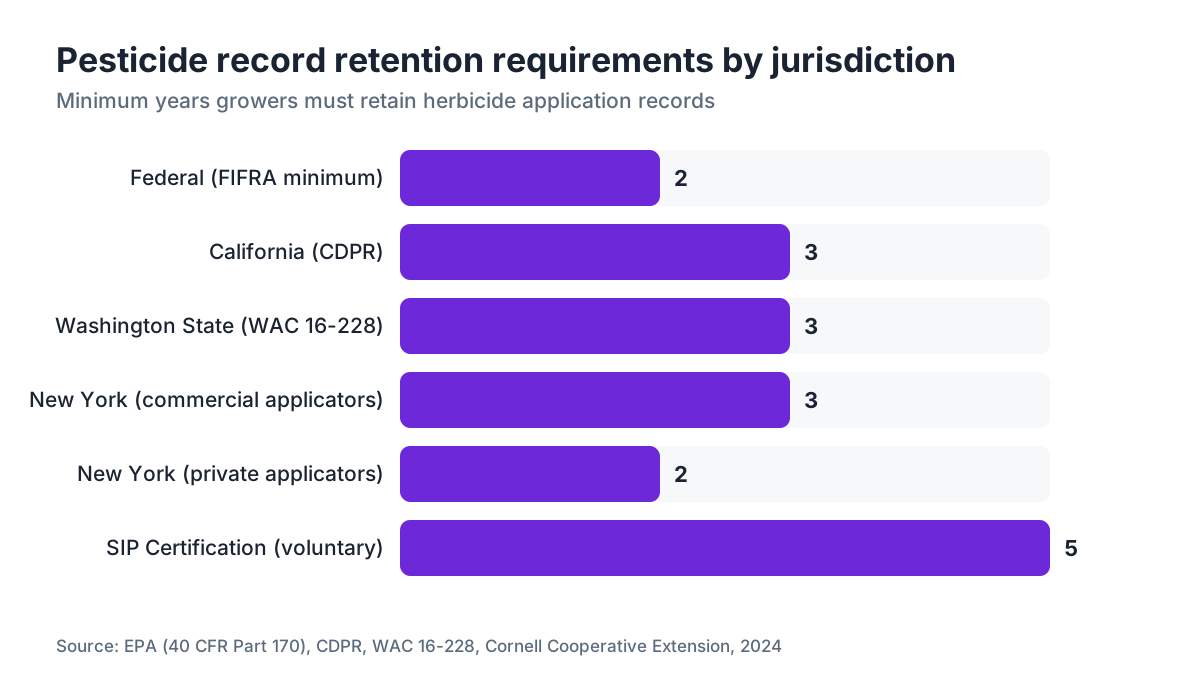
The legal part is simple. Under 40 CFR Part 170, the EPA Worker Protection Standard, any restricted-use pesticide application has to be recorded, and plenty of vineyard pre-emergents fall into that category [1]. California, Washington, and New York all extend that obligation to every pesticide application regardless of RUP status, and California's county agricultural commissioner system is the strictest in the country [2]. The federal floor is two years of retention. Several states push it to three.
Good timing records also protect you commercially. If you're in a third-party program like Lodi Rules or CCSW, an auditor will ask for proof that your pre-emergent applications matched the conditions on the day. "I sprayed in February" doesn't survive that conversation. A record showing soil temperature at 50°F, 0.4 inches of rain forecast within 48 hours, and a label-rate application defends itself.
What information must you record for each pre-emergent application?
The minimum federal fields for a restricted-use pesticide record are applicator name and certification number, product name, EPA Registration Number, total amount applied, application date, location, and crop or commodity [1]. That's the legal floor. Pre-emergents need several more fields before the record is worth anything operationally.
Here are the fields that actually drive pre-emergent timing:
| Field | Why it matters for pre-emergents |
|---|---|
| Application date | Baseline for all timing analysis |
| Soil temperature (°F) at application | Most pre-emergents have labeled soil temp windows |
| Rainfall within 7 days post-application (inches) | Activation requirement for most soil-applied products |
| Weed pressure map or block ID | Links efficacy to specific areas |
| EPA Reg. No. | Required; ties the record to the label |
| Rate (oz or lb a.i./acre) | Required; verifies you matched label rate |
| Application method (banded vs. broadcast) | Affects use rate calculation and re-entry |
| REI (re-entry interval) expiration datetime | Required under WPS [1] |
| Equipment used and calibration date | Useful for drift or efficacy disputes |
WSU Extension recommends tracking the growth stage of existing weed species at the time of application over the calendar date, because growth stage is the variable that actually predicts whether a pre-emergent will intercept germination [3]. UC IPM guidelines for grapes make the same case for recording species composition, since different vineyard floor weeds respond to different active ingredients and germinate at different thresholds [4].
One thing most managers skip: write down who reviewed the soil conditions before the application. If the timing ever gets questioned, a record showing that a licensed PCA (Pest Control Adviser) signed off on the conditions is strong protection.
When is the right timing window for pre-emergent herbicides in vineyards?
This is the agronomic heart of the question, and the honest answer is that it shifts with region, species pressure, and product. There are still solid anchors.
For most annual grassy weeds in California vineyards, the germination window opens when soil temperatures at 2-inch depth drop below 55°F and the first fall rains arrive, usually October through December in the Central Valley and Coast Ranges [4]. That's your application window: after the first real rain (0.5 inches or more) has wet the soil profile, but before germination. Cornell's guidelines for New York vineyards put the equivalent window at late October to early November for fall programs, with a second spring window in March before soil temps climb past 50°F [5].
Most pre-emergents need rainfall or overhead irrigation within 7 to 21 days to move the active ingredient into the germination zone. Indaziflam (Alion) needs 0.5 to 1.0 inch of moisture incorporation within 21 days per its label [8]. Flumioxazin (Chateau) runs a tighter window of two to four weeks. If your record shows you applied but the rain never came, you've documented exactly why control failed, which matters for budget talks and replanning.
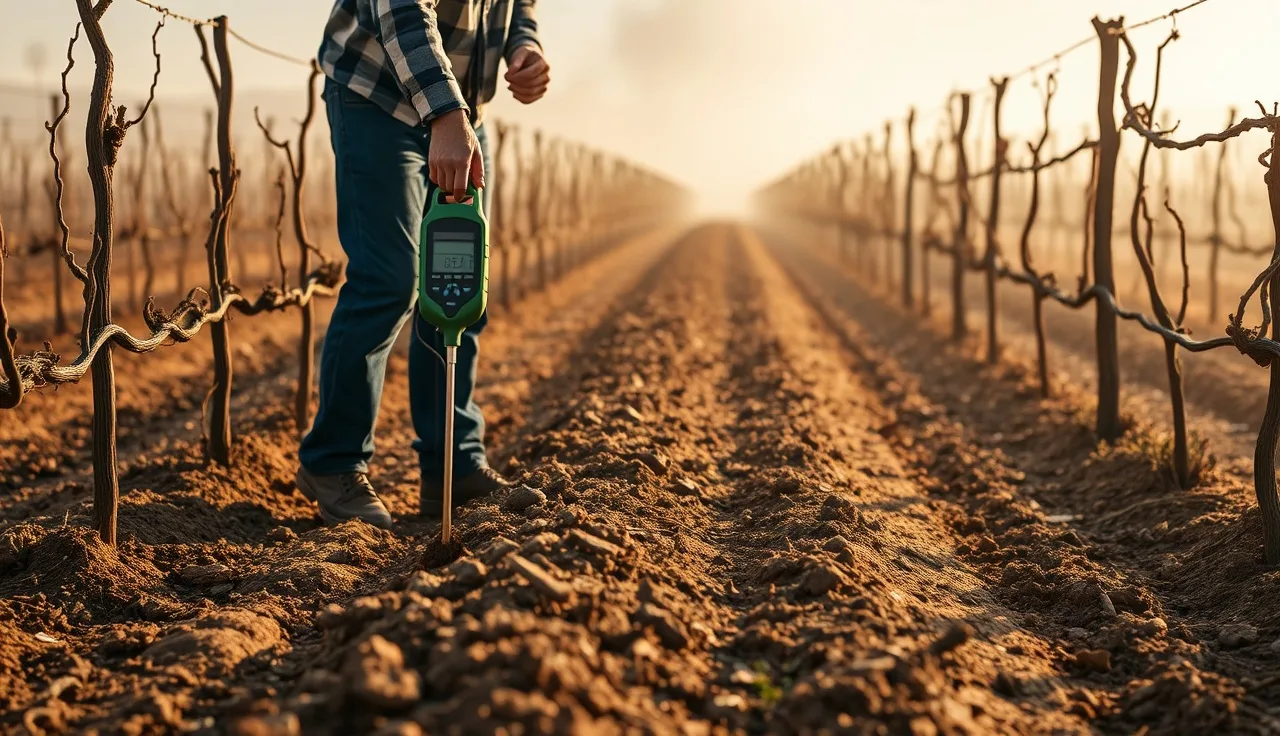
Spring applications handle summer annuals. Soil temperature rising through 50°F at 2-inch depth is the usual trigger for crabgrass, pigweed, and the rest. A soil thermometer and a one-line log entry cost almost nothing. They're often the difference between a defensible record and a guess.
One honest caveat. Nobody has clean universal data on the exact soil temperature threshold for every weed species in every region. The closest published summaries are the UC Davis Weed Research and Information Center resources and the WSU viticulture publications, and many of those aggregate field observations rather than controlled trials [3][9].
How long must you keep pre-emergent herbicide records?
Federal law under FIFRA requires private applicators to keep restricted-use pesticide records for two years from the date of application [6]. Commercial applicators carry the same obligation. Plenty of states set a higher bar.
California requires pesticide use reports for all agricultural applications, filed monthly with the county agricultural commissioner, and records retained for three years [2]. Washington State requires three years under WAC 16-228 [7]. New York requires two years for private applicators and three for commercial applicators [5].
Sustainability certifications often go longer. SIP (Sustainability in Practice) requires five years. If you're growing fruit for a winery that runs third-party audits, check their requirement before you default to the state minimum.
Here's the practical part. The two- or three-year clock matters, but a record is only as good as it is legible. A pencil logbook entry that has faded to nothing is not a compliant record, even inside the retention window. Digital records with a timestamp and a backup end that problem for good.
What are the EPA Worker Protection Standard requirements for herbicide records?
The EPA Worker Protection Standard (WPS), at 40 CFR Part 170, covers pesticide safety for agricultural workers and handlers [1]. On record-keeping, WPS requires specific application information to be available at a central location on the establishment for 30 days after a restricted-use application, and the records kept for two years.
The central posting rule means that if workers or their designated representatives ask for application records, you hand them over. EPA guidance on the Worker Protection Standard states that "agricultural employers must keep pesticide application and hazard information records for 2 years following each application" [1]. That holds even if the herbicide went on the vineyard floor and no worker sets foot in the treated area during the REI. The REI for most pre-emergents runs 4 to 12 hours, but the record obligation does not expire when the REI does.
For pre-emergents, the working WPS checklist is short: post the application information at a central location before handlers enter, record the REI expiration time on the spray record, and keep the field re-entry log consistent with the posted information. Gaps between what's posted and what's in the spray log have produced compliance findings during WPS inspections.
WPS was last substantially revised in 2015, with changes effective in 2016 and 2018, and those revisions strengthened the record-access and training-documentation rules [1]. If your spray record templates predate 2016, they may be missing required fields.
How should you structure a vineyard pre-emergent spray record form?
A good pre-emergent record form has three zones: the required legal fields, the timing-specific agronomic fields, and the outcome fields. Most managers fill out the first zone and stop, and they leave money on the table doing it.
Required legal fields (paper or digital, doesn't matter):
- Applicator name, license or certification number
- Date of application
- Product name and EPA Registration Number
- Rate (per acre and total applied)
- Area treated (acres) and field or block ID
- Crop and growth stage
- REI expiration date and time
- PCA recommendation or supervision documentation (California requires this for most applications)
Timing-specific agronomic fields:
- Soil temperature at application (2-inch depth, °F)
- Soil moisture condition (dry, moist, saturated)
- Rainfall in the 7 days before application (inches)
- Rainfall forecast in the next 7 to 21 days (inches, source)
- Weed species present and growth stage at application
- Application method: banded (how wide?), broadcast, directed spray
Outcome fields (filled in after the season):
- 30-day weed count or percent cover estimate by block
- Duration of control (weeks or months)
- Escapes or failures, with probable cause
That third zone is what turns a compliance record into a management tool. Come back to your records before next year's program, see that one block hit 90% control and another sat at 60%, and you can adjust. If all you kept was the spray date and rate, you start from scratch every single year.
For growers running multiple blocks across more than one ranch, paper records become a real liability for both accuracy and retrieval. A purpose-built system earns its cost here. VitiScribe, for one, is built for vineyard field records and generates the California county ag commissioner report format straight from spray log entries, which kills the transcription errors that trip up audits.
Which pre-emergent herbicides are common in vineyards and what are their label timing requirements?
These are the products you'll see most in California, Washington, and New York vineyards, with general label timing requirements. Always read the current label. This table is a reference, not a substitute for it.
| Product (a.i.) | Application window | Moisture incorporation required | Typical use rate | RUP? |
|---|---|---|---|---|
| Alion (indaziflam) | Fall or spring, pre-germination | 0.5-1.0 in. within 21 days | 5-6 fl oz/acre | No |
| Chateau (flumioxazin) | Fall or spring, pre-germination | 0.5 in. within 2-4 weeks | 6-8 fl oz/acre | No |
| Prowl H2O (pendimethalin) | Fall or spring, pre-germination | Rain or irrigation within 7 days | 2-4 qt/acre | No |
| Solicam (norflurazon) | Fall or early spring | Rainfall or irrigation needed | 2-4 lb/acre | No |
| GoalTender (oxyfluorfen) | Dormant season | Minimal; rain activates | 1-2 pt/acre | No |
| Surflan (oryzalin) | Fall, pre-germination | 0.5 in. within 2 weeks | 2-4 qt/acre | No |
Source: Respective EPA-registered labels; registrations change by state. Check your state's registered product list.
For timing records, the column that matters most is "moisture incorporation required." Apply Alion, get no rain within 21 days, and your record should flag that failure condition so you can plan a corrective pass or expect reduced control. That note saves you from repeating the same mistake next season.
The UC IPM Pest Management Guidelines for Grapes cover most of these products with efficacy ratings by weed species, which helps with timing decisions [4]. WSU Extension's viticulture resources add Pacific Northwest timing windows that differ from California norms [3].
What records do California growers need to submit to the county agricultural commissioner?
California runs the most demanding pesticide use reporting system in the country. Under the California Food and Agricultural Code and Department of Pesticide Regulation (CDPR) rules, every agricultural pesticide application has to be reported to the county agricultural commissioner (CAC) monthly [2]. That includes herbicides on vineyard floors.
The Pesticide Use Report (PUR) goes in on a state or county form and must include application date, location code or site description, product name and registration number, rate and total amount applied, acres or units treated, and the license number of the applicator or the PCA who wrote the recommendation [2].
For pre-emergents, the site code for vineyard floor applications is normally the grape production commodity code, not a bare ground code, because the spray happens in a crop production setting. Getting that wrong is one of the more common findings in CAC audits.
The monthly PUR is due by the 10th of the month after the application month [11]. Apply a pre-emergent on November 15, and the PUR is due by December 10. Late submissions can trigger fines starting at $100 per violation in many counties, and repeat late filing can get you referred to CDPR enforcement [11].
CDPR publishes statewide PUR data as a public database, so your applications sit in a searchable public record. That's rarely a problem, but it's worth knowing that environmental groups and researchers pull this data regularly.
How do you document pre-emergent timing failures or changed conditions?
Most spray records get written before anything goes wrong. The records that actually protect you are the ones you write when something does.
Conditions change and the rain you needed for incorporation never shows. Write it down. Record the expected rainfall, the actual rainfall (from your weather station or NOAA data), and your read on the likely impact [12]. That corrective note protects you when an auditor sees a November application and asks why control failed.
Same logic if you had to delay. Germination had already started, so you held off. Record the original target date, the reason for the delay, and the actual application date. That shows active management instead of a spray on autopilot.
For blocks where control failed, document your scouting with a date. A timestamped photo, a field-log note with weed species and percent cover, and a reference back to the spray record build a chain of evidence that supports both your efficacy call and your replanting or cultivation decision.
WSU Extension recommends a season-end efficacy review as a formal step in integrated weed management, treating the spray record as a data input rather than a compliance chore [3]. That's the right framing.
What records do you need if workers re-enter a pre-emergent-treated area?
This is where your spray records and your WPS postings have to line up exactly. Under WPS, before any worker enters a treated area after application, this information must be available at a central location: product name, EPA Reg. No., active ingredient, location and description of the treated area, the date and time the REI expires, and any specific entry restrictions [1].
Pre-emergents with short REIs (4 to 12 hours) can let workers back in the same day you spray. Your spray record and the central posting have to show the same REI expiration time. Finish application at 10 AM with a 12-hour REI, and the posting reads 10 PM for re-entry. A mismatch is a WPS violation even if nobody got hurt.
Keep a re-entry log for any post-application entry inside 30 days. It doesn't need to be fancy. It needs the date, the time, the names of workers, and the purpose of entry. Crew doing cultivation or canopy work in an adjacent row that drifts into the treated area counts as an entry and needs documenting.
Paper re-entry logs work until they get lost. A tablet-based system in the farm office, or a shared digital log your crew supervisor can reach, solves the retrieval problem.
How can digital record-keeping improve pre-emergent timing compliance?
Paper spray records have one fatal flaw. They're only as complete as the person filling them out in the moment. At the end of a long application day, a tired applicator skips the soil temperature field or forgets the rainfall forecast. Over a season those gaps pile up into a record that's compliant on paper and useless for management.
Digital systems close the gap by requiring fields before a record can save, timestamping entries automatically, and pulling weather data into the application record. Some systems draw NOAA or weather station data for the field location and pre-fill temperature and recent rainfall, so the fields people skip most fill themselves [12].
For California growers, the bigger win is automatic PUR generation. The county ag commissioner report needs specific formatting, and transcribing from a paper spray log into the county form is where most errors get born. A system that generates the PUR directly from the spray log entry cuts that error rate hard.
VitiScribe is built for exactly this workflow, with vineyard block mapping, spray log entry, and compliance report generation in one place. The spray record feeds the PUR and the WPS central posting at the same time, so there's no second data entry step.
If you'd rather stay on paper, Cornell Cooperative Extension publishes a free spray record template that covers the required WPS and state fields through its viticulture extension program [5]. It's a solid baseline even if you move to digital later.
Frequently asked questions
What is the minimum record-keeping period for vineyard herbicide applications under federal law?
Federal law under FIFRA requires private applicators to keep restricted-use pesticide records for at least two years from the date of application. Many states extend this to three years (California, Washington) or longer for sustainability certifications. The EPA Worker Protection Standard sets the same two-year minimum for WPS records. Check your state's rule, since a stricter state requirement overrides the federal floor.
Do I need to record herbicide applications that are not restricted-use products?
Federally, only restricted-use pesticides trigger mandatory record-keeping under FIFRA. But California requires pesticide use reports for all agricultural applications regardless of RUP status, filed monthly with the county agricultural commissioner. Washington and New York have similar broad rules. Most practical programs log every application anyway, since efficacy tracking and audit defense depend on complete data, more than the legally required slice.
What soil temperature should I record when applying pre-emergent herbicides in vineyards?
Record soil temperature at 2-inch depth at the time of application. Most pre-emergents target weed seeds that germinate at specific temperature ranges: cool-season weeds germinate when soil temps drop below 55°F, summer annuals when temps rise through 50 to 55°F. Two-inch depth is where most small-seeded vineyard weeds germinate. A basic soil thermometer costs under $20 and gives you the most useful agronomic field in the record.
How do I document that rainfall activated my pre-emergent herbicide after application?
The simplest approach is a follow-up entry in your spray record, added within 7 to 21 days, noting rainfall amount and date from your weather station or the nearest NOAA cooperative observer. Record the data source. For products like Alion that need 0.5 to 1.0 inch within 21 days, this follow-up entry is the only way to show the incorporation requirement was met. Keep the original application record and the follow-up in the same block file.
Can I use a weather app screenshot as documentation for soil moisture and rainfall in my spray records?
A screenshot beats nothing, but NOAA CoCoRaHS data or your on-site weather station is more defensible for regulators and auditors. Weather app forecasts are not observed data. For California PUR compliance, application date and rate are the required fields, and rainfall documentation is not required on the PUR form itself. For sustainability audits, observed rainfall from a named station is what they expect.
What fields are required on a California Pesticide Use Report for a vineyard floor herbicide application?
California's PUR requires application date, county, site location code, operator of record, pest control business license (if applicable), product name and registration number, amount applied (pounds or gallons), area treated (acres), and commodity code. For vineyard floor applications the commodity is grapes, not bare ground. PURs are due by the 10th of the month after application and go to the county agricultural commissioner.
Does the EPA Worker Protection Standard require herbicide records even if no workers are present during application?
Yes. WPS record-keeping applies whether or not workers were present during application. If you applied a restricted-use herbicide to the vineyard floor, the application information must be posted at a central location for 30 days and retained for two years. Workers or their representatives can request access. The obligation is triggered by the application, not by worker presence.
What is a PCA recommendation and do I need one for pre-emergent vineyard herbicides in California?
A PCA is a licensed Pest Control Adviser. Under California law, a PCA recommendation is required before applying any restricted-use pesticide, and in practice most counties require one for all agricultural applications, including general-use herbicides. The PCA's license number and recommendation date must appear in your records. This is one of the most commonly missing fields during county ag commissioner audits.
How do I record a pre-emergent application that was split across multiple vineyard blocks on different days?
Each block on each application day needs its own record entry. The EPA Reg. No., rate, and applicator info can repeat across entries, but date, block ID, acres treated, and total product applied must be specific to each block and day. Lumping multiple blocks into one record is a common shortcut that breaks down when blocks have different application dates, which matters for REI calculation and for correlating timing with local conditions.
What weed scouting information should I include with my pre-emergent spray records?
WSU Extension recommends recording weed species present, their growth stage (seed, cotyledon, 2-leaf, and so on), and density or percent cover by block at the time of application. This connects your timing decision to actual weed pressure and lets you judge efficacy at season's end. Even a simple grid of dominant species per block beats no species data. Cornell's viticulture program publishes weed identification guides for northeastern vineyards.
Are there pre-emergent herbicides labeled for organic vineyards that also need to be recorded?
Yes. Organically approved materials like corn gluten meal are still pesticide applications in the regulatory sense and must be recorded. In California they still require a PUR submission. Under USDA National Organic Program rules, an Organic System Plan must document all materials applied, including weed management inputs, with dates, rates, and field locations. The format matches conventional programs; the trail just runs to your certifier as well as the county ag commissioner.
How should I handle spray records if I hire a custom applicator for pre-emergent applications?
The custom applicator must give you a copy of the application record within 30 days. Under FIFRA, commercial applicators must provide it to the agricultural producer. You should receive a record with all required fields, including EPA Reg. No., rate, date, and the applicator's license number. Add it to your block files and cross-reference it with your own notes on soil conditions at application. Do not rely only on the applicator's record for your compliance files.
What happens if a California grower misses the monthly PUR submission deadline?
Late PUR submissions can bring a notice of violation from the county agricultural commissioner. Fines vary by county but typically start at $100 per violation and climb with repeat late filings. CDPR enforcement can step in for persistent non-compliance, and in serious cases a grower's license to buy restricted-use pesticides can be suspended. Most county ag commissioners work with first-time late filers, but that goodwill runs out fast if the pattern continues.
Can I use a smartphone photo of a hand-written spray record to satisfy record-keeping requirements?
A timestamped photo of a legible hand-written record works as a backup but is not a substitute for a properly retained original. California regulations require records to be made available for inspection, and a phone photo may not satisfy that in an audit. A scanned PDF stored in a named folder with date-based file naming is better. For the original, keep the paper version in a weather-resistant file at the farm.
Sources
- U.S. EPA, Worker Protection Standard (40 CFR Part 170): WPS requires agricultural employers to keep pesticide application and hazard information records for 2 years following each application, and to make them available to workers and their representatives.
- California Department of Pesticide Regulation, Pesticide Use Reporting: California requires monthly pesticide use reports for all agricultural applications submitted to the county agricultural commissioner, with records retained for three years.
- Washington State University Extension, Viticulture: WSU Extension recommends tracking weed growth stage over calendar date and running a season-end efficacy review as a formal step in integrated weed management.
- UC Integrated Pest Management Program, Pest Management Guidelines: Grapes: UC IPM guidelines recommend recording species composition for vineyard floor weed programs because different species have different germination thresholds and respond to different active ingredients.
- Cornell Cooperative Extension, Grapes and Viticulture: Cornell guidelines place the New York fall pre-emergent window at late October to early November with a spring window in March, and Cornell publishes a free spray record template covering required WPS and state fields.
- U.S. EPA, Federal Insecticide, Fungicide, and Rodenticide Act (FIFRA) recordkeeping: Federal law requires private applicators to keep records of restricted-use pesticide applications for two years from the date of application.
- Washington State Legislature, WAC Title 16 Chapter 228: Washington State requires pesticide application records be retained for three years under WAC 16-228.
- U.S. EPA, Pesticide Registration (Alion / indaziflam label): The Alion label requires 0.5 to 1.0 inch of moisture incorporation within 21 days of application for effective activation.
- UC Davis Weed Research and Information Center: UC Davis WRIC research documents cool-season weed germination in California vineyards primarily occurring when soil temperatures at 2-inch depth fall below 55°F, typically October through December in the Central Valley.
- USDA Agricultural Marketing Service, National Organic Program: USDA NOP rules require an Organic System Plan documenting all materials applied to organic operations, including weed management inputs, with dates, rates, and field locations.
- California Food and Agricultural Code (via California Legislative Information): California FAC requires pesticide use reports to be submitted by the 10th of the month following the application month, and late submissions can result in fines starting at $100 per violation.
- NOAA, National Weather Service and cooperative observer data: NOAA cooperative observer and CoCoRaHS network data provide defensible observed rainfall records for use in pesticide application documentation.
Last updated 2026-07-09