Cover crop nitrogen credit documentation for fertilizer use records
TL;DR
- A cover crop nitrogen credit lowers the synthetic fertilizer you record as applied, but only if you document it.
- You need a dated biomass sample, an N estimate from a lab test or approved lookup table, a plant-available fraction, and a termination date.
- Without that paper trail, your fertilizer records read as an over-application under most state nutrient programs and USDA NRCS practice standards.
What is a cover crop nitrogen credit and why does it belong in your fertilizer records?
A cover crop nitrogen credit is the estimated pounds of plant-available nitrogen your soil gets from decomposing cover crop biomass, subtracted from your crop's total nitrogen need before you decide how much fertilizer to apply. It is not a guess. It is a calculated value, and it belongs in your fertilizer use record the same way a bag of urea does.
Here is why records care about it. Fertilizer use records exist to prove that the nitrogen you put on a field was justified by crop need and an agronomic rate. Say you grew 3,500 pounds per acre of hairy vetch, incorporated it two weeks before budbreak, then applied 60 units of synthetic nitrogen without crediting the vetch. On paper, you over-applied. State nutrient management programs, USDA conservation practice audits, and California's Irrigated Lands Regulatory Program all expect the full picture, credits included.
For vineyards this gets specific fast. Vines are perennial, your rows are only partly covered, and the cover crop species change block by block. A legume mix in one block might credit 40 to 80 pounds of nitrogen per acre. A grass-only cover next door credits close to nothing. Those differences have to land in your records at the block level, not smeared into a farm-wide average.
You can read more about block-level field operations and how they fit a vineyard record system at vineyard.
What calculation methods are accepted for estimating cover crop nitrogen credits?
Three methods are in common use, and the one you pick decides how much documentation you carry. All three are accepted somewhere; the measured methods survive the toughest audits.
Method 1: Dry biomass weight times a species N-concentration factor. You clip and weigh fresh biomass from representative quadrats (typically three to five, each 0.25 square meters), dry the material at 60°C to constant weight, scale to pounds per acre, and multiply by a species nitrogen percentage. UC Cooperative Extension publishes nitrogen concentration ranges for common species: hairy vetch runs roughly 3.5 to 4.5 percent N in above-ground biomass, cereal rye runs 1.2 to 2.0 percent, and a 50/50 vetch-rye mix usually lands between 2.5 and 3.2 percent [1]. A tissue test from an accredited lab gives you the real percentage for your stand and growth stage, and that number is far easier to defend in an audit.
Method 2: Published species lookup tables. USDA NRCS Conservation Practice Standard 340 (Cover Crop) provides representative nitrogen contribution ranges by species group [2]. These are approved for NRCS-funded practice documentation and are often accepted by extension-based state nutrient management plans. The catch: lookup values are conservative averages. If your stand was exceptional, you leave credit on the table.
Method 3: A certified crop adviser or professional agronomist estimate. In states that require a written Nutrient Management Plan, a licensed adviser calculates the credit and signs it. That signature is itself a documentation artifact you attach to the fertilizer record.
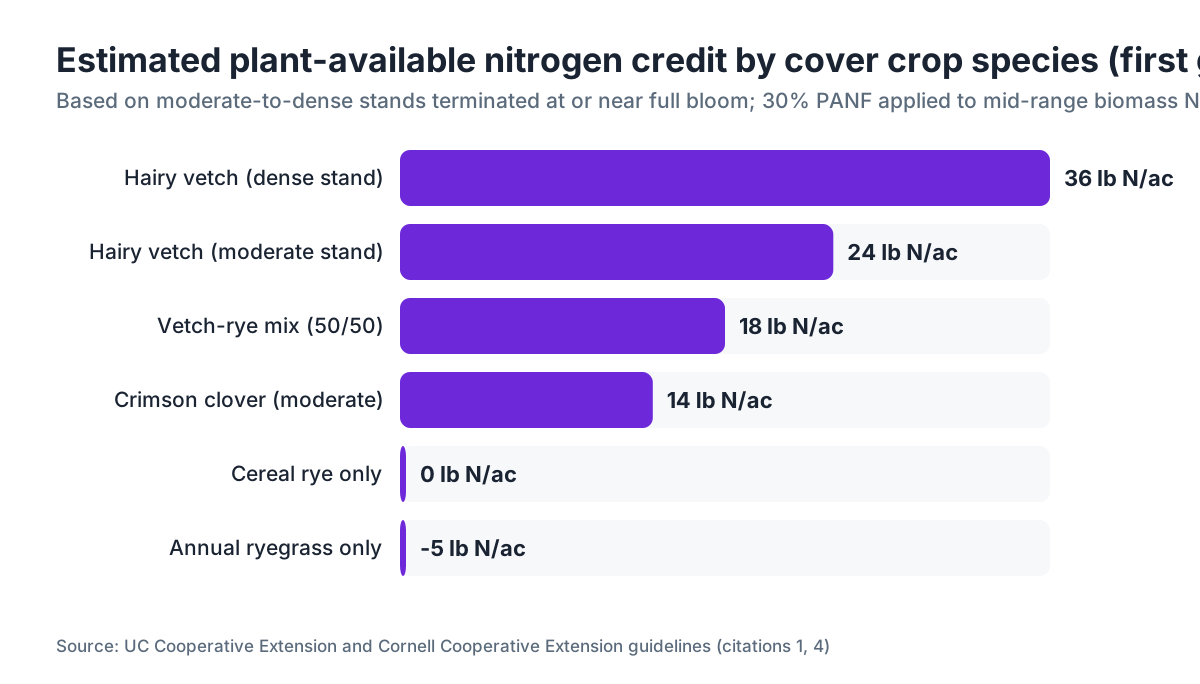
One figure shows up across WSU and UC Davis extension guidance. Expect roughly 20 to 40 pounds of plant-available nitrogen per acre from a moderate legume stand by early spring, climbing to 60 to 100 pounds per acre from a dense, well-nodulated hairy vetch stand at full bloom [1][3]. Cornell's nutrient management program applies a plant-available nitrogen fraction of 25 to 35 percent of total legume N in the year of incorporation [4].
No tissue test? Use the low end of the NRCS table for your species. That is the number that survives an audit.
What specific fields do you need to record to document a nitrogen credit?
Your fertilizer use record for any block getting a nitrogen credit should carry every field below. Miss even two and a reviewer can throw out the whole credit.
| Field | What to record | Example |
|---|---|---|
| Block/field ID | The same identifier used throughout your records | Block 4B, Cabernet Franc, 2.3 ac |
| Cover crop species | Common name and genus where possible | Hairy vetch (Vicia villosa) + cereal rye |
| Seeding date | Date crop was established | October 14, 2024 |
| Biomass sample date | Date of clipping, before termination | March 28, 2025 |
| Fresh weight per quadrat | grams or pounds from each quadrat | 487, 502, 465 g per 0.25 m² |
| Dry weight per acre | After oven drying, scaled to ac | 2,840 lb/ac |
| N concentration (%) | Tissue test result or lookup table source | 3.8% (tissue test, A&L Lab, March 30) |
| Total N in biomass | lb/ac dry weight × N% | 108 lb N/ac |
| Mineralization rate or PANF | Fraction available in-season | 30% (Cornell PANF guideline [4]) |
| Estimated plant-available N credit | lb/ac | 32 lb N/ac |
| Termination method and date | Mow, roll-crimp, herbicide, incorporate | Flail mow April 4; disc-incorporated April 6 |
| Applicator or preparer name | Who made this estimate | Jane Grower, CCA #12345 |
| Synthetic N applied (adjusted) | Total need minus credit | 28 lb N/ac (urea, April 10) |
That last line closes the loop. Your purchase record shows you bought urea. Your application record shows 28 pounds per acre. This worksheet explains why 28 is agronomically enough. Read together, they tell one coherent story instead of three loose ends.
California's ILRP, for Central Coast growers in particular, requires you to keep supporting calculations for at least three years [5]. USDA NRCS wants documentation for the life of the conservation practice agreement, generally counted as part of a six-year farm program record window [2].
How does the plant-available nitrogen fraction affect what you can actually claim?
This is where growers overshoot. They credit the whole biomass number, over-report the reduction in synthetic N, and create an audit problem in the other direction.
Total nitrogen in legume biomass is not the nitrogen your vines can use this season. Microbes release it slowly. The fraction that turns plant-available in the first season after incorporation depends on soil temperature, moisture, the carbon-to-nitrogen ratio of the material, and how deep you buried it.
Cornell puts the first-year plant-available N fraction at 25 to 35 percent for legume cover crops incorporated before planting [4]. WSU Extension uses similar ranges for the Pacific Northwest and notes that vetch incorporated at full bloom releases nitrogen faster than the same vetch at seed set, because the C:N ratio is lower at bloom [3].
So the math is blunt. If your hairy vetch holds 90 pounds of total N per acre and you apply a 30 percent fraction, you document a 27-pound plant-available credit. That is what you subtract from your fertilizer budget. Not 90.
The other 63 pounds does not vanish. It keeps mineralizing over months and into later seasons. Some nutrient management frameworks ask you to estimate a residual carry-over credit in year two, usually 10 to 15 percent of year-one total N [4]. If your state program or NMP wants it, that carry-over goes in next year's records too.
What documentation format does USDA NRCS require for cover crop practice standard 340?
NRCS Conservation Practice Standard 340 covers cover crops. It does not hand you a single form, but it does require that your implementation match the purposes stated in your conservation plan. If nitrogen management is a listed purpose, the nitrogen credit calculation is a required part of the practice documentation [2].
What that means on the ground:
Your NRCS-approved plan or job sheet references the cover crop species, seeding rate, and intended termination timing. If you deviate from the plan (you terminated two weeks early because rain was coming), you record the actual termination date and adjust the credit. Earlier termination before full bloom on a legume usually means less biomass and a smaller credit. And the six-year record retention rule under USDA farm program regulations applies to all practice documentation [2].
For growers in EQIP cost-share programs, the practice activity report you file at the local service center is the main documentation artifact. Ask your NRCS district conservationist whether your calculation worksheet gets attached to that report or kept on-farm. The answer changes by state office, so get it in writing before your next payment cycle.
How do California vineyards document nitrogen credits under the Irrigated Lands Regulatory Program?
California's Irrigated Lands Regulatory Program, run by the Regional Water Quality Control Boards, requires growers in most agricultural regions to build and follow a Farm Nutrient Management Plan [5]. For vineyards, that plan has to account for every nitrogen input, including nitrogen from organic amendments, compost, and cover crop mineralization.
The State Water Resources Control Board's Ag Order framework requires that all nitrogen applications be documented and the basis for each application rate explained [5]. So your cover crop credit calculation is not optional if you are using it to justify a lower synthetic N rate.
The Central Coast Agricultural Water Quality Coalition, one of the approved third-party programs under the ILRP, gives members worksheet templates with a cover crop nitrogen credit field built in. Those templates are designed to meet the regional board's documentation expectations. Growers outside a coalition owe the same standard. They just build their own worksheet.
Some orders also carry a data submission requirement. You may have to enter nitrogen budget data (inputs, credits, crop uptake) into an online reporting portal, where your cover crop credit shows up as a negative input that pulls down your total N applied figure. Report zero credit while your interrows are packed with blooming vetch, and expect a follow-up question from a water board inspector.
Record retention under the Central Coast order is three years minimum [5]. Five is safer if you are also in a federal program running its own clock.
What are common mistakes that get nitrogen credit documentation rejected in audits?
The number one problem: growers note the cover crop in field records but never turn it into a pound-per-acre credit that appears in the fertilizer record. The two documents sit in separate binders and the auditor never sees the link. The fix is one line on the fertilizer record: "N credit from cover crop: see attached worksheet, 28 lb N/ac."
Second most common. Using lookup values for a species you did not grow, or for a growth stage you did not terminate at. A vetch credit calculated at full bloom is not valid if you mowed in February before the plants flowered. Stage at termination matters.
Third. Forgetting to document the termination method. Rolling versus discing versus herbicide changes how fast biomass breaks down and how much N frees up. NRCS field staff will ask.
Fourth. Applying the credit to the whole farm instead of the block where the cover actually grew. If row middles in block 3 had cover and block 7 did not, the credit is block 3's alone.
Fifth. No sample date, no lab report. A number without evidence is just a number. Auditors want to see when the sample was taken, how it was prepared, and where it was analyzed.
For managers who want one place where field notes, biomass worksheets, and fertilizer records stay linked without re-entering data three times, a platform like VitiScribe keeps those artifacts connected at the block level. The audit binder assembles itself instead of you hunting through folders the night before an inspection.
How do you handle partial cover crop stands or interrow-only cover in vineyards?
Vineyards almost never run 100 percent cover. You have a planted row width, a canopy zone with a herbicide strip or cultivated soil, and the interrow cover. That geometry changes how you calculate the per-acre credit, and skipping the adjustment is a fast way to overstate your number.
Say your row spacing is 8 feet and the cover crop fills a 5-foot interrow strip. That is 62.5 percent of the acre in cover. Place your biomass quadrats only in the cover zone, but scale the per-acre number to the covered fraction. If your cover-zone biomass scales to 3,200 lb/ac and the interrow covers 62.5 percent of the field, your effective whole-field biomass equivalent is 2,000 lb/ac. Apply the N concentration and PANF to that adjusted number.
WSU Extension's viticulture cover crop resources spell this out, noting that in-row soil management and interrow cover together set your actual N budget [3][10]. UC Cooperative Extension's wine grape nutrition work likewise separates interrow from in-row nitrogen dynamics when modeling fertilizer needs [1].
Document the row spacing, cover width, and adjustment factor on the same worksheet as your biomass data. Auditors who know vineyards will ask about this calculation. Auditors who do not know vineyard geometry will at least see that you accounted for it.
What records do you need to keep for worker protection if you incorporate cover crops with tillage or herbicide?
This one comes up less than the nitrogen math, but it is just as real. If you use a herbicide to terminate the cover crop, that is a pesticide application, and it generates its own records under the EPA Worker Protection Standard and your state's pesticide use reporting rules [6].
Under the WPS, pesticide application records must include the product name, EPA registration number, application rate, date, location, applicator license or certification number, and any restricted-entry interval [6]. That record is separate from your fertilizer use record, but the two share the termination date. Make sure they match. A mismatch there is exactly the kind of small inconsistency an inspector pulls a thread on.
In California, the Pesticide Use Report goes to your county agricultural commissioner within 30 days of application under statewide reporting rules [7]. Reference the same block ID and date on the PUR and the nitrogen credit worksheet so an inspector can cross-check them in seconds.
For mechanical termination (flail mowing, disc incorporation), there is no pesticide record trigger. But if workers re-enter the field during or right after tillage, your illness and injury prevention program documentation applies. That is not a fertilizer record, but it lives in the same audit universe.
What biomass sampling protocol is defensible for a small vineyard with multiple cover crop blocks?
You do not need to be a soil scientist. You need a repeatable protocol you can describe in writing, and you need to actually follow it every time.
A defensible minimum: three quadrat samples per block, each 0.25 square meters (a 50cm by 50cm frame cut from PVC pipe works). Clip all above-ground biomass at soil level. Weigh fresh right away. Spread it thin and dry in a forced-air oven at 60°C for 48 hours, or send it to a lab that dries it for you. Record the dry weight of each quadrat. Scale to lb/ac: grams per 0.25 m² × 35.7 = lb/ac. (That shortcut folds in the conversion from grams per 0.25 m² to g/m² and then to pounds per acre.)
For a 10-block vineyard, that is 30 quadrat samples, maybe two hours per sampling event. If blocks share the same species mix and were seeded the same week, you can sometimes combine them into a sampling zone. Document that call explicitly. "Blocks 3, 4, and 5 share identical species mix, seeded October 10, sampled as one zone" is a sentence that satisfies most auditors.
Send a composite subsample (mix equal portions from each quadrat) to a certified lab for tissue nitrogen analysis. A&L Western Laboratories and Waypoint Analytical both run cover crop tissue panels for roughly $20 to $35 per sample. Get the report dated and keep it stapled to the worksheet.
How do you integrate cover crop nitrogen credits into an ongoing fertilizer use record across multiple seasons?
The hard part is continuity. Your records need to show, year over year, that your nitrogen budget tracks crop removal and does not pile up excess. Cover crop credits shift season to season because biomass varies, termination dates move, and species mixes change. Each season needs a fresh calculation.
Here is a practical structure. Start each season's fertilizer record for a block with a nitrogen budget page. That page lists estimated crop need (often 20 to 40 lb N/ac for established wine grapes, though this swings widely by yield target and variety), any residual carry-over from the prior year, and this year's cover crop credit from the fresh worksheet. Synthetic or organic inputs fill whatever gap is left. Every line references a supporting document: the tissue test, the carry-over calculation, the petiole analysis, the amendment lab report.
That is what CCA-prepared nutrient management plans look like, and it is what state and federal programs check for. Once you are past a handful of blocks and running this on paper or scattered spreadsheets, the risk is version control. Which tab is current? A system that timestamps entries and links attachments at the block level takes most of that risk off the table. VitiScribe is built around that block-level linkage, which is why managers using it tend to hand over cleaner audit packages than those wrestling generic farm management software.
For fertilizer record requirements across program contexts, the USDA Natural Resources Conservation Service's Field Office Technical Guide is the most complete federal source [2], and UC Cooperative Extension's nutrient management resources for wine grapes are the most vineyard-specific [1].
What do university extension programs say about typical cover crop nitrogen contributions in vineyards?
Three programs publish the most vineyard-specific guidance, and their numbers sit close enough that you can triangulate a defensible figure.
UC Cooperative Extension (UC Davis) estimates that a dense hairy vetch stand terminated at bloom can contribute 80 to 120 pounds of total nitrogen per acre in above-ground biomass, with roughly 30 to 40 percent mineralized in the first season, for a plant-available credit of 24 to 48 lb N/ac [1]. Their wine grape nutrition publications also note that many California vineyards already run enough nitrogen from soil reserves and need no added synthetic N in a legume cover crop year.
WSU Extension covers Pacific Northwest vineyards, where the worry is often too much vegetative vigor rather than an N shortage. Their guidance points out that legume covers can push vigorous varieties like Riesling or Merlot into excess shoot growth, so in Washington the nitrogen credit calculation often drives a decision to cut or drop synthetic N entirely rather than just swap it out [3].
Cornell Cooperative Extension, writing for Northeast and Finger Lakes viticulture, publishes the most detailed PANF tables. Cornell's guidance states that "a legume cover crop can supply 50 to 200 pounds of nitrogen per acre as total biomass N, but the plant-available fraction in the year of incorporation is typically 25 to 35 percent" [4]. That is the most-cited figure in northeastern vineyard nutrient management plans.
Honest caveat: nobody has clean data on vineyard-specific mineralization under the canopy microclimate. Soil temperature, moisture, and row orientation all shift decomposition speed, and no large controlled trial has run across enough vineyard sites to give tight confidence intervals. Use the ranges, document your method, and revise as your own blocks give you real numbers.
Frequently asked questions
Do I legally have to document a cover crop nitrogen credit if I am not in a formal nutrient management program?
In most states, no specific law requires it if you have no NRCS conservation agreement, ILRP enrollment, or state NMP mandate. But if you apply synthetic fertilizer and your rate ever gets questioned, a credit calculation proves you applied at an agronomic rate. Without it, an over-application finding is much harder to defend. Even outside a formal program, the documentation protects you.
Can I use a USDA NRCS lookup table instead of doing a biomass sample?
Yes, for most NRCS-funded programs. Conservation Practice Standard 340 allows published species-specific nitrogen contribution ranges when site-specific biomass data is not available. The tradeoff is that table values are conservative averages. If your stand was unusually dense or thin, a measured biomass sample gives a more accurate credit. Some regional water quality boards prefer or require measured data over table values.
How many years do I need to keep cover crop nitrogen credit worksheets?
NRCS practice documentation: six years under standard farm program record rules. California ILRP: three years minimum under most regional orders, though five is the practical standard if you are in both programs at once. State pesticide records, if herbicide termination was used: two years in most states. Keep everything for five years and you cover nearly every program requirement.
What if I terminated my cover crop early due to dry conditions and it was still vegetative?
Document the actual termination date and growth stage, then look up or measure biomass at that stage. Vegetative legumes hold less total N than bloom-stage plants, though a lower C:N ratio may speed early mineralization slightly. Recalculate the credit using actual dry weight and N concentration for that stage. Do not use a bloom-stage lookup value for a plant that never reached bloom.
Do grass cover crops contribute any nitrogen credit?
Grass-only covers (cereal rye, barley, annual ryegrass) have very low or slightly negative nitrogen credits in the year of incorporation. Their high carbon-to-nitrogen ratios, often above 25:1, cause temporary nitrogen immobilization as microbes break down the material. WSU and UC extension guidance generally credits grasses at zero or assigns a small negative value of minus 5 to 10 lb N/ac. Record that negative value if you use it; it raises your justified synthetic N slightly.
What is the difference between total biomass nitrogen and plant-available nitrogen credit?
Total biomass N is the nitrogen locked in the plant tissue. Plant-available N, the credit, is the fraction that mineralizes and reaches your vines within one growing season, typically 25 to 35 percent of total biomass N for legumes in the year of incorporation. The rest mineralizes slowly over later years. Always document which figure you are using and the source of your mineralization fraction.
Can a tissue test replace the biomass weight measurement?
No, you need both. Tissue N concentration from a lab test tells you what percentage of the dry biomass is nitrogen. Dry biomass weight per acre tells you how much material there is. Multiply the two for total N per acre. A tissue test alone cannot give the credit; you have to know the biomass mass. Some labs offer combined biomass and N analysis if you send a weighed sample.
How do I handle a mixed legume and grass cover crop for the nitrogen credit calculation?
Work out the proportion of each species in your stand, either by visual estimate or by sorting a dried subsample by species and weighing each fraction. Apply the right N concentration to each fraction, sum the totals, then apply the PANF. Most extension programs publish N percentages: hairy vetch around 3.5 to 4.5 percent, cereal rye around 1.2 to 2.0 percent. A 50/50 mix by dry weight usually lands near 2.5 to 3.2 percent combined.
Is a cover crop nitrogen credit considered an organic nitrogen amendment under state reporting rules?
Generally no. State nutrient management programs and the ILRP treat cover crop credits as soil-derived nitrogen, separate from applied organic amendments like compost or manure. You still document it, but it does not trigger the same amendment application records or the waiting periods that applied manure might. Check your specific regional order or state program guidance, because the terminology varies.
What if my vineyard has different cover crop species in each block?
Calculate a separate credit for each block using that block's species, measured biomass, and termination data. The credit is a block-level number, not a farm average. Applying a farm-wide average to blocks that had only grass cover, then under-applying N there, is an agronomic error. Auditors who know viticulture will check that the block IDs in your fertilizer records match the block IDs in your cover crop records.
Does the EPA Worker Protection Standard affect how I document cover crop termination?
Only if you use a herbicide to terminate the cover crop. Herbicide application is a pesticide application under the WPS, requiring records with the product name, EPA registration number, rate, date, location, and restricted-entry interval [6]. Mechanical termination such as mowing or rolling does not trigger WPS pesticide records, but it may trigger re-entry documentation under your IIPP if workers are present during tillage.
Can I claim a carry-over nitrogen credit in the second year after incorporating a cover crop?
Yes, if your nutrient management framework allows it. Cornell's guidelines estimate a second-year carry-over of roughly 10 to 15 percent of the original total biomass N, from continued slow mineralization of stable organic matter [4]. Document it the same way: note the original incorporation date, total biomass N from year one, and the carry-over fraction you apply. Not all state programs recognize carry-over credits, so check your program rules first.
What is the minimum information I need on a cover crop nitrogen credit worksheet to satisfy a routine inspection?
At minimum: block ID, species, sample date, dry biomass weight per acre, N concentration source (lab report or lookup table with citation), total N per acre, PANF fraction applied, resulting plant-available credit in lb/ac, termination date and method, and the preparer's name. A missing sample date, missing biomass weight, or missing N source are the three omissions most likely to void a credit during inspection.
Sources
- UC Cooperative Extension, Wine Grape Nutrition and Nutrient Management: Hairy vetch above-ground biomass contains roughly 3.5 to 4.5 percent nitrogen; dense stands terminated at bloom contribute 80 to 120 lb total N/ac with 30 to 40 percent plant-available in the first growing season
- Washington State University Extension, Cover Crops in Pacific Northwest Vineyards: Vetch incorporated at full bloom releases nitrogen faster than at seed set due to lower C:N ratio; legume covers in Washington vineyards can push vigorous varieties into excess shoot growth, so the credit informs a decision to reduce or eliminate synthetic N
- Cornell Cooperative Extension, Nutrient Management Guidelines for New York Vineyards: Cornell guidelines state that 'a legume cover crop can supply 50 to 200 pounds of nitrogen per acre as total biomass N, but the plant-available fraction in the year of incorporation is typically 25 to 35 percent'; second-year carry-over is estimated at 10 to 15 percent of original total biomass N
- California State Water Resources Control Board, Irrigated Lands Regulatory Program: ILRP Ag Order requires that all nitrogen applications be documented and the basis for application rate explained; record retention is three years minimum under most regional orders
- US EPA, Worker Protection Standard for Agricultural Pesticides: WPS requires pesticide application records to include product name, EPA registration number, application rate, date, location, applicator certification number, and restricted-entry interval for any agricultural pesticide application
- California Department of Pesticide Regulation, Pesticide Use Reporting: California requires monthly Pesticide Use Reports submitted to the county agricultural commissioner, generally due within 30 days of the reporting period
- UC Agriculture and Natural Resources, Cover Cropping for Nitrogen Management: Cereal rye cover crop above-ground biomass contains approximately 1.2 to 2.0 percent nitrogen; grass-only covers may cause temporary nitrogen immobilization due to high C:N ratios above 25:1
- WSU Extension, Soil Fertility and Nutrient Management in Vineyards: WSU extension guidance documents that interrow cover crop geometry in vineyards requires adjustment of per-acre biomass estimates to reflect actual covered fraction of the field
Last updated 2026-07-10