Decontamination facility inspection records for vineyard pesticide handlers

TL;DR
- Under the EPA Worker Protection Standard (40 CFR Part 170), vineyard operators must inspect each pesticide handler decontamination site before every use, record what they found, and keep those records for two years.
- The inspection confirms water supply, soap, single-use towels, and an eyewash source are present and working.
- Missing or incomplete records are one of the most cited WPS violations during state ag inspections.
What does the EPA Worker Protection Standard actually require for decontamination facilities?
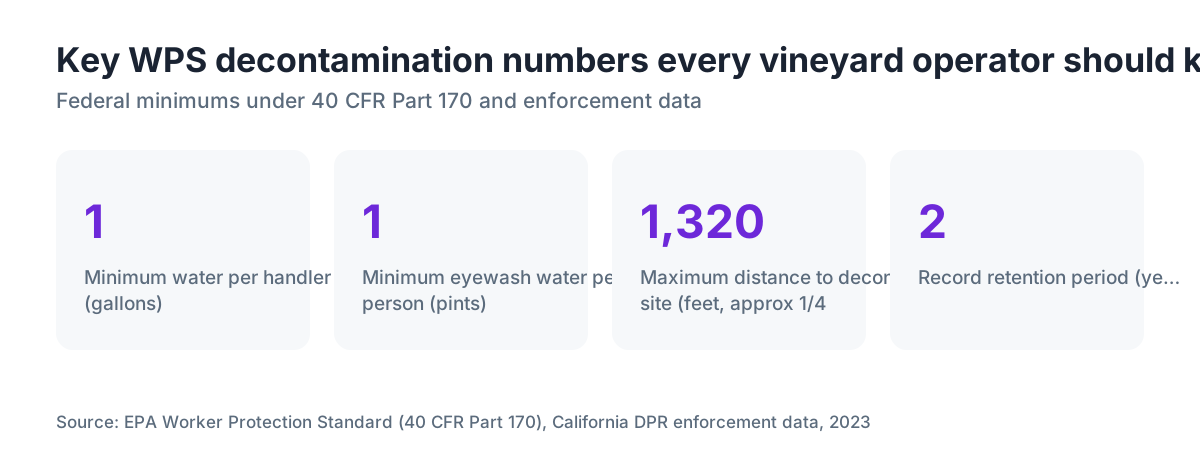
The revised Worker Protection Standard, finalized in 2015 and effective January 2, 2017, requires agricultural employers to provide a decontamination site for each pesticide handler and early-entry worker [1]. The rule sits at 40 CFR § 170.411, and it sets a specific floor: at least one gallon of water per worker expected at the site during the handling task, soap, and single-use towels. The water has to be clean, cool or lukewarm, and it can't be used for anything else during the work period. That last clause trips up a lot of operations that try to share one tank.
Eyewash water is a separate requirement. If handlers use pesticides labeled for eye protection, you need at least one pint of water per person dedicated to eyewash. It can come from the same supply as the decontamination water, but you account for it separately. Bring one gallon total for three handlers who all need eyewash coverage, and the math fails.
The site has to be within a quarter mile of where handlers are working, or at the nearest point of vehicular access if the field is more remote [1]. Most vineyard blocks make this easy. If you're running spray equipment in hillside blocks with limited road access, think it through before the season starts. A kit in the spray rig cab counts, as long as it meets every supply requirement.
The 2015 revision also added an anti-retaliation provision and expanded training. For inspection record purposes, the physical facility requirements at § 170.411 are what the field inspector checks against.
What exactly counts as a decontamination inspection record?
This is where small vineyards get into trouble. The WPS requires decontamination supplies to be provided and maintained, but state readings of what "maintained" means for paperwork vary. California, Washington, and New York, the three states with the most vineyard acreage, all want written proof that inspections happened. The California Department of Pesticide Regulation lists decontamination site inspection records as a required record under Title 3 CCR § 6724 [2].
A defensible record captures the date and time of the inspection, the location or block identifier, the name of the person who did it, what supplies were present and in what quantities, whether the eyewash water was separate and adequate, and whether any deficiency was fixed before work started. That last field matters. An inspector who sees a deficiency noted but no corrective action won't view that record kindly.
You don't need a custom form. A paper log, a field notebook, or a digital entry in any farm record system works, as long as it has those fields. Consistency beats format. Use a paper log in June, switch to a phone app in July with no continuity, and that gap becomes a question.
One detail people miss: this is an inspection record, not a use record. You need it even on days when you inspect and decide not to spray, if handlers are present for any other pesticide-related task. Tie it to handler activity, not to application events.
How often do you need to inspect and document decontamination facilities?
Supplies must be provided and maintained during the handling activity [1]. In practice, enforcement agencies read "maintained" as a check before each handler work period begins. California's DPR guidance is explicit: inspect before each day of use.
For a vineyard running spray applications three or four days a week during bloom or veraison, that's three or four inspection records per week per decontamination site. Run two spray rigs with two separate kits, and you need a record for each kit.
The most common shortcut is one inspection record per week, backdated. Don't. State ag inspectors in California have matched decontamination records to pesticide application records and found the gaps. Backdating turns a missing record into a fraud problem, which is a far worse place to be.
Use a contract labor crew and the crew employer shares WPS responsibility with the agricultural employer. But the agricultural employer, meaning the vineyard owner or manager, is ultimately on the hook for making sure the decontamination site exists and the inspection records get kept. Put this in writing with your labor contractors before the season.
What are the two-year recordkeeping rules and what triggers a records request?
Under 40 CFR § 170.130, agricultural employers must keep WPS-related records for two years from the date they were created [1]. Decontamination inspection records fall under this. Two years means two full growing seasons, so records from your 2023 spray program need to be available through at least the end of 2025.
What triggers a records request? Usually it's a routine inspection by your state department of agriculture or department of pesticide regulation. California's county agricultural commissioners run annual compliance checks, and decontamination records sit on every standard WPS checklist. A worker complaint or a reported exposure incident speeds things up, and in that case you'll be asked for records in days, not weeks.
The WPS at § 170.130 requires that records be made available to the EPA Administrator or an authorized state or tribal agency on request. Plain version: you hand them over when asked, no subpoena needed. Refusing, or claiming you don't have records you should, gets treated as a separate violation on top of any underlying paperwork gap.
Store records somewhere findable. A binder in the farm office is fine. A shared cloud folder works. Whatever you use, make sure someone besides you can find them, because inspectors don't always call ahead.
What are the most common decontamination record violations found during vineyard inspections?
Based on published state enforcement data and university extension reporting, these show up most often:
No inspection records at all. Operators who set up a kit correctly but never wrote anything down. The kit was there, the supplies were adequate, and there's no paper trail. From an enforcement standpoint, if it's not documented, it didn't happen.
Insufficient water quantity. The one-gallon-per-person requirement sounds easy until you count your crew. Three handlers need three gallons minimum for decontamination, plus eyewash on top of that. Plenty of operations show up with a single gallon jug.
Shared water supply. Using the same container for drinking and decontamination is a WPS violation. They have to be separate. Cornell Cooperative Extension's agricultural safety program flags this as a recurring issue in Northeast vineyard audits [3].
Location too far from the work area. A kit in the shop building 800 feet from the block where handlers are spraying can miss the quarter-mile rule if the vineyard road forces a long backtrack. Walk it off if you're not sure.
Incomplete records. Forms with dates but no crew size, or water quantity but no note on soap or towels. Partial records beat nothing but still draw citations in California and Washington.
WSU Extension's pesticide safety materials describe the inspection record as the primary proof that a program is actually running rather than just written down in a plan [4].
How do decontamination requirements differ for pesticide handlers versus early-entry workers?
The WPS draws a clear line between handlers (people who mix, load, apply, or work with pesticide equipment) and early-entry workers (people who enter a treated area during a restricted-entry interval). Both need access to decontamination, but the standards differ slightly.
For handlers, the full site with water, soap, and towels must be within a quarter mile or at the nearest vehicular access point during the entire handling task [1]. For early-entry workers, the site also has to be within a quarter mile of the treated area, but it can sit at the field perimeter rather than inside the field.
For recordkeeping, the practical difference is that you may need separate inspection records if handlers and early-entry workers are operating at the same time in different parts of the vineyard using different kits. Most small to mid-size operations run handler and early-entry work at different times, which simplifies things. During overlap periods, like a spray crew finishing one block while hand workers enter an adjacent treated block, the location logistics and the records need to match what's actually happening.
For operations running cover crop or canopy management crews during or right after fungicide applications, this overlap is more common than people expect. Map it before the season and set which site covers which crew.
What does a compliant decontamination inspection form look like, field by field?
Here's what a complete inspection record entry needs to hold. This isn't a required form. It's the minimum information that satisfies WPS and state requirements.
| Field | What to record | Notes |
|---|---|---|
| Date | Full date (mm/dd/yyyy) | Matches application record date |
| Location / Block ID | Vineyard block or field identifier | Ties to spray record |
| Inspector name | Person who physically checked | More than the supervisor's name |
| Number of handlers present | Count for that work period | Determines water quantity needed |
| Water quantity on hand | In gallons | Minimum 1 gal per person |
| Eyewash water separate? | Yes / No / N/A | Required if label requires eye protection |
| Soap present? | Yes / No | Any soap counts; liquid preferred |
| Single-use towels present? | Yes / No | Reused cloth towels don't comply |
| Distance to work area | Feet or note "within 1/4 mile" | Document if remote access limits this |
| Deficiency noted | Describe if any | Blank if none |
| Corrective action taken | Describe if any | Required if a deficiency was noted |
| Inspector signature or initials | Physical or electronic | Authenticates the record |
This table fits on a half-sheet. Print 50 at the start of the season and keep a stack in the spray rig. UC Davis agricultural safety staff recommend pre-printed forms specifically because blank forms get filled out differently by different people and create inconsistent records [5].
If you run a digital system, a tool like VitiScribe can structure this as a repeating field-log entry tied to your spray event, which means the decontamination check and the application record share a timestamp automatically.
How should you store and organize these records to survive an audit?
Two years of decontamination records for an active vineyard piles up fast. Spray 60 days a season with two rigs and that's 120 inspection records per season, 240 over two years. The system you pick decides how fast you can retrieve one while an inspector stands in your office.
Chronological binders sorted by season work for small operations. Label the spine with the year and keep them where you can reach them, not buried under equipment manuals. Each inspection record should cross-reference the matching pesticide application record. If an inspector picks up your spray record showing a fungicide application in Block 7 on June 14, they'll ask for the decontamination inspection record from that same date and block. Can't produce it in a few minutes? That's a flag.
For larger operations or those using mixed-crew labor contractors, keep records separate by employer. If a labor contractor is the handler employer under the WPS definition, their inspection records are their responsibility, but you as the agricultural employer need to confirm those records exist and are reachable. Get copies at the end of each season.
Digital storage is fine and increasingly preferred by state agencies. The requirement is that records be available for inspection, not that they be paper. A PDF scan of a handwritten form is acceptable. A cloud-based vineyard record system is acceptable. Make sure the data isn't locked behind a software subscription that might lapse before the two years are up. Export copies at season end.
WSU Extension's pesticide compliance guidance suggests keeping all WPS records together rather than scattered: application records, training records, safety data sheets, and decontamination inspection records in one binder or folder per season [4]. Nothing gets separated that way.
What are the penalties for incomplete or missing decontamination records?
Federal WPS violations can carry civil penalties up to $17,833 per violation per day under the Federal Insecticide, Fungicide, and Rodenticide Act (FIFRA) [6]. That ceiling is for egregious or willful violations. In practice, a first-time paperwork violation for a small agricultural operation usually gets a notice of violation with a correction period, not a maximum fine.
State penalties vary a lot. California's DPR has issued fines in the $500 to $5,000 range for missing handler decontamination records where no worker injury was involved. Cases with a documented exposure incident or a worker complaint add aggravating factors that push penalties higher. The Washington State Department of Agriculture operates similarly, treating documented exposure incidents as a separate, more serious category [9].
The bigger financial risk isn't the regulatory fine. It's liability if a handler suffers a pesticide exposure and you have no inspection records to show the decontamination site was set up and checked. In a workers' compensation or tort context, missing records feed a negligence argument. Compliant records are the cheapest insurance an agricultural employer can carry.
New York State DEC and NYSDAM run joint WPS inspections for agricultural operations, and their enforcement approach treats recordkeeping violations as separate from substantive facility deficiencies [7]. Missing the record and missing the soap are two citations, not one.
Do the rules change if you use a pest control adviser or licensed applicator?
If a licensed commercial applicator (a pest control company or an agricultural pest control operator) does the application instead of your own employees, the WPS responsibility still applies, but it shifts. The commercial applicator is the handler employer for their own crew and is responsible for providing decontamination supplies and keeping inspection records for their workers.
You, as the agricultural employer, still have to notify the commercial applicator of any property conditions that might affect compliance, maintain the central posting requirements, and keep records of all WPS information you're responsible for. The EPA's 2015 revision spelled out agricultural employer responsibilities even when work is contracted out [8].
Hire a pest control adviser (PCA) to supervise applications done by your own employees, and those employees are your handler crew. All decontamination and recordkeeping obligations stay with you.
Get written confirmation from any commercial applicator that they keep their own WPS decontamination records. Ask for proof of compliance at season end. Some agricultural employers request copies of the commercial applicator's inspection records and file them alongside their own. That's not a bad habit.
How does California's DPR standard differ from the federal WPS baseline?
California runs its own pesticide regulatory program, which must meet or exceed the federal WPS. In practice, California is stricter on several points that hit decontamination records directly.
Title 3 CCR § 6724 requires agricultural employers to keep records of all WPS activities, including decontamination site inspections, and to make them available to the county agricultural commissioner (CAC) on request [2]. The CAC system gives California local-level enforcement most other states lack. Your county ag commissioner can show up with no advance notice.
California also requires the employer to name a person responsible for maintaining each WPS record type. If several people might do an inspection, each needs training on how to fill out the record correctly. An informal inspection by a new tractor operator who doesn't know the form is a compliance gap waiting to happen.
Washington's approach under WSDA is similar in practice. WSU Extension's pesticide compliance resources describe Washington's inspection record expectations as closely mirroring California's, with the same demand for pre-work inspection documentation [4].
Operate in multiple states, or source labor from crews that cross state lines, and you should assume the stricter state's standard covers your whole operation. It's cleaner than running two parallel systems.
How do you set up a consistent inspection process at the start of each spray season?
The best decontamination programs in vineyard operations share one trait: they treat the inspection as part of equipment staging, not a separate paperwork chore. When the spray rig gets loaded and checked, the decontamination kit gets checked and logged at the same time.
Start the season with a physical inventory. Count how many handlers will be on each spray crew. Buy enough water containers for at least 1.5 gallons per person per day (the extra half gallon covers spills and multi-task days). Stock soap and single-use towels in quantities that last a week without restocking. Seal them in a labeled bin that rides in or on the spray rig. Assign a specific person to the daily inspection, write their name on the bin, and train them once before the season starts.
Pre-print your inspection forms or load your digital template before the first spray day. The worst time to design a form is 6 a.m. before an application. UC Davis extension recommends a pre-season equipment and compliance checklist that lists decontamination kit setup as a line item alongside nozzle calibration and PPE inventory [5].
For operations managing multiple blocks with multiple crews, a vineyard block map showing which kit covers which area heads off the location compliance problem. Mark it on paper and brief every crew lead at the start of the season. Update it if block access changes mid-season.
Review last season's inspection records in March or April before the new season starts. Look for gaps, inconsistencies, or weeks where entries drop off. Those patterns tell you where the process broke down and what to fix before the next cycle.
Frequently asked questions
What is the minimum water supply required for a pesticide handler decontamination site under WPS?
The EPA WPS requires at least one gallon of water per handler expected at the site during the handling task, plus a separate minimum of one pint per person for eyewash if the pesticide label requires eye protection. This water must be clean, cool or lukewarm, and dedicated to decontamination, not shared with drinking water. The requirement is in 40 CFR § 170.411.
How long do I need to keep decontamination facility inspection records for pesticide handlers?
Federal WPS rules at 40 CFR § 170.130 require keeping all WPS records, including decontamination inspection records, for two years from the date they were created. California and Washington state requirements match this two-year minimum. Store them somewhere accessible, because state inspectors can request records on short notice.
Do I need a separate decontamination inspection record for each spray application?
Yes. The practical standard is one inspection record per work period per decontamination site. Spray three days a week with two rigs and that's six records per week. Enforcement agencies in California and Washington read the WPS "maintained" requirement as a before-each-use check, not a weekly or monthly one. Tie each record to the matching application record by date and block.
What happens if a state inspector finds missing decontamination records at my vineyard?
A first-time paperwork violation with no associated worker injury usually gets a notice of violation and a correction window, not an immediate maximum fine. California DPR fines for missing handler decontamination records in non-injury cases have generally run $500 to $5,000. Repeat violations, willful noncompliance, or a worker exposure incident carry much higher penalties and potential civil liability.
Can I use my pesticide application record as the decontamination inspection record, or do they need to be separate?
They can share a form if the form captures all required fields for both. Many vineyard operations add a decontamination section to their daily spray log. What matters is that the inspection data is there: water quantity, soap, towels, eyewash status, number of handlers, and inspector name. If your application record lacks those fields, use a separate decontamination log and cross-reference both by date and block.
If I hire a labor contractor to do spray applications, who is responsible for decontamination records?
The labor contractor is the handler employer and is responsible for providing decontamination supplies and keeping inspection records for their crew. You, as the agricultural employer, stay responsible for ensuring WPS compliance happens on your property and for your own WPS recordkeeping. Request copies of the contractor's inspection records at season end and file them with your own.
Does the decontamination facility requirement apply during the restricted-entry interval (REI) as well as during application?
Yes. Early-entry workers entering treated areas during an REI must also have access to a decontamination site within a quarter mile or at the nearest vehicular access point. The supply minimums match those for handlers. If you have a spray crew and a hand-labor crew working at the same time in different blocks, you may need inspection records for multiple sites on one day.
What counts as an acceptable eyewash supply for the decontamination site?
The WPS requires at least one pint of clean water per person for eyewash when handling pesticides that require eye protection. It can come from your main decontamination water supply as long as the total quantity covers both uses. Commercial eyewash bottles, sealed water containers, or a portable eyewash station all satisfy the requirement. The water must be dedicated, meaning nothing else uses it during the work period.
Does a decontamination site in the spray rig cab count as being within the required quarter-mile distance?
Yes. A kit inside or mounted on the spray rig satisfies the location requirement because it travels with the handler. Make sure the rig-mounted kit meets every supply requirement: water for the full crew, soap, single-use towels, and eyewash water. The inspection record should note that the supply is rig-mounted and travels with the application crew.
Are there any differences in decontamination record requirements for organic vineyards using OMRI-listed pesticides?
WPS decontamination requirements apply based on the pesticide's EPA registration and label, not on whether the operation is certified organic. If an OMRI-listed product has an EPA registration number and a worker protection statement on the label, WPS applies, including decontamination site and inspection record requirements. Copper-based fungicides, sulfur, and many organic-approved pesticides carry active WPS obligations.
How do I handle decontamination records for vineyard blocks with no vehicular road access?
For remote blocks where vehicles can't enter, the WPS allows placing the decontamination site at the nearest point of vehicular access rather than inside the block. Document this in your inspection record by noting the location as the road access point and estimating the walking distance. If the walking distance is significant, consider a portable handler-carried kit to supplement the vehicle-based site.
What training do employees need before they can conduct a decontamination facility inspection?
WPS handler training, which must be completed before handlers work with pesticides, covers decontamination requirements and what an adequate setup looks like. The person doing the daily inspection doesn't need a separate certification, but they must have completed their WPS handler training and understand the minimum supply standards. Keep training records showing completion date, trainer name, and the materials used.
Can I use a mobile app or digital system for decontamination inspection records instead of paper?
Yes. Digital records are acceptable under WPS as long as they can be made available to an inspector on request. EPA and state agencies have confirmed that electronic records satisfy the retention requirement. Make sure records are exportable and not locked to a subscription that might lapse. A system like VitiScribe that ties decontamination logs to spray events creates an automatic cross-reference, which speeds audit retrieval.
What is the WPS requirement for decontamination supplies when handlers are working with fumigants?
Fumigant applications carry extra regulatory requirements beyond standard WPS, including specific emergency procedures and PPE. The basic decontamination supply minimums still apply, but fumigant labels often specify additional emergency response measures. Read the fumigant label in full. Some fumigant use programs require a separate emergency plan on file with the county, distinct from routine decontamination inspection records.
Sources
- EPA, Agricultural Worker Protection Standard (40 CFR Part 170): Decontamination site requirements, location standards, water minimums, and two-year recordkeeping obligation under 40 CFR §§ 170.411 and 170.130
- California Department of Pesticide Regulation, Worker Health and Safety: California Title 3 CCR § 6724 requires agricultural employers to maintain decontamination site inspection records accessible to county agricultural commissioners
- Cornell Cooperative Extension, Agricultural Health and Safety: Shared water supply between drinking and decontamination use cited as recurring WPS violation in Northeast vineyard audits
- Washington State University, Urban IPM and Pesticide Safety Education Program: WSU Extension guidance on organizing WPS records by season and treating inspection records as primary documentation that a compliance program is functioning; Washington decontamination inspection expectations mirror California requirements
- University of California Agriculture and Natural Resources: UC recommendation for pre-printed inspection forms to keep records consistent across employees; pre-season compliance checklist including decontamination kit setup as a line item
- EPA, FIFRA Compliance Monitoring and Enforcement: Maximum civil penalty of $17,833 per violation per day for FIFRA/WPS violations; first-time paperwork violations for small agricultural operations typically result in notice of violation rather than maximum fine
- New York State Department of Environmental Conservation, Pesticides: NYSDEC and NYSDAM enforcement approach treating missing records as separate violations from substantive facility deficiencies
- EPA, Revised Worker Protection Standard Final Rule, Federal Register Vol. 80 No. 221 (2015): 2015 WPS revision finalized, effective January 2, 2017; added anti-retaliation provisions, expanded training requirements, clarified agricultural employer responsibilities when work is contracted
- Washington State Department of Agriculture: WSDA pesticide compliance inspection program; documented exposure incidents treated as a separate, more serious enforcement category than routine paperwork violations
- UC Statewide Integrated Pest Management Program: Guidance on WPS recordkeeping for California agricultural operations including vineyards; decontamination records referenced as part of required handler documentation
Last updated 2026-07-10