How to document emergency exemption pesticide use in vineyard records

TL;DR
- A Section 18 emergency exemption lets you apply a pesticide not yet registered for your crop, but it comes with strict recordkeeping.
- Log the EPA exemption number, the exact application date, rate, and site, and keep the records at least two years.
- State lead agencies add more.
- Miss any field and you can void your legal protection and draw fines.
What is a Section 18 emergency exemption and why does it create extra paperwork?
Under Section 18 of the Federal Insecticide, Fungicide, and Rodenticide Act (FIFRA), EPA can authorize a state to permit use of an unregistered pesticide, or a registered pesticide on an unregistered site, when an emergency poses significant economic risk. For vineyards, those emergencies have included newly arrived pests, disease outbreaks like Pierce's disease pressure events, or a pathogen with no registered product in a given state. [1]
The paperwork runs heavier than a standard application record. The reason is simple. You're using a product or a use pattern that hasn't finished EPA's normal registration review, so the agency needs a paper trail to judge whether the exemption worked, whether residues showed up at unsafe levels, and whether anything went wrong. Think of it as the cost of permission.
Every Section 18 has a specific EPA authorization number, an authorized geographic scope (usually a state or county), a time window, and a maximum rate. Your records have to prove you stayed inside all four fences. A general spray log won't cut it on its own.
What federal records does EPA require for a Section 18 application?
EPA's Section 18 recordkeeping flows through three places at once: the exemption letter itself, 40 CFR Part 171 governing certified applicator records, and the state lead agency (SLA) terms. [2] At the federal level, every Section 18 application record has to contain these fields.
- The specific EPA Section 18 authorization number (format: EPA-HQ-OPP-[year]-[docket])
- The product name and EPA registration number of the pesticide actually applied
- The date(s) of application
- The location: field block or parcel identifier, county, and state
- The total acreage treated
- The application rate (per acre, per unit volume of water, or whatever unit the authorization specifies)
- The name of the certified applicator, or the person under whose direct supervision the application was made
- The pest or disease condition that triggered the use
Some authorizations also require pre- and post-application monitoring, residue testing documentation, or an adverse effects report form if anything goes wrong. Read your specific authorization carefully. The EPA letter granting the Section 18 is the governing document, not a general template.
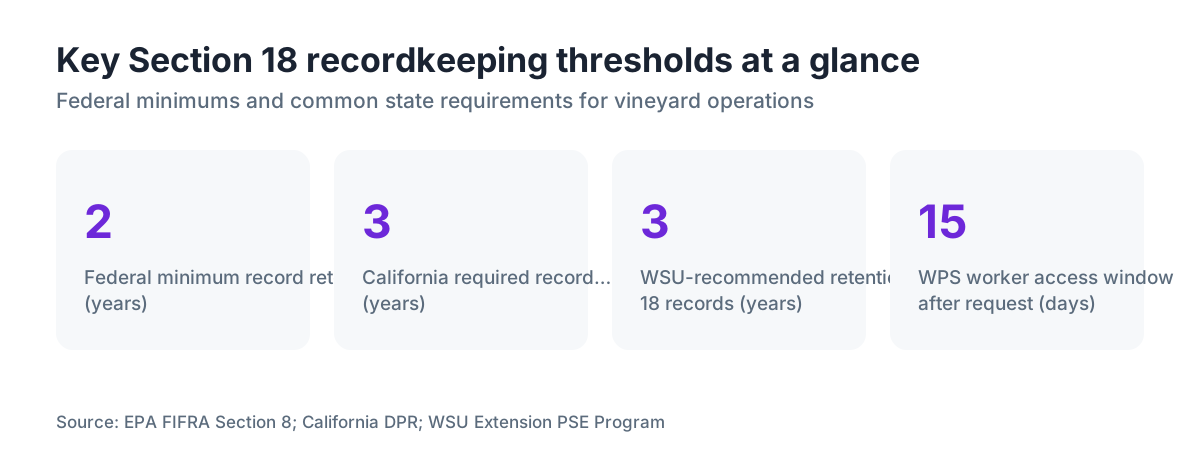
FIFRA Section 8 requires commercial applicators to keep pesticide application records for two years. [3] Many states go longer. California requires three years for agricultural use records under the DPR system. [4]
What additional records do state lead agencies typically require?
The state lead agency petitioned EPA for the Section 18 in the first place, so it also agreed to EPA's monitoring conditions. States layer their own reporting on top of the federal minimum, and they do it every time.
California is the most demanding. Under the California Department of Pesticide Regulation (CDPR), growers file a Pesticide Use Report (PUR) for every application, Section 18 or not, within a defined reporting period. For a Section 18 use, the PUR has to reference the specific exemption and the authorized use pattern, and you submit it to your County Agricultural Commissioner. [4] Skip the PUR and the CAC can issue a Notice of Violation, even if the application itself stayed inside the authorized terms.
Washington State requires pesticide use reports to WSDA for Section 18 uses and may require GPS coordinates for treated blocks. [5] New York runs reporting through Cornell's agricultural pesticide program and has historically asked for spray records within 30 days of the final authorized application date. [6]
Here's the practical part. Get the state authorization letter and read the conditions section word for word. There's almost always a reporting deadline, a designated state contact for adverse effects reports, and sometimes a duty to notify neighboring properties or beekeepers before you spray.
How should you structure a vineyard spray record for a Section 18 use?
A good Section 18 record has three parts: the standard application data, the exemption-specific data, and the supporting file. Here's what each looks like in the field.
Standard application data (what you'd log for any spray):
| Field | Example entry |
|---|---|
| Date | 2024-07-14 |
| Crop | Vitis vinifera (Cabernet Sauvignon) |
| Block ID | Block 3-North, 4.7 ac |
| Product name | [Product name as on label] |
| EPA Reg. No. | [as printed on container] |
| AI and concentration | Active ingredient, % as on label |
| Rate applied | oz or fl oz per acre |
| Volume per acre | gallons |
| Application method | Airblast, ground rig, etc. |
| Applicator name/license | Name, cert. license number |
| Target pest | Named pest or pathogen |
| Growth stage | BBCH scale or Eichhorn-Lorenz |
| Wind speed, temp, RH | Recorded at time of application |
| REI posted | Yes/No, date/time posted |
Exemption-specific data (add these to your standard log or attach a cover sheet):
| Field | Example entry |
|---|---|
| Section 18 authorization number | EPA-HQ-OPP-[year]-[number] |
| Authorized use window | Start date to end date from EPA letter |
| Maximum authorized rate | Per EPA letter |
| Rate actually applied | Must be at or below authorized max |
| State authorization reference | State letter/docket number |
| Required monitoring completed | Y/N, if applicable |
| Adverse effects observed | None observed / describe if any |
Supporting file: Attach (or link in your digital system) a copy of the EPA authorization letter, the state SLA approval, and the product label as it existed on the day of application. Labels change. You need the version that was current on the day you sprayed.
If you already run a digital spray log, tools like VitiScribe let you attach PDF copies of authorization letters straight to the application record, so the supporting file doesn't end up in a separate folder nobody can find during an audit.
How do you handle the EPA authorization number in your records?
The EPA authorization number is the single most important field in a Section 18 record. Without it, you can't prove the application was legally authorized. It reads something like EPA-HQ-OPP-2023-0247 and lives on the official EPA response letter sent to the state lead agency. The state usually forwards it to growers through the county extension office, a commodity organization, or the state department of agriculture. [1]
Get that number before the spray goes on. I've seen a case where the authorization was real and properly filed with the state, but the grower had no copy in hand, and the compliance conversation that followed was ugly. Download the authorization letter, write the EPA number on your spray log in a dedicated field, and keep the letter with your spray records for the full retention period.
Not sure whether an authorization is still active or has been amended? EPA's Office of Pesticide Programs publishes Section 18 emergency exemptions on the EPA website. [1] Cross-check the number and confirm the effective dates before you spray.
What do Worker Protection Standard records look like for a Section 18 application?
The EPA Worker Protection Standard (WPS) applies to Section 18 uses the same way it applies to registered products. Under the 2015 revised WPS, agricultural employers keep application-specific records covering the product, application dates, treated areas, and the restricted entry interval (REI). [7] Those records stay on file for two years and go to authorized worker representatives within 15 days of a request.
Section 18 adds a wrinkle. If the product has no standard EPA label with a printed REI (because it isn't fully registered), the REI comes from the Section 18 authorization document itself. That number has to appear in your WPS records. Don't leave the REI field blank, and don't write "see label" when the standard label doesn't exist for this use.
Posting rules apply too. The EPA authorization number and REI go up at the treated area before the application begins and stay posted until the REI expires. [7] Cornell's agricultural safety program has WPS posting guidance worth bookmarking. [6]
Workers and handlers can ask for this information by name, out loud, and get it within 15 days. Producing the Section 18 authorization number on the spot is part of that obligation.
What is the timeline for submitting Section 18 use reports?
Timelines depend on the state and the terms in your specific authorization letter. Here's the general picture across common state requirements.
| Jurisdiction | Typical submission deadline | Submitted to |
|---|---|---|
| California | Within the monthly PUR reporting cycle | County Agricultural Commissioner |
| Washington | Within 30 days of final application | WSDA Pesticide Management Division |
| New York | As specified in state authorization letter | NYSDAM or Cornell cooperative extension |
| Oregon | Within the period specified in SLA letter | ODA Pesticide Division |
| Federal (EPA) | End-of-season summary report if required by authorization | State lead agency, forwarded to EPA |
The authorization letter almost always carries a sentence like this: "The state lead agency shall submit a report to EPA summarizing use, monitoring, and any adverse effects observed within 90 days of the expiration of this authorization." That's the state's job, but your spray records feed the report. Late or missing records mean the state can't file an accurate one, and that weakens the case for future exemptions on the same pest.
Some authorizations, especially those for high-risk products or new active ingredients, want near-real-time adverse effects reporting. Spot any unexpected crop injury, wildlife mortality, or worker health issue after a Section 18 application? Report it to your state department of agriculture right away and write up the incident within 24 hours. Don't wait for a deadline.
How long do you need to keep Section 18 pesticide records?
The federal floor is two years for commercial applicators under FIFRA. [3] Treat that as a floor, not a target.
California requires three years for use records. [4] Several states match or beat that. Beyond the state minimum, there's a practical reason to keep Section 18 records five years or longer: EPA sometimes revisits a product's registration history and may contact growers years after an exemption closed to ask about residue or environmental outcomes. Having the records intact beats reconstructing them from memory.
WSU Extension's IPM materials recommend keeping pesticide application records, Section 18 documentation included, for at least three years even where two years is the legal minimum, precisely because of that retrospective review risk. [5]
Digital storage helps. A scanned PDF of your spray log, the authorization letter, and any state reporting receipts takes essentially no space. File by year, then by product type or exemption number. During an audit, one clean folder beats any single perfectly filled-out record.
What are the most common recordkeeping mistakes that lead to violations?
The mistakes that actually generate NOVs and fines come down to a short list.
Missing the EPA authorization number. Growers log everything else right but skip the authorization number because it wasn't on the container. It comes from the authorization letter, not the label.
Using the wrong REI. If a product has a standard label REI for a different crop and a different REI under the Section 18 authorization, the authorization REI controls. Use the label REI and you may send workers into a treated area before it's legally safe.
Treating outside the authorized geography. A county-specific Section 18 doesn't cover blocks in the next county, even on the same ranch. Confirm your treated blocks fall inside the authorized area.
Exceeding the authorized rate. Section 18 authorizations set a maximum rate and sometimes a maximum number of applications. Both limits have to show up in your records, along with proof you stayed under them.
Not keeping the authorization letter. The spray log alone doesn't prove the exemption was valid. The letter is the legal foundation. Keep a copy for the full retention period.
Late state reporting. Plenty of growers nail the application record and miss the state filing deadline. Set a calendar reminder the day you spray.
UC Davis Cooperative Extension has flagged late or incomplete PUR filings as one of the most common compliance failures in California vineyard audits. [8] The pattern holds across states. Good application records, missing or late state paperwork.
How does Section 18 recordkeeping fit into your broader vineyard compliance system?
A Section 18 use doesn't live alone. It sits inside your spray program, your WPS documentation, your food safety plan if you're under FSMA, and your organic certification records if you run mixed acres with certified blocks nearby.
The smart move is to treat Section 18 applications the way you treat restricted-use pesticide (RUP) applications: a separate log or clearly flagged entry, a physical or digital copy of the authorization on file, and a reminder for the state reporting deadline. Most vineyards already keep a separate RUP log out of habit. Folding Section 18 applications into that same higher-attention workflow is natural.
Evaluating digital tools? The question that matters is whether the system stores custom fields (authorization number, REI source, authorized geographic scope) and lets you attach supporting documents like the authorization letter to individual records. A product that only handles standard label applications forces your Section 18 documentation into a separate spreadsheet, which is exactly the fragmentation that loses records. VitiScribe's spray record module supports custom fields and document attachments built for this kind of compliance layering.
Running multi-state operations or blocks across counties? Get written confirmation from each county ag commissioner that the Section 18 authorization covers your specific parcel. Keep block maps with GPS coordinates in the file, cross-referenced against the authorization's boundaries.
Where can you find official guidance on Section 18 requirements?
Start with EPA's Office of Pesticide Programs. It publishes the list of currently active Section 18 exemptions, the authorization letters, and guidance for state lead agencies. [1] The EPA website is the authoritative source for what authorizations exist and what their terms are.
For state-specific guidance:
- California: CDPR's website covers PUR reporting for Section 18 uses. [4] Your County Agricultural Commissioner is the first call for local filing questions.
- Washington: WSU Extension's pesticide safety program and WSDA's Pesticide Management Division are both worth using. [5]
- New York: Cornell Cooperative Extension's IPM program keeps guides on emergency exemptions. [6]
- Oregon and other states: Your state department of agriculture pesticide division has the authorization letter on file and can answer questions about state reporting.
For Worker Protection Standard specifics, EPA's WPS page is the primary reference, and the National Agricultural Safety Database (NASD) has plain-language guides for agricultural employers. [7]
UC Davis Cooperative Extension publishes practical compliance guides for California operations and explains how the PUR system intersects with Section 18 use. [8] UC ANR's statewide IPM program covers emergency exemption use patterns for specific pests in wine grapes. [9]
Frequently asked questions
Where do I find the EPA authorization number for a Section 18 exemption?
The EPA authorization number is in the official letter EPA sends to the state lead agency (usually your state department of agriculture) granting the exemption. Your state ag department or County Agricultural Commissioner has a copy. You can also search EPA's Office of Pesticide Programs website, which lists active Section 18 authorizations by state and pest. Never spray under a Section 18 until you have that number in hand.
Can I use my standard spray log for a Section 18 application or do I need a separate form?
You can use your standard spray log if you add the Section 18 fields: the EPA authorization number, the authorized use window, the authorized maximum rate, and the source of the REI if it comes from the authorization rather than a label. Attach a copy of the authorization letter to the record. Many operations find it cleaner to flag Section 18 entries in a separate log section or use a cover sheet to keep audits straightforward.
What happens if I spray under a Section 18 but don't submit the required state use report?
Failing to file a required state pesticide use report is a separate violation from the application itself. In California, a missing PUR filing triggers a Notice of Violation from the County Agricultural Commissioner. Fines vary by state but can run from a few hundred to several thousand dollars per violation. The fine isn't the whole cost: late or missing grower data weakens the state's end-of-season report to EPA and can jeopardize future emergency exemptions for the same pest.
How is a Section 18 emergency exemption different from a Section 2(ee) application?
A Section 2(ee) permits certain uses not on the label, like applying a registered product at a lower rate or with different equipment, when those uses don't conflict with label instructions. A Section 18 goes further: it authorizes use of an unregistered pesticide or a registered pesticide on an unregistered site. Section 18 requires an EPA authorization letter and state approval. Section 2(ee) needs no authorization beyond the existing label.
Does the Worker Protection Standard apply to Section 18 pesticide applications in vineyards?
Yes, WPS applies fully. Under EPA's 2015 revised Worker Protection Standard, agricultural employers keep application records for two years and make them available to worker representatives within 15 days of a request. For Section 18 applications where the product has no standard label, the REI comes from the authorization document. That REI must appear in your WPS records and be posted at the treated area before application begins.
How long do I need to keep Section 18 spray records?
Federal FIFRA requires commercial applicator records for at least two years. California requires three years under DPR regulations. Several extension programs, WSU included, recommend three years as a practical minimum regardless of state law, because EPA occasionally runs retrospective reviews of products that went through Section 18 authorization. For Section 18 uses specifically, keeping records five years is a reasonable precaution.
What is a state lead agency and what role does it play in a Section 18 exemption?
The state lead agency is the state entity, usually the department of agriculture or department of environmental quality, that petitions EPA for a Section 18 on behalf of growers. EPA reviews the petition and issues a letter to the SLA authorizing use under specific conditions. The SLA then communicates terms to growers, monitors use, collects data, and reports back to EPA. Your SLA is also who you notify if you observe adverse effects after application.
Can a Section 18 exemption be revoked while I'm in the middle of spraying?
Yes. EPA can revoke or modify a Section 18 authorization if new safety data emerges, if monitoring shows unexpected residue levels, or if adverse effects are reported. Your state lead agency would notify growers through official channels. If you learn a revocation is in effect, stop applications immediately and document the date you received notice. Applications made after a revocation, even if you didn't know, may still violate FIFRA.
Do organic vineyards ever apply for Section 18 exemptions?
Certified organic operations can petition for Section 18 exemptions, but the authorized product also has to be compatible with USDA National Organic Program rules for the operation to keep organic certification. In practice, most Section 18 authorizations involve synthetic pesticides that would disqualify organic status for the treated acres. Growers managing mixed operations should consult their certifier before any Section 18 application near or on certified acres.
What adverse effects reporting is required after a Section 18 application in a vineyard?
If you observe crop injury, unexpected wildlife mortality, bee kills, or any health effects in workers or handlers after a Section 18 application, report it to your state department of agriculture as soon as possible. Many Section 18 authorization letters specify a reporting window, often 24 to 48 hours for acute incidents. Document the observation in writing with date, time, location, and a description of what you saw. Retain that document for the full record retention period.
How do I document that I applied a Section 18 product within the authorized geographic area?
Include your county name and block GPS coordinates or legal land description in the spray record, and confirm they fall within the authorized geographic scope in the EPA letter. If the exemption is county-specific, note the county explicitly. For larger operations with blocks in multiple counties, keep a copy of the authorization letter for each county where you applied and note in each record which authorization covered that block.
Are Section 18 records subject to inspection by anyone other than EPA and my state ag department?
Yes. Under WPS, workers and their designated representatives can request access to application-specific records for treatments they may have been exposed to. County Agricultural Commissioners in California can inspect records during routine compliance visits. Crop insurance adjusters may request records in a loss claim. If your operation is subject to FSMA food safety rules, records could be reviewed during a farm inspection. Keep records organized and accessible.
Do I need to keep the product label from a Section 18 application separately from the spray record?
Yes, and it's one of the more overlooked requirements. Labels get revised, and if a product later gets full registration with a different label, you need the label version current on the day of the Section 18 application. Print or save a PDF of the label on the day you spray. Store it with your authorization letter and spray record. A later label version doesn't accurately reflect what was authorized or what the use terms were.
Sources
- EPA Office of Pesticide Programs, Section 18 Emergency Exemptions: EPA can authorize states to permit use of unregistered pesticides under Section 18 of FIFRA when an emergency condition poses significant economic risk; active authorizations and authorization letters are published by OPP.
- EPA, 40 CFR Part 171, Certification of Pesticide Applicators: Federal regulations under 40 CFR Part 171 govern certified applicator recordkeeping requirements for pesticide applications including Section 18 uses.
- EPA, FIFRA Section 8, Use, Sale and Removal of Pesticides: FIFRA Section 8 requires commercial applicators to retain pesticide application records for at least two years.
- California Department of Pesticide Regulation, Pesticide Use Reporting: California requires growers to submit Pesticide Use Reports to the County Agricultural Commissioner and retain agricultural use records for three years; Section 18 uses must reference the specific exemption in the PUR.
- Washington State University Extension, Pesticide Safety Education Program: WSU Extension recommends retaining pesticide application records including Section 18 documentation for a minimum of three years; WSDA requires reporting of Section 18 uses within 30 days of final application.
- Cornell Cooperative Extension, New York State Integrated Pest Management Program: Cornell's IPM program maintains guidance on Section 18 emergency exemptions and WPS posting requirements for New York agricultural operations.
- EPA, Agricultural Worker Protection Standard (WPS): The 2015 revised WPS requires agricultural employers to keep application-specific records for two years and make them available to worker representatives within 15 days of a request; the National Agricultural Safety Database offers plain-language employer guides.
- UC Davis Cooperative Extension, Pesticide Compliance and Reporting: UC Davis Cooperative Extension has identified late or incomplete Pesticide Use Report filings as one of the most common compliance failures observed in California vineyard compliance audits.
- UC ANR Statewide Integrated Pest Management Program: UC ANR's IPM program covers emergency exemption use patterns for specific pests in wine grapes, including guidance on authorized products and rates under active Section 18 authorizations in California.
- EPA, FIFRA Section 18 Emergency Exemption Guidance for State Lead Agencies: EPA Section 18 authorization letters specify the authorized geographic scope, maximum application rate, time window, required monitoring conditions, and end-of-season reporting obligations for state lead agencies.
Last updated 2026-07-09