First aid kit inspection records for vineyard field operations

TL;DR
- OSHA 29 CFR 1910.151 requires employers to keep adequate first aid supplies readily available.
- California, Washington, and most state OSHA plans extend that to documented inspections.
- For vineyard fields you need a written log showing who inspected each kit, what they found, what got replaced, and the date.
- Quarterly inspections are the floor most state plans accept.
- Monthly is better during spray season.
What does OSHA actually require for first aid kit records in agriculture?
OSHA's general industry standard 29 CFR 1910.151(b) says "adequate first aid supplies shall be readily available" and that where medical facilities are not near the workplace, a person trained in first aid has to be available. [1] The federal rule names no inspection interval and no paperwork format. That silence is where vineyard managers get burned. No specified format does not mean no documentation needed.
State OSHA plans fill the gap fast. California's Division of Occupational Safety and Health (Cal/OSHA) Title 8 Section 3400 requires employers to keep first aid materials "of a type and amount reasonably needed" and, on farms, to make them readily accessible. [2] Cal/OSHA officers who do field audits ask for inspection logs as a matter of routine. Hand them a kit full of expired supplies and no records, and the presumption goes against you.
Washington's Department of Labor and Industries (L&I) is blunter about it. Its agricultural safety rules require agricultural employers to inspect first aid kits during active operations and keep a record of each inspection. [3] Oregon OSHA reads its own rule the same way.
Here's the practical read. You need a written record, dated and signed. Federal OSHA won't write you a ticket for a missing inspection log by itself, but a missing log makes every related citation worse, because it wrecks your good-faith defense.
Does the EPA Worker Protection Standard require first aid kit records?
Yes, in a specific way that gets missed a lot. The EPA Worker Protection Standard (WPS) under 40 CFR Part 170 requires that handlers and early-entry workers have access to decontamination supplies and "one unit of portable water for emergency eye flushing" at the handler start site. [4] Those supplies have to be in place before any application begins.
The WPS requires agricultural employers to keep decontamination supplies available for workers during and after applications, which means a kit stocked and near the treated area. If an inspector or a state department of agriculture auditor finds that kit depleted or expired, your pesticide use record isn't the only document under scrutiny. Kit condition is part of WPS compliance, full stop.
UC Davis's Western Center for Agricultural Health and Safety recommends that vineyards keep a separate WPS decontamination kit near the spray rig start point, on top of the general OSHA first aid kit at the main work site. [5] The two requirements overlap but aren't identical. Your log should note both and keep them clearly apart. Running one kit for both jobs is technically fine if it's stocked for both, but it muddies things during an audit.
Cornell's agricultural safety program makes a parallel point: pesticide handlers must have eyewash at the mixing site, and that availability should be documented. [6] "Documented" in practice means a log entry at the start of each application day.
How often should you inspect vineyard first aid kits, and when does that change?
Inspection frequency tracks how hard you're using the kit and what hazards your crew faces. That's the honest answer.
Base schedule: quarterly inspections meet the minimum most state plans accept during the off-season. Once field operations start, that moves to monthly. During active spray season, WSU Extension recommends checking pesticide-handler kits at the start of each spray day, even if the check is a quick visual rather than a full inventory. [7]
The use-triggered inspection is the one operations skip most. Any time someone opens a kit to treat an incident, that kit needs a documented restock inspection before it goes back into service. Obvious in hindsight. In practice the kit goes back on the truck un-replenished. A log entry with a blank "restocked" field after an incident is worse than no entry at all, because now you've documented the problem in writing.
Seasonal triggers that should auto-generate an inspection:
- Start of bud break crew work
- First pesticide application of the year
- Start of harvest (crew size often doubles)
- After any incident that opened a kit
- End of season, to record what goes into winter storage
Extreme heat matters too. Adhesive bandages and antiseptic wipes degrade faster stored in a truck cab at 95 degrees. Add a short note on storage conditions when you do summer inspections. It won't satisfy a regulation on its own, but it shows a pattern of reasonable care, and that pattern is exactly what a compliance officer weighs.
What exactly do you record on a first aid kit inspection log?
A compliant log needs at minimum: the kit identifier or location, the inspection date, the name and signature of the inspector, a check of each supply item against the baseline inventory, the expiration dates of any dated items, what was replaced or restocked, and whether the kit went back into service or came out of service pending restock.
Here's a table showing the core fields:
| Field | Why it matters | Common omission |
|---|---|---|
| Kit ID / Location | Links the record to a specific physical kit | Skipped when crew has only one kit |
| Inspection date | Establishes the compliance interval | Sometimes just a month, not a day |
| Inspector name + signature | Accountability; satisfies audit | Initials only, not a real signature |
| Items checked (per inventory list) | Proves you actually looked | Replaced by a checkbox "all good" |
| Expiration dates checked | Expired supplies are a citable deficiency | Almost always omitted |
| Items replaced/restocked | Documents supply chain | Left blank |
| Incident use since last inspection | Triggers mandatory restock check | Almost always omitted |
| Storage condition note | Best practice, not required | N/A |
| Next inspection due | Creates scheduling accountability | Nice to have |
One thing that trips up small operations is the "baseline inventory" the check refers to. You can't verify supplies against a list you don't have. Before the first inspection of the year, write down exactly what a fully stocked kit for your operation should contain. That list becomes your standard. Without it, every inspection is just a feeling.
WSU Extension's agricultural safety materials suggest tying the baseline inventory to the actual work hazards on site rather than a generic 16-unit kit. [7] A vineyard running sulfur dust needs eyewash supplies a hardware-store kit may not carry.
What supplies does a vineyard first aid kit need to contain?
OSHA's general reference point is ANSI/ISEA Z308.1, the American National Standard for Workplace First Aid Kits and Supplies. [8] The 2021 revision defines Type I (stationary), Type II (portable, indoor), and Type III (portable, outdoor/mobile) kits, each with its own minimum contents. A vineyard field kit is almost certainly a Type II or Type III.
For operations with pesticide exposure, extension programs push past the ANSI minimums. Cornell's farmworker safety program lists these as non-negotiable additions for spray work: [6]
- Eyewash solution (minimum 32 oz, or a personal eyewash station)
- Nitrile gloves for the responder
- Emergency contact card with Poison Control (1-800-222-1222) and the site's pesticide SDS
- Plastic bag for contaminated clothing
Expiration dates are the most-cited deficiency in state agricultural inspections. Adhesive bandages rarely fail dangerously, but antiseptics, sterile dressings, and eyewash solutions do. Any kit that's ridden through a Central Valley summer needs its eyewash expiration checked. Degraded eyewash is worse than none in some failure modes, because it buys false confidence.
One opinion, stated plainly: the 16-unit ANSI minimum kit sold at warehouse stores for $8 is not adequate for a crew running sulfur, copper, or organophosphate applications. Spend the $40 to $80 for an agricultural-grade kit with proper eyewash, then actually log your inspections. The kit cost is nothing against a citation or a blinded worker.
How do you set up an inspection log system that actually gets used?
Paper works fine if it actually gets filled out. The trouble with paper is that the log sheet lives in the office, the kit lives on the spray rig, and the person doing the inspection isn't the person who files the paperwork. That gap is where compliance dies.
A few approaches cut the friction.
Attach the log to the kit. A waterproof log sheet in a zip-lock bag clipped inside the lid means the inspector fills it out at the point of inspection. Weekly or monthly, someone transfers or scans it to the office file. Low-tech, but it closes the gap.
Use a photo-plus-form approach. The inspector photographs the kit contents, the timestamp rides along, and it goes to the manager with a quick verbal report. That photo isn't a formal log, but it's contemporaneous evidence of an inspection. Pair it with a weekly summary log and you have a defensible record.
Digital field record systems close the gap most cleanly. Tools like VitiScribe let you build a custom inspection checklist, set it on a recurring schedule, and capture sign-off from the field with a phone. The record is date-stamped, tied to the user, and stored without anyone having to remember to file a piece of paper.
Whatever you pick, the test is simple. If a Cal/OSHA compliance officer walked in today, could you hand them a printed record of every inspection for the past 12 months, sorted by kit location? Yes means your system works. Reconstructing it from memory means you don't have a system yet.
How long do you need to keep first aid kit inspection records?
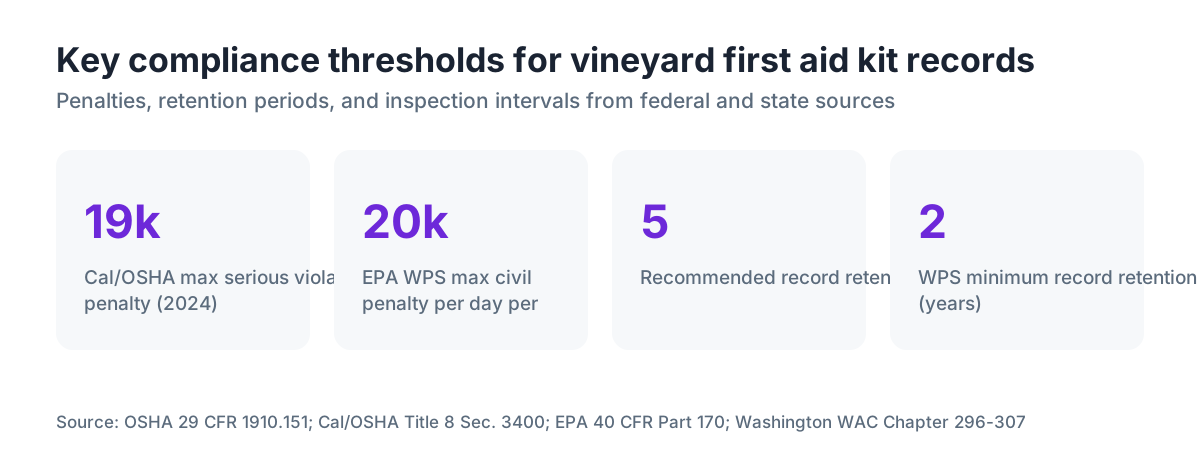
Federal OSHA sets no specific retention period for first aid kit inspection logs. The general principle in OSHA recordkeeping under 29 CFR 1904 is five years for injury and illness records, and that's a fair benchmark for supporting documents. [9]
Cal/OSHA's enforcement posture is that records tied to worker safety program elements should be kept at least three years, and five is safer. [2] Washington L&I also uses a three-year lookback in agricultural inspections.
For WPS records, the standard under 40 CFR Part 170 requires agricultural employers to retain WPS records for two years. [4] Since kit inspection logs bear on pesticide handler safety, the WPS two-year minimum is your floor. Five years is the practice I'd actually run, because a record that could defend a workers' comp claim or a personal injury suit needs a longer tail than any regulatory minimum.
Keep the records somewhere you can actually reach. A box of water-damaged paper in a barn is not a record. Digital storage with a backup means you can produce the document when someone asks, which is the only time it counts.
What happens if you fail a first aid kit audit or inspection?
The consequences stack in a way that surprises people who figure a first aid violation is a small-dollar nuisance.
A Cal/OSHA serious violation (like inadequate first aid supplies under Title 8 Section 3400) runs up to $18,675 per violation as of 2024, with repeat violations carrying higher multipliers. [2] A missing log alone doesn't automatically trigger a serious classification. But a depleted kit plus missing records in an operation with a citation history can be classified as willful, which is a different penalty bracket entirely.
WPS violations under EPA can carry civil penalties up to $19,636 per day per violation (the 2024 inflation-adjusted maximum). [4] EPA rarely drops that ceiling on small farms, but the state departments of agriculture that enforce WPS can and do issue real penalties for decontamination supply failures.
Beyond the fines, a documented first aid failure complicates your workers' comp picture. If a worker is hurt and the investigation shows the kit was depleted or uninspected, that's evidence in a negligence argument that has nothing to do with OSHA at all.
The workers' comp angle is the one that moves most managers once they see it. OSHA fines hurt. A serious injury with a paper trail proving you knew the kit was deficient is a different conversation, and a worse one.
Are there specific first aid kit requirements for vineyard harvest crews and H-2A workers?
H-2A guest worker rules layer on top of OSHA and WPS. The U.S. Department of Labor's H-2A regulations under 20 CFR Part 655 require employers to give workers the same safety and health protections required under applicable federal and state law. [10] Your OSHA and WPS first aid obligations apply to H-2A workers exactly as they do to domestic workers.
During harvest the real issue is kit-to-worker ratio. OSHA 1910.151 names no worker-per-kit number, but state plans read "readily available" to mean accessible within a few minutes. Spread harvest crews across 200 acres in multiple blocks and one kit locked in the manager's truck does not satisfy "readily available." California expects kits physically near where the work is happening.
WSU Extension recommends one kit per field crew working more than a quarter-mile from the central work site during harvest. [7] Not a regulatory citation, but a defensible operational standard.
For H-2A operations, the housing and transportation first aid requirements also apply, and those need their own logs. The kit in the field and the kit at the housing unit are two separate compliance items, with schedules that may not match.
How does first aid kit documentation connect to your overall vineyard safety program?
A first aid kit inspection log doesn't stand alone. It connects to your Injury and Illness Prevention Program (IIPP), required under Cal/OSHA Title 8 Section 3203 in California and equivalent programs elsewhere, and to your pesticide safety program under WPS. [2]
The IIPP requires you to identify workplace hazards, define corrective actions, and document inspection activities. Kit inspections are exactly the hazard-control documentation an IIPP is built to generate. If your IIPP lists "adequate first aid availability" as a hazard control (and it should), then the inspection log is your evidence that the control is operating.
If you already run a full spray record, a heat illness prevention plan, and pesticide handler training records, adding kit logs to that file is a small step. The records already exist. The first aid log just needs a home in the same binder or digital folder.
VitiScribe's field compliance tools let you attach first aid kit records to the same operation record as your spray logs, so a single document pull covers both WPS and safety program documentation. That consolidation earns its keep at audit time.
The connection that gets missed: log a kit as depleted, skip the restock record that closes it out, and you've documented a hazard without documenting the fix. That open-loop record is worse than none, because it proves you knew and didn't act. Close the loop every time.
Where can you find inspection log templates and training resources?
Several university extension programs publish free templates worth using as a starting point.
UC Davis Western Center for Agricultural Health and Safety publishes first aid and safety program materials built for agricultural operations in California. [5] The templates account for the California regulatory environment, which makes them directly usable for vineyards in Napa, Sonoma, the Central Valley, and the Central Coast.
WSU Extension's agricultural safety program has field-specific resources for Washington and the Pacific Northwest, including materials developed for pesticide handler compliance. [7]
Cornell's agricultural safety program covers New York and the broader Northeast, with attention to pesticide handler first aid requirements under WPS. [6]
The National Agricultural Safety Database (NASD) aggregates resources from extension programs across the country and is searchable by topic. Its first aid resources cover multiple state regulatory environments. [11]
For the regulatory text itself, OSHA's 29 CFR 1910.151 is short and readable, but the real detail lives in the state plan interpretations published by each state's occupational safety agency. Don't rely on a summary. Read the actual state plan section that applies to you, because the gaps between federal and state requirements are exactly where compliance problems hide.
Frequently asked questions
Does OSHA require a written first aid kit inspection log for farms?
Federal OSHA 29 CFR 1910.151 doesn't mandate a written inspection log in so many words, but state OSHA plans do. Washington's agricultural safety rules explicitly require monthly inspections and records during active operations. California's Title 8 Section 3400 implies documentation through its IIPP framework. In practice, any state agricultural inspection can go badly without a contemporaneous written log.
How often should a vineyard first aid kit be inspected?
Quarterly at minimum during the off-season, monthly during active field operations, and at the start of each spray day for pesticide-handler kits. Any time a kit is used to treat an injury, inspect and document a restock before putting it back in service. Washington's L&I sets monthly as the minimum during active agricultural operations.
What items must be in a vineyard field first aid kit?
ANSI/ISEA Z308.1-2021 sets minimum contents for portable field kits. For vineyard operations with pesticide exposure, add at least 32 oz of eyewash, nitrile gloves for the responder, a plastic bag for contaminated clothing, and a card with Poison Control (1-800-222-1222) and the pesticide SDS. The basic warehouse-store 16-unit kit is not adequate for spray crew work.
Can expired supplies in a first aid kit result in an OSHA citation?
Yes. Expired supplies, particularly sterile dressings and eyewash solutions, can be cited as a deficiency under the "adequate first aid supplies" standard in 29 CFR 1910.151. California and Washington compliance officers specifically check expiration dates during agricultural inspections. A missing log entry for expiration date checks gives the officer less to work with in your favor.
How many first aid kits does a vineyard need during harvest?
OSHA requires kits to be "readily available," which state plans read as physically accessible within minutes. WSU Extension recommends one kit per crew working more than a quarter-mile from the central site. During harvest with multiple spread-out crews, a single centrally located kit is unlikely to satisfy the readily-available standard, especially for H-2A and large seasonal crews.
Does the EPA Worker Protection Standard require first aid kit documentation?
The WPS under 40 CFR Part 170 requires that decontamination supplies, including eyewash water, be available before pesticide applications begin. Logging that those supplies were in place at the start of each application day is the practical way to show WPS compliance. WPS records must be retained at least two years.
How long should you keep vineyard first aid kit inspection records?
The WPS minimum is two years. OSHA injury and illness record retention runs five years under 29 CFR 1904, which is a reasonable benchmark for supporting records like kit inspection logs. Five years is the practice I'd recommend, because those records can matter in workers' comp disputes long after the regulatory window closes.
What's the fine for not having a first aid kit or inspection records in California?
Cal/OSHA classifies inadequate first aid supplies as a serious violation, with penalties up to $18,675 per violation as of 2024. Repeat or willful violations carry higher multipliers. A depleted kit with no inspection records, found after a worker injury, is far more likely to be classified as willful than a first-time gap in an otherwise documented safety program.
Do H-2A workers have different first aid kit requirements than domestic workers?
No different kit contents are required, but H-2A regulations under 20 CFR Part 655 require the same federal and state safety protections for H-2A workers as for domestic workers. Practically, your inspection logs must cover kits used by H-2A crews in the field, and if you provide housing, the housing unit kits need separate compliance documentation.
Can a photo on a phone substitute for a written first aid kit inspection log?
A timestamped photo showing kit contents is contemporaneous evidence, but it's not a substitute for a signed log. Pair photos with a summary log entry that names the inspector, what was found, and what was replaced. The photo supports the written record; it doesn't replace it. Regulators expect a document they can read and cross-reference, not a camera roll.
Is a first aid kit inspection log part of the IIPP in California?
Yes. California's IIPP requirement under Title 8 Section 3203 asks employers to identify hazards and document that corrective controls are operating. First aid availability is a named hazard control in most vineyard IIPPs. The inspection log is the evidence that control is active. An IIPP that lists kit inspection as a control but has no log to show inspections happened is an IIPP with a documented failure.
What's the best format for a first aid kit inspection log?
At minimum: kit ID, inspection date, inspector name and signature, a line-by-line inventory check against a baseline list, expiration dates checked, items replaced, whether the kit was returned to service, and the date of any incident use since the last inspection. A table format with a row per inspection reads easily during an audit. Keep the baseline inventory list attached so the check can be verified.
Where can I find a free first aid kit inspection log template for vineyard operations?
UC Davis Western Center for Agricultural Health and Safety publishes agricultural safety templates. WSU Extension's agricultural safety program has Pacific Northwest-specific resources. Cornell's agricultural safety program covers Northeast operations. The National Agricultural Safety Database aggregates templates from extension programs nationwide and is searchable by topic and state.
Sources
- OSHA, 29 CFR 1910.151 Medical Services and First Aid: OSHA requires that adequate first aid supplies shall be readily available and that a trained person be available where medical facilities are not in near proximity.
- Cal/OSHA, Title 8 California Code of Regulations, Section 3400: California requires agricultural employers to maintain first aid materials of a type and amount reasonably needed, and serious violations carry penalties up to $18,675.
- Washington Department of Labor and Industries, Agricultural Safety Rules (WAC Chapter 296-307): Washington requires agricultural employers to inspect first aid kits during active operations and maintain inspection records.
- EPA, Agricultural Worker Protection Standard, 40 CFR Part 170: WPS requires decontamination supplies including eyewash water be available before pesticide applications begin, and WPS records must be retained for two years. Civil penalties can reach $19,636 per day per violation.
- UC Davis Western Center for Agricultural Health and Safety: UC Davis recommends vineyard operations maintain a separate WPS-compliant decontamination kit near the spray rig start point, in addition to general OSHA first aid kits.
- Cornell University, Agricultural Health and Safety (Cornell Cooperative Extension): Cornell's farmworker safety program identifies eyewash availability at pesticide mixing sites as essential and recommends documentation of its presence before each application.
- Washington State University Extension: WSU Extension recommends pesticide-handler kits be checked at the start of each spray day and one kit per crew working more than a quarter-mile from the central work site during harvest.
- ANSI/ISEA Z308.1-2021, Minimum Requirements for Workplace First Aid Kits and Supplies (International Safety Equipment Association): ANSI/ISEA Z308.1-2021 defines Type I, II, and III kit classifications with minimum contents requirements for portable field kits used in agricultural settings.
- OSHA, 29 CFR 1904, Recording and Reporting Occupational Injuries and Illnesses: OSHA requires injury and illness records to be retained for five years, establishing a practical benchmark for supporting safety program documentation.
- U.S. Department of Labor, H-2A Temporary Agricultural Program, 20 CFR Part 655: H-2A regulations require that employers provide guest workers with the same safety and health protections required under applicable federal and state law, including first aid requirements.
Last updated 2026-07-10