Documenting biological control agent applications in organic vineyard records

TL;DR
- Organic vineyard BCA records must capture the product name, EPA registration number (or exemption basis), application date, target pest or disease, rate, block or acres treated, and applicator name.
- Your certifier needs these to verify NOP compliance at inspection.
- Miss one field and you can draw a noncompliance finding.
- Keep records at least five years.
What records does the NOP actually require for biological control applications?
The National Organic Program requires records "sufficient to demonstrate compliance," kept for five years past the date of the record. That's it. That's the floor. The regulation at 7 CFR § 205.103 doesn't hand you a form, so your certifier fills in the practical detail. [1]
For a biological control agent (BCA), that means capturing the product name and formulation, the EPA registration number or a clear statement of why the product is exempt (more on that below), the OMRI or certifier-approved status, the application date and time, the target pest or pathogen, the application rate and volume, the field block or row numbers, the total acres treated, the equipment used, and the applicator's printed name and signature.
Some certifiers also ask for the lot or batch number on biofungicides like Bacillus subtilis products. They want traceability if a batch turns out to carry a prohibited co-formulant. Copy that number off the label before you toss the container. [2]
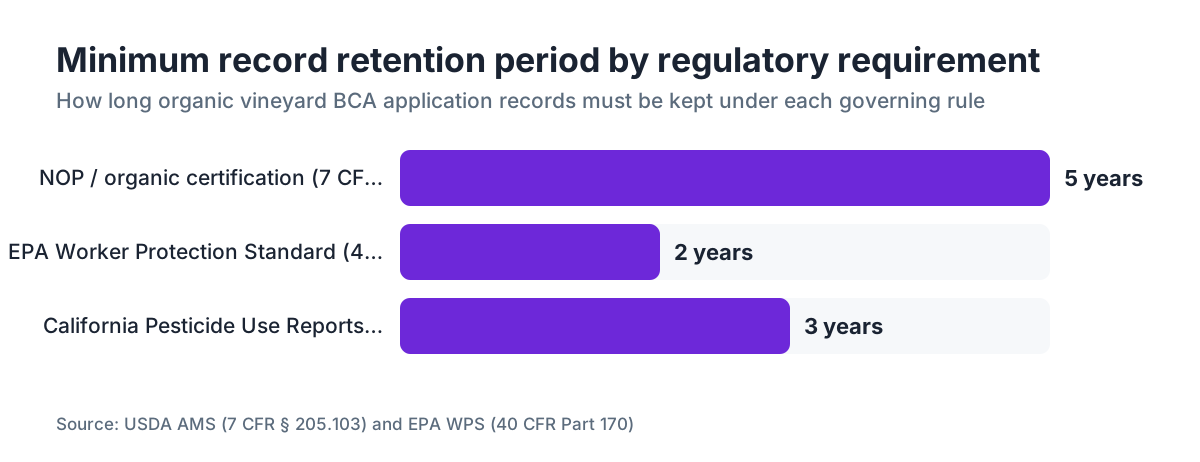
The five-year retention rule is hard, not a suggestion. 7 CFR § 205.103(b) says records must be "maintained for not less than 5 years beyond their creation." [1] If your audit lands in year four after an application, you still need that record in hand. Paper or digital both work. Your certifier decides which format satisfies them at inspection.
Which biological control agents are allowed in certified organic vineyards?
The National List at 7 CFR § 205.601 and the crop pest standard at § 205.206 govern which pest management inputs you can use in organic crop production. Naturally occurring microorganisms and their fermentation byproducts are generally allowed. The product formulation is what makes or breaks it. [3]
Here are the BCAs you'll actually reach for in a vineyard, and where each one sits:
| BCA | Active organism | Common use | Typical regulatory status |
|---|---|---|---|
| Bacillus subtilis (e.g., Serenade) | Bacterium | Botrytis, powdery mildew | OMRI Listed, NOP allowed |
| Bacillus amyloliquefaciens (e.g., Double Nickel) | Bacterium | Downy mildew, Botrytis | OMRI Listed, NOP allowed |
| Trichoderma harzianum (e.g., RootShield) | Fungus | Soil pathogens | OMRI Listed, NOP allowed |
| Ampelomyces quisqualis (e.g., AQ10) | Hyperparasite fungus | Powdery mildew | NOP allowed, check lot |
| Beauveria bassiana (e.g., Botanigard) | Entomopathogenic fungus | Leafhoppers, mites | OMRI Listed, NOP allowed |
| Beneficial insects (lacewings, parasitic wasps) | Macrobial | Various pests | Allowed, no EPA reg required |
| Steinernema spp. (beneficial nematodes) | Nematode | Root pests, soil insects | Allowed, typically exempt |
OMRI listing is not the same as certifier approval. Listed means eligible, not cleared. Your certifier keeps its own approved materials list, and many require a materials approval request before you spray anything new. Submit those requests before the season starts, not three days before botrytis pressure hits. [4]
Beneficial insects and nematodes sold for biological control usually aren't regulated as pesticides under FIFRA, so many carry no EPA registration number. [5] Note that in your record. Write it out plainly: "Steinernema feltiae, beneficial nematode, no EPA registration required, OMRI listing not applicable, certifier confirmed allowed." That one line keeps you clean.
What exactly goes in each field of a BCA application record?
The fields that feel pointless in June are the ones that save you in a December audit. Go through each one carefully enough that you could fill it out correctly at 5 a.m. with a headlamp on.
Product name and formulation. Write the full brand name and formulation code exactly as the label shows it. "Serenade Opti WP," not "Serenade." Different formulations of the same organism can carry different co-formulants, and some of those aren't allowed.
EPA registration number. For a registered biopesticide, this shows on the label as a number in the format XXXXX-XXX. Write it down. If the product is exempt under FIFRA Section 25(b) (minimum risk pesticides), write "FIFRA 25(b) exempt" and note why you believe it applies. [5]
OMRI listing or certifier approval reference. Note the OMRI Generic Materials List category or your certifier's materials approval letter number and date. If approval came over the phone, follow up with an email and keep the email.
Application date and time. Date is obvious. Time matters more than people think, because many BCAs (Bacillus-based products especially) break down under UV. Applying at 6 a.m. versus 2 p.m. tells a story about efficacy and shows you're reading the label.
Target pest or disease. Be specific. "Botrytis cinerea," not "bunch rot." Use the real name. If you're tank-mixing a BCA with sulfur, each input gets its own line with its own target.
Application rate. Record oz/acre, lb/acre, or fl oz/100 gal exactly as used and exactly as the label states. Note any deviation and why. Going below the labeled rate is generally fine. Going above is a compliance problem, organic or not.
Block ID, acreage, GPS reference. Your vineyard map should have named or numbered blocks. Record which blocks got treated and the total acres. If you keep GIS coordinates for blocks, attach them. If an auditor ever disputes what "Block 7" means, GPS data ends the argument.
Applicator name. Printed name and signature. If your state requires a pesticide applicator license for commercial biopesticide work, add the license number. California requires a Qualified Applicator Certificate or License for many registered biopesticides, organic or not. [6]
Equipment used and calibration date. Note the sprayer type, nozzle setup, pressure, and last calibration date. Calibration records live in their own document, but cross-referencing them here costs nothing and reads well to an auditor.
Adjuvants or tank-mix partners. Anything added to the tank gets its own entry. Adjuvants often aren't OMRI listed, and some are prohibited outright. Using a spreader-sticker? Confirm it's on the National List or certifier-approved, and write down that confirmation.
How do organic vineyard spray records differ from conventional spray records?
Organic records answer to two masters. Conventional spray records mostly satisfy state pesticide use reporting laws, which track the product, rate, and acreage for groundwater monitoring and endangered species work. [6] Organic records do that job too, then face a second test at your certification audit: more than "was this legal," but "did every input comply with the NOP, and can you prove it?"
The practical gaps are real. Conventional records rarely ask why you picked a product. Organic records often do, especially for inputs allowed only after preventive practices fail. Under 7 CFR § 205.206 you follow a hierarchy: cultural and mechanical methods first, then biological controls, then allowed botanical or mineral inputs. [3] When your certifier asks why you sprayed Serenade on August 1, your answer lands better with a weather log showing high humidity and morning dew (botrytis risk) than with a shrug.
Some certifiers want a field activity log with scouting notes kept apart from spray applications. Others want them on one form. Ask yours before the season, not at inspection.
One more gap: organic records cover everything applied, not only registered pesticides. Release beneficial insects and you record the release. The NOP has no exemption for "it's just bugs."
What are the EPA Worker Protection Standard requirements for BCA applications?
The Worker Protection Standard applies to most registered biopesticides, and it runs on a different clock than your organic records. Codified at 40 CFR Part 170, the WPS covers agricultural pesticide applications, including biopesticide products that carry an EPA registration number. [7] If the label calls the product a pesticide (most do), the WPS applies to your workers.
The WPS requires that workers get notified of applications, that restricted entry intervals (REIs) be posted or communicated, and that records stay accessible to workers and their designees. Since the 2015 revision, application records must be kept for two years (not five, unlike NOP records) and must include the product name, EPA registration number, active ingredient, location treated, date and time, and the REI. [7]
Many OMRI-listed biofungicides carry a four-hour REI. Bacillus subtilis products like Serenade have a four-hour REI on the label. Beauveria bassiana (Botanigard) also runs four hours. Know your product's REI and post it on your pesticide safety board before the application starts, not after.
Macrobials (beneficial insects, nematodes) without an EPA registration number generally fall outside the WPS. But the moment you apply a registered biopesticide, you're in WPS territory. Keep both your NOP record and your WPS record for those applications. They can share one form if you design it that way.
UC ANR Cooperative Extension notes that growers often treat organic certification requirements and WPS requirements as interchangeable. They aren't. Different retention periods, different required fields, different enforcement agencies (USDA and accredited certifiers for the NOP; EPA and state lead agencies for the WPS). [8]
How should you structure a BCA application record form for an audit?
Design the form for the auditor's eye, more than your own. Inspectors from accredited certifiers see hundreds of operations a year. A clean record makes their job fast, and that goodwill pays you back. A messy one spawns questions that eat your afternoon.
The simplest format that works is a single-page log with these columns: Date | Block ID | Product | EPA Reg. No. | Target | Rate | Acres | REI End | Applicator | Certifier Approval Ref | Notes.
Keep one log per season, or one per block if that's how your head works. What you don't want: separate notebooks by input type, records buried in a binder with invoices, or a napkin (yes, it happens).
Some vineyards build records in a spreadsheet, which makes filtering by block or product easy mid-audit. Others use field operations software. VitiScribe, for one, is built around vineyard compliance workflows and generates spray logs with the NOP-required fields already mapped, which helps at harvest when nobody has the patience to remember record-keeping conventions. Whatever you run, you need to print or export records on the day of inspection.
Pair each application record with supporting documents in a folder or linked file: the product label as it read at purchase, the OMRI listing printout or certifier approval letter, and the Safety Data Sheet. Labels change. An OMRI-listed product can be delisted. Keeping the label as it read on your application date protects you when a product's status shifts later.
Cornell Cooperative Extension recommends a "materials binder" kept separate from your spray log, one section per approved input, holding the label, SDS, OMRI certificate, and certifier approval. [9] The spray log stays lean and fast to complete in the field, and the backup paperwork lives in one place you can find.
What happens if your BCA application record is incomplete during a certification audit?
Missing records are the most common noncompliance finding for organic growers, per USDA Agricultural Marketing Service oversight of accredited certifiers. [10] What it costs you depends on what's missing and whether it's a pattern.
One field missing (you forgot the REI, left acreage blank) usually draws a minor noncompliance notice. You fix it, explain it, move on. Certifiers know farming is chaos.
No records at all for an application period, or records that clash with other evidence (scouting logs showing spray drift on a date you claim nothing was applied), can turn into a major noncompliance finding. That opens the door to suspension or revocation of your certificate. 7 CFR § 205.662 lays out how suspension and revocation proceed. [1]
Fraud is its own category. Falsifying records to hide a prohibited substance application violates the NOP and can trigger civil penalties up to $11,000 per violation under the Organic Foods Production Act. [10]
Honestly, most certifiers want to help you fix a problem, not spring a trap. But "I was busy" doesn't cover missing records in a business where the paper trail is the entire proof behind the organic premium you're getting paid.
Do you need to record BCA applications differently for cover crops or interrow areas vs. the vine canopy?
Yes, and it trips up plenty of growers. Release beneficial insects in the interrow cover crop to manage leafhoppers in the canopy, and you've still made an organic input application on your certified land. Record it. The location reads "interrow, all blocks" or whatever is accurate. The target might be "western grape leafhopper, Erythroneura elegantula."
Applications to the cover crop itself (say, a Beauveria bassiana spray at thrips overwintering in the understory) follow the same rules as canopy work. The NOP draws no line between vine and soil applications for record-keeping.
Soil-applied BCAs like Trichoderma products or beneficial nematodes get a record too: date, block, product, rate per acre or per linear foot, and the target. Applying nematodes at transplant? The transplant date becomes your application date, and you write "at transplant" in the notes.
WSU Extension's organic farming resources note that soil biology records are sometimes kept apart from spray logs. That's fine, as long as both sets cover the same five-year window and both are ready at inspection. [11]
How do you document emergency or off-label BCA applications without losing your certification?
Start here: no "off-label" application is both legal and safe to make. If the label says 4 oz per gallon and you use 8, you've broken FIFRA, certified or not. Don't do it.
What growers usually mean by "emergency application" is using a material they haven't gotten certifier approval for yet, under heavy pest pressure, planning to get approval after the fact. Bad idea, and sometimes a certification-ending one. The NOP wants prior approval of inputs, not retroactive approval. [3]
Here's the move when a new pest or disease shows up mid-season: call your certifier right away. Most accredited certifiers run a fast-track review for real emergencies. Document the call (date, time, who you spoke with, what they said). If they give verbal approval, follow up in writing that same day. Then apply, and record the application normally with a note referencing the emergency approval and the call.
If things move so fast you have to act before you reach anyone, and the material is on the National List or is obviously allowed (a macrobial release, for instance), document the whole decision: what you saw in the field, why you called it an emergency, what alternatives you weighed, and when you notified your certifier. Good-faith decisions backed by real notes keep certifiers far more forgiving than silence does.
What record-keeping tools and templates work best for BCA applications in vineyards?
Paper still works, and don't let anyone shame you out of it. A ring-bound spray log with carbon copies satisfies certification audits, worker protection records, and state pesticide reporting. The catch is that paper doesn't connect to anything: your spray log, your scouting notes, and your weather records all sit in different drawers, and assembling one clean audit package takes hours.
Spreadsheets move you up a rung. A well-built Excel or Google Sheets log with drop-downs for approved products, auto-calculated REI end times, and a printable summary view handles most small operations fine. The weak spot is version control. Plenty of growers end up living in "spray log v3 FINAL FINAL.xlsx," which confuses auditors as much as it confuses you.
Field operations software built for vineyard compliance automates the tedious parts. VitiScribe is made for vineyard operations and generates application records with the NOP-required fields, timestamps, and block-level traceability that export cleanly for an audit. Managing more than roughly 20 acres of certified organic vines and several input types? The time savings and audit-readiness earn back the cost. Farming five acres with one BCA product? A good paper template is probably all you need.
Whatever you pick, test it before inspection season. Print a sample record for a made-up application and ask your certifier's inspector straight out: "Would this record satisfy you?" That answer is worth more than any template.
What does a complete, real-world BCA application record look like?
Here's a realistic completed entry, written out in plain language so you can see how the pieces lock together.
Date: August 3, 2025
Time of application: 6:15 a.m.
Block(s): Blocks 3, 4, and 5 (Cabernet Sauvignon, east hillside, 8.4 acres total)
Product name: Serenade Opti (Bacillus subtilis strain QST 713, wettable powder)
EPA Registration No.: 264-1155
OMRI Listed: Yes, listing current as of 2025 season (printout in materials binder)
Certifier approval: Oregon Tilth materials approval letter dated January 12, 2025, ref. OT-2025-0047
Target pest: Botrytis cinerea (gray mold), elevated risk per Davis weather station data showing 4 consecutive nights above 90% humidity
Label rate: 6-8 oz/acre; applied at 7 oz/acre
Water volume: 50 gal/acre
Equipment: Tower sprayer, 4-row, calibrated June 28, 2025 (calibration log p. 14)
REI: 4 hours. REI ends: 10:15 a.m. August 3, 2025. Posted on information board at 6:00 a.m.
Adjuvants: None
Applicator: Jane Martinez, Pesticide Applicator License No. CA-12345 (California example)
Weather conditions: 62°F, 5 mph W wind, no rain forecast 24 hours
Notes: Scouting observation August 1 noted 3% cluster infection rate in Block 4 (scouting log p. 22). Application made as preventive intervention per NOP 205.206 sequence.
Signature: [Jane Martinez]
That record is complete. It points back to the calibration log, the scouting log, the materials binder, and the certifier approval letter. An auditor can trace every thread without asking a single question.
Frequently asked questions
How long do organic vineyards need to keep BCA application records?
The NOP at 7 CFR § 205.103 requires retention for at least five years from the date of creation. The EPA Worker Protection Standard requires application records for two years. Because the NOP window is longer, keeping everything for five years covers both. If your state has a longer pesticide use reporting rule, follow the longest window.
Does releasing beneficial insects in a vineyard require a spray record?
Yes, though not as a traditional pesticide entry. The NOP requires records of all field activities sufficient to demonstrate compliance. A beneficial insect release is an organic pest management activity and needs a date, species released, quantity, target pest, block, and who did it. No EPA registration number is required because macrobials are typically exempt from FIFRA, but the release still needs documentation.
Can a product be OMRI listed but still not allowed by my certifier?
Yes. OMRI listing means a product is eligible under the NOP, not that every accredited certifier has approved it. Some certifiers keep their own approved materials lists and require a materials approval request before you use anything new. Submit requests before the season starts. Never treat an OMRI listing as a green light without checking your specific certifier's requirements.
What's the EPA registration number for Serenade (Bacillus subtilis)?
Serenade Opti carries EPA Registration No. 264-1155. Serenade ASO carries a different number, so check the specific product label you're using because formulations differ. Always copy the EPA registration number directly off the label in your hand rather than relying on memory or a web search, because formulations and registrations do change.
Do I need to record BCA applications if I'm in organic transition, not yet certified?
Yes. The three-year transition period requires you to operate as if you're certified, and your certifier needs records from the entire transition to verify compliance when you apply. Gaps in transition-period records are a common reason applications get delayed. Start record-keeping on day one of transition, treating BCAs exactly as you would in a fully certified year.
What restricted entry interval applies to most biofungicide products used in vineyards?
Most Bacillus-based biofungicides like Serenade and Double Nickel carry a four-hour REI. Beauveria bassiana products like Botanigard also typically run four hours. Always confirm against the specific product label in your hand, because REIs can differ between formulations of the same organism. Post the REI on your WPS information board before starting any application.
What's the penalty for falsifying organic spray records?
Falsifying records to conceal a prohibited input application violates the Organic Foods Production Act and can bring civil penalties up to $11,000 per violation, plus certificate revocation. Beyond federal penalties, some states have their own organic fraud statutes. The financial and reputational damage far outweighs any short-term problem the false record was meant to bury.
How do I handle a BCA product that was OMRI listed when I bought it but was delisted before I used it?
You're in a tough spot. Using a delisted product, even one bought while it was listed, can create a compliance problem if your certifier treats listing status as current rather than historical. Contact your certifier right away. Keep the original label and any OMRI certificate you saved at purchase. As a habit, buy quantities close to your expected use so you don't hold product through a status change.
Can one application record cover multiple blocks if I sprayed them in the same operation?
Yes. One record can list multiple blocks if the product, rate, date, applicator, and every other field were identical across all of them. List each block ID and total the acreage clearly. If you deviated in rate or timing even slightly between blocks, use separate records. Certifiers accept combined records for continuous operations but flag entries that hide meaningful differences between blocks.
Does my state's pesticide use reporting requirement overlap with or replace NOP spray records?
It overlaps but doesn't replace. California's Department of Pesticide Regulation requires Pesticide Use Reports for any registered pesticide application, including registered biopesticides. [6] That report satisfies state regulatory requirements but not your certifier's NOP documentation, which needs extra fields like certifier approval references and the pest management hierarchy rationale. You typically need both.
What scouting records should accompany BCA application records to satisfy a certifier?
Your certifier wants proof you followed the NOP pest management hierarchy: cultural controls first, then biological controls, then allowed substances. Scouting records that show you observed a pest at a level justifying intervention, dated before the application, are strong support. Record percent infection or pest counts, the date observed, who scouted, and the block. Store these with your spray records so you can cross-reference at inspection.
Are soil-applied BCAs like Trichoderma products documented differently than canopy sprays?
The required fields are the same, but the application method column reads differently ("soil drench," "in-furrow," or "incorporated at planting"). Record the rate per acre or per linear row foot as the label specifies. If you apply at transplant, your application date is the transplant date. Store these records with your other input records, not off to the side, so certifiers can review them alongside canopy applications.
What does a certifier actually look for when auditing BCA records at an organic vineyard?
Certifiers check completeness (every required field filled), consistency (records match field maps, invoices, and purchase records), and plausibility (rates fit the acreage, timing fits typical pest windows). They also check approved-materials documentation, especially that every input had prior certifier approval. Unexplained gaps and applications with no matching purchase invoice are the most common red flags.
How do I document a BCA application that I mixed with an allowed copper or sulfur product?
Each product in the tank mix gets its own line, or at minimum its own clear notation with its own EPA registration number (or exemption basis), rate, and certifier approval reference. Don't lump them into one entry labeled "tank mix." Certifiers verify each material's allowed status on its own. If one component is later found noncompliant, separate records let you show the other inputs were handled correctly.
Sources
- USDA Agricultural Marketing Service, 7 CFR Part 205 National Organic Program: 7 CFR § 205.103 requires organic operations to maintain records sufficient to demonstrate compliance, retained for not less than five years beyond their creation.
- USDA AMS, National Organic Program, The National List of Allowed and Prohibited Substances: The National List governs which substances, including biological control agents and their formulations, are allowed in organic crop production.
- USDA AMS, 7 CFR § 205.206 Crop pest, weed, and disease management practice standard: 7 CFR § 205.206 establishes the hierarchy of pest management practices organic producers must follow, with biological controls listed after cultural and mechanical methods.
- OMRI (Organic Materials Review Institute), OMRI Products List: OMRI listing indicates a product is eligible under NOP standards, but certifier approval is still required before use in a certified organic operation.
- EPA, Minimum Risk Pesticides (FIFRA Section 25(b)): FIFRA Section 25(b) exempts certain minimum-risk pesticide products from EPA registration requirements; macrobial biological control agents are generally not regulated as pesticides under FIFRA.
- California Department of Pesticide Regulation, Pesticide Use Reporting: California requires Pesticide Use Reports for all registered pesticide applications, including registered biopesticides, and requires a Qualified Applicator Certificate or License for commercial applications of many registered products.
- EPA, Agricultural Worker Protection Standard (40 CFR Part 170): The 2015 WPS revision requires application records including product name, EPA registration number, active ingredient, location, date and time, and REI to be kept for two years and made accessible to workers.
- University of California Agriculture and Natural Resources (UC ANR) Cooperative Extension: UC ANR Cooperative Extension notes that growers frequently conflate organic certification record-keeping requirements with WPS record requirements, which have different fields, retention periods, and enforcement authorities.
- Cornell Cooperative Extension: Cornell Cooperative Extension recommends maintaining a materials binder separate from spray logs, with one section per approved input containing the label, SDS, OMRI certificate, and certifier approval documentation.
- USDA AMS, National Organic Program, Enforcement (7 CFR § 205.662): Missing or fraudulent records are the most common noncompliance finding in USDA AMS certifier oversight; falsification can result in civil penalties up to $11,000 per violation under the Organic Foods Production Act.
- Washington State University Extension: WSU Extension organic farming resources note that soil biology management records may be kept separately from spray logs, provided both sets cover the same retention window and are available at inspection.
- EPA, Biopesticides: EPA's biopesticide program registers microbial and biochemical pesticides separately from conventional pesticides; registered biopesticides carry EPA registration numbers on their labels.
Last updated 2026-07-09