Documenting neighbor notification before vineyard pesticide applications

TL;DR
- Most states don't require neighbor notification before routine vineyard sprays, but California, Washington, and Oregon have real rules for certain products and sensitive sites.
- Written proof of any notice you give is your best defense against drift complaints and enforcement.
- Log the date, time, person, product, and method the same day you make contact.
What does the law actually require for neighbor notification before spraying?
It depends on your state, the specific pesticide, and whether the neighbor has registered a formal request to be notified. No single federal rule forces vineyard operators to warn adjacent property owners before every spray.
The EPA's Worker Protection Standard (WPS), revised in 2015, covers notification to agricultural workers and handlers on your own operation. It says nothing about neighboring landowners or residents [1]. Neighbor notification lives almost entirely in state law and county ordinance.
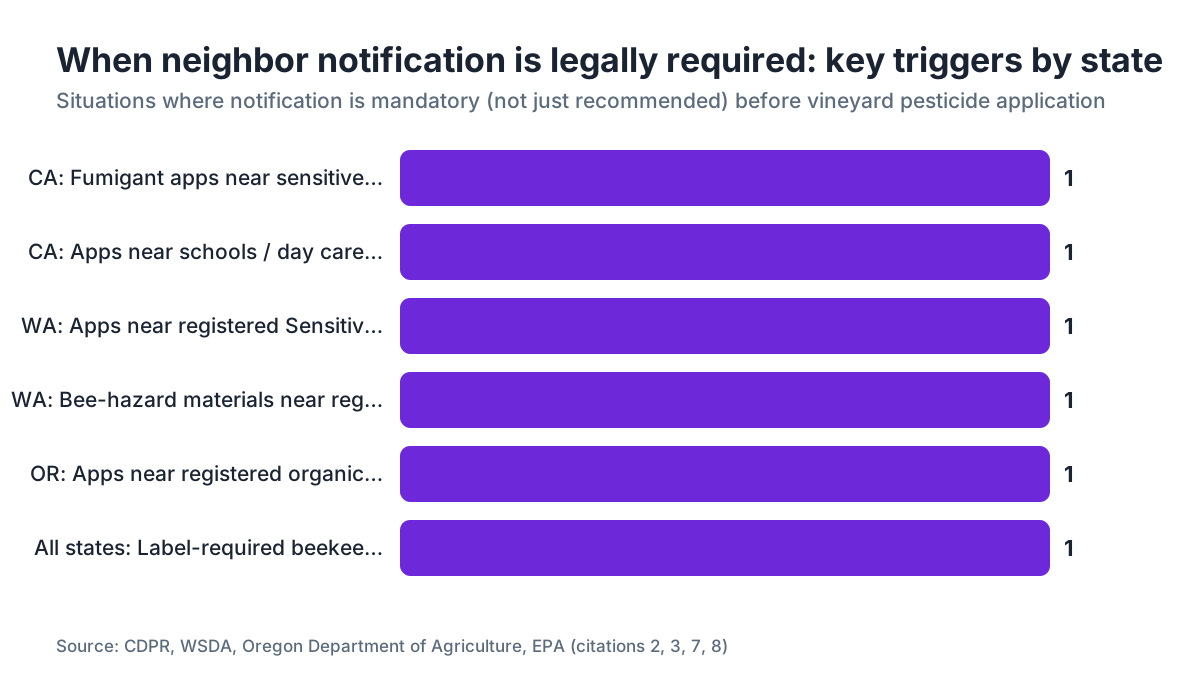
California is the strictest. Under the California Food and Agricultural Code, licensed applicators must record every application within 24 hours on a Pesticide Use Report (PUR), which becomes a public record [2]. That's a post-spray record, not advance notice, but it means the state can reconstruct exactly what you did. The California Department of Pesticide Regulation (CDPR) also runs sensitive-site provisions covering schools and day care centers.
Washington runs a Pesticide Sensitive Area registry. If a beekeeper, organic farmer, or sensitive-site operator near you has registered, you're legally required to notify them before applying certain pesticides, especially those with bee-hazard or drift-risk label language [3]. That notice has to happen a set number of hours ahead, and the Washington State Department of Agriculture (WSDA) expects you to document it.
Oregon has sensitive-site provisions under OAR 603-057, and the Oregon Department of Agriculture can demand applicator records that prove compliance [8].
Here's the part people miss. Your pesticide label is a federal legal document. If it says "notify beekeepers" or restricts application when neighbors are in adjacent areas, following that language is required under FIFRA. Section 12(a)(2)(G) of FIFRA makes it unlawful "to use any registered pesticide in a manner inconsistent with its labeling" [7]. Ignore the label and you've exposed yourself to EPA enforcement, more than civil liability.
Which pesticides trigger mandatory neighbor notification in vineyards?
Bee-hazard materials, restricted use pesticides, and fumigants are the three categories that most often carry a legal notification duty. Everything else is usually courtesy, not law. Knowing which bucket a product falls into tells you whether a phone call is optional or required.
Bee-hazard materials are the biggest group. Active ingredients like imidacloprid and certain pyrethroids carry explicit bee-hazard language. Labels often warn that the product is "highly toxic to bees exposed to direct treatment or residues on blooming crops." Spray during bloom or near registered apiaries and many states require advance notice to beekeepers. Washington's registry is the most formal version of this in the West [3].
Restricted Use Pesticides (RUPs) are the second tier. Because they require a licensed applicator and carry higher risk, some counties stack extra notification rules on top of state minimums. Napa, Sonoma, and Monterey counties each have agricultural commissioner requirements that can go beyond the state baseline.
Fumigants are their own world. Chloropicrin and metam sodium, still used in some pre-plant soil programs, carry mandatory neighbor notification in California regardless of other rules. CDPR's soil fumigant regulations set buffer distances, perimeter posting, and in some cases advance notice to adjacent occupants [9].
Organic operations face a different angle. The National Organic Program doesn't mandate neighbor notification, but many certifiers want you to document drift risk management in your organic system plan. If a conventional neighbor's spray drifts onto your certified block, your certifier wants records showing you weren't the source and that you managed the adjacency. The reverse holds too. An organic grower spraying approved materials near a conventional neighbor who later cries contamination is far better off with a paper trail than without one.
What records do you actually need to keep, and in what format?
A defensible notification record has seven pieces: date and time of contact, the person's name, their relationship to the adjacent property, the contact method, the product you named, the planned application window, and your name as notifier. That's the minimum. Anything less falls apart in an administrative hearing.
This is where most small vineyards fall short. They make a call, knock on a door, then spray. No paper, no timestamp, no witness. When a drift complaint lands six months later, that verbal conversation is worth nothing.
Start with a dated notification log. A spreadsheet or a field notebook page works. Email and text do the timestamp work for you, so save those messages in a folder organized by year and property. If you call, log it right after: "Called Maria at 4:15 pm, left voicemail." "Called but no answer, left voicemail at 4:15 pm" is better still, because it shows a reasonable effort.
For registry-based notifications in Washington, the WSDA registry provides its own confirmation. Print or screenshot it [3].
California licensed pest control advisers and operators know they have to keep records for three years. Private applicators sometimes don't realize the same expectation covers their spray records under the California Food and Agricultural Code [2]. Keep notification records with your spray records, not filed separately, so a regulator or attorney sees the whole timeline of an application in one place.
The table shows what each record type proves and how long to hold it.
| Record type | What it proves | How long to keep |
|---|---|---|
| Signed acknowledgment form | Neighbor received and understood the notice | Minimum 3 years, ideally 5 |
| Email/text chain | Date, time, and content of notice | 3 to 5 years |
| Phone log entry | Attempt was made at a specific time | 3 to 5 years |
| Registry confirmation (WA, OR) | Legal compliance with state registry rule | 3 years minimum [3] |
| Certified mail receipt | Neighbor had legal opportunity to receive notice | Until property adjacency changes |
| Voicemail log note | Good-faith effort when no answer | 3 to 5 years |
A platform like VitiScribe can attach notification logs directly to the spray event record. That keeps the link intact and makes it much easier to rebuild the timeline when a complaint arrives.
How far in advance do you need to notify neighbors before spraying?
There's no universal number, and anyone who gives you one is guessing. The window depends on your state and the product. Washington's registry generally runs 48 to 72 hours ahead. California fumigants can require 48-hour notice to adjacent occupants. For plain neighbor courtesy, 24 to 48 hours is the practical standard.
For Washington's Pesticide Sensitive Area registry, required advance notice varies by product and registration tier. WSDA guidance generally points to 48 to 72 hours for registered sensitive sites, but confirm the exact requirement for each site and product through the WSDA registry portal [3].
For California fumigant applications under CDPR rules, the window depends on the fumigant and how close sensitive receptors sit. Some require 48-hour notice to adjacent occupants. Some require posting at the field perimeter before application starts [9].
For informal notifications, the ones you make because it's the right thing to do, 24 to 48 hours gives neighbors time to close windows, move furniture, keep kids inside, or bring in beehives. Calling at 7 am to say you'll spray at 8 am isn't reasonable notice, even if it technically comes "before application."
Organic certifiers rarely set advance windows for neighbor relations. But if you're managing adjacency risk in your organic system plan, documenting when you notified and giving real lead time shows your certifier you take it seriously.
What should a notification letter or form actually say?
Keep it short and specific. Neighbors don't need a dissertation. They need enough to make decisions about their family, animals, and property: your name and contact info, the block being treated, the planned date and time window, the pesticide (trade name and active ingredient), the target pest, the application method, any label precautions for bystanders, and an invitation to call before the spray.
Don't make it legalistic. A plain-language letter does more than something that reads like a liability waiver. You want them to read it and call you if there's a problem, not feel threatened.
Here's the part that matters for your records. Get something back. A reply email, a text that says "thanks," a signed copy. Unilateral notification you can't prove was received is weaker than a short exchange showing the neighbor acknowledged it. You don't need a contract. You need evidence of two-way contact.
For organic operations or registered beekeepers, consider a one-page annual notice covering your typical spray program, with a short specific notice before each application. That cuts friction, builds the relationship, and creates a trail without a new process every time.
How do California, Washington, and Oregon differ on vineyard spray notification?
California runs the most complex system, Washington runs a formal registry, and Oregon sits in between with less structure. These three states cover most U.S. wine grape acreage, and the differences are big enough to matter if you farm across state lines.
California is the most involved. CDPR requires licensed applicators to file Pesticide Use Reports within 24 hours of each application, and those are public records [2]. Each county's agricultural commissioner can add local requirements. Sensitive-site and fumigant rules pile on more. If you're a private applicator rather than licensed, the reporting differs somewhat, but the label compliance duty under FIFRA still applies [7]. UC Davis's Statewide IPM Program publishes working-farmer guidance on the PUR system and neighbor relations [4].
Washington's defining feature is the registry. The WSDA Pesticide Sensitive Area Registry lets beekeepers, organic operators, and others register their locations and receive notice through the system [3]. If you're a licensed applicator and a registered site sits near your vineyard, you're legally required to use the registry's notification system before applying designated materials. WSU Extension publishes guidance on how applicators interact with the registry [5].
Oregon lands in the middle. The Oregon Department of Agriculture has sensitive-site provisions and organic farm notification requirements under OAR 603-057, but the system is less formal than Washington's [8]. Oregon applicators should check ODA's current rules and call their county agent for local reading.
If you farm in more than one state, apply the strictest documentation standard everywhere. That's not gold-plating. That's not running two different systems.
What happens if a neighbor complains about pesticide drift with no documentation?
A drift complaint can trigger a call from the county agricultural commissioner, a state pesticide investigation, a civil lawsuit, or a complaint to your certifier if you're organic. In every one of those, the first thing investigators ask for is your application records and any notification documentation. This is exactly what your records are built for.
With no records, you're working from memory against a motivated complainant. With records, you have a timeline. You can show when you sprayed, what you applied, the wind conditions from your weather log or a nearby station, and that you notified the neighbor ahead of time. That's a defensible position.
CDPR can require production of all pesticide use records during an investigation. California law sets a three-year retention minimum for licensed applicators [2]. But a minimum isn't a target. If a civil suit gets filed two years after an application, you want those records still on hand and detailed enough to matter.
USDA publishes no specific data on how often drift complaints end in penalties, but state agricultural commissioner annual reports often carry complaint and enforcement counts. CDPR posts its enforcement actions, and drift cases show up in them regularly.
The uncomfortable truth: even if you did nothing wrong, thin documentation leaves you unable to prove it. Good records also signal to neighbors and regulators that you run a professional operation, which changes how a complaint gets received before an investigator ever opens a file.
Does the EPA Worker Protection Standard require neighbor notification?
No. The WPS covers agricultural workers and pesticide handlers on your own establishment, not adjacent property owners or off-farm residents. Neighbor notification comes from pesticide labels, state regulations, and local ordinance. The WPS is the wrong instrument to look to for any off-farm duty.
The revised Worker Protection Standard, effective January 2017, requires agricultural employers to post application-specific information in a central location for workers and handlers: the pesticide used, the dates and times, and the restricted-entry interval [1]. It also requires advance notice to workers when applications happen in areas where they work. None of that reaches off-farm residents.
The standard is scoped to workers and handlers on the agricultural establishment. Bystander and neighbor protection runs through pesticide labeling, state law, and local ordinance instead [11].
One wrinkle. If your workers live in housing on your property, the WPS Application Exclusion Zone provisions can affect when and how you spray near that housing [1]. If your property line sits close to off-farm dwellings, that could touch neighboring residential areas indirectly. Know what the WPS covers for your crew, then look to your state's rules and the product label for anything off-farm.
How should notification records be organized and stored for a compliance audit?
Organize records by application event, not by neighbor. When you spray Block 4 on July 14, every document tied to that day (spray ticket, weather log, calibration note, and neighbor notification records) belongs in one place, physical or digital. That lets you rebuild the full picture of the day without hunting across filing systems.
The two failure modes are records that exist but can't be found, and records that never existed. The first is almost as bad as the second when an inspector is sitting across the table.
For digital storage, use a folder structure like Year / Application Date / Block. Name files so they read themselves: "2025-07-14_Block4_Neighbor-Smith-notification-email.pdf" beats "scan0047.pdf" every time.
Keep backups. A single hard drive is not a filing system. Cloud storage with a reputable provider, or a compliance platform built for farm records, is worth the small cost.
Operations on VitiScribe store spray events and attached notification documents in a timeline-based record that ties application data, regulatory requirements, and communication logs together, which shortens audit prep.
Paper works, but scan every paper record within a week of creating it. Paper fades, floods, and burns. Your notification records from five years back need to be legible when a complaint surfaces in year three.
One practical move for small vineyards: name one person as the notification records owner. Not "whoever does it." One named person who makes contact, logs it, and files it the same day. Compliance tasks owned by everyone get done by no one.
Are there any good template resources for neighbor notification letters?
Several extension programs publish templates or guidance you can adapt for free. UC Davis, WSU Extension, and Cornell all cover neighbor notification for working farmers rather than lawyers. Your organic certifier likely has a required checklist too.
UC Davis's Statewide IPM Program publishes neighbor notification guidance as part of its pesticide use documentation resources [4]. Practical, California-specific, written for people who actually spray.
WSU Extension has resources for applicators working through Washington's sensitive-site and registry notification requirements [5]. Cornell Cooperative Extension covers notification for northeastern vineyards and is useful for New York state requirements [6].
For organic operations, your certifier probably has a preferred format or a required checklist. OMRI and CCOF both publish compliance resources touching buffer zone and neighbor notification documentation in organic contexts.
Building your own template? The essential fields are your name and contact info, the property being treated, the application date and time window, the pesticide trade name and active ingredient, the application method, any label-required bystander precautions, and a line for the neighbor to sign and return if you want an acknowledgment. One page. Nobody reads two.
State agricultural commissioner offices sometimes publish their own templates, especially for fumigant notifications, which run more formal. If your county ag commissioner doesn't have one online, call them. They'd rather help you get it right than open a complaint investigation later.
What's a realistic system for small vineyard operations without dedicated compliance staff?
If you're running 20 to 100 acres with a seasonal crew and no compliance manager, you need a system simple enough that it actually gets used. It comes down to three things: a contact list per boundary, a pre-spray check against that list, and a same-day log. Total monthly cost during the season: under an hour.
Start with a one-page neighbor contact list for each property boundary. Name, phone, email, the nature of their adjacent use (residential, beekeeper, organic farm, school), and any sensitivities they've mentioned. Update it once a year. Two hours to build the first time, twenty minutes to maintain.
Before each spray, run the list and ask three questions. Does this application require notification by law? Does this neighbor have a standing request to be notified? Is there any reason, even plain courtesy, to give a heads up? Make the calls or send the messages 24 to 48 hours out. Log it right away.
Run three spray events a month in season and that's maybe 45 minutes of notification work per month. Real, but small.
Handle more complex situations (fumigant programs, properties next to sensitive sites, several registered neighbors in a state registry) and the workload scales up enough that a structured digital system starts paying for itself in time saved and errors avoided.
The hard part isn't doing it. It's doing it consistently when you're busy, tired, and the forecast window just opened and you need to spray tomorrow. Build the notification step into spray planning, not as an afterthought. The notice goes out before you schedule the crew, not the night before.
Frequently asked questions
Do I have to notify neighbors before every pesticide application in my vineyard?
Not universally. Federal law doesn't require it. State law may, depending on your state, the pesticide, and whether adjacent landowners are registered in a formal notification program. California, Washington, and Oregon have specific situations that trigger mandatory notice. For any application near sensitive sites, registered beekeepers, or organic operations, check your state's pesticide regulations and the product label. When in doubt, notify and document it.
What is Washington's Pesticide Sensitive Area registry and how does it affect vineyard spraying?
The WSDA Pesticide Sensitive Area Registry lets beekeepers, organic farmers, and sensitive-site operators register their locations. Licensed applicators in Washington must notify registered sites before applying designated materials, generally 48 to 72 hours ahead. If a registered site sits near your vineyard, you're legally required to use the registry's notification system. Non-compliance can lead to license action. Check the WSDA website for the current list of covered pesticides and notification windows.
How long do I need to keep neighbor notification records?
California requires licensed applicators to keep pesticide use records for three years under the Food and Agricultural Code. Washington and Oregon set similar minimums. For civil liability protection, five years is the more conservative practical standard. Keep notification records attached to the spray event records they belong to, not in a separate system, so the full application timeline is reconstructable if a complaint or lawsuit arrives years later.
Does the EPA Worker Protection Standard require me to notify my neighbors before spraying?
No. The EPA's Worker Protection Standard governs notifications to agricultural workers and pesticide handlers on your own operation. It does not cover adjacent property owners, off-farm residents, or neighboring landowners. Neighbor notification obligations come from pesticide labels, state pesticide regulations, and local ordinances. The WPS is the wrong framework for off-farm notification requirements.
What should a neighbor notification form include for vineyard pesticide applications?
At minimum: your name and contact information, the vineyard block or property being treated, the planned application date and time window, the pesticide trade name and active ingredient, the application method (airblast, hand, drone), any label-required bystander precautions, and an invitation to contact you before the spray. Keep it to one page. For formal situations like fumigants, use your state ag commissioner's required format.
Can a verbal notification to a neighbor count as documentation?
A verbal notification you fail to write down the same day is almost worthless in a hearing or lawsuit. If you spoke with a neighbor in person or by phone, log it immediately: date, time, who you spoke with, what you told them, their response. A contemporaneous written log of a verbal contact is legitimate documentation. A memory of a conversation from six months ago is not.
What happens if a neighbor files a pesticide drift complaint against my vineyard?
The county agricultural commissioner or state pesticide agency will likely request your application records, including spray tickets, weather logs, and any notification documentation. If your records show the application date, product, conditions, and pre-spray neighbor notification, you're in a defensible position. Without records, you're working from memory against a motivated complainant. State ag commissioner offices publish enforcement data showing drift complaints get taken seriously.
Are there special notification rules for fumigant applications near vineyard neighbors?
Yes. Fumigants are among the most tightly regulated pesticide categories for neighbor notification. California's CDPR soil fumigant regulations specify buffer distances, perimeter posting, and in some cases advance notice to adjacent occupants for chloropicrin and metam sodium. These rules go beyond general courtesy and carry real enforcement consequences. Check with your county agricultural commissioner for the specific requirements that apply to your fumigant program.
Do I need to notify neighbors differently if my vineyard is certified organic?
Your certifier may require documentation of drift risk management in your organic system plan. The NOP doesn't mandate neighbor notification, but showing that you've communicated with adjacent conventional operations about your organic status protects you if their drift threatens your certification. If you're a conventional grower next to organic vineyards, some certifiers require the organic operator to have notified you of their status and buffer needs.
Is there a federal notification requirement for pesticide applications near schools or sensitive sites?
There's no single federal law requiring vineyard operators to notify schools before every application. California's CDPR has sensitive-site provisions that restrict pesticide use near schools and day care centers, with notification and buffer requirements that can apply to adjacent agricultural operations. Check your state's agricultural department and the specific product label for sensitive-site language. Many labels carry explicit instructions about application near occupied structures.
How do I handle neighbor notification when spraying is weather-dependent and plans change last-minute?
This is the hardest practical challenge. Notify neighbors of a spray window rather than a fixed time: "We plan to spray Thursday or Friday morning if winds are under 8 mph." That gives advance notice without locking you into a schedule you can't keep. Log the window you communicated. If the application shifts outside it, make a second quick contact and log that too. Documenting good-faith communication matters more than hitting an exact timeline.
What records should I keep about weather conditions at the time of spraying to protect against drift claims?
Keep a weather log for every application: wind speed and direction, temperature, relative humidity, and time of day. With an on-site weather station, log directly from it and note the station's location relative to the treated block. Using a nearby airport or NOAA station, note which one and save the data. Many states accept third-party weather records in a drift defense. Combined with your notification records, this creates a complete picture of the application event.
Can I use text messages or emails as neighbor notification documentation?
Yes, and they often beat paper because the timestamp is automatic and the content is preserved exactly. Save notification emails and texts in a dedicated folder organized by year and application event. Screenshot text conversations and save them as PDFs if your phone backup isn't reliable. An email thread where the neighbor replies, even just to say thanks, is strong documentation because it proves receipt, more than sending.
Sources
- U.S. EPA, Agricultural Worker Protection Standard: The EPA's revised Worker Protection Standard governs notification to agricultural workers and handlers on the agricultural establishment and does not cover neighboring landowners or off-farm residents.
- California Department of Pesticide Regulation: California requires licensed applicators to file Pesticide Use Reports within 24 hours of each application and to maintain records for three years under the California Food and Agricultural Code.
- Washington State Department of Agriculture: Washington's Pesticide Sensitive Area Registry requires licensed applicators to notify registered sites including beekeepers and organic farmers before applying designated pesticides, generally 48 to 72 hours in advance.
- UC Statewide Integrated Pest Management Program (UC ANR): UC IPM publishes practical guidance on California pesticide use documentation, neighbor notification, and Pesticide Use Report requirements for agricultural operators.
- Washington State University Extension: WSU Extension provides guidance for licensed applicators on Washington's sensitive-site notification requirements and registry-based notification procedures.
- Cornell Cooperative Extension: Cornell Cooperative Extension covers neighbor notification and pesticide documentation requirements for northeastern vineyard operations including New York state requirements.
- U.S. EPA, Federal Insecticide, Fungicide, and Rodenticide Act (FIFRA): FIFRA Section 12(a)(2)(G) makes it unlawful to use any registered pesticide in a manner inconsistent with its labeling, making label-required neighbor and beekeeper notifications legally mandatory.
- Oregon Department of Agriculture, Pesticides Program: Oregon's pesticide rules under OAR 603-057 include sensitive-site provisions and organic farm notification requirements for pesticide applicators.
- California Department of Pesticide Regulation, soil fumigant regulations: California's CDPR regulations for soil fumigants specify buffer distances, perimeter posting requirements, and in some cases advance notification to adjacent occupants before application.
- U.S. EPA, Pesticide Labeling: The EPA states that pesticide labels are legal documents and applicators must follow all label directions including any neighbor, beekeeper, or sensitive-site notification requirements.
- National Pesticide Information Center (Oregon State University): Guidance clarifies that bystander and neighbor protection is governed by pesticide labeling, state law, and local ordinance rather than the Worker Protection Standard.
Last updated 2026-07-09