Flame weeder use records in certified organic vineyard operations

TL;DR
- Certified organic vineyards don't need to track flame weeders as a pesticide application, but certifiers still expect written records of each use, the equipment, the treated areas, and the date.
- USDA NOP rules require an Organic System Plan that accounts for all weed management tools, and auditors read your flame weeding logs to confirm you did what the plan says.
Do organic certifiers actually require flame weeder records?
Yes, but not for the reason most growers assume. Flame weeding uses no synthetic chemical, so it doesn't trigger pesticide application records under USDA National Organic Program rules. What it does trigger is the recordkeeping requirement tied to your Organic System Plan.
The NOP regulation at 7 CFR § 205.103 requires that certified operators "maintain records sufficient to demonstrate compliance with the Act and regulations in this part." [1] That language is broad on purpose. Your certifier reads it this way: if your OSP says you use thermal weeding in row middles, you need documentation showing you actually did it, when, and where.
Most accredited certifiers request flame weeder logs during the annual inspection because the logs help them verify three things. That you're not skipping the practice and substituting something not listed in your plan. That you're not accidentally treating areas covered by a different protocol. That your labor and fuel records match the frequency you've claimed.
Here's the honest version. You won't lose certification over a missing flame weeding log the way you would over a missing pesticide record. But a pattern of undocumented field operations is exactly the kind of gap that triggers a corrective action notice or, in repeat cases, a suspension review.
What does the NOP actually require you to document for non-chemical weed control?
The NOP recordkeeping rule (7 CFR § 205.103) covers every activity described in your Organic System Plan, not only inputs. [1] For weed management, the upstream requirement is 7 CFR § 205.205, which says producers must "use tillage and cultivation practices that maintain or improve the physical, chemical, and biological condition of the soil and minimize soil erosion." [2] Flame weeding sits in that bucket as a physical/thermal practice similar to mechanical tillage.
What this means for your logbook: you need enough information to reconstruct what happened in each block on each date. The USDA guidance document "Organic System Plans: Livestock and Crops" (NOP 5020) lists recordkeeping as a core verification tool and names field activity logs among the records an inspector may request. [3]
Most certifiers converge on a minimum field set that looks like this:
| Field | Why it matters |
|---|---|
| Date of operation | Ties the activity to your seasonal plan |
| Block or row ID | Confirms treated area matches your OSP map |
| Equipment used | Identifies the tool listed in your OSP |
| Operator name | Links to worker training records |
| Weather/wind at time of use | Safety and efficacy context |
| Fuel type and tank fill quantity | Cross-check against fuel invoices |
| Observations (escaping flame, missed rows) | Documents good-faith management |
You don't need all seven fields in every certifier's program. Oregon Tilth, for instance, asks for date, field ID, activity, and operator. CCOF's field activity log template adds fuel quantity. Check your certifier's specific forms before you design your own.
How is a flame weeder log different from a pesticide application record?
This distinction matters because growers sometimes apply pesticide record logic to flame weeder logs and either over-document or lose track of what's actually required.
A pesticide application record under the EPA Worker Protection Standard (40 CFR Part 170) must include the product name, EPA registration number, active ingredient, restricted-entry interval, and the handler who made the application. [4] Flame weeders use none of that. No EPA registration number, no REI, no handler certification required by WPS.
Under California's pesticide use reporting system (administered by CDFA under Food and Agriculture Code §§ 11901-11932), growers must report pesticide applications to the county agricultural commissioner. [5] Propane or natural gas burned in a flame weeder is not a pesticide under that definition, so no county PAR report is triggered.
What you're left with is the organic certifier's own program requirements, which come from the NOP OSP documentation rules. Those rules care about field activities, not chemical inputs. So your flame weeder log looks more like a tractor cultivation record than a spray record: date, location, equipment, operator, and any observations worth noting.
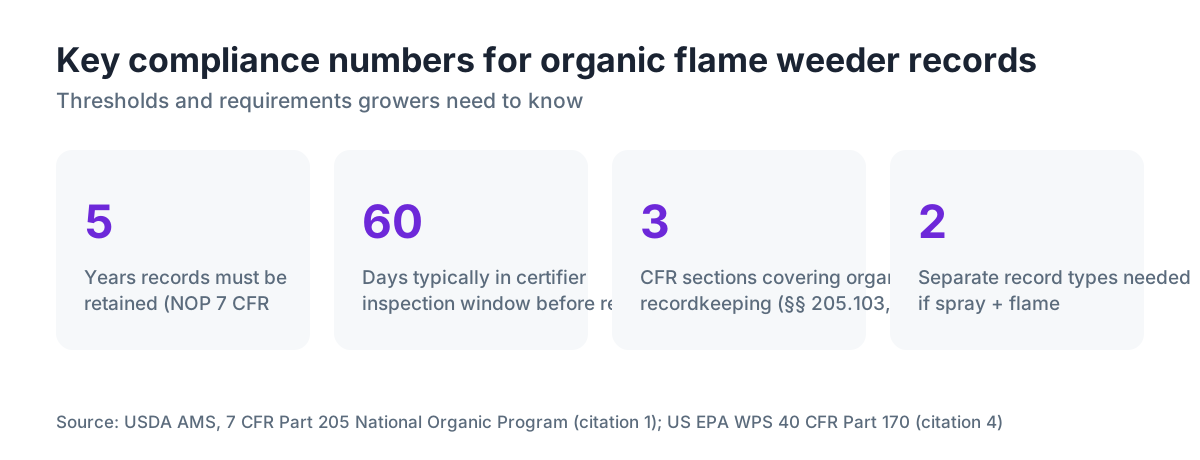
One thing does bridge both worlds. If you also spray an allowed material (say, an acetic acid herbicide) in the same block on the same day, you need two separate records. The spray gets a pesticide application log. The flame pass gets a field activity log. Combining them into one entry is the kind of sloppiness that confuses inspectors.
What format do flame weeder logs need to be in?
The NOP does not mandate paper. 7 CFR § 205.103(b) says records must be "adapted to the operation" and retained for at least five years. [1] Digital logs, spreadsheets, farm management software outputs, and legible handwritten field notebooks all satisfy the rule as long as they're available for inspection.
Still, two practical issues push most small vineyards toward a consistent template. Your certifier will ask for records during the inspection window, usually 30 to 90 days before your certificate renewal. If your logs live in seven different formats across three people's phones, pulling them together becomes a real project. And inconsistency across years is a red flag. An inspector who sees a detailed 2022 log and a nearly blank 2023 log for the same block will ask questions.
Keep it simple. A dedicated paper field log stored in the farm office works fine for most operations under about 50 acres. One page per week, rows for each block, columns for activity type, operator, and fuel quantity. Sign and date each sheet at the end of the week.
For larger operations, or anyone who already tracks spray records digitally, add flame weeder entries to whatever system you're already using. Tools like VitiScribe let you log mechanical and thermal field activities next to your spray records so everything lives in one place for audits.
One format note. If you export records for your certifier, include column headers in plain English. Inspectors who review dozens of operations per season don't have time to decode abbreviations they've never seen.
How long do you need to keep flame weeder records for organic certification?
Five years minimum. That's the NOP rule at 7 CFR § 205.103(b)(2). [1] Your certifier may require longer retention, so check your certification agreement.
The five-year window matches the three-year transition period plus a buffer. If a question ever comes up about whether you were truly organic during a transition year, auditors want records that reach back far enough to verify the full timeline.
Store paper records somewhere dry and accessible. Water-damaged records have come up in certification disputes, and "the barn flooded" is not a defense certifiers accept well. Digital backups, even a periodic phone photo of each log sheet, add real protection for almost no effort.
Does propane use in a flame weeder require any safety documentation?
Yes, and this obligation has nothing to do with organic certification, though vineyard managers often lump it in with their compliance records.
OSHA's Hazard Communication Standard (29 CFR § 1910.1200) requires that Safety Data Sheets for all hazardous chemicals used in the workplace be accessible to workers. [6] Propane (UN 1978) has an SDS, and if you're refilling tanks in the field, that SDS needs to be available. Not an organic program requirement, but keeping the SDS in your compliance binder next to your flame weeder logs is just sound practice.
For California vineyards, Cal/OSHA's General Industry Safety Orders also apply to compressed gas handling. Tank storage, regulator maintenance, and no-smoking zones around refueling areas all carry specific requirements under Title 8 CCR § 4650. [7]
The EPA Worker Protection Standard does cover most vineyard workers during field activities broadly. [4] If workers re-enter a block within 30 minutes of a flame weeding pass (a realistic scenario in narrow-row vineyards), document that timing. It's not an REI in the pesticide sense, but showing you thought about worker safety during thermal operations matches the record of responsible management certifiers like to see.
WSU Extension's organic farming resources and UC Davis viticulture publications both touch on equipment safety for thermal weed control, though neither has a dedicated SDS checklist for vineyard flame weeders. eOrganic includes general thermal weed control guidance worth reviewing before your first season. [8]
What does an Organic System Plan entry for flame weeding look like?
Your OSP is the document you file with your certifier each year describing how you manage every part of your operation. For weed management, you list every tool and practice you use: mechanical cultivation, hand hoeing, cover crops, thermal weeding.
A bare-minimum flame weeder entry in the weed management section might read like this:
"Row middles and under-vine areas in Blocks 3-7 are treated with a propane flame weeder (make/model) 2-4 times per season, primarily from bud break through early summer. Applications target annual broadleaf weeds before they reach 2 inches in height. No synthetic inputs are used in these areas."
That entry does three things: names the tool, describes the target and timing, and confirms no prohibited materials. When your inspector pulls your field activity logs, she's checking whether what you actually did matches what you wrote in the OSP.
Add a new piece of equipment mid-season, like switching from a single-row to a multi-row unit, and update your OSP before you use it. Running equipment not described in your current OSP is a common minor violation. It's easy to fix and easier to avoid.
UC Davis's Agricultural Sustainability Institute has published guidance on organic transition planning that covers OSP structure in useful detail, even though it doesn't focus only on vineyards. [9]
Can flame weeder records be shared with other agencies or used in other compliance contexts?
Occasionally, yes. Three situations come up in practice.
First, if you're applying for USDA EQIP payments or NRCS conservation support that includes organic transition assistance, your certifier records including field activity logs can serve as supporting documentation for the application and for payment verification. The NRCS EQIP Organic Initiative has used certifier-verified records as the primary proof of practice adoption. [10]
Second, if you sell grapes to a winery that requires third-party sustainability certification (SCS Global's Certified Sustainable Winegrowing, Lodi Rules, CSWA Certified Sustainable, and others), those programs often ask for weed management records as part of their audit. Your flame weeder logs count toward the weed management indicator in most of those systems.
Third, in California, the Healthy Soils Initiative and related CDFA programs have used farm activity records to verify cover cropping and reduced-tillage claims. Flame weeding is a lower-tillage alternative to discing, and if you're making that argument in a grant application, your logs are your evidence.
None of these secondary uses require a special format. The same field activity log that satisfies your certifier satisfies the other programs. Keep a clean digital copy and you're covered.
What mistakes do organic vineyards most often make with flame weeder documentation?
Four patterns show up again and again in certifier feedback.
The first is logging the equipment purchase but not the use. A grower buys a flame weeder, mentions it in the OSP, then has no field records showing it ran. Inspectors notice when capital equipment appears in equipment lists but never in activity logs.
The second is inconsistent block identification. If your OSP map labels your blocks A, B, and C, but your field crew writes "north side," "main road block," and "the rocky one" in the logs, an inspector has to take your word for which is which. Use the same identifiers everywhere.
The third is skipping records during busy periods. Flame weeding frequency usually peaks around bud break and again before harvest when cover crops need knocking back. Those are also the busiest weeks in the vineyard. Record gaps that line up perfectly with busy periods read as missing records, not missing flame passes.
The fourth is treating the flame weeder log as separate from everything else. Your certifier is looking at the whole picture: spray records, cultivation records, fuel invoices, labor hours. A flame weeder log that shows 40 passes in a season against fuel invoices that account for only 15 tanks of propane will prompt questions. Keep your records internally consistent and cross-referenced.
The most useful thing VitiScribe-style software does here is connect field logs to equipment and input records automatically, so those cross-referencing gaps don't happen silently.
How does flame weeder documentation interact with buffer zone and neighbor notification rules?
A less common issue, but real for vineyards with close neighbors or land near sensitive areas.
Flame weeders produce open flame and can throw smoke particulate. In counties with air quality restrictions, burning during certain wind conditions or on high-AQI days may be prohibited or require notification. California's Air Resources Board and local air districts run burn day systems that apply to agricultural burning broadly, and some districts have read propane flame weeding as agricultural combustion subject to those rules. Check with your county air quality management district before assuming propane flame weeding is unrestricted. [11]
Organic buffer zone requirements under the NOP (7 CFR § 205.202) address the risk of prohibited substance contact from neighboring operations, not the reverse. But if your flame weeder burns vegetation on a neighbor's property line or causes smoke drift during an air quality event, the record of the incident (and your corrective response) belongs in your farm records.
For vineyards near wildlife corridors or waterways, check whether local fire regulations require permits for open-flame equipment during dry season. Several California counties require a burn permit for propane equipment operated within 100 feet of brush. Your permit is part of your compliance record even though it has nothing to do with organic certification.
What should a complete flame weeder field log entry look like?
Here's a realistic example of a single log entry, written out the way you'd actually fill it in:
Date: June 4, 2025
Block: Block 5 (Zinfandel, 4.2 acres)
Equipment: Flame Engineering VT-4-N, tractor-mounted, 4 burners
Operator: Maria S.
Start/end time: 7:10 AM to 9:45 AM
Fuel: Propane, 1/2 tank used (est. 5 gallons)
Target: Annual grasses and broadleaf weeds under-vine, 2-3 inch height
Wind: Calm, less than 5 mph
Notes: Missed 3 rows at north end due to irrigation riser; will complete next pass
That entry takes two minutes to write and answers every question an inspector is likely to ask. The missed-rows note matters because it shows good faith, not a failure to follow your plan.
Some growers add a "re-entry" field noting when workers next entered the block. Not required for organic purposes, but it matches WPS documentation habits and adds useful context if a safety question ever comes up.
Store the log for each season in a single binder or folder, labeled by year and block. At annual inspection time, you hand it over without searching.
Frequently asked questions
Is a flame weeder considered a pesticide under USDA organic regulations?
No. A flame weeder is a physical/thermal tool, not a pesticide. It carries no EPA registration number and doesn't trigger NOP pesticide recordkeeping rules. You still need to document its use as a field activity in your Organic System Plan records, but the format and retention rules are less prescriptive than those for allowed pesticide applications.
Does the EPA Worker Protection Standard apply to flame weeder operations?
The WPS (40 CFR Part 170) applies to pesticide applications. Flame weeding is not a pesticide application, so the WPS-specific REI, handler certification, and application record requirements don't apply. General OSHA worker safety rules still cover flame weeder use, including compressed gas handling, fire safety, and heat hazard communication. An SDS for propane should be accessible to all workers.
How many times per season should an organic vineyard use a flame weeder?
There's no regulatory minimum or maximum. Most organic vineyards in Mediterranean climates make two to five passes per season: typically one around bud break, one or two during the rapid spring growth flush, and sometimes one before harvest to manage cover crop regrowth. What matters for certification is that your frequency matches what your OSP describes and that every pass is logged.
Can I use a digital app to keep flame weeder records for organic certification?
Yes. The NOP (7 CFR § 205.103) doesn't require paper records, only that records be adapted to your operation and retained for five years. Any digital format, spreadsheet, farm management app, or PDF export satisfies the rule as long as you can produce the records during an inspection. Consistent formatting across years matters more than the specific tool you use.
Do I need to report flame weeder use to the county agricultural commissioner?
In California, county pesticide use reporting applies only to pesticide applications under Food and Agriculture Code §§ 11901-11932. Propane burned in a flame weeder is not a pesticide, so no PAR report is required. Other states have similar pesticide reporting rules that also exclude thermal equipment. Check your state's department of agriculture if you're outside California.
What happens if my flame weeder logs are incomplete during an organic inspection?
Incomplete logs usually result in a corrective action request, not immediate decertification. Your certifier documents the gap and asks how you'll fix your recordkeeping going forward. Repeated incomplete records across multiple inspection cycles are more serious and can escalate to a Notice of Noncompliance under 7 CFR § 205.662. First-time gaps with a clear correction plan are usually resolved without penalty.
Do flame weeder records count toward USDA EQIP or NRCS conservation program documentation?
They can. NRCS EQIP's Organic Initiative uses certifier-verified records as primary evidence of practice adoption, and field activity logs including flame weeder records support payment verification. If you're also claiming reduced-tillage or low-disturbance weed management in a conservation program application, your flame weeder logs are direct evidence of the practice.
Does switching from a single-row to a multi-row flame weeder require updating my Organic System Plan?
Yes. Any equipment not described in your current OSP should be added before you use it. Running equipment that isn't in your filed OSP is a common minor violation during inspections. The fix is straightforward: submit an OSP amendment to your certifier with the new equipment's make and model, and note the date of first use. Don't wait until annual renewal.
Are there air quality or burn permit requirements for propane flame weeders?
Possibly, depending on your location. California counties with air quality management districts may classify propane flame weeding as agricultural combustion subject to burn day restrictions. Some counties require a burn permit for open-flame equipment operated within 100 feet of brush. Check with your county air quality management district and local fire department before your first use each season.
What's the difference between a flame weeder record and a tillage or cultivation record for organic purposes?
Functionally they're the same type of document: a field activity log. Neither needs the EPA registration number or REI fields that pesticide records do. Both live in your general farm records under the NOP's 7 CFR § 205.103 documentation requirement. Some certifiers use a combined mechanical/thermal operations log; others keep cultivation and thermal records on separate sheets. Either works.
Does wind speed need to be recorded when using a flame weeder in an organic vineyard?
Your certifier's forms don't always require it, but recording wind speed and direction is a good practice. Wind affects flame direction and can ignite dry vegetation or push combustion products toward neighboring blocks. It also helps document why a pass was abbreviated or postponed. If your OSP includes a weather-conditions operating protocol, log the conditions that confirm you followed it.
How should I document a flame weeder pass that I had to abort mid-block?
Log it honestly: note the start time, the rows completed, the reason you stopped (equipment issue, wind shift, worker availability), and whether you returned to finish. Partial-pass records with clear notes are not a problem in inspections. What inspectors flag is a pattern of entries that look too perfect, every pass listed as complete on the planned date, which can signal that logs were reconstructed rather than recorded in real time.
What training do operators need before using a flame weeder in an organic vineyard?
The NOP doesn't specify training requirements for thermal equipment operators. OSHA's general duty clause and compressed gas handling standards apply. Practically, operators should be trained on propane tank connections, burner ignition and shutdown, fire extinguisher use, and the vineyard's specific no-flame zones (near irrigation lines, wooden trellis components, or dry mulch). Document that training in your personnel records alongside your field activity logs.
Sources
- USDA Agricultural Marketing Service, 7 CFR Part 205 National Organic Program: 7 CFR § 205.103 requires certified operators to maintain records for at least 5 years sufficient to demonstrate compliance, adapted to the operation
- USDA AMS, 7 CFR § 205.205 Crop Rotation Practice Standard: 7 CFR § 205.205 requires tillage and cultivation practices that maintain soil condition and minimize erosion, under which thermal weeding is classified
- USDA NOP, Guidance NOP 5020: Organic System Plans: NOP 5020 identifies field activity logs as records inspectors may request to verify OSP compliance
- US EPA, Worker Protection Standard 40 CFR Part 170: 40 CFR Part 170 requires pesticide application records to include product name, EPA registration number, active ingredient, REI, and handler identity; flame weeding is not a pesticide application
- California Department of Food and Agriculture, Pesticide Use Reporting Program: California Food and Agriculture Code §§ 11901-11932 require reporting of pesticide applications to county agricultural commissioners; propane burned in a flame weeder is not a reportable pesticide
- US Occupational Safety and Health Administration, Hazard Communication Standard 29 CFR § 1910.1200: 29 CFR § 1910.1200 requires Safety Data Sheets for all hazardous workplace chemicals including propane to be accessible to workers
- California Department of Industrial Relations, Cal/OSHA General Industry Safety Orders, Title 8 CCR: Cal/OSHA General Industry Safety Orders under Title 8 CCR regulate compressed gas handling, including tank storage and refueling zones
- eOrganic (Cornell University / Land-grant consortium), Thermal Weed Control in Organic Systems: eOrganic provides peer-reviewed guidance on thermal weed control practices applicable to organic vineyards
- UC Davis Agricultural Sustainability Institute, Organic Transition Resources: UC Davis ASI publishes OSP planning guidance covering weed management documentation requirements for organic transition
- California Air Resources Board, Agricultural Burning Regulations: CARB and county air quality districts regulate agricultural combustion including open-flame equipment; some districts apply burn day restrictions to propane flame weeders
- Washington State University Extension, Organic Farming Systems: WSU Extension organic farming resources address equipment use documentation and field record expectations for certified organic operations in the Pacific Northwest
Last updated 2026-07-09