Glyphosate application records under weed resistance management guidelines

TL;DR
- Federal WPS rules require pesticide application records for at least two years.
- Weed resistance management guidelines from HRAC, EPA, and state extension programs add a practical layer: track the mode-of-action group (Group 9 for glyphosate), site history, and rotation schedule.
- Those records do double duty.
- They're your legal shield and your resistance early-warning system.
What records does federal law actually require for glyphosate applications?
The EPA Worker Protection Standard (WPS), codified at 40 CFR Part 170, requires agricultural employers to keep a central display record for every pesticide applied. That means product name, EPA registration number, active ingredient, application rate, location, date, time, and the restricted-entry interval (REI). Those records have to stay accessible for at least two years from the date of application. [1]
Glyphosate products sold for farm use carry EPA registration numbers, so they fall squarely under this rule. There's no exemption for low-toxicity herbicides. The REI for most glyphosate formulations is four hours, and that number belongs in your record alongside the applicator's name and certification number if a restricted-use product is in the tank. Standard glyphosate is a general-use pesticide, but some tank-mix partners are restricted-use, and that changes your paperwork.
Some states pile requirements on top of the federal floor. California requires pesticide use reports filed with the county agricultural commissioner within seven days of application, under the Department of Pesticide Regulation's system. [2] Washington makes licensed commercial applicators hold records for two years and demands immediate notification for certain fumigants and restricted-use materials. Figure out which standard is higher in your state. That's the one that governs you.
Here's the short version. If you're running a vineyard and spraying glyphosate under the vine row, you need a finished record before the next application happens, not a scramble at the end of the season.
What is HRAC Group 9 and why does it appear on your record forms?
The Herbicide Resistance Action Committee (HRAC) sorts herbicides by mode of action. Glyphosate is Group 9. It blocks the enzyme EPSPS (5-enolpyruvylshikimate-3-phosphate synthase) in the shikimate pathway, and no other herbicide in commercial use shares that exact mechanism. [3]
That matters for record-keeping because every resistance management framework, whether from HRAC, the Weed Science Society of America (which uses the same number), or a university extension program, asks you to log the mode-of-action group on each spray record. The logic is simple. Resistance is site-specific, and selection pressure adds up. Spray only Group 9 on a block for eight straight seasons and you're selecting hard for any weed already carrying a partial resistance trait. Your records are how you prove to yourself, and to a certifier, that you rotated.
WSU Extension's integrated weed management guidance recommends logging herbicide group numbers on every application record and checking them once a year so no single group runs more than about half of your total herbicide applications in any three-year window. [4] UC Cooperative Extension makes a similar call in its undervine weed management materials for wine grapes. [5]
In practice this is one extra column on whatever form you already use. Call it "HRAC Group." For glyphosate it's always 9. For a glufosinate follow-up it's Group 10. Tracked across seasons, that single column is your resistance rotation audit.
What does a complete glyphosate spray record look like for resistance management purposes?
A minimum-compliant WPS record and a resistance-management record are not the same document. Here's where they overlap and where you need to add fields.
| Field | WPS Required? | Resistance Mgmt Recommended? |
|---|---|---|
| Product name and EPA reg. no. | Yes | Yes |
| Active ingredient (glyphosate) | Yes | Yes |
| HRAC / WSSA mode-of-action group | No | Yes |
| Application rate (oz or lb a.i./acre) | Yes | Yes |
| Location / block ID | Yes | Yes |
| Date and time | Yes | Yes |
| Applicator name and cert. no. | Yes (RUP only) | Yes (all) |
| REI | Yes (display) | Yes |
| Weed species targeted | No | Yes |
| Weed pressure rating (light/moderate/heavy) | No | Yes |
| Growth stage of target weed | No | Yes |
| Tank-mix partners and their HRAC groups | Partial | Yes |
| Previous herbicide use on this block (3-yr history) | No | Yes |
| Observed efficacy at 14-21 days post-application | No | Yes |
| Suspected resistance notes | No | Yes |
The efficacy follow-up row is the one most vineyard managers skip. It takes five minutes to walk the block three weeks after spraying and score whether the target weeds are dead, stressed, or thriving. If survivors show up at a higher rate than your normal coverage would explain, that's your early signal. Write it down. Cornell's viticulture extension team flags undervine glyphosate applications in established vineyards as a high-resistance-risk situation because the same ground gets treated over and over, season after season, with little tillage. [6]
Block ID earns its column in a real vineyard. A 40-acre property with eight blocks can carry eight different glyphosate histories. Keeping records at the block level, not the property level, is what lets you catch block-specific resistance before it spreads.
How many years of records do resistance management guidelines recommend keeping?
Federal WPS says two years. Resistance management guidelines say keep them longer, and the biology backs that up.
Glyphosate-resistant biotypes in perennial cropping systems usually take five to ten years of steady selection pressure to show up at the population level. By the time you notice survivors in your undervine strip, resistant individuals may have been building for several seasons. A three-year record tells you almost nothing about what happened before that window. A ten-year record shows the whole rotation history.
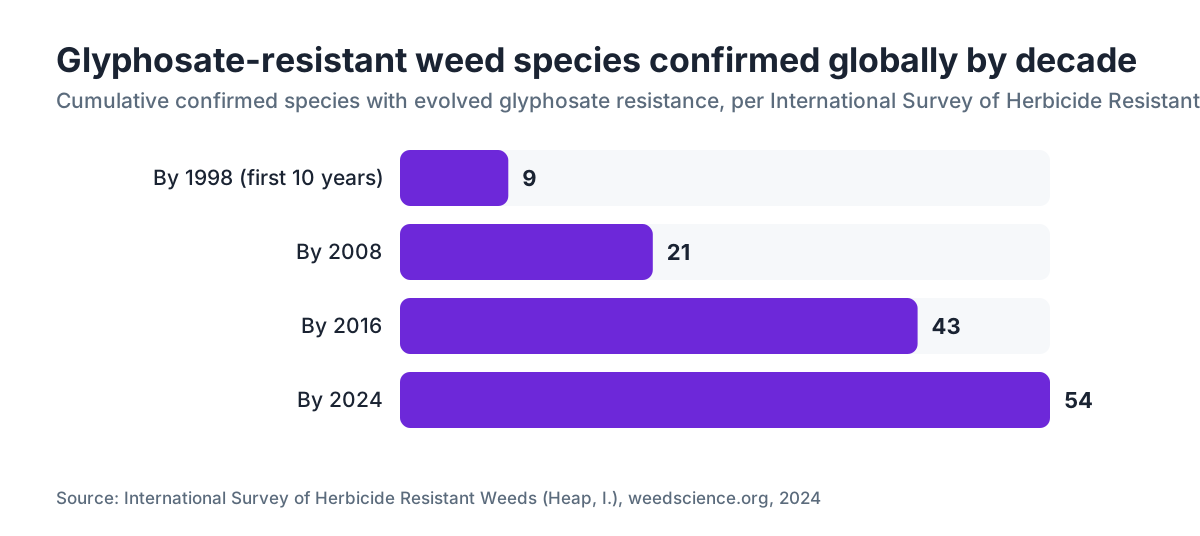
The International Survey of Herbicide Resistant Weeds, maintained by Ian Heap, lists more than 50 weed species with confirmed glyphosate resistance worldwide as of 2024. [7] In California vineyards, annual bluegrass (Poa annua) and hairy fleabane (Conyza bonariensis) are flagged most often. Both evolved resistance fairly fast under heavy glyphosate use in orchards and vineyards.
Keep your records at least five years if you're spraying glyphosate on the same blocks repeatedly. Some stewardship and cost-share programs, including USDA NRCS's Environmental Quality Incentives Program (EQIP), may ask for up to five years of application history when you apply for help with resistance-management practices. [8] That's a real reason to hold longer records even though the law only demands two.
Digital record-keeping makes this painless. Paper logs from 2017 tend to be missing, smeared, or buried in a cabinet nobody opens. A system that stores spray records with block IDs and date stamps, searchable by HRAC group, pulls a five-year rotation report in minutes.
Which weed species are most likely to develop glyphosate resistance in vineyards?
Three things drive resistance risk in a vineyard: how often you spray glyphosate on the same ground, how much tillage or physical disturbance you do between passes, and which weed species are present. Stack all three the wrong way and resistance follows.
In California wine country, hairy fleabane and horseweed (Conyza canadensis) have the most documented glyphosate resistance in tree and vine crops. UC Cooperative Extension has published specific recommendations calling for rotation with non-Group-9 herbicides and cover crops to manage these species in undervine strips. [5] In the Pacific Northwest, Italian ryegrass (Lolium multiflorum) and common waterhemp (Amaranthus tuberculatus) are the headline concerns, and WSU Extension notes that ryegrass resistance to glyphosate in tree fruit blocks is well established. [4]
Eastern states, including New York's Finger Lakes and Hudson Valley, see more pressure from common ragweed (Ambrosia artemisiifolia) and giant ragweed. Cornell's integrated pest management program recommends herbicide group rotation and annual weed mapping as first-line prevention. [6]
So the "weed species targeted" field isn't busywork. When you keep hitting the same species with glyphosate and control starts slipping, the species name in your old records is what lets you connect the dots and report a possible resistance case to your local extension office.
What rotation strategies should your records reflect to prove resistance management compliance?
No regulator currently mandates a specific herbicide rotation schedule for glyphosate. But if you're in a stewardship program, applying for EQIP cost-share, or trying to show Good Agricultural Practice to a winery buyer, your records have to show a real rotation pattern.
The standard most extension programs recommend is this: no single herbicide mode-of-action group should be the only post-emergent tool on a given block for more than two years running. After two years of glyphosate-only, you rotate to a different group, add a different-mode tank partner, or switch to mechanical or cultural control for a season. [4][5]
Common rotation partners in vineyards:
- Flumioxazin or oxyfluorfen (Group 14, PPO inhibitors) as pre-emergent alternatives
- Pelargonic acid (Group 26) as a burndown option with no residual resistance risk
- Carfentrazone (Group 14) as a tank-mix partner to add a second mode
- Cover crops in the undervine row, which drop the need for any herbicide that season and reset selection pressure
Your records should show what you applied and also what you chose not to apply, and why. A note like "Block 4: switched to undervine mowing + flumioxazin pre-emergent, no glyphosate this season, part of 3-year rotation" is exactly the entry that reads as intentional management instead of default reliance on one chemistry.
Tools like VitiScribe let you tag each application by HRAC group and generate a rotation report by block, which is the fastest way to audit your own history before a buyer or certifier asks for it.
How does the EPA's resistance management guidance affect what you're required to document?
The EPA's resistance management requirements for glyphosate live in the product labels, not in a standalone regulation. Under FIFRA, the label is the law. Most current glyphosate labels carry a "Resistance Management" section telling users to "use in accordance with IWM or IPM programs" and to rotate herbicide modes of action. [9]
The EPA's 2020 Interim Registration Review Decision for glyphosate (Docket EPA-HQ-OPP-2009-0361) said "the Agency is not currently mandating specific resistance management practices," but encouraged growers to follow HRAC guidelines and keep records of their programs. [9] The agency has signaled it may revisit this in later registration cycles as more resistant biotypes get confirmed.
What that means on the ground: you won't get fined today for failing to rotate modes of action. But picture an EPA inspection that finds eight years of nothing but Group 9 on the same block, plus a confirmed resistance case. Now you're in a weak spot arguing you followed label directions to use glyphosate as part of an integrated program. The label language is an instruction. Your records are the evidence of whether you followed it.
The WPS inspection framework kicks in from a complaint or a routine state inspection, and it treats your central display and application records as primary documents. An inspector who finds gaps, missing dates, or no block-level detail can issue a Notice of Warning or a civil penalty. Under 40 CFR Part 170, penalties can reach up to $19,787 per violation per day for serious or willful violations. [1] Most vineyard violations end in warnings and corrective action plans for first-timers.
What state-specific requirements change your recordkeeping obligations?
State rules vary enough that you need to check your own state department of agriculture directly. Here are the frameworks that hit most wine-grape states.
California runs the strictest system. Under the California Food and Agricultural Code, licensed pest control advisers file a pesticide use report with the county agricultural commissioner within seven days of each application. [2] The grower keeps a copy. California DPR also maintains a statewide pesticide use database that's publicly accessible, so your application history is already on record whether you think about it or not. County ag commissioner offices in Napa, Sonoma, and San Luis Obispo have posted specific guidance on the fields required in filed reports.
Washington makes commercial applicators hold records for two years, matching the federal floor. The Washington Department of Agriculture's pesticide program also publishes resistance management recommendations that line up with HRAC and reference glyphosate specifically in tree fruit and wine grape production. [4]
New York doesn't require grower-level application records beyond the WPS standard for non-restricted-use pesticides, but the state DEC requires restricted-use pesticide records for five years. Cornell's viticulture extension team recommends growers voluntarily keep more detail than required, pointing to the long lag before resistance is even detectable. [6]
Oregon's Department of Agriculture requires pesticide application records for two years and has specific provisions for ground application near water bodies. That matters for vineyards near riparian zones, where glyphosate use is limited to certain formulations.
Grow in multiple states, or sell to wineries with sustainability certifications, and the highest state standard is the one worth designing your system around.
How do you document suspected glyphosate resistance when you see it in the field?
Poor control in an undervine strip doesn't automatically mean resistance. First question: did you have good coverage, the right water volume, the correct growth stage, and the right adjuvant? Most "resistance" cases turn out to be application failures once you review them.
But if you've checked all those boxes, the weeds came back in the same pattern for two or more seasons, and other species in the same area are dying normally, you have a fair suspicion of resistance. Here's what your record should capture at that point.
Date of application and follow-up observation date. A percent-control estimate ("approximately 40% of hairy fleabane showing no wilting 21 days post-application"). The rate used and whether it was at the label maximum. Species name, as precise as you can manage (a photo in your records beats a guess). A comparison to a nearby block where glyphosate still works.
Next, call your county extension office or state department of agriculture. Many states run cooperative programs that confirm herbicide resistance through seed collection and greenhouse screening. UC Cooperative Extension's statewide weed science program has done this testing for California growers. [5] WSU Extension has a similar inquiry process. [4] These tests are often free or low-cost.
The International Survey of Herbicide Resistant Weeds (weedscience.org), maintained by Ian Heap, is the global registry where confirmed cases get logged. [7] A confirmed case in your county or region signals other growers and shifts local extension recommendations. Getting a suspected case properly confirmed, instead of quietly swapping products, adds to what everyone around you knows.
Record the outcome of any testing. If resistance is confirmed, your block-level rotation records from prior seasons become your management audit trail.
What's the easiest practical system for staying current on glyphosate application records?
Paper works if you're disciplined. A pre-printed field spray record form, kept in a binder in the tractor cab, filled out at the time of application, and filed by block and year, is compliant and enough. UC ANR publishes a sample pesticide use record form that satisfies both California DPR and WPS requirements. [10]
The trouble with paper is retrieval. A certifier asks for the three-year glyphosate history on Block 6, and your paper records live in three binders across two locations. Now the audit is a project. Digital records, in a spreadsheet or field operations software, make retrieval instant.
For a digital setup, the minimum viable version is a spreadsheet with these columns: Date, Block ID, Product, EPA Reg. No., Active Ingredient, HRAC Group, Rate (oz/acre or lb a.i./acre), Application Method, Target Weed Species, Applicator Name, REI, and a Notes field for efficacy observations. Save it in a shared folder with a backup. That's it.
Managing more than about 30 acres across multiple blocks, or entering data on a phone in the field (which is when data entry actually happens, not later at the office), tips the math toward a purpose-built tool. Something like VitiScribe handles the block-level structure and tags HRAC groups without making you remember the numbers. It also holds your records against the WPS two-year retention requirement automatically.
One opinion. Don't spend money on software until you've had the discipline problem that requires it. A good spreadsheet used every time beats expensive software you ignore. But if you're already keeping paper and losing it, or hand-compiling data at audit time, the software pays for itself in the first certification cycle.
How do sustainability certifications use your glyphosate records?
Several sustainability programs for wine grapes have explicit herbicide management requirements that your spray records have to support.
The California Sustainable Winegrowing Alliance runs SIP Certified, which asks growers to document their weed management approach and show they're evaluating alternatives to synthetic herbicides. Your spray records, the field-by-field history of what you applied and what alternatives you tried, are the evidence reviewers examine. [11]
LIVE Certified (Low Input Viticulture and Enology), based mainly in Oregon and Washington, requires growers to track pesticide use by active ingredient and show integrated pest management. Glyphosate is a flagged chemistry in their scoring, so heavy use without documented alternatives drags your score down. Spray records showing rotation and cover crop use in alternate seasons pull it back up.
USDA Organic certification bans synthetic herbicides outright. If you're in transition or maintaining a certified organic block, your glyphosate records on adjacent conventional blocks need to show buffer management and application dates that keep drift risk low during transition periods.
Napa Green, Fish Friendly Farming, and other regional programs each carry their own frameworks, but they generally lean on your existing WPS-format records plus a self-assessment of rotation and alternative practices. The records you keep for compliance are, with small additions, the records you need for every major sustainability program in the industry.
One thing ties all these programs together. They want to see that your weed management is intentional and documented, not the same product on the same ground year after year by default.
Frequently asked questions
How long do I need to keep glyphosate application records?
Federal WPS requires two years minimum from the date of application, stored in a central accessible location at the farm. California requires seven-day reporting to the county ag commissioner, with your copy kept on file. Resistance management programs and sustainability certifications often want three to five years of history. Keep five years if you can. Digital storage makes this a non-issue.
Is glyphosate a restricted-use pesticide?
Standard glyphosate formulations are general-use pesticides, so they don't require a certified applicator license to buy or apply. Some specialized or high-concentration products may carry restricted-use classification, so check the specific product label and EPA registration. General-use status doesn't remove your WPS record-keeping duty. Any pesticide applied on a farm where workers or handlers may be present requires a central display record.
What HRAC group is glyphosate, and what does that mean for rotation?
Glyphosate is HRAC Group 9 (EPSPS inhibitor). It's the only commercial herbicide with that mode of action. For rotation, bring in a product from a different group: Group 14 (PPO inhibitors like flumioxazin), Group 10 (glufosinate), or Group 26 (pelargonic acid) are common vineyard alternatives. The goal is to avoid selecting for resistance by giving resistant survivors no advantage in at least every other treatment cycle.
What happens if an EPA or state inspector finds incomplete glyphosate records?
First-time violations under WPS typically bring a Notice of Warning and a corrective action plan. Serious or willful violations can carry civil penalties up to $19,787 per violation per day under 40 CFR Part 170. State penalties vary. California's DPR can assess fines per unreported application day. Most vineyard inspections come from worker complaints or routine audits, not targeted glyphosate enforcement. Complete records are your primary protection.
Do I need to record the weed species I was targeting when I sprayed glyphosate?
Federal WPS doesn't require it. Resistance management guidelines from HRAC, UC extension, Cornell, and WSU extension all recommend it. Species-level records let you track whether control is dropping on the same species over time, which is your earliest practical signal of resistance. It takes 30 seconds to write 'target: hairy fleabane' on a spray record, and it's worth far more than 30 seconds when you're chasing a resistance problem four years later.
Can I use glyphosate in a certified organic vineyard block?
No. Synthetic herbicides including glyphosate are prohibited in certified organic production. If you have mixed conventional and organic blocks, your glyphosate records on conventional blocks need to document application dates, buffer distances, and wind conditions to support any claims about protecting organic areas from drift. During transition to organic certification, any glyphosate use resets the transition clock for that block.
What should I do if I suspect glyphosate-resistant weeds in my vineyard?
Document what you see: species, percent control, application rate and date, and growth stage at treatment. Check your records to confirm you had adequate coverage and correct water volume. If poor control persists over two or more seasons at label-rate applications with good technique, contact your county extension office. UC Cooperative Extension and WSU Extension both collect seed samples and screen for resistance in greenhouse bioassays. Confirmed resistance should be reported to weedscience.org.
How often should I review my glyphosate rotation history to catch resistance risk?
Once a year, before the growing season, review the last three years of herbicide applications by block. Count how many were Group 9 versus other modes of action. If any block shows three years running with glyphosate as the only post-emergent tool, plan a rotation that season. Most extension programs recommend no single mode of action exceed roughly half of herbicide applications in a three-year window on the same site.
Does the glyphosate label require me to keep resistance management records?
Most current glyphosate labels include a resistance management section telling users to apply the product 'in accordance with IWM or IPM programs' and to rotate modes of action. The label is legally enforceable under FIFRA. While the label language carries no specific record-keeping mandate for resistance management, the instruction to rotate is one you should document following. The EPA's 2020 interim review decision said the agency encourages, but does not currently mandate, specific resistance documentation.
What's the restricted-entry interval for glyphosate and where does it go in my records?
The REI for most glyphosate formulations is four hours. Some formulations with specific adjuvants or higher concentrations may differ, so always check the product label. The REI must appear in your WPS central display and in your application record. Workers and handlers can't enter the treated area until the REI expires unless they have the required PPE. Record the REI, the entry-restriction end time, and any early-entry procedures you authorized.
Do tank-mix partners affect my glyphosate resistance records?
Yes, and this is where most growers underrecord. If you tank-mix glyphosate (Group 9) with carfentrazone (Group 14), you're applying two modes of action in one pass. Record both active ingredients, both EPA registration numbers, both HRAC groups, and both rates. That tank-mix counts as a real rotation event in your resistance history. Recording only 'glyphosate' when you used a two-way mix understates your actual effort and hides your rotation record.
Are there cost-share programs that reward good glyphosate resistance records?
USDA NRCS's EQIP program offers cost-share for certain integrated pest management and cover crop practices that reduce herbicide reliance. Applications sometimes require three to five years of herbicide use history to show baseline reliance and justify the practice change. Well-kept spray records with block-level detail and HRAC group tracking are what make those applications competitive. Contact your local NRCS office for current practice standards and payment rates in your county.
How do sustainability certifications like SIP or LIVE use my spray records?
California's SIP Certified program and the Pacific Northwest's LIVE Certified program both review pesticide use documentation during audits. They look for evidence of integrated management: rotation of modes of action, documented use of alternatives, and declining or stable herbicide use over time. Glyphosate is often a flagged chemistry in scoring, so use without documented alternatives or rotation lowers your score. Your spray records, with HRAC group columns and notes on alternatives tried, are the primary evidence reviewed.
Sources
- U.S. EPA, Worker Protection Standard for Agricultural Pesticides (40 CFR Part 170): WPS requires pesticide application records retained for at least two years; civil penalties can reach up to $19,787 per violation per day for serious violations.
- California Department of Pesticide Regulation, Pesticide Use Reporting: California requires pesticide use reports filed with the county agricultural commissioner within seven days of each application.
- Herbicide Resistance Action Committee (HRAC), Mode of Action Classification: Glyphosate is classified as HRAC Group 9, an EPSPS inhibitor; it is the only commercial herbicide with this mode of action.
- Washington State University Extension, Integrated Weed Management in Pacific Northwest Vineyards: WSU Extension recommends logging herbicide group numbers on every application record and ensuring no single mode-of-action group exceeds roughly half of herbicide applications in any three-year window.
- UC Cooperative Extension, Undervine Weed Management in Wine Grapes: UC Cooperative Extension recommends rotation with non-Group-9 herbicides and cover crops to manage glyphosate-resistant Conyza species in California vineyard undervine strips.
- Cornell Cooperative Extension, Integrated Pest Management for Grapes: Cornell's viticulture extension flags undervine glyphosate applications in established vineyards as high-resistance-risk and recommends herbicide group rotation and annual weed mapping.
- International Survey of Herbicide Resistant Weeds (Heap, I.), weedscience.org: Over 50 weed species have confirmed glyphosate resistance globally as of 2024; hairy fleabane and annual bluegrass are among the most commonly flagged species in California vineyards.
- U.S. EPA, Glyphosate Interim Registration Review Decision, Docket EPA-HQ-OPP-2009-0361 (2020): The EPA's 2020 interim registration review decision for glyphosate noted 'the Agency is not currently mandating specific resistance management practices' but encouraged growers to follow HRAC guidelines and document their programs.
- UC Agriculture and Natural Resources, Sample Pesticide Use Record Form: UC ANR has a publicly available sample pesticide use record form designed to satisfy both California DPR reporting requirements and federal WPS application record standards.
- California Sustainable Winegrowing Alliance, SIP Certified Program Standards: SIP Certified audits review growers' weed management documentation, including spray records and evidence of evaluated alternatives to synthetic herbicides, as part of certification scoring.
Last updated 2026-07-09