How to communicate smoke exposure history to winery buyers in writing
TL;DR
- Put the smoke exposure history in writing before any grape sale.
- A solid disclosure covers the fire name and dates, wind data, phenological stage at exposure, any volatile phenol test results, and why you decided to harvest.
- Buyers need it to make sound winemaking calls.
- You need it to limit liability if taint shows up mid-fermentation.
Why does written smoke disclosure matter at all?
Smoke taint is real, measurable, and expensive. Grapes exposed to wildfire smoke absorb volatile phenols, mainly guaiacol, 4-methylguaiacol, syringol, and their glycoconjugate forms, which hydrolyze during fermentation and release smoky, ashy aromas that can make wine unsaleable [1]. A winery that buys your fruit and finds taint mid-fermentation, or worse at bottling, comes back to you. The conversation gets ugly fast.
Written disclosure is not a legal requirement under current federal law. It is the single clearest way to document that you told the buyer what you knew. If a dispute lands in arbitration or small claims, a dated, signed disclosure letter is your best evidence. Verbal conversations disappear. Paper does not.
The wine industry has no universal disclosure form yet. California, Oregon, and Washington have all taken heavy fire-related crop losses in recent years, but as of 2025 none of those states mandates a specific smoke exposure disclosure format for grape sales. So you write your own. The quality of what you write decides how protected you are. This article gives you the structure and the specifics to do it right.
What information should a smoke exposure disclosure letter include?
Treat the disclosure letter as a field report, not a legal brief. Give the buyer every material fact you have so they can decide how to handle the fruit. At minimum, cover eight areas.
1. Property identification. Block name, APN or legal description, AVA, variety, and tonnage estimate. The buyer needs to match your disclosure to a specific lot.
2. Fire event details. The official CAL FIRE or NIFC incident name, ignition date, and geographic relationship to your vineyard. Include the approximate distance from the perimeter to your nearest block at peak intensity. NIFC publishes incident data at nifc.gov [2].
3. Exposure window. The dates and times when smoke was visibly present over the vineyard. If you have hourly weather station data showing wind direction during the event, attach it or note the source. Most of the damage happens when dense smoke sits over the canopy for extended periods, particularly during ripening after veraison [1].
4. Phenological stage at exposure. Growers leave this one out most often. Smoke exposure before veraison carries lower taint risk than exposure during sugar accumulation. Note the approximate Brix at each significant smoke event. Washington State University's extension program found that exposure timing relative to fruit development changes glycoconjugate uptake substantially [3].
5. Canopy management context. Were clusters shaded or open? Had you leafed out the fruiting zone? Open canopies with direct cluster sun exposure during smoke events may build up more volatile phenol precursors. Mention any practices that affected cluster exposure.
6. Laboratory test results. If you tested, report the numbers. Attach the lab report as an exhibit and reference it by date and lab name. If you did not test, say so plainly: "No laboratory analysis of volatile phenols or glycoconjugates was performed prior to harvest." Silence reads as concealment. Honesty about what you did and did not do reads as good faith.
7. Your harvest decision rationale. Why harvest and sell rather than drop the crop? Lay out the considerations: Brix, estimated taint risk, crop insurance status, financial pressure, a winemaker's preliminary read. This section shows you made a considered decision, not a reckless one.
8. Buyer's right to test before accepting delivery. Offer, or at least acknowledge, the buyer's option to run their own pre-harvest or pre-crush assessment. Some buyers send a team to pull trial fermentation samples. Say whether you will support that.
Put the letter on your letterhead. Date it, sign it, and send it before the purchase contract is finalized, or at the latest before delivery. Keep a copy with your spray and field records for the same vintage.
What volatile phenol thresholds matter, and should you test before selling?
Short answer: yes, test if you can afford it and the exposure hit during ripening. Testing costs a few hundred dollars. A post-crush taint fight costs a contract.
The compounds that drive taint in finished wine are mostly the glycoconjugate forms of guaiacol, 4-methylguaiacol, cresols, and syringol. Free volatile phenols are measurable in grapes but predict poorly, because the bound forms release during fermentation [1]. The University of California, Davis viticulture and enology program has published guidance noting that free volatile phenols in grape juice do not reliably predict taint in finished wine because of the contribution of glycoconjugate precursors [4].
Labs like ETS Laboratories in St. Helena and others run panels measuring both free and total (post-hydrolysis) volatile phenols. A full smoke taint panel typically runs $150 to $400 per sample as of 2024, depending on the lab and the number of analytes. Real money. Still a fraction of the argument you get if a buyer finds taint post-crush.
Results below detection thresholds are genuinely good news, and reporting them protects both parties. Elevated results do not obligate you to destroy the crop. They obligate you to tell the buyer the numbers. Let them decide whether they want the fruit for a blending wine, a sparkling base, or at a discount.
Neither the TTB nor USDA has set federal maximum residue limits for smoke taint compounds in grapes [5]. Australian research published in the American Journal of Enology and Viticulture set a sensory detection threshold for guaiacol in wine at roughly 9 to 22 micrograms per liter depending on wine matrix [6], but US commercial buyers often work from their own internal thresholds. Ask your buyer what threshold they use before you spend money on testing.
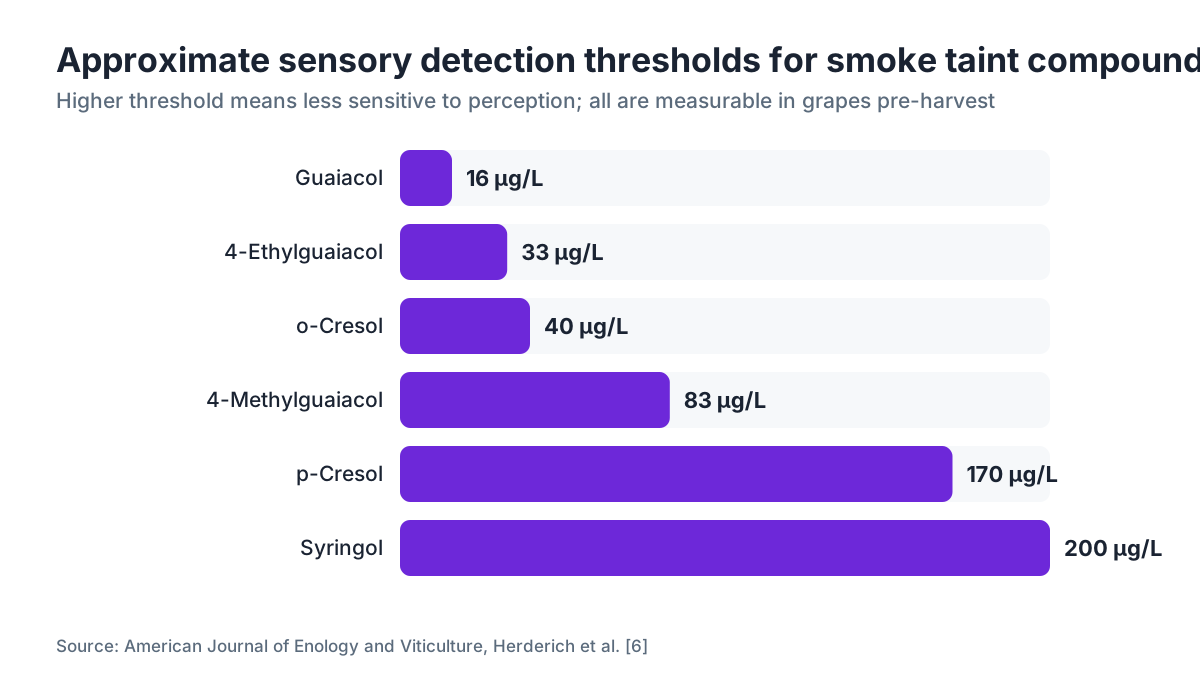
Key smoke taint data reference: compounds, thresholds, and test types
This table lists the main volatile phenols tied to smoke taint, their approximate sensory detection thresholds in finished wine, and whether labs can measure them in grape or juice samples before harvest. Threshold figures come from peer-reviewed enology literature [6][7].
| Compound | Odor descriptor | Approx. sensory threshold in wine (µg/L) | Measurable in grapes pre-harvest? |
|---|---|---|---|
| Guaiacol | Smoky, medicinal | 9 to 22 | Yes (free + glycoconjugate) |
| 4-Methylguaiacol | Smoky, spicy | 65 to 100 | Yes |
| Syringol | Smoky, phenolic | ~200 | Yes |
| o-Cresol | Phenolic, medicinal | ~40 | Yes |
| p-Cresol | Phenolic, barnyard | ~170 | Yes |
| 4-Ethylguaiacol | Smoky, clove | ~33 | Yes |
Detection thresholds shift with wine type, alcohol content, and residual sugar. A dry red expresses these compounds more prominently than a sweet or tannic white. Read these numbers as guides, not cutoffs.
Testing at the grape or juice stage catches the free forms reliably. The bound glycoconjugates need enzymatic or acid hydrolysis to measure. Ask your lab straight out whether they are running total (hydrolyzed) volatile phenols or only free forms. That difference decides how well the test predicts finished wine quality.
How do you structure the disclosure letter itself?
Here is a structure you can adapt. This is not legal advice. Have any contract language reviewed by an attorney familiar with agricultural sales in your state.
[Your vineyard name and address]
Date:
To: [Winery buyer name, contact]
Re: Smoke Exposure Disclosure, [Vintage Year], [Variety], [Block Name]
Section 1: Property and Lot Description
Describe the specific blocks covered. Include acreage, variety, rootstock if relevant, and estimated yield.
Section 2: Fire Event Summary
Name the fire, dates, distance from vineyard perimeter, and primary wind direction during peak smoke events. Attach any AQI logs or weather station data.
Section 3: Exposure Timeline and Phenological Stage
List specific dates and estimated Brix at time of exposure. Note whether exposure was pre-veraison, during color change, or during sugar accumulation.
Section 4: Canopy and Cultural Conditions
Describe leafing, crop load, and cluster exposure at the time of the event.
Section 5: Laboratory Analysis
If tested: attach the lab report, name the lab, give the report date, and summarize key findings. If not tested: state plainly that no smoke taint testing was performed.
Section 6: Harvest Decision
Explain the basis for your decision to harvest and offer the fruit for sale.
Section 7: Buyer's Pre-Acceptance Rights
State whether the buyer may conduct pre-harvest or pre-crush testing and whether you will provide representative samples on request.
Section 8: No Warranty / As-Is
A plain statement that this disclosure represents your complete knowledge and that no warranty of freedom from taint is expressed or implied. Again, have an attorney check this language for your state.
Seller Signature / Date and a Buyer Acknowledgment Signature / Date line.
The buyer acknowledgment line is the part most growers forget. Get their signature confirming they received and read the disclosure before you deliver fruit. Without it, a buyer can claim they never saw the letter.
What records should you keep before you write the disclosure?
Good disclosure letters come from good records. If you tracked field conditions all season, writing the letter is easy. If you did not, you are reconstructing from memory, which is unreliable and legally weak.
Before you write a smoke disclosure, you want these in hand: your spray and observation log with dated field notes from the smoke period, any air quality index readings you recorded or can pull from the nearest EPA or state air monitoring station [8], weather station data showing wind speed and direction, date-stamped photos of smoke over the vineyard (phone photos are fine), any communication with your farm advisor or PCA during the event, and your harvest decision notes.
The EPA Worker Protection Standard already requires you to keep certain pesticide application records for agricultural workers, but field observation logs are separate and not federally mandated for viticulture [9]. Growers who document field conditions systematically, on paper or in farm management software, are the ones who write a credible disclosure after a fire without scrambling.
VitiScribe is built for vineyards that want spray records, field observations, and compliance documentation in one place. If you are starting fresh after a fire season with records scattered across notebooks and text messages, this is the time to build a system rather than patch the current gap.
For blocks that saw smoke exposure, add a permanent notation to your block records so the exposure history follows the parcel forward. The next buyer, or the next vintage where you replant, may want that history.
Does smoke disclosure affect your grape purchase contract or price negotiation?
Yes. Expect it to. That is honest and appropriate.
A buyer who gets a disclosure showing verified elevated volatile phenol levels will decline the fruit, discount the price, or accept it for a specific use like a blending wine. None of those feel good. All three beat delivering the fruit, saying nothing, and facing a claim for damaged wine six months later.
Price cuts for smoke-exposed fruit vary enormously by exposure severity, variety, and buyer. There is no published benchmark for discount rates on smoke-tainted grapes. What you can do is get the lab results, share them openly, and let the negotiation run on real data rather than guesswork.
Some buyers will ask for a price reduction plus an indemnification clause in the contract, releasing them from liability for wine quality issues from smoke taint. That is reasonable from their side. What you agree to depends on your exposure level, your test results, and your attorney's read of the language.
Crop insurance is a related piece. If you are insured through the USDA Risk Management Agency's Multi-Peril Crop Insurance program, smoke-related crop loss may be coverable depending on your policy endorsement and the cause-of-loss determination [10]. Call your crop insurance agent before you sell the fruit at a deep discount. A settlement with your insurer might beat a distressed sale.
What does extension research say about the timing and severity of smoke exposure risk?
Three university extension programs have published the most useful guidance for growers dealing with smoke.
UC Davis Cooperative Extension has published multiple resources through its viticulture program noting that grapes are most susceptible to smoke taint absorption from veraison through harvest, roughly the six to eight weeks when sugar accumulation is active [4]. Their guidance also points to the berry skin as the primary site of uptake, so canopy architecture matters.
Washington State University Extension has addressed smoke taint risk in Pacific Northwest vineyards with attention to the 2020 and 2022 fire seasons. Their published work found that smoke exposure from veraison to harvest poses the greatest risk for glycoconjugate accumulation in berry tissue [3]. WSU has also published guidance on small-lot trial fermentations as a pre-purchase assessment tool, worth recommending to buyers who want a practical pre-crush evaluation.
Cornell Cooperative Extension has less direct experience with wildfire smoke, given New York's fire geography, but its enology program has published on volatile phenol analysis methods and sensory evaluation that shape how taint is detected and communicated post-harvest [7].
All three programs agree on one thing: no field test definitively predicts taint in finished wine without laboratory analysis. Visual assessment of smoke density does not correlate reliably with chemical uptake. Heavy visible smoke for a few hours can leave little grape impact. Lighter smoke over several days during peak ripening can produce meaningful uptake. Log the events, test the fruit, disclose what you know.
How should you handle disclosure when you have multiple blocks with different exposure levels?
Write a separate disclosure for each lot you sell. This is not paperwork for its own sake. Different blocks get different exposure because of topography, wind patterns, canopy density, and pick timing. Lumping everything into one letter and calling it "the vineyard" creates exactly the ambiguity you are trying to avoid.
If you have three blocks and only one had significant exposure, the buyer of the clean blocks does not need a smoke disclosure. The buyer of the exposed block gets the full disclosure for that lot only. Keep the paperwork matched to the actual lot.
For blocks where you are genuinely uncertain, say a block at the edge of visible smoke or where smoke was intermittent, be honest about the uncertainty in the letter. Something like: "Block C was periodically exposed to visible smoke from [date] to [date] at approximately [Brix]. Exposure was lighter and more intermittent than Block B. No laboratory testing was performed for this block. The buyer should assess this risk independently." That sentence protects you more than silence does.
What are the legal and liability considerations for growers who don't disclose?
This section is general information, not legal advice. Consult an agricultural attorney in your state for specific guidance.
Most states treat commercial grape sales as sales of goods under their version of the Uniform Commercial Code. Under the UCC, sellers carry an implied warranty of merchantability for goods sold in the ordinary course of business. If a buyer shows that your fruit was not fit for its ordinary purpose, which is making saleable wine, and that you knew of a material defect and did not disclose it, you have potential liability for consequential damages [11].
Consequential damages in a wine context could include the cost of the lost wine, the cost of processing grapes that produced unsaleable product, and possibly reputational damage claims if the buyer connects your fruit to a specific bottling. Courts have varied widely on these cases. The grower who produced a written disclosure in good faith is in a far better position than the one who said nothing.
California's commercial code, Oregon's, and Washington's are all based on the UCC model. If you sell across state lines, which happens constantly in the Pacific Northwest, the governing law clause in your purchase contract matters.
The disclosure letter is not a magic shield. A buyer who proves you had lab results showing high taint levels and buried them still has a strong claim. The letter protects you when you acted in good faith and disclosed what you knew. It does not protect dishonesty.
For buyers reading this: the disclosure is also a fair basis for requesting a contract addendum that modifies the implied warranty of merchantability for smoke-tainted fruit. A buyer who knowingly accepts disclosed tainted fruit at a negotiated price has much weaker later claims on taint.
Can you use field management software to generate and store smoke disclosures?
Yes, and you should. A disclosure letter is only as credible as the records behind it. Gaps in your field observation log, or a vague smoke event notation, make the letter itself read as weak.
VitiScribe lets you attach dated field notes, upload lab reports, and log observation records by block, so when you sit down to write a disclosure, the evidence is already organized and timestamped. That matters when a buyer asks how you know the exposure window was June 15 to June 18. You show them the log.
Whatever system you use, the habit that counts is contemporaneous documentation. Log smoke events the day they happen, not three weeks later while writing the disclosure. A field note dated June 15 reading "heavy smoke from Corral Fire visible from 9am, wind from SE, Brix at 18, leafed zone open" carries far more weight than a summary reconstructed at harvest. Courts understand the difference between contemporaneous notes and retroactive summaries. So do buyers.
For Paso Robles wineries, mountain winery operations, and other vineyards in fire-prone regions, building this habit before a fire season is what separates a manageable disclosure conversation from a panicked reconstruction.
What should buyers expect to receive, and what questions should they ask?
If you are on the buying side, here is what a complete disclosure should include and where to probe for gaps.
A solid disclosure letter tells you the fire name, the dates, the approximate distance, the phenological stage at exposure, and whether testing was done. If any of those are missing, ask for them in writing before you accept delivery.
The most important question to ask: were glycoconjugate (total) volatile phenols tested, or only free volatile phenols? Free phenol results alone understate taint risk. If the grower tested only free phenols, request a total volatile phenol panel before accepting.
Also ask whether the grower will support a small-lot trial fermentation from a representative sample before you commit to the full purchase. WSU Extension recommends this as a practical predictive tool [3]. It costs a few hundred dollars in lab time and predicts wine quality far better than grape-stage testing alone.
For high-value lots or large purchases, consider hiring an independent enology consultant to review the grower's disclosure and lab data before you sign. The fee is small next to the risk on a 100-ton purchase.
If you are a city winery or urban production facility sourcing fruit from fire-prone regions, build smoke disclosure requirements into your standard fruit purchase agreement so the expectation is set before any fire season starts.
Frequently asked questions
Is a smoke exposure disclosure legally required when selling wine grapes?
No federal law and no state law currently mandates a specific smoke exposure disclosure form for commercial grape sales in the US, as of 2025. Commercial sales are governed by state versions of the Uniform Commercial Code, which includes implied warranties of merchantability. Failing to disclose a known material defect can create liability for consequential damages. Written disclosure is your best protection in a dispute, even though it is not legally required.
What volatile phenols should I test for after a smoke event?
The primary compounds are guaiacol, 4-methylguaiacol, syringol, o-cresol, p-cresol, and 4-ethylguaiacol. Ask your lab to run both free and total (post-hydrolysis) volatile phenol panels. The bound glycoconjugate forms predict finished-wine taint better because they release during fermentation. A panel that measures only free volatile phenols understates the taint risk in the finished wine.
When during the growing season is smoke exposure most damaging to grapes?
Research from UC Davis and WSU Extension consistently points to veraison through harvest as the highest-risk window. That is when berry skins are most permeable and sugar accumulation is active. Smoke exposure before veraison is not risk-free, but glycoconjugate uptake is substantially lower. Log Brix readings at each smoke event so you can document the phenological stage in your disclosure letter.
How much does a smoke taint lab test cost for grapes?
A full smoke taint panel, covering both free and total volatile phenols across the main six to eight compounds, typically runs $150 to $400 per sample at commercial enology labs as of 2024. Prices vary by lab and analyte count. Test multiple blocks independently, since exposure levels differ across a vineyard. The cost is small next to the value of a grape contract or the liability from undisclosed taint.
Should I disclose smoke exposure even if I don't think the taint will be noticeable?
Yes. Your sensory impression in the vineyard does not reliably predict what the winery experiences during fermentation. The glycoconjugate precursors that drive taint in finished wine are not detectable by smell in the field. Disclosing what you observed and what you did not test is honest practice and limits your liability. Silence about a known smoke event, even one you thought was minor, is the riskiest position you can take.
Can I sell smoke-exposed grapes at full price if I disclose the exposure?
Price is a negotiation, and disclosure does not automatically force a discount. If your lab results show volatile phenol levels below sensory thresholds, a buyer may accept fruit at full price. If results are elevated, expect price talk. The disclosure letter sets honest terms for that negotiation. Selling at full price while hiding elevated test results creates far larger legal and reputational risk than accepting a negotiated discount.
What should I do if I have no lab results before the buyer asks?
State it clearly in the disclosure letter: "No laboratory analysis of volatile phenols or glycoconjugates was performed prior to harvest." Then document the fire event details, exposure dates, phenological stage, and your harvest decision rationale as fully as you can. Offer the buyer the chance to test before accepting delivery. Honest acknowledgment of what you do not know beats omitting the subject entirely, both legally and commercially.
Do I need a separate disclosure for each block I'm selling?
Yes, if blocks had different exposure levels. Lumping multiple blocks with different smoke histories into one disclosure creates ambiguity that could be read against you. Write a disclosure keyed to the specific lot or block, matched to the purchase contract lot identification. Buyers need to know which fruit the disclosure covers. If some blocks were not meaningfully exposed, those blocks may not need a smoke disclosure at all.
How long should I keep smoke disclosure records?
Keep them at least as long as the wine made from your grapes could be on the market and open to a quality dispute, which for most still wines means five to seven years minimum. For premium wines with aging potential, longer is safer. Store the signed disclosure letter, the underlying field notes, the lab reports, and any weather data together in a file keyed to the vintage and block. Digital copies with off-site backup are a practical minimum.
Can a buyer refuse delivery after receiving a smoke disclosure?
Yes. A buyer who receives your disclosure before signing a purchase contract can decline the fruit. That is one purpose of pre-contract disclosure. If you deliver fruit under an existing contract and then provide the disclosure, the buyer's options depend on the contract terms. Delivering after contract execution without prior disclosure limits the buyer's practical ability to refuse, which is why timing the disclosure before the contract is signed matters so much.
What's the best way to document AQI data during a fire event for later use in a disclosure?
The EPA's AirNow system (airnow.gov) archives hourly AQI readings by monitoring station. During a fire event, note the nearest monitoring station name and record the daily AQI values in your field log. After the event, download historical data from EPA's monitoring network. CAL FIRE and state fire agencies also publish incident perimeter maps with daily timestamps, useful for documenting the distance from fire perimeter to your vineyard.
Should I recommend a trial fermentation to the buyer?
Yes, especially for high-value lots or borderline grape-stage results. A small-lot trial fermentation, typically 5 to 10 gallons of representative fruit fermented to dryness, predicts taint in finished wine far better than grape testing alone. WSU Extension recommends this approach for smoke exposure assessment. Offering to help collect samples for a trial fermentation signals good faith and helps both parties make a better-informed decision.
Does crop insurance cover smoke-related grape losses?
Potentially, depending on your policy. USDA Risk Management Agency's Multi-Peril Crop Insurance covers certain cause-of-loss categories for wine grapes, and some policies have provisions for smoke damage. Contact your licensed crop insurance agent before selling tainted fruit at a distressed price. Filing a claim rather than accepting a deep discount may be the better financial outcome. Policy terms and cause-of-loss requirements vary significantly by endorsement and region.
Sources
- American Journal of Enology and Viticulture, Kennison et al., 2008: Smoke-derived taint in grapes and wine: Volatile phenols including guaiacol and their glycoconjugate forms are absorbed through grape berry skins during smoke exposure and hydrolyze during fermentation to release smoky, ashy aromas
- National Interagency Fire Center (NIFC), Incident Information: NIFC publishes official incident names, ignition dates, and perimeter data for wildfire events
- Washington State University Extension, Smoke Taint in Wine Grapes: WSU Extension found that smoke exposure during the period from veraison to harvest poses the greatest risk for glycoconjugate accumulation in berry tissue, and recommends small-lot trial fermentations as a pre-purchase assessment tool
- UC Davis, Viticulture and Enology (UC Agriculture and Natural Resources), Smoke Taint Guidance: UC Davis guidance states that free volatile phenols in grape juice do not reliably predict taint in the finished wine due to the contribution of glycoconjugate precursors, and that grapes are most susceptible during the period from veraison through harvest
- US Alcohol and Tobacco Tax and Trade Bureau (TTB): no federal maximum residue limits for smoke taint compounds: As of 2025, neither the TTB nor USDA has established federal maximum residue limits specifically for smoke taint volatile phenol compounds in grapes or wine
- American Journal of Enology and Viticulture, Herderich et al., smoke taint sensory thresholds in wine: Sensory detection threshold for guaiacol in finished wine is approximately 9 to 22 micrograms per liter depending on wine matrix; thresholds for other volatile phenols including 4-methylguaiacol (65-100 µg/L), syringol (~200 µg/L), o-cresol (~40 µg/L), and p-cresol (~170 µg/L) have been identified
- Cornell University, College of Agriculture and Life Sciences, Enology: Volatile Phenol Analysis and Sensory Evaluation: Cornell's enology program has published on volatile phenol analysis methods and sensory evaluation relevant to smoke taint detection
- US EPA AirNow, Air Quality Index Historical Data: EPA's AirNow system archives hourly AQI readings by monitoring station and can be used to document air quality conditions during fire events
- US EPA, Agricultural Worker Protection Standard: The EPA Worker Protection Standard requires maintenance of certain pesticide application records for agricultural workers; field observation logs for smoke events are separate from this requirement and not federally mandated
- USDA Risk Management Agency, Multi-Peril Crop Insurance for Wine Grapes: USDA RMA's Multi-Peril Crop Insurance program covers wine grapes and may include provisions for smoke-related crop losses depending on policy endorsement and cause-of-loss determination
- Uniform Commercial Code, Article 2: Sales, Implied Warranty of Merchantability (Legal Information Institute, Cornell Law School): Under UCC Article 2, sellers have an implied warranty of merchantability for goods sold in the ordinary course of business; failure to disclose a known material defect can create liability for consequential damages
Last updated 2026-07-10