Smoke exposure documentation for vineyard insurance and winery disclosure
TL;DR
- After a smoke event, vineyards need dated field observations, air quality logs, lab results (guaiacol and 4-methylguaiacol are the key markers), and a clear chain of custody for fruit samples.
- Insurers want records made at the time, not reconstructed later.
- Winery buyers want disclosure before purchase.
- Start the day smoke arrives, not after harvest.
Why does smoke exposure documentation matter so much?
Smoke taint is real, it's commercially damaging, and it's spreading beyond the usual West Coast fire zones into parts of New York and Virginia. Here's what insurers and winery buyers both fixate on: the damage isn't always visible. Grapes can look perfect after a smoke event and still carry enough volatile phenols to wreck a finished wine. That gap between what you see and what the lab finds is the whole reason documentation exists.
Insurers need proof that the event happened, that you responded like a reasonable grower, and that the crop loss or quality downgrade traces back to the smoke and not to disease, weather, or neglected vines. Winery buyers need to know what they're buying. Sell smoke-tainted fruit without disclosure and you're open to contract disputes, rejected loads, and fraud claims. Most custom crush and grape purchase agreements written since 2020 carry smoke taint representations, and buyers test incoming fruit as a matter of course now [1].
Documentation is the line between a paid claim and a denied one. The most common reason agricultural smoke claims get reduced or denied is a timeline the grower can't establish. Get the records right from day one, because you can't backfill a smoke event.
What records should you collect the day smoke arrives?
The first 24 to 72 hours of a smoke event is the window that decides your claim. That's when volatile phenols from combustion absorb into berry skins and start glycosylating, the chemical process that locks taint compounds into a form that survives fermentation [2]. Start documenting a week late and you've lost the part of the story that matters most.
On the day smoke arrives, record at minimum:
- Date, time, and GPS location of your observation
- Wind direction and rough visibility (is the horizon gone? can you still see the ridgeline?)
- The AQI reading from the nearest official monitor at that moment (pull it from AirNow.gov and screenshot it)
- Fire name, incident number, and distance from your vineyard if known (Cal Fire and InciWeb publish this)
- Photographs of the sky, the rows, and any ash on leaves or clusters
- The growth stage: veraison-stage fruit is far more vulnerable than fruit at pea size or fruit that's already picked [3]
Do this every day the smoke lingers. One entry proves nothing. Adjusters want to see that you tracked duration, more than the moment smoke showed up. AQI readings above 150 (unhealthy) and above 200 (very unhealthy) carry the most weight with underwriters, because UC research ties higher taint risk to sustained AQI in those ranges [3].
Take berry samples for baseline lab analysis as fast as you can. If you have a reading from before the smoke and one after, you've got a real before-and-after. Most growers have no pre-event sample, which is exactly why a season-long sampling routine pays off in fire country.
Which lab tests actually show smoke damage in grapes?
Guaiacol and 4-methylguaiacol (4-MG) are the two compounds that carry a smoke taint case. Both are volatile phenols made when lignin in wood and plant material burns. In grapes they bind to sugars and form glycosides, which are odorless in the fruit and then release that smoky, ashy, medicinal aroma during fermentation once yeast and acids cut the sugar bond [2].
Standard panels from accredited ag labs report free guaiacol and 4-MG (the volatile fraction your nose can catch) plus total guaiacol and 4-MG (free plus the bound glycosides). For insurance and disclosure, the total fraction is the number that counts, because it predicts what the finished wine will smell like better than the fruit does at harvest.
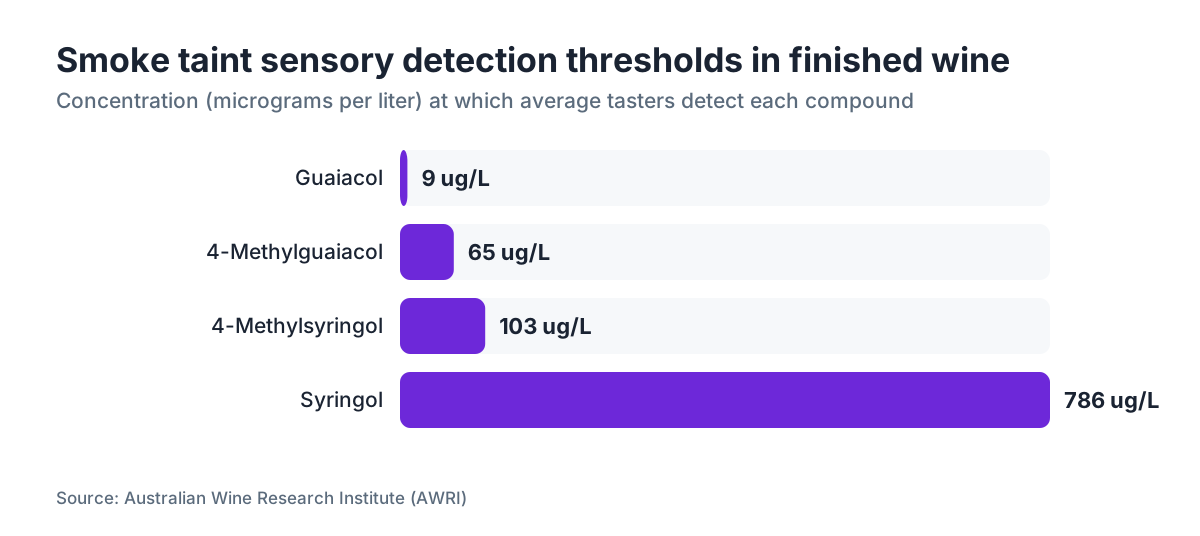
Labs often add other markers: syringol, 4-methylsyringol, furfural, and cresols. The Australian Wine Research Institute has done the deepest work on this panel [4]. AWRI puts the guaiacol detection threshold around 9 micrograms per liter in wine for most tasters, though individual sensitivity swings widely.
For a claim, you want three things:
- A COA (certificate of analysis) from an accredited lab carrying your vineyard block ID, sample date, and chain of custody
- Results in micrograms per liter (ug/L) or micrograms per kilogram (ug/kg) for fruit
- A written comparison to published sensory thresholds, which your lab or a wine consultant can supply
WSU Extension keeps a smoke taint testing guide that names Pacific Northwest labs doing this work [5]. UC Cooperative Extension publishes parallel guidance for California [3].
| Compound | Sensory threshold in wine (ug/L) | Source |
|---|---|---|
| Guaiacol | ~9 | AWRI |
| 4-Methylguaiacol | ~65 | AWRI |
| Syringol | ~786 | AWRI |
| 4-Methylsyringol | ~103 | AWRI |
These are detection thresholds for the average taster. Some panelists pick up guaiacol at 5 ug/L. Don't treat them as pass/fail lines. Treat them as context you hand an adjuster or a buyer.
How do insurers evaluate smoke damage claims for vineyards?
Most vineyard crop insurance in the U.S. runs through USDA's Risk Management Agency (RMA) under the Multi-Peril Crop Insurance (MPCI) program. Smoke taint coverage under MPCI exists, but the language shifts by policy endorsement, so read your own policy for how "smoke" or "fire" is defined as a cause of loss [6].
RMA requires a notice of loss filed within 72 hours of discovering damage (or within 15 days of harvest, whichever comes first), cooperation with the assigned loss adjuster, and evidence tying the loss to a covered peril. Wildfire smoke counts as a covered peril under most MPCI grape policies.
Private specialty crop insurers such as Great American and Nationwide Agribusiness set similar bars but sometimes flex on evidence. Some accept AQI logs plus a sensory evaluation from a certified enologist as partial documentation even without a full lab panel.
The adjuster is answering three questions. Did smoke exposure happen? Was it bad enough to cause economic damage? Did the grower mitigate the way a reasonable grower would? That last one bites. If you had time to harvest earlier and chose not to, or you passed on mitigation tools with no stated reason, your claim can shrink. Write down every mitigation decision and the reason behind it, while it's happening.
When a claim is disputed, the process starts at the insurance company, then moves to RMA's National Appeals Division. State department of agriculture offices can sometimes help, though they hold little authority over federal crop insurance. The American Association of Crop Insurers is an industry group, not a regulator, and it publishes guidance on claim documentation.
What do winery buyers and custom crush clients expect for disclosure?
Here documentation turns into a sales and legal question rather than an insurance one. Sell grapes or juice to a winery, have taint show up later, and you're looking at rejection at the crush pad (you eat the loss), a demand for refund or damages after the wine is made, and a burned relationship with that buyer.
Most California grape purchase agreements signed since 2018 carry a warranty clause that makes the seller disclose known quality defects. A smoke event you tracked, that returned elevated lab values, is a known defect. Staying quiet about it is the risky move.
Disclosure in practice is simple. Give your buyer a written summary of the event (dates, AQI readings, fire proximity), your lab results with the COA, and your own read on likely impact. Don't guess at whether the wine will taste smoky. Hand over the data and let the buyer's winemaker make that call. Plenty of buyers will still buy at a negotiated discount. That beats a rejected load or a lawsuit every time.
Wineries making wine from estate fruit face a different, softer set of obligations on the consumer side. TTB doesn't require smoke taint disclosure on wine labels [7]. Some direct-to-consumer wineries disclose voluntarily anyway, and trade buyers and wine media tend to reward that honesty.
If your vineyard sits inside a designated American Viticultural Area (AVA), remember that one smoke event can hit every grower in the region at once. Regional disclosure norms grow informally, and being early on that curve protects your relationships.
How should you organize your smoke documentation records?
Paper binders work. Digital works better, especially when an adjuster or a buyer wants everything emailed by Friday.
A solid smoke file breaks into five folders:
- Event log (dated daily entries, AQI screenshots, fire incident numbers, observation notes)
- Photographs (date-stamped, geotagged if you can, filed by date)
- Lab results (COAs, chain of custody forms, sample submission receipts)
- Communications (emails or texts with your agent, any written notice to buyers)
- Mitigation records (harvest decisions, canopy changes, spray records tied to the event)
Keep everything at least three years from the event date. Crop insurance disputes can run a year or more. Contract fights over delivered fruit sometimes surface 18 to 24 months later, once the wine is released. Three years is the safe floor.
Block-level records beat vineyard-wide averages, and it's not close. A block on the northwest corner might catch 40 hours of direct smoke while the southeast block catches 12. That granularity matters to an adjuster and to a buyer who only wants certain blocks.
This is where a field operations platform like VitiScribe earns its keep: log smoke observations by block with GPS coordinates, attach photos, and export a timestamped report already laid out for an adjuster. Paper can do the same job. Producing a clean, formatted PDF under pressure is just a lot easier from software than from a three-ring binder.
Does smoke exposure always mean crop loss, or can you salvage affected fruit?
Not always a total loss. The science here is more forgiving than the insurance conversation usually admits.
Several mitigation strategies have research behind them. None come with a guarantee. The practical ones:
- Early harvest. Picking before or right after a smoke event, if Brix and acid are workable, cuts the berry's exposure time. Glycosylation keeps going after harvest if the fruit sits warm, so move sampled fruit to a cold environment fast.
- Less skin contact. Winemaking that minimizes maceration pulls fewer glycoside-bound phenols. Some winemakers push affected red fruit toward a white-wine-style process.
- Activated carbon fining. Charcoal fining after fermentation can drop guaiacol, but it also strips other flavor compounds. AWRI has shown the effect varies with dose and wine matrix [4].
- Spinning cone or reverse osmosis. Expensive, out of reach for many small wineries, but these physical methods can pull taint out of finished wine.
For insurance, write down every mitigation step you consider, including the ones you reject. If you skipped early harvest because Brix was 16 and the contract required 22, put that in the file. A reasonable decision, explained in writing at the time, shields you from an adjuster second-guessing you after harvest.
WSU Extension notes that some styles, heavily oaked reds in particular, can mask low levels of taint that a rosé or a light white cannot [5]. That's not a reason to hide a problem. It's context for a winemaker deciding what to do with exposed fruit.
What AQI thresholds and air quality data sources should you use?
AirNow.gov, run by EPA with state air agencies, is the primary reference for real-time and historical AQI in the U.S. [8]. Use it. Timestamped screenshots are admissible documentation. You can also pull historical data by monitor ID from EPA's Air Quality System (AQS) database, handy after the fact when you're rebuilding a timeline.
Here's the AQI scale for PM2.5, which is the measure that matters for wildfire smoke:
| AQI Range | Category | Description |
|---|---|---|
| 0-50 | Good | No concern |
| 51-100 | Moderate | Sensitive groups |
| 101-150 | Unhealthy for sensitive groups | Limited exposure advised |
| 151-200 | Unhealthy | General population affected |
| 201-300 | Very unhealthy | Serious health effects |
| 301-500 | Hazardous | Emergency conditions |
For taint risk, the research points to elevated concern at sustained AQI above 150, especially from veraison through harvest [3]. One day at 180 worries less than five days at 155, because total exposure time drives the damage.
If your vineyard sits far from an official monitor, say so in your records. The nearest monitor may read 110 while your site runs higher because of local terrain. Purple Air sensors aren't regulatory-grade, but they can supplement official data, and many insurers accept them as supporting evidence, not primary. Pair the Purple Air reading with official AQI and explain any gap in your notes.
The EPA Worker Protection Standard also puts obligations on agricultural employers during poor air quality, including protective measures for workers [9]. Filing those worker records next to your crop documentation shows steady, contemporaneous record-keeping, which helps your credibility with an adjuster.
Are there specific regulations that require smoke documentation from vineyards?
No federal regulation requires grape growers to document smoke exposure. Full stop. This is a best-practice area driven by insurance contracts, grape purchase agreement warranties, and plain risk management, not by statute.
State requirements vary. The California Department of Food and Agriculture has issued guidance on smoke events but has not set a mandatory documentation standard for growers as of this writing. Oregon's Department of Agriculture sits in the same guidance-without-mandate place.
What is regulated: worker safety during smoke. Cal/OSHA's emergency wildfire smoke regulation kicks in on AQI, requiring employers to check air quality, cut work intensity, provide respirators, and document protective measures when outdoor workers face AQI above 151 [10]. Those records, which you already have to keep, double as evidence of when the smoke hit and how bad it got.
TTB requires no wine label disclosure of smoke taint or smoke events [7]. The industry has talked about whether that should change, but no rulemaking is pending as of mid-2026.
Wineries with wine club members or restaurant accounts should read their own sales contracts and representations. If tasting room staff make specific quality claims that don't hold up after a smoke-affected vintage, that's a consumer protection problem in most states. Train staff on what they can and can't say about a vintage.
How do you document smoke exposure when you suspect damage but have no lab results yet?
You rarely get to send samples and wait before decisions come due. Labs in California and Washington can take one to three weeks during peak fire season because everyone ships samples at once. Here's how to document a presumed event while the lab works.
File a notice of loss with your crop insurer right away if you think a covered event happened. Don't wait for lab results. RMA's notice-of-loss clock runs from discovery of damage, and a late filing can sink the claim [6]. State in the notice that testing is pending and you'll send results when they land. Adjusters see this constantly.
Same logic for the buyer. Send a written notice describing the event (dates, AQI, fire proximity), note that testing is underway, and say you'll share results as soon as you have them. That establishes good faith and gives the buyer time to plan around a possible supply gap.
In your field notes, capture sensory observations. Do the crushed berries smell smoky? Does the canopy carry a smoky note in the morning air? These aren't proof, but they're relevant supporting notes. Record who observed it and when.
If you know neighboring growers or belong to a local cooperative, note whether they also saw smoke and whether they're testing. Regional corroboration strengthens an individual claim.
Cornell Cooperative Extension publishes guidance for New York growers on responding to smoke events, including sample submission protocols that speed things up during fire season [11]. WSU Extension keeps parallel Pacific Northwest resources [5].
How do you store and present documentation when filing an insurance claim?
The adjuster, whether standing in your rows or calling from a desk, wants a coherent story: smoke hit on these dates, at this severity, during this growth stage, and here's what it cost me in revenue or crop value. Your records have to tell that story with no gaps.
Present everything in chronological order. Nobody wants to sort a shoebox. A one-page timeline summary up front, followed by supporting documents in order, moves a claim faster than anything else you can do.
For revenue loss math: your price-per-ton contract or historical average price per ton, applied to the share of crop you couldn't sell or had to dump at a discount. If you negotiated a price cut with a buyer, document it in writing and keep the original contract price for comparison.
Get a second opinion if the claim is denied or reduced. Independent agricultural appraisers and viticulture consultants can write assessments that support an appeal. That costs a few hundred to a few thousand dollars, money well spent on a large claim.
If you run a farm management or compliance platform like VitiScribe, set your export so records carry block ID, timestamps, and your vineyard's legal property description. Adjusters juggling many claims appreciate documentation that doesn't force them to reverse-engineer your farm.
Wineries at high-fire-risk destinations like Ponte Winery, Mountain Winery, and South Coast Winery in Southern California should build a smoke response protocol before fire season, so nobody is inventing the system while smoke rolls in. The same holds for Paso Robles wineries in the Santa Lucia foothills, where dry easterly winds and heavy nearby fuel loads make smoke events a regular part of the planning.
Frequently asked questions
How soon after a smoke event do I need to file a notice of loss with my crop insurer?
Under USDA MPCI policies, you must file a notice of loss within 72 hours of discovering damage, or within 15 days of the final harvest date for that crop, whichever comes first. Filing late can be grounds for denial. When in doubt, file immediately even if your lab tests aren't back yet. You can supplement the notice with test results as they arrive.
Can I use Purple Air sensor data to document smoke exposure, or do I need official EPA monitor readings?
Official EPA AQI readings from AirNow.gov are the primary reference for most insurers and adjusters. Purple Air sensors are consumer-grade, not regulatory-grade, but they work as supplemental evidence, especially if you're far from an official monitor. If you use Purple Air data, pair it with the nearest official monitor reading and note the distance between your vineyard and that monitor in your documentation.
What is the most important smoke taint compound to test for in grapes?
Guaiacol and 4-methylguaiacol (4-MG) are the two primary markers. For predicting finished wine quality, the total fraction (free plus glycoside-bound forms) of both compounds matters more than the free fraction alone. The Australian Wine Research Institute puts the guaiacol detection threshold around 9 micrograms per liter in finished wine. Test both free and total forms for any documentation meant for insurance or buyer disclosure.
Does TTB require smoke taint disclosure on wine labels?
No. As of mid-2026, TTB has no labeling requirement for smoke taint disclosure. Wine labels don't have to mention wildfire smoke exposure or smoke-derived compounds. Some wineries choose voluntary disclosure in vintage notes or tasting room communications, and trade buyers may ask for disclosure in purchase contracts. Federal labeling law does not mandate it.
At what growth stage is smoke exposure most damaging to wine grapes?
The stretch from veraison (when berries begin to soften and color) through harvest is when berries are most vulnerable. Skin permeability rises at veraison, so volatile phenols absorb more readily. Smoke before veraison, while berries are still hard and waxy, generally causes less taint. Post-harvest smoke on vines poses little wine quality risk but may still be worth documenting for crop insurance.
Can I sell smoke-affected grapes without telling the buyer?
That's a serious legal and commercial risk. Most grape purchase agreements include warranty clauses requiring sellers to disclose known quality defects. A smoke event you've documented is a known condition. If taint turns up in the wine, you face potential claims for damages, rejected payment, and a lost buyer relationship. Disclosing at negotiation with your lab data typically leads to a price adjustment rather than a complete loss.
How long should I keep smoke event records?
Keep records at least three years from the event date. Crop insurance disputes can take a year or longer through RMA's appeals process. Contract disputes over delivered fruit can surface 18 to 24 months after harvest when the wine is released. If a dispute heads toward litigation, your attorney may advise longer retention. Digital records with offsite backup are safer than paper-only files.
What worker protection records do I need to keep during a smoke event?
California's Cal/OSHA emergency smoke regulation requires employers to check air quality, cut work intensity when AQI exceeds 151, provide N95 respirators when AQI exceeds 151, and document protective measures taken. Those worker protection records also serve as independent contemporaneous documentation of the smoke event's timing and severity, which can support an insurance claim.
Is smoke taint damage covered under standard USDA crop insurance for vineyards?
Wildfire smoke generally qualifies as a covered peril under USDA Multi-Peril Crop Insurance policies for grapes, but coverage terms vary by endorsement. Read your specific policy for how 'smoke' or 'fire' is defined as a cause of loss. Some private specialty crop insurers offer additional smoke-specific coverage. Confirm your coverage with your agent before fire season, not after an event.
What documentation do I need if I decide to early-harvest because of smoke?
Document the AQI readings and fire proximity that drove the decision, the Brix and acid readings at harvest, any communication with your buyer about the early pick, and the gap between actual harvest date and your original target. If you picked at suboptimal maturity, record the expected quality impact and any price penalty you accepted. This shows reasonable mitigation and protects you under the insurance claim's mitigation requirements.
How do I find a lab that tests for smoke taint compounds in grapes and must?
UC Cooperative Extension, WSU Extension, and Cornell Cooperative Extension all keep lists of accredited labs doing smoke taint analysis in their regions. In California, ETS Laboratories and Enartis are common. In Washington and Oregon, Winesecrets and several university-affiliated labs accept samples. Confirm the lab tests both free and total glycoside-bound fractions of guaiacol and 4-methylguaiacol before you ship.
Are there mitigation treatments that reduce smoke taint after fermentation?
Activated carbon fining can lower guaiacol in finished wine, with efficacy that varies by concentration and wine type. Spinning cone column and reverse osmosis are physical removal techniques available at larger wineries or through service providers. None are guaranteed, and activated carbon strips desirable flavors along with taint. Document any treatment used, including product, rate, and effect, for your insurance and winery records.
Do smoke events in neighboring counties affect my vineyard's insurance claim?
They can help your case. If a fire in an adjacent county sent smoke tracking across your region, the fire incident records from Cal Fire or InciWeb, combined with regional AQI data, build a documented regional event. Adjusters working a regional event know multiple growers are filing similar claims and the cause is well established. Reference the fire name and incident number in your notice of loss.
What is the difference between free guaiacol and total guaiacol in a lab report?
Free guaiacol is the volatile form your nose can detect directly. Total guaiacol includes both the free form and the glycoside-bound form, where guaiacol is attached to a sugar molecule, odorless in fruit but released during fermentation. For predicting finished wine quality, total guaiacol is the more predictive figure. For documentation and disclosure, report both numbers and note which threshold each is compared to.
Sources
- Wine Institute, Smoke Taint Resources for California Wineries: Winery buyers routinely test incoming fruit for smoke taint markers and most grape purchase agreements written after 2020 include smoke taint representations
- Australian Wine Research Institute (AWRI), Smoke Taint: Volatile phenols from combustion bind to sugars forming glycosides in grape berries, which release smoky aroma during fermentation when yeast and acids cleave the sugar bond
- UC Cooperative Extension, Smoke Exposure and Smoke Taint in Wine Grapes: Increased taint risk is associated with sustained AQI levels above 150, particularly from veraison through harvest; veraison-stage fruit is most vulnerable to smoke absorption
- Australian Wine Research Institute (AWRI), Sensory Thresholds for Smoke Taint Compounds in Wine: AWRI research identifies guaiacol detection threshold around 9 ug/L, 4-methylguaiacol at 65 ug/L, syringol at 786 ug/L, and 4-methylsyringol at 103 ug/L in wine; activated carbon fining shows varying efficacy in reducing taint compounds
- Washington State University Extension, Wildfire Smoke and Wine Grapes: WSU Extension identifies Pacific Northwest labs conducting smoke taint testing and notes that heavily oaked red wine styles may mask low-level taint better than rosé or light-bodied whites
- USDA Risk Management Agency, Crop Insurance for Grapes: MPCI policy requires notice of loss within 72 hours of discovering damage or within 15 days of harvest, whichever is earlier; smoke from wildfire qualifies as a covered peril under most MPCI grape policies
- Alcohol and Tobacco Tax and Trade Bureau (TTB), Labeling Requirements: TTB does not currently require wine label disclosure of smoke taint, smoke events, or smoke-derived compounds
- EPA AirNow, Air Quality Index (AQI) Basics: AirNow.gov provides real-time and historical AQI data by monitor location; PM2.5 AQI categories range from Good (0-50) through Hazardous (301-500)
- EPA, Worker Protection Standard for Agricultural Pesticides: EPA Worker Protection Standard requires employers in agriculture to protect workers during adverse conditions including poor air quality and maintain records of protective measures
- Cornell Cooperative Extension, Wildfire Smoke and New York Wine Grapes: Cornell Cooperative Extension has published guidance for New York wine grape growers on responding to smoke events, including sample submission protocols for accelerated lab testing during fire season
- Cal Fire, Incident Information: Cal Fire publishes fire name, incident number, and proximity data for active and archived wildfires in California, usable as supporting documentation for vineyard smoke exposure records
Last updated 2026-07-10