How to document deficit irrigation decisions in vineyard water records

TL;DR
- Good deficit irrigation records capture the decision trigger (soil moisture reading, ETc calculation, or visual stress cue), the volume applied or withheld, the date and growth stage, and who made the call.
- California's SGMA and many state water boards now require growers to report applied water totals every year.
- A two-column field log plus a seasonal summary sheet covers most audit scenarios.
Why does documenting deficit irrigation decisions matter for compliance?
Water regulators and third-party auditors want a paper trail that shows you're applying water on purpose, not by accident. That distinction is the entire point of deficit irrigation. It's also invisible unless you write it down.
California's Sustainable Groundwater Management Act (SGMA), passed in 2014 and operative for critically overdrafted basins since 2020, gives Groundwater Sustainability Agencies (GSAs) the power to require agricultural water users to report applied water volumes [1]. Many GSAs in the San Joaquin Valley and Central Coast have already issued extraction reporting rules. Can't show how much you applied and when? You're in a weak spot the moment your GSA asks.
SGMA is only one source of pressure. The USDA's Natural Resources Conservation Service (NRCS) ties irrigation water management plans to EQIP payments for practices like 449 (Irrigation Water Management). The practice standard says the grower has to document the scheduling approach and the outcomes [2]. No records, no payment verification.
Certified sustainable programs, including LODI Rules, SIP, and Fish Friendly Farming, all score water efficiency partly on record quality. Your records are the evidence that efficient intent became efficient action.
What information belongs in a deficit irrigation decision log?
A complete record for a single irrigation decision has six fields. Miss any one of them and you lose the ability to reconstruct what happened.
| Field | What to record | Example |
|---|---|---|
| Date and time | When the decision was made | June 14, 9:00 AM |
| Phenological stage | Growth stage at decision time | Berry set, 20 days post-bloom |
| Decision trigger | What data drove the call | SWP at -1.2 MPa (predawn) |
| Action taken | Irrigate, skip, or reduce | Skipped; next window July 1 |
| Volume applied (if any) | Gallons or acre-inches per block | 0.35 acre-in, Block 3 Cab |
| Responsible party | Who made the call | J. Morales, vineyard manager |
The decision trigger is the field most growers skip, and it's the one auditors want most. "We irrigated on Thursday" tells nobody anything. "Predawn stem water potential reached -1.2 MPa on June 13, exceeding our veraison target of -1.0 MPa" tells an auditor you ran a real deficit program.
UC Davis Cooperative Extension recommends tracking at minimum: irrigation dates, run times, flow rates, and a reference to the scheduling method you used [3]. Stem water potential (SWP) readings are their preferred trigger metric for wine grapes, with published baseline curves by variety and phenological stage to compare against.
For the volume field on a drip system, record emitter flow rate times run time times emitter count. On overhead, use your flow meter reading. Estimating is fine if your estimate method is documented. A flow meter reading is always better in an audit.
How do you record soil moisture and plant water status readings correctly?
The reading itself is only half the record. You also need context: when you took it, where, at what soil depth, with what instrument, and against what target threshold.
For soil moisture sensors (capacitance probes, gypsum blocks, TDR), record the sensor location by GPS or block map reference, the depth (typically 12 inches and 24 inches for wine grapes), the raw reading in whatever units your sensor uses, and the conversion to volumetric water content (VWC) or soil water tension (centibars or MPa) if your sensor doesn't output those directly.
For pressure chamber readings (stem water potential), WSU Extension's irrigation guides recommend measuring at solar noon on at least three representative vines per block, bagging the leaves 90 minutes before measurement [4]. Record all three individual readings, more than the average, because the spread tells you something about within-block variability.
Predawn leaf water potential is simpler to collect but less sensitive to managed stress. UC Davis drought stress work generally treats predawn LWP below -0.6 MPa as a trigger to consider irrigation in the pre-veraison window [3].
A minimal sensor log entry looks like this:
Date: July 3
Block: East Hillside Syrah
Instrument: Pressure chamber, Model PMS-1000
Readings (3 vines): -1.1, -1.3, -1.2 MPa (predawn LWP)
Mean: -1.2 MPa
Target range for this stage: -0.8 to -1.2 MPa (moderate stress)
Action: Within target, no irrigation
Logged by: R. Chávez
That's a complete entry. It takes under two minutes to write.
How do you calculate and record ET-based irrigation scheduling?
Evapotranspiration-based scheduling is the other main trigger system, and it generates its own paper trail you need to keep.
The calculation runs like this. You pull daily reference ET (ETo) from a weather station (CIMIS in California, AgWeatherNet in Washington, NEWA in the Northeast), multiply by your crop coefficient (Kc) for the current growth stage to get crop ET (ETc), then subtract any rainfall to get the net irrigation requirement. For a deficit program, you apply some fraction of ETc, usually 50 to 70 percent during berry development.
Record the following for each irrigation event or skip decision:
- ETo source (station name and ID, more than "weather station")
- Date range covered
- Kc used and its source (UC Davis, WSU, or your own calibrated value)
- Calculated ETc in inches
- Rainfall credited
- Net deficit carried forward
- Fraction of ETc you chose to apply, and why
The "why" on fraction selection is where most logs fall short. "Applied 60% ETc per our veraison protocol" is a complete reason. "Applied some water" is not a record.
CIMIS (California Irrigation Management Information System) provides daily ETo by station and offers a water balance tool that runs the tally for you [5]. Download the CIMIS report and attach it to your seasonal file. That's a timestamped data source no auditor can question.
What does a seasonal water use summary need to include?
Individual event logs are the raw material. The seasonal summary is the document an auditor, GSA, or certifier actually reads first.
A good seasonal summary covers one block or management zone for one growing season and contains:
- Total applied water in acre-inches (or acre-feet, depending on your basin's reporting units)
- Number of irrigation events
- Applied water as a percentage of full ETc for the season
- Start and end dates of the irrigation season
- Peak stress periods (dates when stress was highest, SWP or LWP readings)
- Any significant weather events that affected decisions (heat spikes, early rain)
- Yield and fruit quality notes if available, because tying water use to outcomes is the whole story of deficit irrigation
For SGMA reporting specifically, most GSAs want applied water in acre-feet per year at the parcel level. Your seasonal block-level summaries need to roll up to parcel totals [1]. Farm multiple parcels? Build that aggregation step into your end-of-season routine.
Cornell's viticulture extension team has published guidance on connecting irrigation records to quality outcomes in eastern U.S. vineyards, noting that records showing the relationship between water applied and Brix at harvest are more defensible than volume records alone [6].
How should you organize water records to survive an audit?
Paper or digital, the logic is the same: you need to get from any outside question ("how much water did Block 5 use in 2024?") to a complete answer in under five minutes. If it takes longer, your records are too scattered.
The filing structure that works for most operations:
By year > by block > chronological event logs + one seasonal summary per block
Your 2024 folder has a subfolder for each block. Inside each subfolder: the event log (one row per decision), any sensor data exports, CIMIS or AgWeatherNet printouts for the season, and the one-page seasonal summary. The event log is the spine. Everything else supports it.
For digital records, tools that timestamp entries and log who made them beat a shared spreadsheet with no audit trail. Regulators increasingly care about data integrity, more than data presence. A platform like VitiScribe ties each irrigation entry to a user account and timestamps it automatically, which fills the "responsible party" and "date" fields with no extra effort.
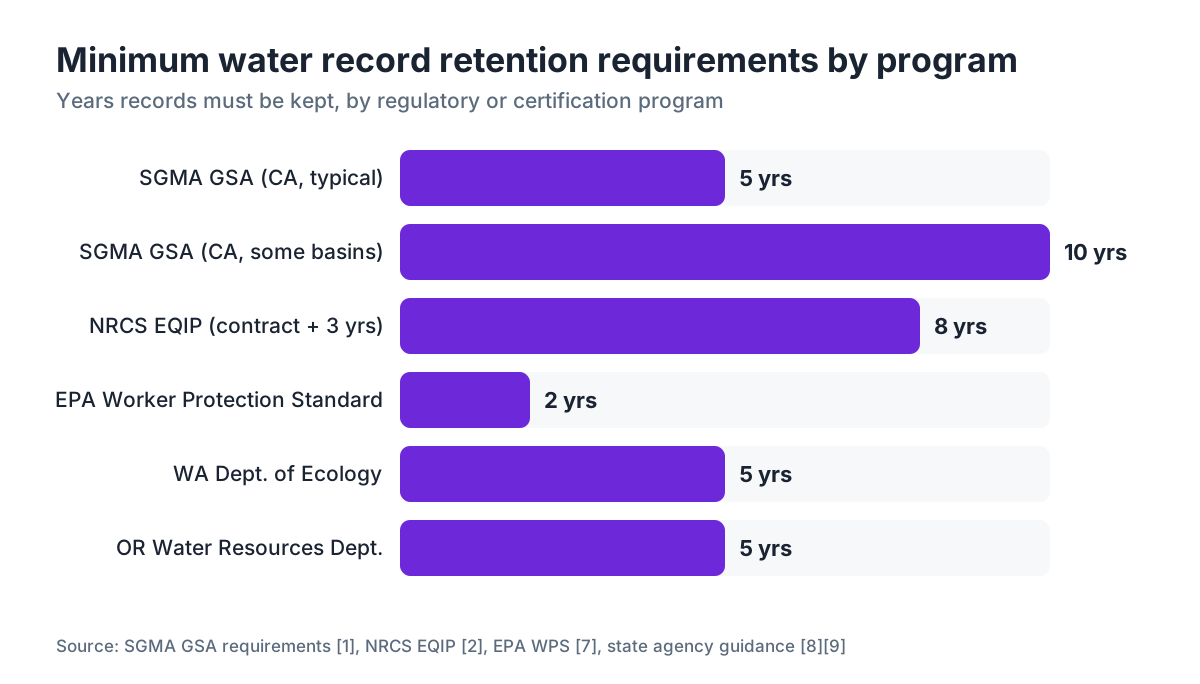
Back up your records off-site. Water records for SGMA compliance should be kept at least five years under most GSA rules, though some require ten [1]. Spray records under the EPA Worker Protection Standard require two years of retention [7]. Keep your irrigation records on the longer schedule to be safe.
What are the regulatory minimum record requirements for vineyard water use?
Requirements vary by state and program, and the floor is lower than compliance talk suggests. The ceiling keeps rising.
California (SGMA basins): If your well is subject to extraction reporting, you must report annual applied water, typically by April 1 for the prior year. Many GSAs require monthly or quarterly reporting. Check your specific GSA's Groundwater Sustainability Plan [1].
Washington: The state's water rights system requires permit holders to report actual annual use compared to permitted quantities. The Department of Ecology keeps these records [8].
Oregon: Water right holders must submit annual use reports to the Oregon Water Resources Department. Agricultural users over certain thresholds use the online WRD reporting system [9].
NRCS EQIP (all states): Practice 449 requires documentation of the irrigation scheduling approach and seasonal applied water totals for payment verification [2].
Certified sustainable programs: LODI Rules, SIP Certified, and Fish Friendly Farming all require irrigation records for annual audit. Specific fields vary by program.
EPA Worker Protection Standard: The WPS itself doesn't regulate water records, but if you keep combined field records, the WPS requires specific pesticide application records for two years [7]. Keep your irrigation log in the same system so nothing falls through a gap.
The honest minimum that covers most scenarios: date, block, volume, and a one-line reason for the decision. Everything above that is better, and everything above that helps you learn from the season.
How do you document a decision NOT to irrigate under a deficit program?
This is the part growers skip most, and it's the part that proves you're running a managed deficit rather than just forgetting to turn on the pump.
Every scheduled decision window, whether you irrigate or not, needs a record. Checked your tensiometers on July 8, decided the vines were inside your target stress range, and skipped irrigation? That needs to appear in your log.
A skip entry is simpler than an event entry:
Date: July 8
Block: West Block Grenache
Reading: SWP -0.9 MPa (predawn), within veraison target of -0.8 to -1.2 MPa
Action: No irrigation
Next review: July 15
Logged by: S. Park
That's it. Four lines. It proves you checked, it shows what you found, and it shows the decision was on purpose.
A common real-world problem: growers take the readings and make the calls but log only the irrigation events. When a certifier asks "how many times did you check and decide not to irrigate during veraison?" there's no answer. All you have is the irrigation events. The whole story of deficit irrigation is the withheld water, and you can't tell that story without the skip entries.
Can you use a simple spreadsheet, or do you need dedicated software?
A spreadsheet works. The requirements don't mandate any particular tool. What matters is consistency, completeness, and the ability to produce a seasonal summary when asked.
A Google Sheet or Excel file with one tab per block, columns for each required field, and a summary tab that aggregates by season is fully functional for operations with fewer than about a dozen blocks. The risks with spreadsheets: no automatic timestamps, no user attribution (so you can't prove who entered what), and easy accidental editing of past records.
For operations with more blocks, multiple employees making entries, or GSA reporting obligations, a dedicated record-keeping tool earns its cost. VitiScribe was built for field operations records including irrigation logging, with timestamped entries and block-level aggregation built in. A well-disciplined spreadsheet still beats a poorly-used app every time.
Whatever tool you choose, the test is this: can you produce a complete seasonal water use report for any single block within ten minutes, starting from nothing? If yes, your system works. If not, fix the gaps before your GSA asks.
How do you connect your water records to your overall vineyard compliance file?
Water records don't live in isolation. They connect to spray records (irrigation affects canopy and disease pressure and often happens near spray events), fertilizer records (fertigation needs separate nutrient logs), and any reporting obligations to your GSA or water rights agency.
The cleanest approach is a block-based filing system where every management action for a block in a given season sits in one place. Open Block 7's 2024 folder and you find irrigation events, spray applications, soil samples, and yield data. A question about any one thing doesn't send you hunting across multiple systems.
For vineyard operations that sell to wineries with third-party sustainability audits, your water records get reviewed alongside your spray records. Auditors look for internal consistency. If your records show heavy irrigation during disease-prone periods, they'll want to see corresponding spray records. If your records show extreme water stress during fruit development, they'll want yield data that matches that stress level. Records that contradict each other raise flags.
WSU Extension's irrigation management guides for Washington wine grapes stress keeping records that link water decisions to observations about canopy closure, cluster development, and shoot growth, because those connections make the water record readable in context [4].
What are common mistakes growers make in vineyard water records?
A few patterns come up again and again when growers try to reconstruct their records at audit time.
Recording run time instead of volume. Run time is useful only if you also have the flow rate. Write both. If your drip system runs at 0.5 GPH per emitter, 300 emitters, for 4 hours, record that calculation, more than "4 hours."
Lumping multiple blocks under one entry. "Irrigated Zone A" when Zone A holds three blocks with different vine ages, rootstocks, and stress levels is not a useful record. Block-level entries take 90 seconds more and produce ten times the value.
Using vague triggers. "Vines looked stressed" is not a decision trigger. "Leaves were cupping and tendrils were wilting at 10 AM observation on July 2" is a decision trigger.
Not recording the scheduling method. Whether you use SWP, ETc, or a combination, state the method at the start of each season and reference it in each entry. An entry that says "triggered by ET balance, see CIMIS export" is complete. One that says "it was dry" is not.
Forgetting to note rainfall. Rainfall credited toward your water balance needs to appear in the log. A 0.4-inch rain event that pushed your decision window out by 10 days is part of the story.
End-of-season data loss. If your records live only on a phone or a single computer, back them up before the device fails. Lose a season's water records in a critically overdrafted SGMA basin and you have no defense in a compliance proceeding.
How do deficit irrigation records help you improve future seasons?
Compliance is a side effect of good recordkeeping. The main reason to keep detailed deficit irrigation records is that they're the only way to learn whether your program is actually working.
At the end of each season, your records should let you answer:
- Which blocks showed the most water use efficiency (Brix or quality per acre-inch applied)?
- Were there decision windows where you applied water that, in retrospect, wasn't needed?
- Did any blocks consistently run stress levels above your target range?
- How does this year's applied water total compare to the three-year average for the same blocks?
Nobody has great aggregated data on the long-run quality effects of specific deficit levels across different California appellations. The closest published work is a set of UC Davis trials showing that moderate pre-veraison deficit (50 to 60 percent ETc) consistently reduced berry size and increased skin-to-pulp ratios in Cabernet Sauvignon without significantly reducing yield, with the effects most pronounced in loamy soils [3]. That's replicated trial work on a research vineyard. Your records from your blocks are the only data that applies to your specific combination of soil, rootstock, scion, climate, and management.
Multi-year records that connect stress levels to sensory outcomes are worth real money when you're making varietal decisions or talking with a winery buyer who wants the production story. That context doesn't exist without the records.
Frequently asked questions
How long do I need to keep vineyard irrigation records?
It depends on which obligations apply to you. SGMA GSAs in California typically require five to ten years of extraction records, depending on the basin's Groundwater Sustainability Plan. NRCS EQIP practice documentation must be kept for the length of the contract plus three years. EPA Worker Protection Standard spray records require two years. Keeping all field records on a ten-year schedule puts you safely inside every program's window.
Do I need to report my vineyard water use to the state if I have a private well?
In California, if your well sits in a medium- or high-priority basin under SGMA, your GSA likely requires extraction reporting regardless of whether the well is private or shared. The reporting obligation follows the basin designation, not the ownership structure. In Washington and Oregon, water right holders must report actual use annually regardless of source. Check your specific GSA's Groundwater Sustainability Plan and your state water right permit conditions for the exact thresholds.
What's the difference between recording applied water and net irrigation requirement?
Net irrigation requirement (NIR) is the calculated amount of water your vines theoretically need after accounting for rainfall, which is ETc minus effective precipitation. Applied water is what you actually put in the ground. In a deficit program, applied water is intentionally less than NIR. Both numbers matter for records: NIR shows your calculation baseline, applied water shows your actual input. The gap between them is your documented deficit, and it's what regulators and certifiers want to see.
Can visual stress observations count as a documented decision trigger?
Yes, if they're specific. "Mild leaf rolling observed on 15% of vines in Block 2 at 10 AM, consistent with mild midday stress" is a defensible trigger. "Vines looked stressed" is not. Visual observations are weaker than instrument readings because they're not reproducible, but they're used routinely, especially in operations that don't own a pressure chamber. Pair visual observations with the growth stage, time of day, and temperature to give them context.
How do CIMIS or AgWeatherNet data fit into my irrigation record?
These state weather networks provide reference ET (ETo) data that forms the basis of ET-based scheduling. Log the station name and ID, the date range, and the ETo values you used. Download and attach the station report to your seasonal file. CIMIS (California) and AgWeatherNet (Washington) both allow data export by station and date range. That export is a timestamped third-party data source that anchors your calculations and is very hard for an auditor to dispute.
What crop coefficient (Kc) should I use for wine grapes and where does that number come from?
UC Davis and WSU Extension both publish Kc curves for wine grapes by growth stage. UC Davis values for wine grapes typically range from 0.15 at early budbreak to a peak of around 0.70 at full canopy, dropping again after veraison. The values depend on canopy cover and training system. Record which Kc source you're using (publication and year), and note if you've calibrated it to your site. Using published values without documentation still beats using no Kc at all.
Does my deficit irrigation record need to be block-specific or can I record by management zone?
Block-specific is better and what most certifiers and GSAs prefer. A management zone that combines blocks with different rootstocks, vine ages, or soil types into one entry loses the resolution needed to understand outcomes. If you genuinely manage blocks identically and apply water identically, a zone entry is defensible, but document why the blocks are treated as a unit and make sure your flow meter or volume calculation still gives you a real number, not an estimate.
What stem water potential readings indicate I'm running a deficit, and how do I record those thresholds?
Predawn leaf water potential below -0.6 MPa and midday stem water potential below -1.0 to -1.2 MPa are commonly cited as entry points for managed stress in wine grapes, depending on variety and growth stage. UC Davis extension materials provide threshold ranges by phenological stage. Record the threshold you're targeting in your seasonal irrigation plan at the start of the year, then reference it in each entry. That way, individual readings make sense in context.
If I use a consultant to make irrigation decisions, do I still need to keep the records?
Yes. The compliance obligation follows the water right, not who made the management decision. Your consultant should give you written decision summaries after each site visit or remote review. Those summaries become part of your records. Make sure your agreement with the consultant says they'll provide dateable, signed documentation of each decision they make. Verbal recommendations from a consultant don't satisfy an auditor.
How do I record an irrigation event where I ran shorter than planned because of equipment failure?
Record what actually happened, not what you planned. Note the planned run time and volume, the actual run time and estimated volume delivered, the reason for the difference (equipment failure, power outage, etc.), and any corrective action taken. An honest partial event entry is not a compliance problem. A falsified complete entry is. Equipment failures are normal; document them and move on.
Do water records for deficit irrigation help with crop insurance claims?
They can. If you file a USDA Risk Management Agency claim for drought or heat-related loss, documentation showing you followed an established irrigation management plan rather than underirrigating by neglect strengthens your claim. The RMA doesn't require specific irrigation records, but an adjuster reviewing a yield loss claim will find it much easier to credit drought stress as the cause if you have dated stress readings showing vine water status throughout the season [10].
What's the minimum record a small one- or two-acre vineyard needs to keep?
If you're below the reporting thresholds for your state's water rights system and not enrolled in a certified sustainable program, the minimum that's still useful is: date, volume applied or skipped, and a one-line reason. Three fields per event. Even that simple log will tell you your annual applied total and give you something to reference when you're trying to remember why you made a certain call. It takes under a minute per entry.
Can I photograph my pressure chamber readings instead of writing them down?
A timestamped photo of the gauge is decent supporting evidence but shouldn't be your only record. Pressure chamber gauges don't show which block, which vine, or who was measuring. Take the photo if you want a secondary record, but pair it with a written or typed log entry that adds the missing context. Photos stored only on a personal phone also have a high attrition rate; they get lost when phones are upgraded or broken.
How do I roll up block-level water records into a parcel or farm total for GSA reporting?
Add a summary column to your seasonal spreadsheet that aggregates applied water by parcel APN (Assessor's Parcel Number). Each block entry should carry the APN it sits on, so summing by APN gives you the parcel total in acre-inches. Convert to acre-feet by dividing by 12. Most GSA online reporting portals accept acre-feet by APN. If a block straddles two parcels, split the acreage proportionally and allocate applied water the same way.
Sources
- California Department of Water Resources, Sustainable Groundwater Management Act: SGMA gives Groundwater Sustainability Agencies authority to require agricultural water users to report applied water volumes, with most reporting in acre-feet per year at the parcel level
- UC Davis Cooperative Extension, Irrigation Management for Wine Grapes: UC Davis recommends tracking irrigation dates, run times, flow rates, and scheduling method; predawn LWP below -0.6 MPa is a trigger threshold pre-veraison; moderate pre-veraison deficit (50-60% ETc) consistently reduced berry size and increased skin-to-pulp ratios in Cabernet Sauvignon without significantly reducing yield
- Washington State University Extension, Wine Grape Irrigation Management: WSU Extension recommends measuring stem water potential on at least three representative vines per block with leaves bagged 90 minutes before measurement, and keeping records that link water decisions to observations about canopy closure and cluster development
- California Department of Water Resources, California Irrigation Management Information System (CIMIS): CIMIS provides daily reference ET (ETo) by station and offers a water balance tool; data exports are available by station and date range
- Cornell Cooperative Extension, Viticulture and Enology Program: Cornell's viticulture extension team notes that records showing the relationship between water applied and Brix at harvest are more defensible than volume records alone
- U.S. Environmental Protection Agency, Agricultural Worker Protection Standard: The EPA Worker Protection Standard requires specific pesticide application records to be retained for two years
- Washington State Department of Ecology, Water Rights: Washington water rights permit holders must report actual annual use compared to permitted quantities to the Department of Ecology
- Oregon Water Resources Department, Water Use Reporting: Oregon water right holders must submit annual use reports to the Oregon Water Resources Department; agricultural users over certain thresholds use the online WRD reporting system
- USDA Risk Management Agency, Crop Insurance: RMA crop insurance adjusters review management practices including irrigation when evaluating drought or heat-related yield loss claims
- AgWeatherNet, Washington State University: AgWeatherNet provides reference ET and weather data by station for Washington growers to use in ET-based irrigation scheduling
Last updated 2026-07-10