How to document IPM decisions in vineyard records

TL;DR
- Every IPM record needs four things: the pest or condition that triggered a decision, the threshold or scouting data behind it, the action you took (including 'no spray' calls), and who made the call.
- The federal Worker Protection Standard and most state ag departments can pull these records going back two years.
- A paper log works.
- A timestamped digital system works better.
Why do vineyard IPM records matter for compliance and audits?
IPM documentation is not optional paperwork. It's the evidence that justifies your pest management choices to certifiers, auditors, buyers, and regulators. If you farm under a third-party sustainability program like Lodi Rules, CSWA, or LIVE, your records get reviewed on a set cycle. If you hold an organic certificate, your certifier can request spray and scouting logs at any time. And if you ever face a pesticide misuse complaint, your records are the first thing a state ag investigator asks for.
The EPA Worker Protection Standard (WPS), revised in 2015, requires pesticide application records be kept for two years and made accessible to workers and their representatives on request [1]. That's a federal floor. Many states stack longer retention windows or more detailed field-level rules on top of it.
The practical case is just as strong. Vineyards that track scouting data over several seasons start seeing patterns: which blocks get powdery mildew pressure first, which cover crop mix runs alongside lower leafhopper counts, which years early-season botrytis risk is real versus years it fizzles. Without records, that institutional knowledge walks out the door when a vineyard manager changes jobs.
Here's the thing most managers miss. Documenting the decision NOT to spray matters as much as logging an application. An IPM program that can only show spray records looks like a conventional program with extra steps. The 'no-spray' entry, tied to a threshold that never got crossed, is what proves you're actually running IPM.
What information belongs in an IPM decision record?
Every IPM decision entry needs six data fields at minimum. Miss any one and the record loses its evidentiary value.
Date and block ID. The date must be the actual scouting or decision date, not the day you got around to filling in the log. Block ID should match your farm map exactly. Auditors cross-reference field IDs across spray records, water use logs, and harvest reports.
Pest or disease, growth stage, and conditions. Name the specific pest or pathogen (Erysiphe necator for powdery mildew, more than 'mildew'). Record vine growth stage using a standard scale like BBCH or Eichhorn-Lorenz. Note temperature, humidity, and recent rain if a disease risk model informed your call.
Scouting data. How many vines or leaves did you sample? What did you find? Leafhopper egg counts per leaf, percent shoot infection for powdery mildew, mite-infested leaves per sample: write the actual numbers. UC IPM guidelines for wine grapes give sampling protocols and economic thresholds for most major California pests [2].
Threshold comparison. State the action threshold you used and its source, then compare your scouting result against it. 'Found 2 leafhoppers per leaf; UC threshold for first generation is 15 to 20 per leaf; no action taken' is a complete entry. 'Bugs present; sprayed' is not.
Decision and rationale. What did you decide, and why? If you sprayed, name the product, rate, and application method. If you didn't spray, say so and explain briefly. If you used a cultural or biological control instead, describe it.
Who scouted and who decided. These can be the same person. Both need names. Initials with a key elsewhere in your logbook are fine. This matters for WPS compliance and for any liability question about who had authority to make the call [1].
Cornell's IPM program recommends putting weather conditions and field history notes in every scouting record, noting that records without context are hard to read in future seasons [3].
What are the required IPM thresholds and scouting protocols for wine grapes?
Action thresholds are the backbone of IPM. They're the documented trigger points that separate pest management from calendar spraying. For your records to hold up, cite a recognized threshold source. A gut feeling won't survive an audit.
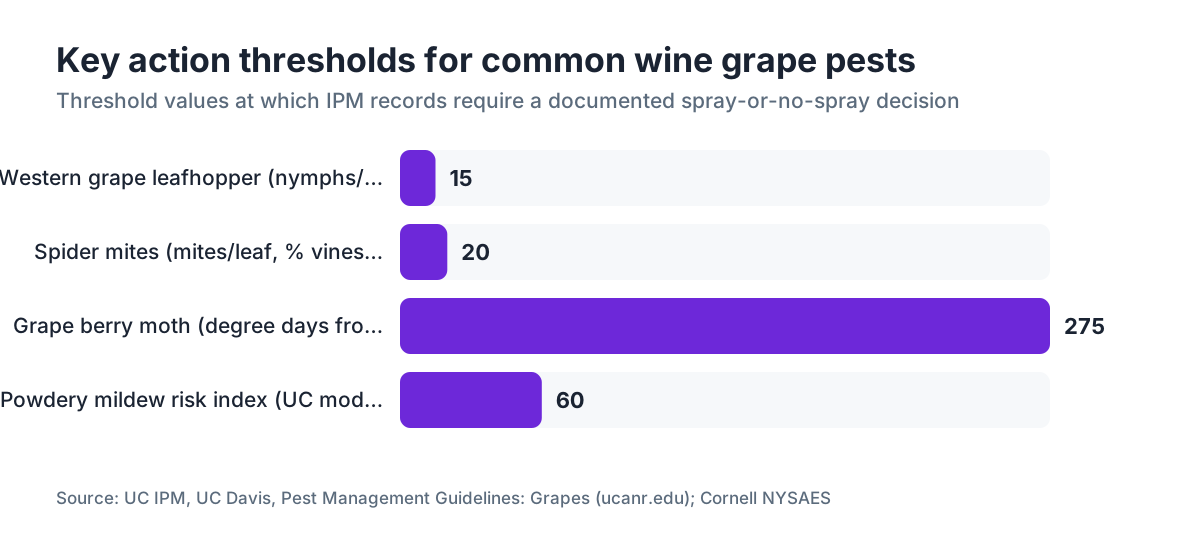
Here's a working reference table for common wine grape pests, with thresholds pulled from UC IPM and WSU Extension:
| Pest | Threshold (scouting trigger) | Source |
|---|---|---|
| Western grape leafhopper | 15-20 nymphs per leaf (1st gen); 20 per leaf (2nd gen) | UC IPM [2] |
| Grape mealybug | 1 mealybug per vine at delayed dormant; any egg mass present near harvest | UC IPM [2] |
| Powdery mildew | Disease risk index >60 (UC model); or 1+ infected shoot per 25 scouted | UC IPM [2] |
| Botrytis bunch rot | Risk-based threshold using weather models at bloom and veraison | WSU Extension [4] |
| Grape berry moth | 250-300 degree-day accumulation from biofix for first spray timing | Cornell NYSAES [3] |
| Spider mites | 20+ mites per leaf on 50% of sampled leaves | UC IPM [2] |
WSU Extension's viticulture and enology program covers Pacific Northwest pest management in detail, including thresholds tuned to eastern Washington conditions [4]. For New York and the eastern states, Cornell's New York State IPM Program publishes wine grape guidelines updated most growing seasons [3].
Record the specific threshold you used each time. If you run a disease risk model like UC's powdery mildew risk index or a botrytis calculator, print or screenshot the model output for that date and keep it with your scouting log. That output is your documentation.
How should a vineyard IPM logbook be organized?
Structure matters more than most people think, on paper or on a screen. Auditors and certifiers work fast. If your records are hard to navigate, they assume you're hiding something or that the system is unreliable.
Organize by block, then by date within each block. A single chronological log covering the whole farm looks fine to you but is nearly impossible for an auditor to verify against a field-level complaint or a certification review for one parcel.
A block-level folder system, paper or digital, lets you pull every decision ever made in Block 7 in under two minutes. Each block folder should hold the block map, the season's scouting logs in date order, spray records for that block (or a clear pointer to your central spray log), and the end-of-season pest summary if your program wants one.
Inside each scouting entry, use a consistent template. Blank fields invite shortcuts. A template with labeled fields for every required data point takes the guesswork out for whoever fills it in, especially a crew member rather than the manager.
Keep a decision register separate from your scouting log. The register is one running list: date, block, pest, decision, product or action if any, and a cross-reference to the scouting entry that backs it up. This becomes your audit-ready summary. It shows reviewers your decision cadence without making them page through every scouting sheet.
Digital systems make cross-referencing and retention much easier. Tools like VitiScribe let you attach photos, model outputs, and weather data to individual block entries, so your threshold comparison carries its supporting evidence right there. Paper is still defensible. You just need a clear backup and retention plan.
What do certifiers and auditors actually look for in IPM records?
Published Lodi Rules and CSWA standards spell out what flags a record set as incomplete, and the pattern is consistent across programs.
First, the decision trail. Can a reviewer follow the logic from pest observation to threshold comparison to action? If the trail breaks anywhere, the record gets flagged. The most common break: spray records exist but scouting records for that date and block are missing. That pattern suggests the spray came first and the justification got filled in later, which is exactly what IPM is supposed to prevent.
Second, negative decisions. A vineyard that sprayed eight times and has eight scouting entries looks suspicious. A vineyard that scouted fifteen times, sprayed eight, and has 'threshold not reached' notes on the other seven looks like a real IPM program.
Third, product records that line up with IPM principles. If your program restricts certain pesticide classes, your spray records need to show only permitted materials. When a borderline product got chosen, your documentation needs a stated reason, like resistance management or a case where softer alternatives already failed.
Fourth, signature and dating. Backdated records are obvious when they're written in a different pen color or carry suspiciously uniform handwriting across a week of entries. Date and initial at the time of scouting.
The Lodi Winegrape Commission's Lodi Rules program, which covers roughly 800 grower members, requires that IPM records include monitoring data, action thresholds, and the management response for each decision [5].
How do you document 'no-spray' decisions and justify them?
This is where most vineyard IPM record-keeping falls apart. Managers think records are for applications. They're not. They're for decisions.
Every time you scout and choose not to spray, that entry needs the same fields as a spray decision: date, block, pest, count or observation, threshold, decision, and who made it. Only the action column changes. It reads something like 'threshold not reached; no action taken.'
Why does this matter in practice? Because IPM audits calculate your threshold-based decision rate. If 80% of your scouting entries end in a spray, you may be running a calendar program and calling it IPM. If 40% end in a spray and every one ties clearly to a crossed threshold, your program is defensible.
A 'no-spray' entry also captures the value of cultural practices you used instead. Adjusted canopy management to cut humidity and lower botrytis risk? Log it. Released predatory mites to hold down spider mite pressure without a miticide? That entry shows the biological control choice and its rationale.
Some managers add a short weather note to no-spray entries during high-risk stretches. 'Checked powdery mildew risk model on 6/14; index at 42, below spray threshold of 60; no application made' takes about thirty seconds to write and makes the record airtight.
What are the EPA Worker Protection Standard requirements for pesticide records?
The WPS under 40 CFR Part 170 sets baseline federal rules for any agricultural establishment where pesticides are applied and workers are present [1]. A few WPS provisions bear directly on IPM documentation.
Application records must include the product name, EPA registration number, active ingredient(s), crop treated, location and size of the treated area, date of application, and the restricted entry interval (REI) for each product. These records must be kept for two years from the application date and made available to workers or their designated representatives within 15 days of a request [1].
WPS defines 'agricultural establishment' broadly. Hire any labor for vineyard work and use any registered pesticide, and you're covered. There's no small-acreage exemption.
WPS records are separate from your IPM decision log, but the two need to be compatible. Your spray record and your IPM decision record for the same block on the same date should tell one story. If your IPM log says 'leafhopper threshold reached; applied Movento at 6 fl oz/acre,' your WPS application record should show Movento, the EPA reg number, the treated block, and the date. Mismatches between the two sets are a red flag in any audit.
The WPS revised rule took effect January 2, 2017. It also added anti-retaliation protections, designated representative access, and expanded mandatory training content [1]. Those aren't strictly IPM documentation, but they're part of the same compliance picture your records need to support.
How long do you need to keep vineyard IPM and spray records?
Retention rules vary by record type and jurisdiction, so know your specific obligations.
Federal WPS: two years from the application date [1].
California DPR: California requires pesticide use reports (PURs) for all agricultural applications, submitted monthly to the county agricultural commissioner. The underlying field-level records that support the PUR must be kept for two years under state law [6]. California also requires a licensed pest control adviser (PCA) recommendation before you buy or apply most pesticides on commercial vineyards, and those recommendation records belong in your compliance file.
Oregon and Washington: both states require pesticide application records with two-year minimums, though Washington layers on tighter, more detailed rules for certain restricted-use pesticides [7].
Organic certification (NOP): the USDA National Organic Program requires certified operations to keep records for five years covering all practices and materials used in production [8]. For a certified organic vineyard, your IPM scouting logs, input applications, and threshold documentation all fall under that five-year rule.
The practical answer: keep everything for five years regardless of certification status. Storage is cheap. Losing records in a dispute is expensive. Go digital and you should make sure backups are offsite or cloud-based with documented access controls.
Third-party sustainability programs like Lodi Rules and LIVE set their own retention requirements, usually aligned with an audit cycle that runs every two to four years.
What does a complete IPM record look like for a single scouting event?
Here's a concrete example of an audit-ready IPM record for one scouting event. It's not a template to copy line for line. It's an illustration of the data density that makes a record defensible.
Date: June 18, 2025
Block: Estate North, Block 3 (Cabernet Sauvignon, 4.2 acres, drip irrigated)
Growth stage: BBCH 75 (75% berry size; pre-veraison)
Scouted by: J. Ramos
Decision made by: T. Chen (Vineyard Manager)
Pest/disease targeted: Powdery mildew (Erysiphe necator)
Scouting method: 25 shoot tips examined on 25 randomly selected vines across block
Observation: 1 infected shoot tip found; 4% incidence
Threshold used: UC IPM wine grape powdery mildew threshold for pre-veraison: >5% shoot infection warrants application [2]
Risk model consulted: UC Powdery Mildew Risk Index checked on 6/18; index = 38 (below action level of 60)
Weather last 7 days: 3 rain events totaling 0.4 inches; max humidity 74%; temperature range 58-82°F
Decision: No application. Incidence below threshold; risk index below action level. Canopy management (shoot thinning completed 6/10) adequate for airflow.
Next scouting date: June 25, 2025
Notes: Watch Block 3 closely; it's the first to show symptoms most years due to a lower-elevation frost pocket with morning humidity.
That entry takes about three minutes to write. It would take thirty minutes to reconstruct from memory after the fact, and a reconstruction won't fool an auditor who knows what real contemporaneous records look like.
How can digital record-keeping improve IPM documentation in vineyards?
Paper works. Plenty of vineyards run clean IPM programs on paper logbooks, and there's nothing wrong with that. But paper has four failure modes digital systems dodge.
First, legibility. Field notes written in the rain, in a hurry, by different people with different handwriting are hard to read six months later and nearly impossible to aggregate across blocks or seasons.
Second, searchability. When a certifier says 'show me every entry where you found leafhopper above one nymph per leaf,' paper makes you page through every scouting record for the relevant blocks and seasons. A database query returns the answer in seconds.
Third, photo and data attachment. UC and WSU both recommend photographing pest damage and attaching disease model outputs to scouting records [2] [4]. Paper can't do this natively.
Fourth, backup. A fire, a flood, a lost logbook. Paper records are gone. A cloud-backed digital system carries a full audit trail with timestamps showing when each entry got created, which is itself a form of data integrity evidence.
For managers who want a system built around field operations and compliance, VitiScribe structures IPM logs, spray records, and WPS documentation in a single block-level interface, with export formats aimed at common certification audits.
That said, the best system is the one you'll actually keep up. A well-maintained paper log beats a neglected digital one every time.
How does IPM documentation connect to spray record requirements?
Your IPM decision log and your spray record are two different documents that need to stay consistent and cross-referenced.
The spray record is an application document: what product, what rate, what block, what date, who applied it, what the REI is, what the PHI is. It's required by WPS, by California DPR through the PUR system, and by most state ag departments [1] [6].
The IPM decision log is a decision document: what pest or disease was observed, what threshold was relevant, what action got chosen. IPM certification programs and organic certifiers require it, and it supplies the 'why' that a spray record leaves out.
The connection runs both ways. Every spray entry in your spray record should have a matching IPM decision entry explaining why the spray happened. Every IPM decision entry that ends in a spray should have a matching spray record. Entries in one log without a counterpart in the other are a documentation gap.
A practical approach: run a decision register as the master document. Each row is a date-block combination where a scouting event happened. Columns cover pest, threshold status, action taken, and spray record reference number if applicable. This register is the index that ties your two record sets together and hands auditors a single starting point.
When a PCA is involved, their written recommendation joins the chain too. The PCA rec documents what product got suggested and why; your spray record documents what got applied; your IPM log documents the scouting that came before the PCA recommendation. All three tell one story from different angles.
What are common IPM record-keeping mistakes that fail audits?
The same mistakes show up over and over in state compliance reviews and certification audits. Steer clear of these.
Missing scouting data behind spray decisions. A spray record with no matching scouting entry is the single most common audit failure. The rule: no spray record should exist without a scouting entry that triggered it.
Generic pest names. 'Mites' is not a pest record. 'Willamette mite at 18 per leaf on 15 of 25 sampled vines in Block 2' is. Precision matters because thresholds are species-specific.
No threshold source cited. 'We decided to spray because levels were high' fails on the spot. High relative to what? Cite the specific UC, WSU, or Cornell threshold you used, or your own farm-validated threshold with its documentation.
Backdated entries. Auditors can tell. Date and sign at the time of scouting.
Spray records and IPM logs that don't match. If your spray record shows Quintec applied to Block 5 on July 3 but your IPM log has no Block 5 entry near that date, you have a problem.
No records for organic or soft materials. Sulfur, Bt sprays, kaolin clay, copper: these are pesticide applications and need records just like synthetic materials do.
Missing REI and PHI on spray records. WPS requires these [1]. Auditors check them.
End-of-season abandonment. Some managers scout hard through bloom and fruit set, then quit. Veraison and pre-harvest are high pest and disease risk periods. Your records need to cover the full season.
Washington State Department of Agriculture guidance is blunt on this point: incomplete records get treated the same as missing records in state compliance reviews [7].
Frequently asked questions
Do small vineyards under 10 acres need to keep IPM records?
Yes. If you apply any registered pesticide and employ any agricultural workers, the federal WPS two-year record retention requirement applies regardless of acreage. California, Oregon, and Washington have no small-farm exemption for pesticide application records. If you're certified under any third-party program (Lodi Rules, organic, LIVE), those programs also require records regardless of farm size.
Can I use a simple spreadsheet instead of specialized software for vineyard IPM records?
Yes. A well-built spreadsheet with consistent column headers, one row per scouting event, and a separate sheet for spray records works fine for audits. The requirements are about content, not format. Specialized software adds searchability, photo attachment, and built-in export formats, but those are conveniences, not compliance requirements. Use whatever system you'll actually maintain.
What is an action threshold and do I have to cite one every time I make an IPM decision?
An action threshold is the pest or disease level at which the cost of damage exceeds the cost of control. For IPM certification, yes, you need to cite a recognized threshold source for every decision. UC IPM, Cornell NYSAES, and WSU Extension all publish thresholds for major wine grape pests. If you use a farm-specific threshold, you need documentation showing how you derived it.
How often should a vineyard manager scout each block during the growing season?
It depends on the pest and the risk period. UC IPM recommends weekly scouting for powdery mildew and leafhopper during the high-risk window from budbreak through veraison. Disease-risk models can stretch the interval during low-risk stretches. At minimum, scout every 10 to 14 days through the growing season and document each visit, including visits where you found nothing of concern.
Does documenting IPM decisions matter if I'm not in a certification program?
Yes, for two reasons. WPS spray records are a federal requirement regardless of certification. And detailed scouting and decision records build a farm-specific pest database over seasons that makes future calls cheaper and sharper. Many buyers and distributors now request IPM documentation as part of supplier vetting even when no formal certification is in play.
What's the difference between an IPM decision log and a spray record?
A spray record is an application document: product, rate, block, date, who applied it, REI, PHI. It's legally required. An IPM decision log is a decision document: what pest or disease was observed, what threshold applied, what action got chosen, including no-spray decisions. IPM certification programs require the decision log. Both documents should cross-reference each other for every application event.
Does California require a pest control adviser recommendation before vineyard pesticide applications?
Yes. Under the California Food and Agriculture Code, a licensed pest control adviser (PCA) written recommendation is required before buying or applying most pesticides on commercial agricultural operations, including vineyards [6]. The PCA recommendation is part of your compliance record chain and should be kept with your spray records for the two-year minimum.
How do I document the use of disease risk models like the UC powdery mildew model in my IPM records?
Note the model name and the index value on the scouting date in your IPM log. Print or screenshot the model output and attach it to the record. Write it clearly: 'UC Powdery Mildew Risk Index consulted on [date]; index value = [X]; action threshold = 60; no spray made' or 'index = [X]; above threshold; spray initiated.' The model output is supporting evidence for your decision.
How do IPM records differ for organic-certified vineyards?
Organic-certified vineyards under the USDA National Organic Program must keep all production records, including IPM scouting logs and input applications, for five years rather than the two-year WPS minimum. Every material applied must appear on the NOP National List of approved substances. Your IPM log needs to show prohibited materials were never used, so no-spray entries and organic-approved material entries both carry compliance weight.
What photo documentation should accompany vineyard IPM records?
Photos add credibility and detail that written notes sometimes miss. Good IPM photos show the pest or disease symptom with a scale reference, the plant part and growth stage, and a block or row identifier in the frame when possible. Date-stamp photos automatically if your phone allows. Store them linked to the matching scouting entry. UC Davis IPM recommends photographic documentation especially for new or ambiguous pest identifications.
Can a vineyard worker fill out IPM scouting records, or does it have to be the manager?
A trained worker can fill out scouting records. The record must name who scouted and who made the treatment decision, which can be different people. The manager or designated decision-maker needs to be identified for every action decision. If you delegate scouting to a crew member, make sure they're trained on the sampling protocol and know how to record actual counts, more than presence or absence.
How do I handle IPM records when I hire a third-party pest management consultant?
You keep copies of everything the consultant provides: scouting reports, written recommendations, and any correspondence about threshold decisions. The consultant's records are part of your compliance file, not a substitute for it. If your consultant gives recommendations verbally, ask for written confirmation. Your auditor wants the decision trail from observation to action, regardless of who filled in each step.
Is there a standard form for vineyard IPM record-keeping, or do I need to create my own?
There's no single federally mandated form. WPS specifies required data fields for spray records; IPM certification programs specify required fields for decision records. Most extension programs publish templates: UC ANR, Cornell NYSAES, and WSU Extension all have downloadable scouting and spray record forms. You can adapt these or build your own as long as every required field is present.
Sources
- EPA, Worker Protection Standard (40 CFR Part 170): WPS requires pesticide application records be kept for two years and made available to workers upon request; revised rule effective January 2, 2017
- UC IPM, UC Davis, Pest Management Guidelines: Grapes: UC IPM provides established sampling protocols, economic thresholds, and disease risk model guidance for wine grape pests including leafhopper, mealybug, powdery mildew, and spider mites
- Cornell University, New York State Integrated Pest Management Program: Cornell NYSAES recommends including weather conditions and field history in every scouting record, and publishes grape berry moth degree-day thresholds for spray timing
- Washington State University, Viticulture and Enology Program: WSU publishes wine grape pest management guides with Pacific Northwest-specific thresholds and botrytis risk-based timing recommendations
- Lodi Winegrape Commission, Lodi Rules Sustainable Winegrowing: Lodi Rules certification requires IPM records to include monitoring data, action thresholds, and management response for each pest decision; approximately 800 grower members
- California Department of Pesticide Regulation, Pesticide Use Reporting and Record-keeping: California requires monthly pesticide use reports to county agricultural commissioners and underlying application records kept for two years; PCA written recommendation required before most commercial applications
- Washington State Department of Agriculture, Pesticides and Fertilizers: WSDA guidance states incomplete records are treated the same as missing records in state compliance reviews; restricted-use pesticide records have additional requirements
- USDA National Organic Program, Organic Regulations 7 CFR Part 205: NOP requires certified operations to maintain all production and handling records for five years; includes IPM scouting logs and input application records for certified organic vineyards
- UC Agriculture and Natural Resources, IPM in Practice: Principles and Methods of Integrated Pest Management: UC ANR guidance establishes that documenting no-spray decisions tied to thresholds is required evidence that a program is operating as true IPM rather than calendar-based spraying
- Oregon Department of Agriculture, Pesticides Program: Oregon requires pesticide application records with minimum two-year retention consistent with WPS baseline
Last updated 2026-07-09