How to file a pesticide use report when a licensed PCA is not on-site

TL;DR
- In California, the grower or farm operator is legally responsible for filing a pesticide use report (PUR) even when no licensed Pest Control Adviser is present.
- Reports are due to the county agricultural commissioner within 7 days of application.
- The applicator's license number, target pest, acres treated, and product EPA registration number all have to appear on the record.
- A missed filing can trigger civil penalties up to $5,000 per violation.
Who is legally responsible for filing a pesticide use report when there's no PCA?
You are. Under California Food and Agricultural Code Section 12979 and the regulations at 3 CCR Section 6618, the grower or the person who directs the pesticide application is responsible for making sure the pesticide use report gets filed with the county agricultural commissioner (CAC). A licensed Pest Control Adviser has to write a written recommendation before a restricted-use pesticide goes on, but the PCA does not have to be standing in your vineyard at spray time. Their absence changes nothing about who files. [11]
Here's the part that trips people up. If a licensed PCA wrote the recommendation, the reporting duty can fall on the pest control operator (PCO) or the grower, depending on who actually made the application. A grower who applies on their own property under the grower exemption is the responsible party. A custom applicator or PCO who applies for hire files their own PUR. The PCA who wrote the recommendation is not necessarily the filer, and being off-site has nothing to do with it. [2]
Most small vineyard operations, the owner or vineyard manager does the spraying and the filing. Get clear on which category fits you before spray season. Sorting it out after a missed deadline is a bad time to learn.
What information must go on a pesticide use report?
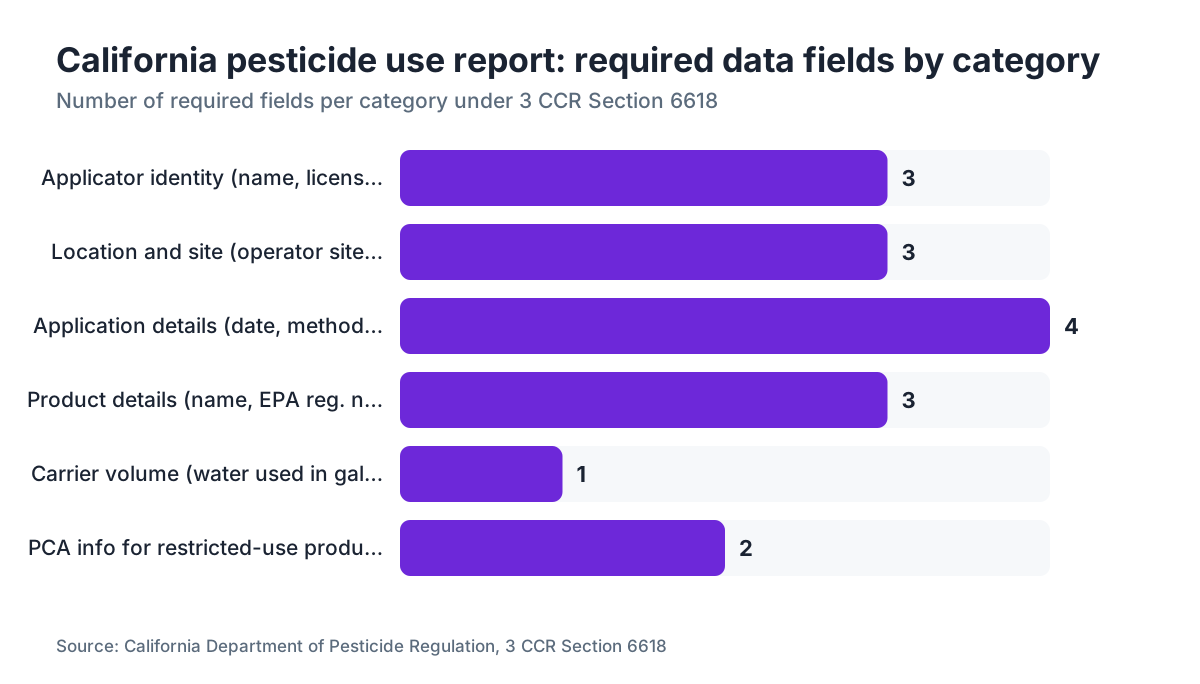
California's required data fields for a PUR are set in 3 CCR Section 6618. Every report needs the operator site ID, the application date, the applicator's name and license number, the commodity treated, acres treated, the target pest, the product and its EPA registration number, the amount applied, and the water carrier volume. Miss one field and the county can bounce it back. [1]
Here is the full list:
- The operator site identification number (site ID assigned by the county)
- Date of application
- Name, address, and license or certificate number of the person making the application
- The commodity or site treated (for a vineyard, that's wine grapes, plus the county and section/township/range or GPS coordinates of the block)
- Acres or units treated
- The pest(s) targeted
- The pesticide product name and EPA registration number
- Amount of product applied
- Water used as carrier (in gallons)
- Application method (airblast sprayer, backpack, etc.)
That water volume line surprises people. It's required. Run a 200-gallon-per-acre program through an airblast rig on 3 acres, and that's 600 gallons of water carrier on the report.
For restricted-use pesticides, you also need the PCA's name and license number, even if they wrote the recommendation two weeks ago and never showed up for the spray. Pull that off the written recommendation and put it on the record. [3]
The EPA registration number is printed on every label, usually near the top right. It looks like this: EPA Reg. No. 62719-446. Write it down before you empty the container. Digging it out of a rinsed jug afterward is genuinely miserable.
What is the filing deadline for a pesticide use report in California?
Seven days. Applications made in a given week have to reach the county agricultural commissioner no later than 7 days after the application date, and most counties run a weekly Friday cycle that lands on the same result. The California Department of Pesticide Regulation (CDPR) sets the statewide standard at 7 days after the end of the reporting period. [4]
Check with your specific CAC office. Sonoma, Napa, San Luis Obispo, and the other major wine grape counties each run their own submission portals, and each has its own quirks about formatting and delivery. Some take email with attached spreadsheets. Some want paper. A few have moved fully online. None of them will remind you when the deadline slides by.
Filing late is a real enforcement trigger. CDPR inspection data shows late or missing PURs are among the most common violations found during routine grower audits. Civil penalties under Food and Agricultural Code Section 12999.5 can reach $5,000 per violation per day. Miss several applications and that number climbs fast. [4]
Does a grower still need a PCA recommendation if no PCA is on-site?
For restricted-use pesticides, yes. A written PCA recommendation has to be in your hands before the application, whether or not the PCA ever sets foot on the property. No recommendation, no spray. [3]
For general-use pesticides applied by the grower on their own property, a PCA recommendation is not legally required in California, though plenty of growers get one anyway for liability and record-keeping. The filing requirement still applies to general-use products.
Growers get burned confusing "I have a PCA on retainer" with "my PCA has issued a written recommendation for this specific application." A phone call or a text is not a written recommendation. UC Cooperative Extension has good guidance on what a valid written recommendation has to contain under California law, including the date ranges and product specifications that need to appear in the document. [5]
A remote PCA is fine. Many PCA-grower relationships run entirely on email and periodic site visits. The PCA writes the recommendation, sends it to you electronically, and you keep it on file. They don't need to be present for the spray or the filing.
How does a grower-applicator file without a PCO license?
California lets growers apply pesticides on property they own or rent without a pest control operator license, under the grower exemption in Food and Agricultural Code Section 11502. That covers a lot of small and mid-sized vineyards. You still need a Qualified Applicator License (QAL) or Qualified Applicator Certificate (QAC) to apply restricted-use pesticides, or you have to work under the direct supervision of someone who holds one. [2]
When you file the PUR as a grower-applicator, you use your own name and grower registration number, not a PCO license number. Your county CAC can confirm exactly what ID goes in the applicator field. Applying under supervision? The supervising license holder's information goes on the record.
For vineyard managers who are employees rather than owners, the legal duty sits with the employer, the vineyard entity, but the manager is usually the one filling out the form. Whoever completes the paperwork needs the site ID, the block identifiers, and the EPA registration numbers on hand. Those three pieces cause the most delays when someone finally sits down to file and comes up empty.
What records do you need to keep, and for how long?
California requires pesticide use records kept for three years from the date of application, under 3 CCR Section 6618. [1] The EPA Worker Protection Standard (WPS), which applies to agricultural establishments that employ workers or handlers, has its own record-keeping rules, and those records have to be kept for two years from the date of application at the federal level. [6]
Keep everything three years and you cover both. Hold on to:
- The completed PUR (your copy, even after submitting to the CAC)
- The PCA written recommendation for any restricted-use product
- The pesticide product label (or a digital copy)
- The Safety Data Sheet (SDS) for each product
- Any re-entry interval (REI) posting records required by WPS
WSU Extension has a useful summary of WPS record-keeping for tree fruits and grapes in the Pacific Northwest, which tracks the California framework closely enough to use as a cross-check. [7]
Digital records are fine in California as long as they're accurate and you can pull them up. A shared spreadsheet that auto-timestamps entries works. So does purpose-built vineyard compliance software. The format matters less than this test: could an inspector sit down and reconstruct every application you made in the past three years in about 20 minutes?
How does the EPA Worker Protection Standard interact with PUR filing?
The Worker Protection Standard (40 CFR Part 170) is a federal rule run by EPA that protects agricultural workers from pesticide exposure. It requires application-specific information posted at a central location on the establishment and accessible to workers and handlers. [6]
WPS and the California PUR system are separate requirements, but they share a lot of data. Both need the product name, EPA registration number, application date, and location treated. Building a spray record form from scratch? Design it to capture every WPS field and every PUR field at once. Then you're filling out one document, not two.
WPS also sets re-entry intervals (REIs) that have to be respected and posted. REIs run from 4 hours for some general-use products up to 48 hours or more for certain restricted-use fungicides and insecticides common in vineyards. A captan spray, for instance, carries a 24-hour REI on most labels. Sulfur is commonly 24 hours as well. Your PUR doesn't record REI compliance directly, but if there's ever an inspection or a worker exposure incident, your spray records are the first thing an inspector reviews to check whether REIs were posted and observed. [6]
Cornell's Pesticide Management Education Program has solid resources on WPS record-keeping that apply to grape growers in any state. [8]
Can you file a pesticide use report electronically, and what tools help?
Most California counties now take electronic PUR submissions, and CDPR has been pushing toward statewide electronic reporting for years. CDPR's Pesticide Use Reporting system pulls data from all 58 counties, and the county portals vary. Some use CDPR's own online tools. Some have county-specific systems. A few still want paper or spreadsheet uploads. Check your county CAC website directly. [4]
The workflow that actually holds up in the field is simple: enter spray data during the application or right after, then export or submit to the county system at the end of the week. Any gap between application and data entry breeds errors, especially on the EPA registration number and the water carrier volume, the two fields people reconstruct from memory instead of writing down in real time.
A tool like VitiScribe helps here. It's built for vineyard compliance paperwork, including spray records formatted to match California PUR requirements, so you're not reformatting data by hand before submitting to the county. The point isn't to automate the thinking. It's to make the weekly filing take 10 minutes instead of an hour.
Managing multiple blocks across more than one county? You file with each county's CAC separately. There's no single statewide portal that counts for all counties as of this writing. That's a real friction point, and CDPR has been working on it for years.
What are the penalties for missing or incorrect pesticide use reports?
California Food and Agricultural Code Section 12999.5 authorizes civil penalties up to $5,000 per violation per day for pesticide use reporting violations. [4] A grower who missed three spray applications over a busy two-week stretch is looking at up to $15,000 in civil penalties before any mitigating factors come in.
In practice, first-time violations with good records and no evidence of harm often land as warning letters or smaller fines, especially if you self-report and fix the records. CAC offices care more about compliance than about revenue from penalties. Repeat violations, incomplete records during a worker exposure incident, or evidence of intentional non-reporting get treated far more seriously.
The CDPR enforcement database is public. Violations are recorded and searchable. For a winery or vineyard that sells direct-to-consumer or has retail relationships, a public enforcement record is a reputation problem on top of a money problem.
Missing a PCA written recommendation for a restricted-use pesticide is a separate violation from a missing PUR, and both can be cited at once. Apply a restricted-use product without a written recommendation and also fail to file the PUR, and that's potentially two violations per application.
How do growers in other states handle pesticide use reporting without an on-site PCA?
California runs the most detailed and strictly enforced pesticide use reporting system in the country. Most other states ask for far less. Washington requires pesticide applications recorded but has no mandatory PUR submission to a county office. Oregon has record-keeping requirements too, nothing as granular as California's weekly county submissions. [7]
Federal law under FIFRA (the Federal Insecticide, Fungicide, and Rodenticide Act) requires certified applicators to keep records of restricted-use pesticide applications, but those records stay with the applicator and get produced for inspection rather than filed with an agency. [9]
For Washington and Oregon grape growers, the practical bar is this: keep application records that would satisfy a WPS inspection, document the PCA recommendation if one was required, and hold those records at least two years under the federal WPS standard. Some states pile on extra requirements. Always check with your state department of agriculture.
Grow in multiple states, and California is the highest bar in the room. Build your record-keeping to meet California and you're compliant everywhere else by default.
| State | PUR Submission Required | Deadline | Submission Target |
|---|---|---|---|
| California | Yes | 7 days after application | County Ag Commissioner |
| Washington | No (records kept on-site) | N/A | N/A |
| Oregon | No (records kept on-site) | N/A | N/A |
| Federal (FIFRA) | No (for RUPs, records kept on-site) | N/A | Available for inspection |
What's the simplest field workflow to make sure your PUR is always on time?
The growers who never miss a PUR filing share one habit: they record the application data before they leave the block, not back at the office. The spray log rides with the tractor or the crew, on paper or on a phone.
A workflow that holds up:
- Before the application, confirm you have the written PCA recommendation on file if the product is restricted-use.
- During or right after the application, record the product name, EPA reg number, amount used, water volume, start time, acres treated, and the block identifier.
- At the end of each day, enter that data into your record-keeping system.
- Every Friday (or whatever day your county's weekly cycle ends), pull the week's records and submit to the CAC.
Step 4 takes 15 minutes if steps 1 through 3 were done right. If it takes an hour, that's your signal that data entry is happening at filing time instead of at application time.
One physical backup nearly every experienced vineyard manager swears by: a waterproof spray log binder in the tractor cab. Even on digital systems, the paper backup has bailed people out when phones die, apps crash, or an inspector shows up before the sync finished. UC Agriculture and Natural Resources recommends keeping physical backup records for exactly this reason. [10]
Running multiple blocks across different varieties and spray programs? Use a block-by-block spray record system rather than one long chronological log. Pulling records for a single block during an inspection gets much faster.
Where can you get the official PUR forms and county submission guidance?
The California Department of Pesticide Regulation publishes the official PUR data requirements and county contacts on its website. [4] Each county agricultural commissioner's office runs its own submission process, and the CDPR directory links to each one.
New to filing? Call the county CAC office first. Most counties have an agricultural ombudsman or compliance specialist who walks you through the submission format, explains the site ID system, and tells you whether the county uses a paper form, a spreadsheet template, or an online portal. The call takes 20 minutes and saves a lot of confusion.
UC Cooperative Extension farm advisors are another good resource. They know the PUR system in their counties and often run pre-season workshops covering both the agronomic and compliance sides of vineyard spray programs. The UC ANR website lists current farm advisors by county and commodity. [10]
For the federal WPS posting and record-keeping requirements, EPA's pesticide worker safety section has the full text and explanatory guides. [6] Cornell's PMEP site turns that regulatory text into plain-language summaries that read much easier. [8]
VitiScribe keeps an updated summary of county-specific PUR submission requirements for California grape-growing counties, handy if you'd rather not call each CAC separately or if your operation spans several counties.
Frequently asked questions
Do I need a PCA on-site when I apply a pesticide to my vineyard?
No. A licensed Pest Control Adviser does not have to be physically present during pesticide applications in California. For restricted-use pesticides, what you need is a written PCA recommendation in hand before you start spraying. The PCA can write it remotely based on a site visit and crop assessment. Their absence at application time has no effect on the validity of the recommendation or your obligation to file a PUR.
What is the deadline to file a pesticide use report in California?
California requires pesticide use reports submitted to the county agricultural commissioner within 7 days of application, or by the end of the weekly reporting period your county uses. Most counties run a Friday-to-Friday cycle. Missing this deadline can trigger civil penalties under Food and Agricultural Code Section 12999.5. Check with your specific county CAC for their exact window and format.
What happens if I spray a restricted-use pesticide without a PCA recommendation?
Applying a restricted-use pesticide without a written PCA recommendation violates California Food and Agricultural Code Section 11503. It's a separate violation from any PUR filing issue, so both can be cited at once. Civil penalties can reach $5,000 per violation per day. In cases involving worker exposure or environmental harm, criminal referrals are possible. Get the written recommendation before you spray, not after.
Can a vineyard manager file a PUR, or does it have to be the owner?
A vineyard manager can and often does file PURs on behalf of the operation. The filing responsibility belongs to the person or entity that directed or performed the application. If the manager runs the spray program, they're typically the one submitting records. The employer, the vineyard entity, stays legally responsible for compliance, so make sure whoever files has the correct site ID and applicator information.
Do general-use pesticides require a pesticide use report in California?
Yes. California requires PURs for all pesticide applications to agricultural commodities, well beyond restricted-use products. The information requirements are the same. General-use products don't require a PCA written recommendation, but the application still has to be reported to the county agricultural commissioner within 7 days. This is stricter than the federal FIFRA standard, which only requires records for restricted-use pesticides.
How long do I need to keep pesticide use records?
California requires pesticide use records kept for three years from the date of application under 3 CCR Section 6618. The federal EPA Worker Protection Standard requires application records kept for two years. Keep records three years and you satisfy both. Records have to be accurate and retrievable. Digital records are acceptable in California as long as you can produce them promptly during an inspection.
What is the EPA registration number and where do I find it on a pesticide label?
The EPA registration number is a unique identifier assigned to each pesticide product, printed on the label near the top, usually formatted as 'EPA Reg. No. XXXXX-XXXXX.' It's required on every California PUR. Write it down before you empty or rinse the container. If you use the same product regularly, keep a reference list of your standard spray materials with their registration numbers to speed up filing.
Does the EPA Worker Protection Standard require separate records from a California PUR?
WPS (40 CFR Part 170) and California's PUR system are separate legal requirements, but they share many data fields. A well-designed spray record captures both at once. WPS records stay on-site and accessible to workers and handlers. California PURs go to the county CAC. Build one field form that satisfies both and you skip the duplicate data entry.
Can I file pesticide use reports electronically in California?
Most California counties accept electronic PUR submissions. County systems range from online portals to email-based spreadsheet uploads. CDPR has been expanding electronic reporting across the state. Check your specific county agricultural commissioner's website for their current accepted format. There is no single statewide portal that satisfies all county submission requirements at once as of mid-2026.
What re-entry intervals do I need to post for vineyard spray applications?
The EPA Worker Protection Standard requires re-entry interval (REI) information posted at a central location accessible to workers before applications begin. REIs vary by product: sulfur commonly carries a 24-hour REI, captan-based fungicides 24 hours, and some restricted-use materials 48 hours or more. Check the specific product label. Failure to post REIs is a WPS violation and will show up in any inspection triggered by a PUR audit.
Do Washington and Oregon vineyards have the same PUR filing requirements as California?
No. Washington and Oregon don't require growers to submit pesticide use reports to a government agency. Both states require records maintained on-site and available for inspection, consistent with federal FIFRA requirements for restricted-use pesticides. California's county-submission system is unique in its scope and detail. Farm in multiple states, and building your records to California's standard means you're compliant everywhere else by default.
What should I do if I realize I missed a pesticide use report filing deadline?
File as soon as you catch the omission and call your county agricultural commissioner's office to explain. Late filings with a good-faith explanation, no history of violations, and accurate records are usually handled with a warning or reduced penalty on a first offense. Backfilling records inaccurately or ignoring the missed filing is far riskier than self-reporting. Document your correction and the date you filed the late report.
Does a grower need a qualified applicator license (QAL) to apply restricted-use pesticides?
In California, a grower applying restricted-use pesticides on their own property has to either hold a Qualified Applicator License or Qualified Applicator Certificate, or apply under the direct supervision of someone who does. The grower exemption in Food and Agricultural Code Section 11502 covers general activity, but restricted-use materials add the QAL or QAC requirement. Check with CDPR or your county CAC to confirm your situation.
What records from my PCA do I need to keep on file?
Keep every written PCA recommendation for restricted-use pesticide applications at least three years. The recommendation should include the PCA's name, license number, date, the specific product and rate recommended, the target pest, and the fields or blocks covered. If an inspector or county auditor reviews your spray records, they'll cross-reference the PUR data against the recommendation to confirm the application matched what was recommended.
Sources
- California Code of Regulations, Title 3, Section 6618 - Pesticide Use Records: Requirements for pesticide use record content, including operator site ID, applicator license number, pest targeted, acres treated, product name, EPA registration number, water carrier volume, and 3-year retention period
- California Food and Agricultural Code Section 11502 - Grower Exemption: Growers may apply pesticides on property they own or rent without a PCO license under the grower exemption; filing obligation falls on the person directing the application
- California Food and Agricultural Code Section 11503 - PCA Written Recommendation Requirement: A written PCA recommendation is required before restricted-use pesticide applications; PCA physical presence at application is not required
- California Department of Pesticide Regulation - Pesticide Use Reporting: PURs must be filed with the county agricultural commissioner within 7 days; civil penalties under FAC 12999.5 can reach $5,000 per violation per day
- UC Cooperative Extension - Pest Control Adviser Recommendations: UC Cooperative Extension guidance on what constitutes a valid written PCA recommendation under California law, including required date ranges and product specifications
- U.S. EPA - Worker Protection Standard, 40 CFR Part 170: WPS requires application information to be posted at a central location and records kept for two years; REI posting requirements apply to all agricultural pesticide applications
- Washington State University Extension - Pesticide Record Keeping for Agricultural Producers: Washington state requires pesticide application records to be maintained on-site but does not require submission to a county agency; federal FIFRA record-keeping applies
- Cornell University Pesticide Management Education Program (PMEP) - WPS Record Keeping: Plain-language summary of EPA WPS record-keeping requirements for agricultural pesticide applications applicable to grape growers in any state
- U.S. EPA - Federal Insecticide, Fungicide, and Rodenticide Act (FIFRA): Federal FIFRA requires certified applicators to keep records of restricted-use pesticide applications available for inspection; no mandatory submission to a federal agency
- UC Agriculture and Natural Resources - Integrated Pest Management: UC ANR recommends maintaining physical backup spray records; county-specific farm advisor contacts and PUR filing guidance are available through the UC ANR system
- California Food and Agricultural Code Section 12979 - PUR Filing Responsibility: The grower or person directing the pesticide application is responsible for ensuring the PUR is filed with the county agricultural commissioner
Last updated 2026-07-09