California DPR audit checklist for vineyard pesticide record compliance

TL;DR
- California growers must keep pesticide application records for 3 years (some counties require 5), submit each application report to the county agricultural commissioner within 7 days, and keep Worker Protection Standard materials on-site.
- A DPR audit can happen with no notice.
- Missing, incomplete, or late records are the top citation triggers, and penalties run up to $5,000 per violation per day.
What triggers a DPR audit of a vineyard's pesticide records?
Three things trigger an audit: a scheduled county inspection, a complaint investigation, or a random spot check. The California Department of Pesticide Regulation (DPR) works through county agricultural commissioners (CACs), who do the actual enforcement. Your CAC can walk into your operation on any business day with no notice to examine records, interview employees, and inspect equipment. [1]
Complaints trigger more audits than growers expect. A neighbor's drift call, a worker health complaint, or a fish-and-wildlife referral opens a mandatory investigation file. Once that file is open, every record gap becomes its own potential violation.
Routine county inspections are the most common case. Many counties inspect licensed applicators once a year, and that inspection almost always includes a records review. Napa, Sonoma, and Fresno keep field staff who rotate through commercial vineyards on a set cycle.
Smart growers treat every quarter like a pre-audit. Here's the math. A civil penalty runs up to $5,000 per violation per day under Food and Agriculture Code Section 12999.5, and checking your own records takes about an hour. [2] One hour against tens of thousands of dollars is not a hard call.
What records does California law require vineyards to keep?
Two rules set the mandatory fields: California Food and Agriculture Code Section 12976 and the California Code of Regulations Title 3, Division 6. Every pesticide application record has to carry the fields below. Miss one and the record is incomplete, which is the single most cited violation in the state. [2][3]
| Required field | Detail required |
|---|---|
| Grower/operator name and address | Full legal name, more than a DBA |
| Location of application | County, section, township, range or equivalent GPS/parcel ID |
| Pesticide product name | Full label name, no slang or abbreviation |
| EPA registration number | Printed on the label |
| Pest treated | Specific pest or disease, more than "disease" |
| Crop and acreage | Grape variety is not required but is good practice |
| Date and time of application | Start and end time |
| Amount of pesticide used | Pounds of active ingredient AND total product volume |
| Application method | Air blast, hand spray, chemigation, etc. |
| Name of person applying | Licensed PCA signature if required |
| REI (restricted entry interval) | Start date/time and expiration |
| Wind speed and direction | Required for outdoor applications |
| Weather conditions | Temperature at application time |
The wind speed field catches people. Growers write "calm" when the label wants an actual measurement. Buy a $30 anemometer and log the number. "Calm" is not a number, and inspectors know the difference. [3]
If you use a Pest Control Adviser (PCA), the PCA's written recommendation has to accompany the application record. That recommendation is a legal document. It is not a courtesy email from your farm supply rep. [4]
How long do you have to submit records after a pesticide application?
Seven days. You have to submit a copy of each pesticide application record to the county agricultural commissioner within 7 days of the application. [1][3] The clock is a rolling 7 days from each individual application, not a monthly or annual batch. This is the deadline growers blow most often.
There is an exception for operators who apply less than a set threshold of restricted materials. But most commercial vineyards use restricted materials (sulfur dust, some copper formulations, any organophosphate), so assume the 7-day window applies to you.
On-site retention is a separate obligation. You have to keep your own copy of every application record for at least 3 years from the application date. Monterey and Santa Barbara have historically required 5 years through local ordinance, so confirm with your CAC before you trust the shorter number. [1]
Submit late once and you've built a paper trail of non-compliance. Submit late twice in a review period and you move from an administrative citation toward possible license action if you hold an applicator license.
What are the Worker Protection Standard requirements that show up in DPR audits?
The EPA's Worker Protection Standard (WPS), revised in 2015 and enforced in California through DPR, adds documentation that inspectors check right alongside your application records. [5] Miss the central posting for an active REI and you've handed the inspector a clean citation.
The WPS requires agricultural employers to:
- Post pesticide application information in a central location workers can reach, within 24 hours of any application. The posting has to list the product name, EPA registration number, active ingredient, location and description of the treated area, and the REI end date and time.
- Keep pesticide safety training records for all agricultural workers and handlers. Training records stay on file for 2 years.
- Give workers access to pesticide labeling and Safety Data Sheets (SDS) for any product they might encounter.
- Set up a decontamination site with soap, water, and single-use towels within 1/4 mile of workers in treated areas. [5]
Inspectors check the central posting board during audits. A missing or outdated posting for an active REI is one of the easiest violations to avoid and one of the most common to find.
UC IPM guidance flags WPS training records as one of the recurring documentation gaps in California vineyard inspections. [6] Training has to cover set content (how to spot pesticide illness, routes of exposure, worker rights under WPS) and has to be documented with employee names, dates, and trainer credentials.
Run H-2A workers or any non-English-speaking crew and your WPS materials have to be in a language those workers understand. Federal rule. Not optional. [5]
Which pesticides used in vineyards require a restricted materials permit?
You need a Restricted Materials Permit (RMP) from your county agricultural commissioner before you buy or apply any pesticide California classifies as a restricted material. Applying one without a valid permit is a separate violation from any record-keeping issue, and the penalties stack. [2]
Common restricted materials in California vineyards:
| Product category | Examples | Why restricted |
|---|---|---|
| Fumigants | Metam sodium, chloropicrin (pre-plant) | Acute toxicity, groundwater risk |
| Organophosphates | Phosmet (Imidan), some formulations | Worker safety, environmental hazard |
| Certain fungicides | Some EBDC products | Carcinogenicity classification |
| Certain herbicides | Some diuron formulations | Groundwater potential |
DPR maintains the restricted materials list and updates it during the year through rulemaking. Check the current list on the DPR site before each season, more than at license renewal. [11]
Your RMP sets the allowed acreage, allowed dates, required setbacks, and any county-specific mitigation. The permit has to be on-site or immediately accessible during any application of a restricted material. A PCA recommendation is also required before you apply one. Inspectors check both documents. [4]
What does a DPR inspection actually look like step by step?
Knowing the sequence tells you what to have ready. Here's how a typical CAC field audit of a vineyard runs:
- The inspector identifies themselves and asks for the operator or a designated representative. You don't have to stop mid-application, but you do have to cooperate.
- They ask for your pesticide application records over a set period, usually the past 12 months at minimum.
- They cross-reference your records against the county's submission database. An on-site record that was never submitted is an immediate finding.
- They check that every required field is complete on each record. Blank fields or shorthand get flagged.
- They review your Restricted Materials Permit (if you hold one) and confirm applications stayed inside permit conditions.
- They check WPS posting and training documentation.
- If a licensed PCA is required, they confirm the recommendations are on file and properly signed.
- They may walk treated blocks to check REI compliance and look at equipment calibration records.
- At the end, they issue either a Notice of Inspection (clean or minor) or open a formal enforcement action.
Step 3 catches the most operations. County submissions live in a database, and inspectors pull your submission history before they arrive. Show up with your own organized file and you've already made your case for good faith.
If you manage multiple parcels or share record duties across a team, software like VitiScribe can centralize application logs and flag missing fields before submission. That's the exact gap that surfaces in step 4.
What are the most common violations found in vineyard pesticide audits?
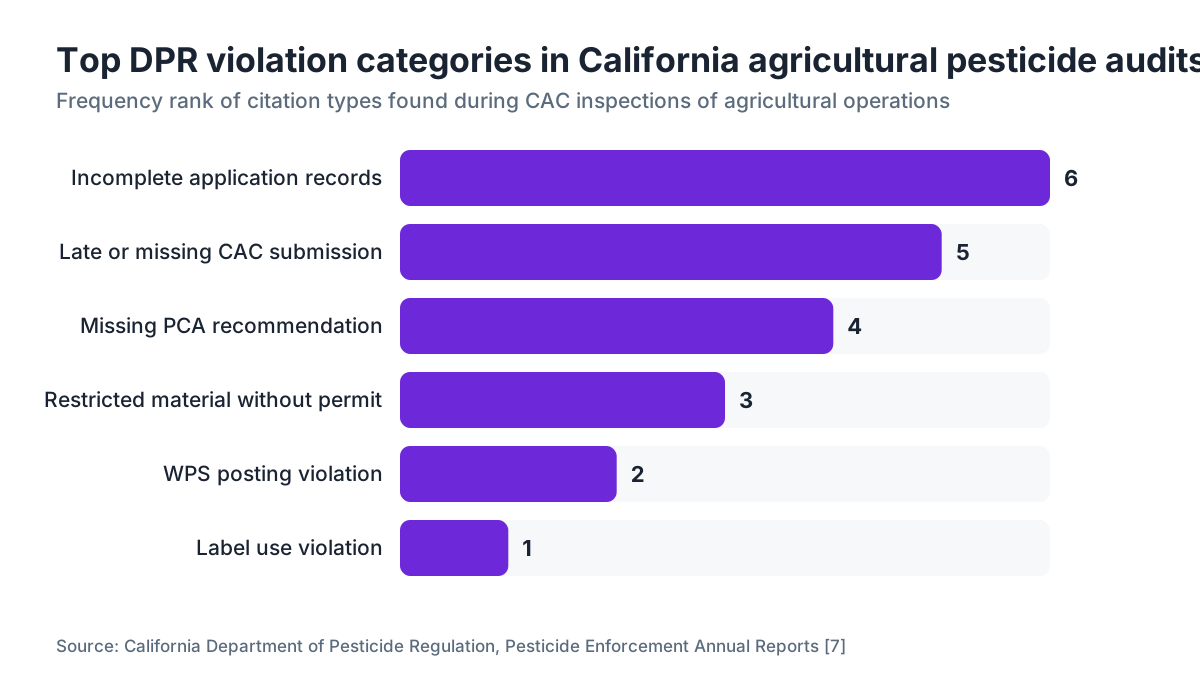
DPR's annual enforcement reports show where operators fail. The top citation categories for California agricultural operations run in this order: [7]
- Incomplete application records (missing REI, missing weather data, or missing active ingredient amounts)
- Late or missing county submissions (past the 7-day deadline)
- Applications without a valid PCA recommendation when one was required
- Restricted material use without a valid permit
- WPS posting violations (missing or outdated central location posting)
- Label violations (rates above the label, use on an unlisted crop, or the wrong application interval)
Label violations deserve extra attention. In California, the label is the law, and DPR treats it that way. If your Cabernet Sauvignon block reads "table grapes" on the record but you used a product labeled "wine grapes only," that's a use inconsistency. Some products carry crop-specific registrations. Know yours.
Missing start and end times is a smaller but very common citation. Growers write the date and skip the time. The time matters because it ties to your wind speed log, your temperature reading, and the REI clock.
What is the role of the Pest Control Adviser in vineyard record compliance?
A licensed Pest Control Adviser (PCA) has to give you a written recommendation before any application that uses a restricted material or any application made by a licensed pest control operator. For most commercial vineyards, that means nearly every application needs a PCA recommendation on file. [4]
The recommendation has to name the pest, the recommended pesticide (product name and EPA reg number), the application method, the rate and timing, and the PCA's license number and signature. A generic spray schedule handed out at the start of the season does not cover each individual application.
PCAs carry their own licensing risk. A PCA can lose their license for signing off on applications that broke label requirements or permit conditions, which puts you and your adviser on the same side. A good PCA is a compliance partner, more than a product seller.
WSU Extension's pesticide management resources report that growers who work with PCAs providing application-specific written recommendations run fewer record-keeping violations than those relying on informal advice. [8] The written recommendation also protects you later if anyone asks why you chose a particular product.
How do you organize your vineyard pesticide records to survive an audit?
Organization is the difference between a 30-minute inspection and a 3-hour one. Inspectors aren't your enemy, but they look for things that are easy to find. Hand them a clean file and they move on fast.
Here's the system that works for most vineyards.
Keep a physical binder and a digital backup. Organize the binder chronologically by application date, with a tab for each month. Behind each application record, file the PCA recommendation that goes with it. At the front, keep your current Restricted Materials Permit(s), your applicator license (if you hold one), and your WPS central posting log.
For the digital side, a spreadsheet or dedicated software is fine as long as it exports a compliant record. Your county submission copy and your on-site copy have to match. Inspectors compare them.
Label each record with the parcel name or APN so an inspector can cross-reference your RMP acreage limits without asking you to read your own handwriting.
Run a self-audit every 90 days. Pull 10 random records and check every field against the required list in the table above. Find a blank field, correct it, and note the correction date. A corrected record with a dated note beats an incomplete one every time. You can't change a submission after the fact, but your on-site file can carry an annotation.
Past one applicator or 50 acres, paper alone gets messy. VitiScribe is built for multi-parcel, multi-applicator record management and flags required fields before you submit.
What penalties can a vineyard face for pesticide record violations?
Food and Agriculture Code Section 12999.5 authorizes civil penalties up to $5,000 per violation per day. [2] That figure is not theoretical. One inspection that finds multiple incomplete records across multiple application dates can add up to tens of thousands of dollars before any appeal.
The enforcement process usually runs:
- Notice of violation issued by the CAC
- Grower gets a window to respond (usually 10 to 30 days)
- CAC recommends a penalty amount
- Grower can request an informal conference with the CAC
- If it stays unresolved, the matter goes to a formal hearing
- DPR can pursue license suspension or revocation for repeated or serious violations
First-time violations with no history and prompt correction often end in a Warning Notice or a reduced penalty through settlement. Repeat violations, label violations, or restricted material use without a permit get far less leniency.
Licensed applicators (PCAs, pest control operators) face a second track. Violations can trigger license action through DPR's licensing division, separate from any money penalty. A suspended license means no applications until it's reinstated.
The fine hurts, but the operational hit is often worse. A stop-work order or permit suspension during a spray window can cost you a critical fungicide application in a high-pressure disease year. That loss dwarfs any penalty on the notice.
How does a vineyard prepare for a DPR audit before the inspector shows up?
Run this checklist every quarter. You don't need an inspection notice to start, and in most cases you won't get one.
Records completeness check
- Pull every application record from the past 3 years
- Verify all required fields are filled (see the table above)
- Confirm wind speed is a real number, not "calm" or "light"
- Verify each record has a matching PCA recommendation (if applicable)
- Confirm amounts appear in both product volume and pounds of active ingredient
Submission verification
- Request a submission history printout from your CAC office (most provide it on request)
- Cross-reference your on-site file against that submission log
- Flag any late submissions and document your corrective action
Permit and license review
- Confirm your Restricted Materials Permit is current and covers everything you plan to use
- Check permit acreage limits against your planned spray blocks
- Verify your applicator license (if any) is current
- Verify your PCA's license is current (check DPR's license lookup)
WPS documentation
- Check the central posting board carries current application information
- Pull WPS training records and confirm they cover every current employee
- Verify training content meets WPS requirements (check EPA's WPS guidance) [5]
- Confirm SDS files are complete and accessible
Equipment records
- Calibration records for spray equipment aren't always legally required, but they're strong evidence of label compliance if a rate question comes up
- Keep them anyway
Cornell Cooperative Extension's compliance resources note that growers who run pre-season internal audits carry lower violation rates than those who react to inspection notices. [9] Same logic holds in California.
Are there special requirements for organic or biodynamic vineyards?
Yes, and they stack on top of the standard DPR rules, not in place of them. Organic vineyards certified under the USDA National Organic Program (NOP) still have to keep California pesticide application records for every input, including materials approved for organic use. [10] Sulfur, copper, and biological pesticides all land on application records the same as synthetic products.
The difference is that your inputs have to appear on the National List of Allowed and Prohibited Substances, and your certifier audits those same records at certification review. An application of a prohibited substance that never makes it into your DPR records is still a DPR violation. One that does make it in and involves a prohibited substance is both a DPR violation and a certification problem.
Organic operators sometimes assume DPR rules skip them because they're "not using chemicals." Wrong. The record-keeping law covers any pesticide as defined in California Food and Agriculture Code Section 12753, which includes substances for plant disease control and pest repellents regardless of natural or synthetic origin. [2]
Biodynamic certification (Demeter, CCOF biodynamic) carries its own audit requirements from the certifying body, separate from DPR. DPR does not care about your biodynamic certification. The CAC inspector cares about your application records and your WPS posting.
Where can vineyard operators find California-specific pesticide compliance training and resources?
These sources are authoritative and free.
California DPR runs the Agricultural Pest Control Adviser and Agricultural Pest Control Operator licensing programs and publishes the current restricted materials list, pesticide use reports, and enforcement guidance. [7]
County Agricultural Commissioners are your first stop for permit questions, submission rules, and county-specific requirements. Every California county has a CAC office. Contact information and local ordinances run through the CDFA site. [1]
UC Cooperative Extension publishes region-specific pest management guidelines through the UC IPM program. The UC IPM site covers approved materials, application timing, and resistance management for every major vineyard pest and disease in California. [6]
UC Davis Department of Plant Sciences offers pesticide safety education and workshops for California operators. Its PCA exam prep materials also cover record-keeping requirements in detail.
EPA Worker Protection Standard compliance materials, including training templates, posting templates, and the full rule text, live on the EPA pesticide worker safety site. [5]
Western IPM Center (a USDA-funded collaboration that includes WSU and UC Davis) publishes integrated pest management resources for West Coast viticulture, including pesticide selection guides that head off label compliance problems before they start. [8]
For day-to-day record management across an operation, see related resources on vineyard operations and Paso Robles wineries compliance, which often surface county-specific RMP details worth knowing.
Frequently asked questions
How far back can a DPR inspector request pesticide application records?
Inspectors can request records going back 3 years, the minimum retention period under California law. If your county requires 5 years (some do), your CAC can request the full 5. There's no practical barrier to requesting older records when a complaint investigation covers a specific earlier date, but enforcement actions are typically bounded by a statute of limitations.
Can a vineyard owner apply pesticides without a pest control license in California?
Yes, with conditions. A property owner can apply pesticides on their own property without a license. But if you hire a pest control operator, they must hold a valid California pest control business license. Anyone paid to apply pesticides on your vineyard, or their employer, needs a license. The PCA requirement for restricted materials applies no matter who holds the applicator license.
What happens if I miss the 7-day submission deadline to the county ag commissioner?
Submit the record the moment you catch the error and add a note explaining the delay. Late submission is a violation, but submitting late beats not submitting at all. A first-time late submission with a good compliance history often draws a warning rather than a fine. Repeated late submissions or a pattern of missing ones will generate rising penalties.
Do I need to keep records for pesticides I apply but don't purchase, like custom-applied materials?
Yes. The record requirement attaches to the application event, not the purchase. If a contract applicator sprays your vineyard, you still have to hold that application on record. The contractor also carries their own record-keeping obligations. Get a copy of every application record from anyone who applies pesticides on your property, immediately after each application.
What is a Pest Control Adviser written recommendation and when is it legally required?
It's a signed document from a licensed California PCA specifying the pest, product, rate, timing, and method for each application. California law requires it before applying any restricted material and before any application made by a licensed pest control operator. For non-restricted applications the grower makes themselves, it's not always required by law, but it protects you if questions come up later.
Does the Worker Protection Standard apply to family members who work in the vineyard?
WPS covers all agricultural workers and handlers employed for compensation. Immediate family members of the agricultural employer (spouses, children, parents, siblings) are exempt from WPS requirements under the federal rule. California state law may add employee safety requirements that reach family members in some situations. Check with your CAC or a California labor attorney if you mix family and non-family workers.
Are there pesticide record requirements specific to grape growing that differ from other crops?
California has no grape-specific record-keeping rules beyond the general requirements that apply to every agricultural commodity. The practical difference is that wine grapes carry specific label registrations for some products, separate from table or raisin grapes. So 'wine grapes' versus 'table grapes' as the crop designation can matter for label compliance. Always match the crop on your record to the exact crop language on the label.
What is California's pesticide use reporting system and how does it relate to compliance?
California's Pesticide Use Reporting (PUR) system is one of the most detailed in the country. Your 7-day county submissions feed the statewide PUR database DPR maintains. DPR uses the data for enforcement analysis, trend monitoring, and risk assessment. The same data inspectors pull to check your submission history comes from PUR. Accuracy matters because a mismatch between your on-site file and the PUR database is a red flag during audits.
Can I use a mobile app or software to maintain compliant pesticide records in California?
Yes. California does not require paper records. Digital records are acceptable as long as they carry all required fields and can be produced for inspection. The key requirement is that digital records have to be as accessible as paper during an inspection, so you need to print or display them on-site. Whatever system you use, export and submit to your CAC in the required format and keep a backup that survives a device failure.
What is the difference between a civil penalty and a criminal penalty for pesticide violations in California?
Most record-keeping violations draw civil penalties under Food and Agriculture Code Section 12999.5, up to $5,000 per violation per day. Criminal penalties (misdemeanor or felony charges) are reserved for knowing and willful violations, fraud, or applications that cause significant human harm or environmental damage. Label violations that result in worker illness or serious environmental contamination can escalate to criminal referral in the worst cases.
How do I find out if my pesticide is on California's restricted materials list?
DPR maintains the current restricted materials list on its website, searchable by product name or active ingredient. Your county agricultural commissioner also keeps local copies and can confirm permit requirements for specific materials in your county. Check the list at the start of each spray season, more than at license renewal, because DPR updates it through administrative rulemaking during the year.
What records do I need to keep for pesticide applications in a certified organic vineyard?
Exactly the same records as any other California vineyard: product name, EPA registration number, application rate, date, location, weather, and REI. Organic inputs are still classified as pesticides under California law when used for pest or disease control. Your organic certifier audits these same records at certification review, so they do double duty. Keep your National Organic Program documentation separate from but cross-referenced to your DPR records.
How often does the California DPR update its pesticide record-keeping requirements?
The core record-keeping framework under Title 3 of the California Code of Regulations has held steady for many years, but DPR does update requirements through rulemaking. Restricted materials lists, permit conditions, and product-specific requirements change more often. Subscribe to DPR's email notice list for regulatory updates, and review requirements with your PCA at the start of each growing season.
Sources
- California Department of Food and Agriculture, County Agricultural Commissioners: County agricultural commissioners are the enforcement arm for DPR pesticide regulations and can conduct unannounced inspections; pesticide records must be submitted to the CAC within 7 days of application and retained for a minimum of 3 years
- California Legislative Information, Food and Agricultural Code Section 12999.5: Civil penalties up to $5,000 per violation per day authorized for pesticide law violations; definition of pesticide under Section 12753 includes materials used for plant disease control regardless of natural or synthetic origin
- California Code of Regulations, Title 3, Division 6, Pesticide Regulations: Mandatory fields for pesticide application records including start and end time, wind speed and direction, temperature, amount of active ingredient, and REI start and end
- California Department of Pesticide Regulation, Pest Control Adviser Requirements: A written PCA recommendation is required before any application of a restricted material in California; the recommendation must include pest, product, EPA reg number, rate, and method
- U.S. EPA, Agricultural Worker Protection Standard: WPS requires central location posting of pesticide application information within 24 hours, training documentation for 2 years, decontamination sites within 1/4 mile, and materials in workers' language
- UC ANR, UC IPM Program, Pest Management Guidelines: WPS training records and incomplete application records are among the top documentation gaps found during routine inspections of California vineyard operations
- California Department of Pesticide Regulation, Pesticide Enforcement and Annual Reports: Top citation categories in DPR annual enforcement reports include incomplete records, late submissions, missing PCA recommendations, restricted material use without permit, and WPS posting violations
- Washington State University Extension, Pesticide Management: Growers working with PCAs who provide application-specific written recommendations have significantly fewer record-keeping violations than those who rely on informal advice
- Cornell Cooperative Extension, Agricultural Pesticide Compliance Resources: Growers who conduct pre-season internal audits have a substantially lower violation rate than those who respond reactively to inspection notices
- USDA National Organic Program, Allowed and Prohibited Substances: Organic vineyards certified under NOP must maintain California pesticide application records for every input applied, including materials approved for organic use such as sulfur, copper, and biological pesticides
- California Department of Pesticide Regulation, Restricted Materials List: The California restricted materials list includes fumigants, certain organophosphates, some fungicides, and certain herbicides; the list is updated through administrative rulemaking and requires a county permit before purchase or application
Last updated 2026-07-09