How to complete a pesticide incident report form for your state ag department

TL;DR
- A pesticide exposure, drift, or crop damage event at your vineyard usually has to go to your state department of agriculture inside 24 to 72 hours, depending on how bad it is.
- The form wants exact product, application, weather, and exposure details.
- Get those fields right the first time and you head off enforcement follow-up and protect your license.
What is a pesticide incident report form and when do you actually need one?
A pesticide incident report form is the official document your state department of agriculture uses to record that a pesticide caused harm it wasn't supposed to. That harm covers a wide band. A worker who absorbed enough chemical to feel sick. A neighbor's ornamentals that died from drift. Fish killed in an irrigation ditch. Bees found dead near a treated block. A crop failure you think a faulty or mislabeled product caused. The form creates a paper trail the state can investigate, and it starts your own protection if the incident ends up in court.
Not every spray mishap needs a form. A little off-target movement that caused no measurable damage generally isn't reportable, though your use records still need to show what happened. The threshold for mandatory reporting changes state to state, but two triggers are almost universal: a human exposure that needed medical attention, and any environmental damage (fish, wildlife, pollinators) tied to an application you made or one made on land you manage.
The EPA's Worker Protection Standard, at 40 CFR Part 170, requires agricultural employers to keep records of pesticide-related medical emergencies involving workers, and those records are the backbone of any incident report you file afterward [1]. California, Washington, New York, and most other big grape states stack their own mandatory reporting on top of the federal baseline. Check your state's pesticide regulation division first. The California Department of Pesticide Regulation (CDPR) publishes its incident reporting rules under Agricultural Code Section 12999, and the Washington State Department of Agriculture (WSDA) runs its own pesticide incident reporting portal [2][9][3].
Who is required to file a pesticide incident report?
The person who made the application, or the grower who hired them, or both. States usually put the reporting obligation on the pesticide applicator of record first. If you used a licensed PCA or a commercial applicator, they carry primary responsibility for reporting, but you as the landowner or vineyard manager can still be held liable if you knew about the incident and did nothing.
Here's where it gets practical. If you hold a certified private applicator license and you sprayed the block yourself, the report is yours to file. If you hired a commercial applicator, get written confirmation from them that they've filed, and keep a copy. Never assume the contractor handled it.
Physicians are required reporters in many states too. Under California law, any licensed health care provider who treats a patient for a pesticide-related illness must file a report with the county agricultural commissioner within 24 hours of diagnosis [2]. That report becomes part of the state's epidemiological record, and you want to know it exists, because investigators will line it up against your spray records.
Wineries that farm their own fruit run under the same rules as any other agricultural employer. Processing wine on site doesn't get you out of field-side reporting. See the general framework for how vineyard operations track compliance responsibilities across dual-use properties.
What are the reporting deadlines for pesticide incidents?
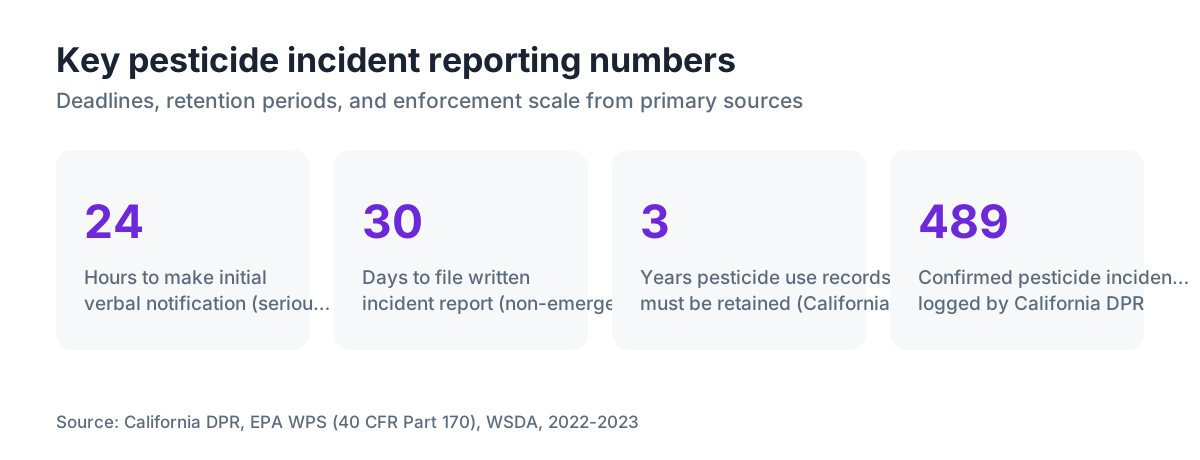
Deadlines split by severity. A human exposure that needs emergency medical treatment generally triggers a 24-hour verbal or phone notification to the county agricultural commissioner or state ag department, then a written report within a few days, often three to five business days. A non-emergency exposure, property damage, or crop loss incident typically gives you 30 days for the written form, though some states compress that to 15.
California's system is among the most documented. The CDPR Pesticide Incident Monitoring Program asks county commissioners to submit confirmed incidents, and its 2022 report logged 489 confirmed cases [2]. Washington State requires same-day notification for any incident involving hospitalizations, and the WSDA Pesticide Management Division takes those calls directly [3].
Miss the phone notification window and you've turned a compliance problem into a possible license problem. Set an alarm the moment you learn of an incident. You don't need all the details to make the initial verbal call; the agency expects you to have gaps at that stage. What they won't forgive is three days of silence while you figure out what to say.
A useful rule: the clock starts when a reasonable person would have known an incident happened, not when you personally found out. If your crew chief saw the problem Monday and told you Wednesday, the clock started Monday.
What information does the form ask for, field by field?
Most state forms follow a similar structure even though they look different. Here are the major sections you'll hit and exactly what goes in each.
Applicator and license information. Your full legal name or business name, pesticide applicator license number and category, the name and license number of any PCA who recommended the product, and your contact information. Double-check your license number. Transposing digits is the single most common error on this block.
Property and site information. The physical address or parcel number of the treated site, the crop type (write 'wine grape' or the varietal block designation, more than 'grapes'), acreage treated, and GPS coordinates if your state asks for them. For drift incidents, you'll also need the address of the affected property.
Product and application details. EPA registration number (it's on the label, formatted as two hyphenated numbers like 62719-492), product trade name, active ingredient(s), formulation type (SC, WP, EC, etc.), application method (airblast sprayer, handgun, drone), equipment description, and application rate in both per-acre and total-quantity terms. Applied a tank mix? List every product separately.
Weather conditions at time of application. Temperature, relative humidity, wind speed and direction, atmospheric stability class if your state asks for it, and whether there was a temperature inversion. This section is where thin records sink you. No weather station in the block? You need to pull data from the nearest NOAA station and document the source. Some states want weather logged at application start, midpoint, and end.
Description of the incident. A factual narrative of what happened, when you first noticed it, and the sequence of events. Plain language. 'At approximately 0730 on June 14, field worker Maria R. reported burning eyes and dizziness after entering Block 7 during application. She was removed from the field immediately and transported to County General by her supervisor.' That reads like you know what you're doing. Skip speculation about cause. Stick to what was observed.
Persons affected. Name, age (or date of birth), job title, length of time in the exposure area, personal protective equipment worn, symptoms reported, medical treatment received, and the name and address of the treating physician or facility. Multiple workers affected? List each one separately.
Environmental impacts. Species affected (identify to genus/species if you can for wildlife), number of animals, water body name and distance from the treated block, and whether a sample was collected. For bee incidents, note whether you had a bee kill count and whether the dead bees were collected for testing.
Corrective actions taken. What you did right after the incident: rinsed equipment, notified workers, secured the block, applied first aid, called poison control (1-800-222-1222 nationwide). Document these even when they seem obvious.
Keep copies of everything you attach: label, SDS, equipment calibration records, spray log, and any photographs. Photos aren't always mandatory. They're always helpful.
How do your pesticide use records connect to the incident form?
Your pesticide use records are a different document from the incident report, but the incident report leans on them constantly. California requires commercial applicators to file pesticide use reports (PURs) with county ag commissioners within seven days of each application [2]. Washington State requires pesticide use records be kept for two years and made available on request [3]. Those records are what investigators pull first when your incident report lands.
If your use records show you applied product X on a given date, the rates and equipment match the label, and the weather logs put you inside the label's wind-speed window, you've got a defensible record. If your use records are vague, incomplete, or fight with the incident form, you've got a problem.
That's the real reason vineyard managers should care about daily spray records beyond simple compliance. Cornell's viticulture program and UC Davis extension both treat spray records as the grower's first line of legal protection in any pesticide dispute [8][4]. WSU's viticulture extension program says the same thing, calling accurate application records foundational to any post-incident investigation [6].
Managing multiple blocks with multiple operators? A digital record system makes the tie between use records and incident documentation much cleaner. VitiScribe's spray record module, for one, keeps application data in a format you can export straight into most state-form fields, which matters at 7 AM when you're stressed and trying to reconstruct Monday's spray log.
One thing to watch: don't alter a use record after an incident. Add a supplemental note if you find an error, but never change the original entry. Altered records look like cover-ups and can turn a compliance issue into a fraud issue.
What mistakes do applicators most often make on these forms?
The most common error is vague product identification. Writing 'fungicide' or 'sulfur spray' instead of the full trade name and EPA registration number leaves the investigator unable to check label compliance without calling you back. Pull the actual label and copy the registration number directly.
Second most common: missing or estimated weather data. 'Winds were calm' is not a weather record. You need a number. No in-block sensor? Document that you pulled data from a named NOAA station with a specific station ID.
Third: wrong timing of first awareness. Investigators are good at rebuilding timelines from worker interviews, medical records, and cell phone logs. If your form says you learned about the incident at noon but the ER timestamp reads 9 AM, that gap follows you.
Fourth: thin PPE documentation. Don't just write 'gloves and goggles.' Name the glove material (nitrile, neoprene), whether it met the label's chemical-resistance requirement, and whether workers were trained on donning and doffing. EPA's Worker Protection Standard requires annual training for all agricultural workers who may be in areas where pesticides are applied, and documented training is part of your incident defense [1].
Fifth: no narrative. Many forms have a blank box marked 'describe the incident' and applicators write three words. Write three paragraphs. Investigators prefer specifics, and a complete narrative often heads off a follow-up inspection.
Does filing a report automatically mean you'll be fined or cited?
No. Self-reporting isn't an admission of wrongdoing, and most state ag departments treat voluntary, timely, accurate reports differently than incidents they discover through third-party complaints or inspections. California DPR's enforcement policy explicitly weighs whether a violation was self-disclosed when it sets penalty amounts [2].
That said, the report does trigger a review. An investigator will likely contact you, ask for your records, and may inspect the site. If the investigation finds the application was in full label compliance and the incident came from factors outside your control (weather shifting after the label's notification window, say), you may face no enforcement action at all.
The riskier path is not reporting. If a neighbor complains to the county, or a worker goes to the ER and the hospital reports, investigators pull your records anyway. Now you've failed to report and possibly violated application standards on top of it. That combination is what generates the big fines and license suspensions you want to avoid.
For a sense of scale: California assessed $1.47 million in pesticide enforcement penalties in fiscal year 2021-2022, and a real share of those cases involved failure to report or falsified records [2].
How do state forms differ, and where do you find the right one?
Every state has its own form. There's no single federal pesticide incident report form for routine agricultural incidents, though EPA maintains a national pesticide incident data system that states feed into [7]. Here's how to find what you need by state.
| State | Agency | Where to find the form |
|---|---|---|
| California | Dept. of Pesticide Regulation (CDPR) | cdpr.ca.gov, Enforcement Division |
| Washington | WSDA Pesticide Management Division | agr.wa.gov, Pesticides section |
| New York | NYSDEC / NYS Dept. of Agriculture | dec.ny.gov, Pesticides section |
| Oregon | ODA Pesticides Division | oregon.gov/ODA |
| Texas | TCEQ / TDA | tda.texas.gov, Pesticides |
| Florida | FDACS / Bureau of Pesticides | fdacs.gov, Pesticides |
For states not listed here, search '[your state] department of agriculture pesticide incident report.' County agricultural commissioners in California also accept initial reports and can hand you the correct form directly.
Always download the current version of the form from the agency website the day you need it. Forms get revised. Using a year-old copy you printed last spring can mean missing new required fields and having to refile.
What happens after you submit the form?
The agency logs your report and assigns it a case number. Hold onto that number. It's how you reference the incident in any future correspondence.
An investigator may visit the site within days if the incident was severe, or the case may get reviewed administratively if it was minor property damage or a single non-hospitalized worker exposure. You'll typically get written notice of whether the agency intends to investigate further, close the case, or take enforcement action.
If an investigation opens, notify your insurance carrier right away if you haven't already. Many vineyard and farm policies include pesticide liability coverage, and late notice to your insurer can void it. Notify your attorney too if the incident involved serious human injury.
The investigation record, your incident report included, becomes part of the public file in most states once the case closes. California publishes its confirmed pesticide illness cases in the annual Pesticide Incident Monitoring Program report [2]. Good motivation to file accurately: what you write ends up on the record permanently.
What documentation should you keep alongside your incident report?
Think of the incident report as the index. You're building a folder around it.
Start with the product label and SDS as they read on the day of application. Print or save the version current on the day of the spray, because labels get amended. Keep the calibration record for your sprayer from within 30 days of the incident. Keep the spray logbook page for the application in question. Keep any photographs taken at the site on the day of the incident or within 24 hours.
For human exposure incidents, keep copies of any first-aid documentation, the name and address of the treating physician, and any worker medical records you're entitled to under the WPS. The Worker Protection Standard at 40 CFR 170.311 requires employers to give workers access to their own incident-related medical records [10].
For environmental incidents, keep any samples you collected (dead bees, dead fish, plant tissue) properly preserved and labeled. Chain of custody matters if the case goes to litigation or criminal referral.
For neighbor or property damage claims, keep timestamped photographs of the allegedly damaged plants or property, and document your own observations of those plants before and after the incident where you can.
Store everything for at least three years, the standard statute of limitations for pesticide violations in most states. California requires pesticide use records for at least three years under the Agricultural Code [9], and federal WPS records must be kept for two years [1].
Running a multi-block operation and want all of this in one place? A compliance platform built for vineyard operations makes retrieval much faster when an investigator calls. VitiScribe's compliance record system keeps spray logs, calibration records, and incident notes linked to the same block and date, so you're not digging through paper folders under pressure.
How does the EPA Worker Protection Standard connect to your incident report?
The WPS is federal and sets baseline protections for agricultural workers and pesticide handlers. It doesn't create a pesticide incident report form itself, but it defines the records you must have and the notifications you must give before any report gets filed.
Under 40 CFR Part 170, if a worker or handler is caught in a pesticide exposure, you must provide immediate decontamination facilities, make the product's SDS available to medical personnel within 24 hours, and keep a written record of the incident including the pesticide involved, location, date, symptoms, and medical treatment [1]. That written record is essentially a draft of your incident report.
The WPS also requires that you notify workers of pesticide applications and post the treated area with required signs during restricted-entry intervals (REIs). Skip that step before an incident and you both harm workers and gut your incident defense, because the investigator's first question will be whether workers were notified.
EPA's WPS training materials are free through its website, and UC Cooperative Extension has produced Spanish-language WPS training resources used across California [1][5]. Haven't done annual WPS training for your crew? That's an independent violation stacked on top of any incident you report.
What if the incident involves pesticide drift to a neighboring property?
Drift incidents are among the most common and most contentious pesticide cases in wine country. The form mechanics are the same, but a few specifics shift.
You'll document the affected property address and the property owner or tenant's name and contact information. The form asks for the distance between your application site and the affected property, and usually the wind direction and speed at the time of application relative to where the affected property sits.
If the neighbor already called the county, the county may have opened a separate complaint file. Your incident report and that complaint file get cross-referenced. File promptly and make sure your facts match what you tell any investigator who calls.
Drift onto an organic operation can trigger separate issues. If a synthetic pesticide contaminates a certified organic crop, the organic producer may lose certification on affected lots. That's not a criminal matter, but it generates civil liability that can run high. Napa and Sonoma counties have both seen multi-hundred-thousand-dollar drift settlements involving vineyards.
Document your buffers, your sprayer calibration, your wind records, and any notification you gave neighbors. Some counties near paso robles wineries and south coast winery areas run voluntary neighbor notification programs for aerial applications. Taking part creates a paper trail that helps in drift claims.
Frequently asked questions
Do I have to report a pesticide incident if no one got sick and there was no visible damage?
Generally, no mandatory state report is required if there was no measurable harm. But you should still log the event in your own spray records with a note about what happened. Some states require notification if you believe an off-label application occurred even without visible damage. When in doubt, call your county agricultural commissioner and describe the situation before deciding whether to file.
What is the EPA registration number and where do I find it on a pesticide label?
The EPA registration number is a unique identifier assigned to every registered pesticide product. It appears on the front panel of the label as two groups of numbers separated by a hyphen, for example 62719-492. The first number identifies the registrant company, the second identifies the specific product. Copy it exactly as printed; the agency uses it to pull the label electronically and verify application rates and requirements.
Can I file the pesticide incident report online or does it have to be mailed?
Depends on your state. California county agricultural commissioners accept reports by phone, mail, or in person; the CDPR does not currently have a statewide online submission portal for grower-filed incidents. Washington State WSDA has online reporting options for some incident types. Check your state agency's website for current submission methods, and confirm whether a phone notification is required first, separate from the written form.
What happens if I miss the 24-hour notification deadline for a serious incident?
Report as soon as you become aware, even if the window has passed. Late reporting is treated as a violation but is generally a lesser offense than no reporting at all. Document why you were delayed, whether you learned of the incident late or a key person was unavailable. Most states let investigators consider mitigating circumstances. Do not wait another day hoping it resolves; a late report beats a missed one.
If a licensed PCA recommended the application, are they responsible for filing the incident report?
The PCA carries responsibility for the recommendation record and may have to file their own report with the state licensing board, especially if the incident involved a recommendation error. But the applicator of record, whether that's you or a commercial applicator, holds primary responsibility for filing the pesticide incident report with the department of agriculture. In practice, confirm in writing with both your PCA and any commercial applicator who filed and what they filed.
What's the difference between a pesticide incident report and a pesticide use report (PUR)?
A pesticide use report (PUR) documents every routine application you make and is filed regularly, often weekly or monthly depending on your state. A pesticide incident report is filed specifically when something went wrong: an exposure, environmental damage, or crop injury. California requires both, filed with the county agricultural commissioner. Most states that require PURs treat the incident report as a separate form with different fields and a different regulatory purpose.
Do I need an attorney before I file a pesticide incident report?
For a minor incident with no injuries or significant damage, you don't need an attorney to file the form. For any incident involving hospitalization, a formal neighbor complaint, or potential litigation, consult an attorney before you submit your written report. Your initial verbal notification to the agency doesn't need legal review, but the written form creates a permanent record. Agricultural liability attorneys who know pesticide law can review your narrative section before submission.
What's the best way to document weather conditions if I don't have an in-field weather station?
Pull data from the nearest NOAA Automated Surface Observing System (ASOS) or agricultural weather station, record the station name and ID, and note the distance from your block. UC Cooperative Extension's California Irrigation Management Information System (CIMIS) provides hourly weather data by station and is widely accepted in California incidents. Log the data within 24 hours of the application while records are still retrievable, and note any gaps between the remote station and your own observations.
How long do I need to keep copies of the incident report and supporting documents?
Keep everything for at least three years, which covers most state statute of limitations periods for pesticide violations. California's Agricultural Code requires pesticide use records for three years. The EPA Worker Protection Standard requires incident-related records for two years at the federal minimum, per 40 CFR Part 170. If the incident led to litigation or a formal enforcement case, retain all records until the case is fully resolved, which may run well past three years.
What should I do if an employee refuses to give me their personal information for the form?
Explain that the form is required by law and their information documents the incident, not penalizes them. Workers have rights under the WPS, including access to their own medical records from the incident. If a worker still declines, document what you do know (date, block, symptoms, treatment sought) and note in the form that the employee declined to provide identifying information. Do not falsify the record or leave the section blank without explanation.
Are bee kill incidents reported differently than human exposure incidents?
The same state form typically covers bee kills, but the required detail shifts. You'll document the species if identifiable, the estimated number of dead insects, proximity to treated blocks, whether hives were present with beekeeper contact information, and whether samples were collected. The National Pesticide Information Center (1-800-858-7378) can advise on sample collection protocol. Some states coordinate bee kill investigations between the ag department and the state apiarist, so your report may route to multiple offices.
What does the Worker Protection Standard require me to post or notify before an application?
Under 40 CFR Part 170, before applying a pesticide with a restricted-entry interval, you must notify workers through oral warnings, written warnings posted at entry points to the treated area, or central posting, depending on the REI length and whether workers are on site. Application exclusion zones must also hold during spray. Failure to post or notify is an independent WPS violation that investigators will document alongside any incident report, compounding your enforcement exposure.
Can a pesticide incident report be used against me in a civil lawsuit?
Yes. Once filed, the report is a public record in most states and can be obtained through discovery or public records requests. Write it accurately and factually. Speculation, admissions of fault, and inflammatory language in your narrative section can become exhibits. Stick to observable facts: who, what, when, where, what you did in response. Leave cause and fault determinations to the investigation. That's not stonewalling; it's appropriate reporting practice.
Sources
- EPA, Worker Protection Standard for Agricultural Pesticides (40 CFR Part 170): WPS requires agricultural employers to provide decontamination, SDS access to medical personnel within 24 hours, and written incident records for any worker pesticide exposure; records must be retained for two years; annual worker training is mandatory.
- California Department of Pesticide Regulation, Pesticide Illness and Incident Monitoring: California's CDPR logged 489 confirmed pesticide incident cases in 2022; assessed $1.47 million in enforcement penalties in FY 2021-2022; requires physician reporting within 24 hours of diagnosis; PURs due within 7 days of application.
- Washington State Department of Agriculture, Pesticide Management Division: WSDA requires same-day notification for incidents involving hospitalizations and mandates pesticide use records be kept for two years and produced on request.
- UC Agriculture and Natural Resources, Cooperative Extension: UC Davis extension materials stress that spray records are the first line of legal protection in any pesticide dispute and are foundational to post-incident investigation.
- UC Agriculture and Natural Resources, Worker Safety and WPS Training Resources: UC Cooperative Extension has produced Spanish-language WPS training resources used across California for agricultural worker pesticide safety training.
- Washington State University Extension: WSU viticulture extension program notes that accurate application records are foundational to any post-incident investigation.
- EPA, Pesticides: EPA maintains a national pesticide incident data system that states feed into; no single federal form exists for routine agricultural incidents.
- Cornell University College of Agriculture and Life Sciences, Cornell Cooperative Extension: Cornell's viticulture program emphasizes that spray records are the grower's primary legal protection in any pesticide dispute involving drift or exposure claims.
- California Legislative Information, California Agricultural Code Section 12999: California Agricultural Code Section 12999 establishes mandatory pesticide incident reporting requirements; California requires pesticide use records be retained for at least three years.
- EPA, Worker Protection Standard for Agricultural Pesticides (40 CFR 170.311): 40 CFR 170.311 requires agricultural employers to provide workers access to their own incident-related medical records under the Worker Protection Standard.
- UC Agriculture and Natural Resources, CIMIS California Irrigation Management Information System: CIMIS provides hourly weather data by station and is widely accepted in California pesticide incident investigations as documentation of conditions at time of application.
Last updated 2026-07-09