How to plant a grape vineyard: a practical field guide
TL;DR
- Planting a vineyard takes 2-3 years before you see any harvestable crop and 4-7 years to reach full production.
- The core steps are site evaluation, varietal and rootstock selection, soil preparation, trellis installation, planting, and first-year canopy management.
- Budget $15,000-$35,000 per acre for establishment in most U.S.
- regions before you pick a single cluster.
What do you need to know before you plant a single vine?
Most vineyard failures are decided before the first vine goes in the ground. Siting mistakes, wrong variety choices, and skipped soil work are far harder to fix after planting than before. So the honest answer is: spend at least one full growing season studying your site before you commit to a planting date.
Start with a soil pit. Dig to at least 36 inches, ideally 48-60 inches, and look at drainage, compaction layers, and parent material. Grapevines need well-drained soil. Waterlogged roots invite Phytophthora and a short, miserable vine life. If you hit a hardpan or clay layer above 24 inches, you need to either deep rip before planting or seriously reconsider the block.
Get a full soil chemistry panel from a certified lab, more than a basic pH test. You want pH, organic matter, cation exchange capacity, nitrate nitrogen, phosphorus, potassium, calcium, magnesium, sulfur, boron, zinc, manganese, and iron at minimum. UC Davis Cooperative Extension has published detailed soil sampling protocols for wine grapes that cover depth intervals and handling [1]. Without this data you're guessing at lime rates and amendment timing.
Climate is the other half of site evaluation. Pull the nearest NOAA weather station data and calculate growing degree days (GDD) using a 50°F base. Bordeaux varieties like Cabernet Sauvignon need roughly 2,700-3,200 GDD [2]. Pinot Noir tops out around 2,600 GDD before it loses acidity. If your site runs 1,800 GDD in a normal year, plant a cool-climate variety or you'll never ripen.
Frost pocket mapping matters too. Walk the site at dawn after a spring frost event and mark where ice formed last. Cold air drains and settles, so a low-lying quarter-acre at the north end of your block might lose a full vintage to late frost even when the rest of the site is fine.
How do you choose the right grape variety and rootstock?
Variety and rootstock are a pair. You almost never plant own-rooted vinifera in commercial U.S. vineyards because Phylloxera (Daktulosphaira vitifoliae) is present in virtually every wine-growing region in the country [3]. The louse feeds on vinifera roots, eventually killing the vine. Grafted vines on a resistant rootstock are the standard.
Rootstocks vary in their Phylloxera resistance, nematode tolerance, soil adaptation, and vigor. Here's a quick reference:
| Rootstock | Phylloxera resistance | Nematode tolerance | Best soils | Vigor |
|---|---|---|---|---|
| 110R | High | Moderate | Drought-prone, rocky | Medium-high |
| 5BB Kober | High | Low | Deep, fertile | High |
| 3309C | High | Low | Deep, moist loam | Medium |
| 420A | High | Low | Limestone, low K | Low-medium |
| Freedom | High | High | Sandy, warm | High |
| Harmony | Moderate | High | Sandy, warm | Medium |
| St. George (AxR#1 NOT recommended) | Moderate (breaks down) | Low | Avoid for new plantings | High |
Cornell University's viticulture program and WSU Extension both publish rootstock selection guides that match rootstock to soil type and pest pressure in their respective regions [4][5]. Use those as your first filter, then talk to a local nursery or UC Cooperative Extension farm advisor about what's actually performing in your county.
Variety selection comes down to market, climate, and personal conviction. If you're growing for your own winery, make sure you can actually ripen the variety on your site. If you're growing for a contract, let the buyer's needs drive it. Don't plant Cabernet Sauvignon in a 1,900 GDD site because you love Cab. Plant Pinot Gris or Gewurztraminer and be happy.
What does proper soil preparation look like before planting?
This is where most people underinvest and later regret it. You get one real window to fix soil structure before the trellis is in the way. Use it.
Start amendments based on your lab results. If pH is below 6.0, broadcast and till lime (usually agricultural limestone) to raise it. Cornell's guidelines target pH 6.0-6.5 for most vineyards [4]. Magnesium deficiency is common, and dolomitic lime addresses both pH and Mg at once. If phosphorus is low, broadcast rock phosphate or triple superphosphate and incorporate it. Phosphorus doesn't move much in the soil profile; incorporating it before planting is your only efficient chance.
Deep ripping is non-negotiable on any site with a compaction layer. Use a ripper or subsoiler to break through to 24-36 inches on your intended vine rows. This opens drainage channels and lets roots establish faster in the first two years. Some growers run a cover crop for one season after deep ripping to stabilize soil structure before planting, which also lets you verify drainage under a full rain season.
If you have nematode issues, fumigation is an option, but it's heavily regulated, expensive (cost can run $800-$1,500 per acre depending on fumigant and application method), and the efficacy window is finite because nematodes recolonize from field edges. In many cases, planting on a nematode-tolerant rootstock like Freedom or Harmony is a more durable answer. Talk to your county agricultural commissioner about fumigation permit requirements before assuming it's accessible.
Final pre-plant field work: mark your rows with stakes, check row orientation (north-south rows maximize sun exposure in most temperate zones), and confirm spacing based on your planned trellis system and equipment width.
What trellis system should you install and when?
Install the trellis before or at the time of planting, not after. Trying to retrofit a trellis system around established vines is miserable work.
The most common commercial trellis in U.S. wine vineyards is the vertical shoot positioning (VSP) system on a 6-7 wire configuration with end posts, line posts, and catch wires above a fruiting wire. End posts take the whole load of the row, so most growers use 4-5 inch round treated wood or steel H-braces, set 36-42 inches deep, and anchored with a deadman or screw anchor. Line posts are typically 8-10 feet long set 2.5-3 feet deep, spaced 20-24 feet apart in the row.
Spacing affects everything. Closer vine spacing (3 feet in-row by 5 feet between rows) produces more vine density per acre but costs more per acre to plant and manage. Wider spacing (6-8 feet in-row by 10-12 feet between rows) lets you use standard orchard tractors and reduces vine count per acre. Most California and Washington commercial plantings run something like 8x10 to 6x8 feet, yielding 540-1,210 vines per acre. French high-density plantings run as tight as 3.3x3.3 feet (roughly 4,000 vines per acre) and require specialized narrow tractors.
Trellis wire gauge and tensioning matter. Fruiting wire is typically 12.5 gauge high-tensile. Catch wires can be 14 gauge. Loose wire leads to poor shoot positioning and management headaches every season. Get a wire tensioner and use it.
For the first year, most growers put in just a stake per vine and a single training wire at 30-36 inches. That's enough to train the trunk. You add upper catch wires in year two as the canopy develops.
How deep should you plant grapevines and what's the correct technique?
Vine planting depth depends on whether you're planting grafted or own-rooted vines, and on your frost risk. For grafted vines, the graft union must stay above soil level, typically 4-6 inches above grade, to prevent the scion from rooting into the soil (which would bypass your Phylloxera-resistant rootstock entirely and defeat the purpose of grafting).
For own-rooted cuttings, plant deep enough so the basal bud is at or just below grade, usually 12-18 inches deep to protect from frost.
Order vines from a certified nursery well in advance. Availability of grafted vines can be tight 12-18 months out for popular varieties, and certified plant material from a state-registered nursery helps ensure you're getting true-to-type plants free of major viruses. In California, request vines certified through the Foundation Plant Services (FPS) program at UC Davis [6]. Other states have analogous programs.
On planting day: keep roots moist. Don't let bare-root vines sit exposed in the sun. Plant into moist (not waterlogged) soil. Trim excessively long or J-shaped roots before planting. Set the vine in the hole, backfill, firm the soil to eliminate air pockets, and water in immediately.
Force the vine to a single strong shoot. Many growers cut back the scion to 2-3 buds at planting to direct all energy into one vigorous shoot that becomes the trunk. Resist the urge to leave more buds in hopes of a head start. A single strong shoot trained to your training wire by end of season one is better than three weak tangled shoots going nowhere.
If your area has late spring frost risk, biodegradable grow tubes or wax paper tree shelters can protect young shoots and accelerate early growth by creating a microclimate around the emerging cane.
How much does it cost to plant a vineyard per acre?
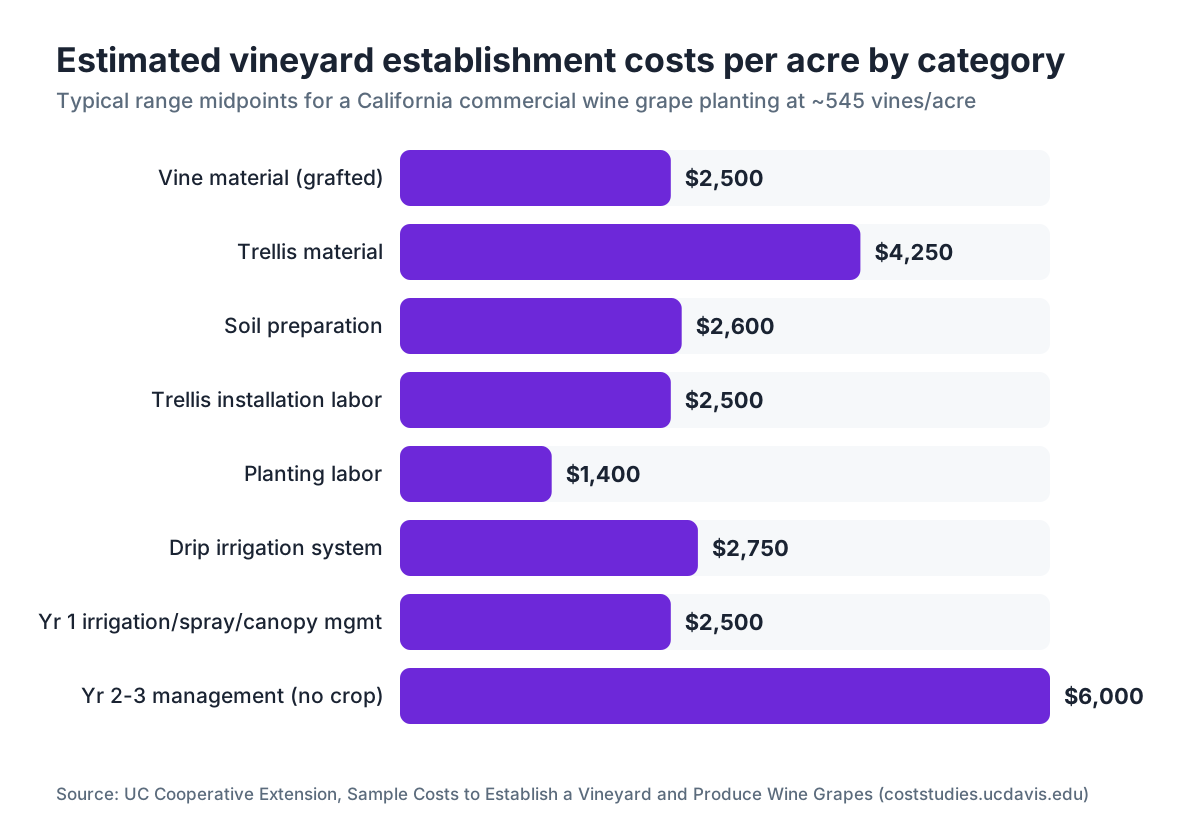
Per-acre establishment costs in the U.S. run from about $15,000 on the low end (simple site, lower-cost region, DIY labor) to $75,000+ per acre in Napa or Sonoma with high vine density, premium rootstocks, and contractor labor [7]. Most commercial plantings in the Pacific Northwest and mid-tier California regions land in the $25,000-$45,000 per acre range over a 3-year establishment period.
Here's how those costs typically break down:
| Cost category | Typical range per acre |
|---|---|
| Vine material (grafted, ~545 vines/acre at 8x10 spacing) | $1,500 - $3,500 |
| Trellis material (posts, wire, anchors) | $2,500 - $6,000 |
| Soil preparation (deep ripping, amendments, cover crop) | $1,200 - $4,000 |
| Trellis installation labor | $1,500 - $3,500 |
| Planting labor | $800 - $2,000 |
| Irrigation system (drip) | $1,500 - $4,000 |
| First-year irrigation, fertilization, spray, canopy management | $1,500 - $3,500 |
| Second and third year management (no crop) | $4,000 - $8,000 total |
Those numbers come from University of California Cooperative Extension sample cost studies, updated periodically by region and free online [7]. The UC studies are the most detailed public benchmarks available for California. WSU Extension publishes analogous budgets for Washington state wine grapes [5].
You won't see positive cash flow from the vineyard until year 4 at the earliest in most scenarios. Plan your operating capital accordingly. Many small vineyard operators undercapitalize for the establishment years and end up selling or leasing the property before it reaches production.
What irrigation and drainage infrastructure does a new vineyard need?
Drip irrigation is the standard in commercial wine vineyards across most U.S. regions. It delivers water directly to the root zone, reduces disease pressure from wet foliage, and allows fertigation (delivering dissolved fertilizers through the drip system).
A basic single-lateral drip system on 5-foot row spacing runs one drip line per vine row with emitters at 18-24 inch spacing. In-line emitters (built into the tubing) at 1 GPH (gallon per hour) are common. Pressure-compensating emitters matter on sloped ground, where pressure variation along a long run would otherwise cause uneven water distribution.
Filter stations, pressure regulators, and backflow prevention are not optional. They're required by many water districts and protect the system from clogging. Your local irrigation supplier can size the system to your acreage and water source pressure.
In humid regions like New York, Virginia, or the Willamette Valley, drainage often matters more than irrigation. Tile drainage in poorly drained blocks can be the difference between functional viticulture and annual losses to Botrytis and root disease. Cornell Extension has specific guidance for managing vine nutrition and drainage in cool humid regions [4].
For frost protection, overhead sprinklers are the proven method in regions with spring frost risk. They work by releasing the latent heat of fusion as water freezes on buds, holding bud temperature near 32°F even when air temperature drops lower. Wind machines are an alternative but are less effective in radiation frost events when there's an inversion layer. Budget $3,000-$8,000 per acre for overhead frost protection systems if your site needs it.
How do you manage pests, diseases, and sprays in the first growing season?
Young vines are vulnerable. They have limited canopy, undeveloped root systems, and no crop load to buffer stress from disease or pest pressure. The most common first-year problems are powdery mildew (Erysiphe necator), downy mildew (Plasmopara viticola), Botrytis bunch rot (in humid climates), and leafhoppers or mites.
For powdery mildew, sulfur-based fungicides are the backbone of organic and conventional programs alike. Apply on a 7-14 day schedule from bud break through veraison. Do not apply sulfur when temperatures exceed 90-95°F; you'll burn the leaves. University of California IPM guidelines give detailed spray timing, thresholds, and product options for California wine grapes [8].
First-year vines typically don't have a fruit crop to protect, so your primary spray goal is protecting the canopy that will feed the vine going into dormancy. Don't skip sprays just because there's no fruit. Defoliation from mildew in year one sets back the vine's root development and pushes your production timeline back.
Any worker applying pesticides in the vineyard must operate under the EPA Worker Protection Standard (WPS). That means proper pesticide handler training, personal protective equipment (PPE) as specified on the product label, restricted entry intervals (REI) posted at field entry points, and access to decontamination supplies [9]. The WPS applies to any agricultural establishment where pesticides are used and employees or handlers are present. Even a small family operation with two people is covered if those people qualify as agricultural workers or pesticide handlers under the WPS definition.
Keep a spray record for every application: date, product name, EPA registration number, rate, target pest, application method, REI, and worker/handler information. This is a legal requirement in most states. If you're already keeping field records in a system like VitiScribe, your spray log is time-stamped and searchable without shuffling paper.
What does first-year canopy training look like and why does it matter?
The trunk is the most permanent structural element of your vine. Getting a straight, well-developed trunk trained to your cordon or cane height in years one and two saves years of remediation later.
In year one, the goal is simple: drive one strong shoot straight up to the training wire. Tie it loosely to the stake every 8-12 inches as it grows. Remove all lateral shoots that emerge below the desired cordon height. Some growers remove flower clusters in year one even if vines are healthy enough to set some fruit, because crop load in year one slows trunk development and root establishment. WSU Extension recommends removing all fruit in years one and two to maximize structural development [5].
In year two, if the vine reached the training wire in year one, you select two lateral canes to train horizontally as cordons, one each direction along the fruiting wire. Tie them down and allow spur development. If the vine didn't reach the training wire in year one, repeat: select the strongest cane, cut back, and drive it to the wire in year two. Don't try to rush cordon development off a weak vine.
Pruning decisions in year two and three set up the fruiting structure you'll manage for the next 20-30 years. Take your time, use clean sharp tools (sterilize between vines if Eutypa or trunk diseases are present in your region), and make clean cuts. Ragged or torn pruning wounds are entry points for wood pathogens.
For a look at how established vineyards handle ongoing operations and canopy decisions, operations at a place like Gervasi Vineyard or the plantings around Paso Robles wineries show the range of trellis systems and training approaches that work at commercial scale in different climates.
What records do you need to keep from day one of planting?
Record-keeping starts the day you break ground, not the day you make wine. A vineyard block record should capture: block ID, acreage, variety, clone, rootstock, vine spacing, row orientation, planting date, vine source (nursery name, certification status), and any replant decisions made in subsequent years.
Spray records are legally required by most state departments of agriculture and are the paper trail you'll need if there's a worker exposure incident, a pesticide drift complaint, or a buyer or certifier audit. Required elements under California law, for example, include the product name, EPA registration number, pest or disease targeted, site treated, date and time, application method, amount applied, applicator name and license number, and REI [10]. Other states have comparable requirements; check with your state department of agriculture for the specific form and retention period.
Fertigation and soil amendment records are not legally required in most jurisdictions, but they're enormously useful for your own agronomic decisions year to year. You can't interpret a new soil test without knowing what you applied two seasons ago.
For ongoing compliance and tracking, a purpose-built vineyard record system makes searching and reporting far faster than paper logs or spreadsheets. VitiScribe is built specifically for vineyard compliance and spray records, with templates that mirror what most state ag departments actually ask for at audit time.
Retain all pesticide application records for at least two years. California requires three years [10]. If you're farming under a GAP (Good Agricultural Practices) certification or a sustainability program, your auditor will want five or more years of records, so keeping everything is the safest practice.
How long before your vineyard produces a real crop?
You will not pick a significant crop in year one or year two. Most growers remove all fruit clusters in years one and two to protect vine establishment. In year three, a healthy vine on a well-prepared site might produce 0.5-1.5 tons per acre. Full production for most wine grape varieties is 3-5 tons per acre (depending on variety and farming goals) and typically isn't reached until years five through seven.
Nobody has great industry-wide data on average time to full production because it varies too much by region, variety, rootstock, vine spacing, and management quality. The closest benchmark is the UC Cooperative Extension cost studies, which model establishment over a 3-5 year pre-production window with explicit year-by-year cost estimates [7].
Early-bearing varieties like some Pinot Noir clones or Grenache can give you a partial crop by year three. Later-maturing or higher-vigor varieties like Cabernet Sauvignon may take until year five or six to fill their trellis space and hit target yields.
The patience required is one reason many first-time vineyard planters underestimate the capital commitment. Building a vineyard is a five-to-ten year financial commitment before you're seeing the returns you modeled. That's not a reason to skip it. It's a reason to model your cash flows honestly before you order vines.
Frequently asked questions
How many vines per acre should I plant?
At a typical 8x10 foot spacing, you get about 545 vines per acre. Tighter spacing like 6x8 feet yields roughly 908 vines per acre. High-density European plantings at 3x3 feet can reach 4,000+ vines per acre but require specialized narrow equipment. Most U.S. commercial vineyards plant 450-1,000 vines per acre. Your row width should match the widest equipment you plan to run.
What time of year do you plant grapevines?
Bare-root vines go in during late winter to early spring, after the last hard frost risk but before active growth begins, typically February through April in most U.S. wine regions. Potted vines can be planted a little later, into early summer. Spring planting allows root establishment during the growing season. Fall planting is practiced in mild climates but carries more frost risk to young root systems.
Do I need to irrigate a new vineyard?
Yes, in virtually all cases during establishment. Even in regions where mature vines are dry-farmed, young vines need supplemental irrigation for the first 2-3 years to develop a deep root system. Drip irrigation at 1-2 gallons per vine per day during dry spells is a common starting point. Adjust based on soil moisture monitoring, not a fixed schedule.
How do I know if my site has Phylloxera?
Phylloxera (Daktulosphaira vitifoliae) is present in most U.S. wine regions and should be assumed to be in any soil with a history of grapevine production. The only reliable way to confirm its absence is soil sampling and lab analysis, and even that has limits. In practice, plan on planting grafted vines on a resistant rootstock regardless, unless you're in a region with certified Phylloxera-free soil status.
What soil pH is best for wine grapes?
Most wine grape varieties grow well in soil pH of 6.0-6.5. Below 5.5, aluminum and manganese toxicity can become a problem. Above 7.5, iron and zinc deficiency are common. If your soil is outside this range, lime (to raise pH) or sulfur (to lower pH) applied and incorporated before planting is far more effective than trying to adjust pH after trellis installation.
Can I plant a vineyard without a tractor?
At small scale (under half an acre), hand management is possible but labor-intensive. You'll hand-hoe, hand-spray, and hand-harvest. For anything over about a quarter acre, some form of mechanization, even a walk-behind tractor or an ATV with a spray attachment, saves significant time. Commercial vineyards of any real scale are not practically manageable without at least a small tractor.
What cover crops should I plant between vine rows?
Common choices include a mix of grasses and legumes: hard fescue, sheep fescue, or perennial ryegrass for permanent sod between rows, with resident vegetation managed in the vine row. In drier climates, bare or herbicide-managed under-vine strips reduce water competition with young vines. Cornell and UC Davis both publish cover crop selection guides specific to vineyards. Avoid aggressive tap-rooted species that compete hard for water in establishment years.
How do I get certified plant material and why does it matter?
In California, certified vine material comes through the Foundation Plant Services (FPS) program at UC Davis, which tests and maintains clean stocks of approved varieties and clones. Certified plant material reduces the risk of introducing grapevine leafroll virus, grapevine fanleaf virus, and other viruses that can reduce yield and quality for the life of the vineyard. Other states have analogous certification programs. Always ask your nursery for the certification documentation.
What permits do I need before planting a vineyard?
Requirements vary by county and state, but common permits include: a county agricultural commissioner pesticide permit (required before purchasing or applying restricted-use pesticides), a water right or well permit if you're developing new irrigation water, and potentially a grading or land disturbance permit for larger earthmoving operations. In some coastal California counties, additional environmental review is required. Check with your county ag commissioner and planning department before breaking ground.
What is a growing degree day (GDD) and how do I use it to choose a grape variety?
GDD is a heat accumulation measure: the sum of daily mean temperatures above a base of 50°F from April 1 through October 31. Cool-climate varieties like Pinot Noir ripen at 2,200-2,700 GDD. Warm-climate varieties like Cabernet Sauvignon need 2,700-3,200 GDD. Pull at least 10 years of temperature data from the nearest weather station and average the GDD to understand your site. Single-year data is misleading because vintage variation can swing 200-400 GDD.
How do I protect young vines from deer and rabbits?
Deer fencing around the perimeter (8 feet high minimum for mule deer) is the most effective long-term solution. Per-vine protection options include plastic trunk guards, hardware cloth cylinders, or commercial grow tubes, which protect the lower trunk from rabbit and rodent chewing. Grow tubes also provide a frost and wind buffer for young shoots. They cost $1-$3 per tube and are worth it on any site with known deer or rabbit pressure.
What does the EPA Worker Protection Standard require for vineyard spray operations?
The EPA WPS requires that agricultural workers and pesticide handlers receive specific safety training before working in treated areas. Handlers must have product-specific PPE as listed on each pesticide label. Restricted entry intervals must be posted at field entry points. Employers must provide decontamination supplies (water, soap, towels) in or adjacent to the treated area. Records of training and applications must be maintained and available for inspection. The WPS applies to any farm where workers or handlers are employed, regardless of size.
How long do grapevines live and when do they reach peak quality?
Well-managed wine grape vines can live 50-100 years or more. Many of the world's most celebrated wines come from vines over 50 years old, often called 'old vines,' with no universally agreed minimum age for that term. Yield typically peaks in years 5-12 and gradually declines with age, while some growers argue that fruit concentration and complexity improve as vine vigor naturally slows in older, deeper-rooted vines.
Sources
- UC Davis Cooperative Extension, Soil Sampling for Vineyards: Soil sampling protocols for wine grapes, including depth intervals and handling procedures for a full chemistry panel
- UC ANR, Grape Phylloxera in California: Phylloxera (Daktulosphaira vitifoliae) is present in virtually every wine-growing region in the United States and kills own-rooted Vitis vinifera vines
- Cornell University Cooperative Extension, Viticulture Program: Cornell targets soil pH 6.0-6.5 for most vineyard soils and provides rootstock selection guidance and cool humid region drainage practices
- Washington State University Extension, Wine Grape Production: WSU recommends removing all fruit clusters in years one and two to maximize vine structural development and root establishment; publishes rootstock selection guides and per-acre cost budgets for Washington wine grapes
- UC Davis Foundation Plant Services (FPS): FPS maintains certified clean stocks of approved grape varieties and clones to reduce virus introduction risk in new California plantings
- UC Cooperative Extension, Sample Costs to Establish a Vineyard and Produce Wine Grapes: Per-acre establishment costs for California wine grapes range from approximately $15,000 to $75,000+ depending on region, density, and management; models a 3-5 year pre-production window with year-by-year cost estimates
- UC IPM, Pest Management Guidelines: Grape: UC IPM provides spray timing, thresholds, and product options for powdery mildew and other wine grape diseases in California; advises against sulfur applications above 90-95°F
- U.S. EPA, Worker Protection Standard for Agricultural Pesticides: The EPA Worker Protection Standard requires handler training, PPE as specified on pesticide labels, posted REIs, and decontamination supplies for all agricultural establishments where pesticides are applied
- California Department of Pesticide Regulation, Pesticide Use Reporting: California law requires pesticide application records including product name, EPA registration number, pest targeted, site, date, rate, applicator license number, and REI, retained for a minimum of three years
Last updated 2026-07-09