Organic vineyard management: the complete field guide
TL;DR
- Organic vineyard management means growing grapes without synthetic pesticides or fertilizers under USDA National Organic Program rules, after a 3-year transition period.
- It costs more per acre in labor and materials, and can earn a price premium.
- Success runs on soil health, canopy management, and a compliant spray program built from OMRI-listed inputs and documented every step.
What does organic vineyard management actually require?
Organic viticulture is a production system, not a label you slap on. It means no synthetic pesticides, no synthetic fertilizers, no genetically modified organisms, and full compliance with the USDA National Organic Program (NOP) as codified in 7 CFR Part 205 [1]. That statute runs several hundred pages, but for a working vineyard the rules collapse into a few non-negotiables: every input has to appear on the National List at 7 CFR 205.601 [11], you maintain a detailed organic system plan, and you work with an accredited certifier who audits your records once a year.
The 3-year transition period is the first hard gate. Any parcel that got a prohibited substance, which covers most synthetic herbicides and fungicides, within the 36 months before your first harvest sold as certified organic cannot carry the USDA organic seal [1]. During that window you farm organically and sell conventionally. That gap is where a lot of vineyard managers quit before they start.
Past the legal framework, organic management changes how you think about pest and disease pressure. You're no longer reaching for a systemic fungicide when powdery mildew breaks. You're running a spray calendar of elemental sulfur, copper hydroxide, potassium bicarbonate, and biorationals that need tighter timing and more passes than most conventional programs. UC Cooperative Extension data shows organic vineyards in California typically spray 10 to 16 times per season for fungal disease, against 5 to 8 well-timed applications with conventional chemistry [2].
Nobody said it was simpler. It's just different, and the tradeoffs are real.
What is the 3-year transition period and how do you get through it?
The transition is the most financially painful stretch of the whole process. You spend more on inputs and labor, sell fruit at conventional prices, and build your certifier relationship all at once. The NOP requires that "land must have had no prohibited substances applied to it for a period of 3 years immediately preceding the harvest of the organic crop" [1]. That language means the clock starts on the last date a prohibited substance touched the ground, not on the day you decide to go organic.
Good record-keeping from day one is how you prove that clock. Every input, every application date, every field block gets documented with product names and lot numbers. This is the exact record that has to survive an audit, more than a memory check. VitiScribe's spray record module was built so those logs are date-stamped, linked to field blocks, and exportable for your certifier on demand.
During transition your organic system plan (OSP) has to be on file with your certifier. The OSP is a living document covering your cover crop strategy, your pest and disease approach, your fertility plan, and your buffer zones from neighboring conventional operations. Most certifiers hand you an OSP template. Oregon Tilth, CCOF, and OCIA are among the major accredited certifiers working in wine regions.
Smart growers use the transition years to test which cover crop mixes, compost sources, and spray programs actually work in their blocks before every decision has to pass an audit. That's the right instinct. Treat it as a calibration period, not a regulatory waiting room.
Which organic sprays actually control powdery mildew and downy mildew?
Powdery mildew (Erysiphe necator) is the disease most likely to end your organic program early if you disrespect the spray interval. Elemental sulfur is the workhorse, period. At 3 to 6 lb per acre per application it works when applied ahead of infection periods, temperatures stay below 90 degrees F (phytotoxicity risk climbs sharply above 95 degrees F), and coverage is complete [2]. Most organic growers in humid climates spray every 7 to 10 days through the high-risk window from budbreak to fruit set.
Copper materials (copper hydroxide, copper sulfate, Bordeaux mixture) are allowed under NOP rules, with a catch: copper accumulates in soil and turns toxic to earthworms and soil microbes over time. The NOP caps copper at 1 lb of elemental copper per acre per year [1]. That's a real limit in high downy mildew years. Cornell Cooperative Extension in New York publishes copper budgeting worksheets for organic growers precisely because the cap gets tight by midsummer in bad seasons [3].
Potassium bicarbonate (sold as Kaligreen, Armicarb, and others) is OMRI-listed and works by shifting surface pH to block mildew germination. It has more curative punch than sulfur and no temperature restriction, which makes it your heat-wave tool when sulfur is risky. Bacillus subtilis products (Serenade, Rhapsody) give moderate suppression and mix well with other inputs. Regalia (extract of Reynoutria sachalinensis) acts as a plant defense activator rather than a direct fungicide, and earns its place layered into a rotation instead of used alone.
For grape berry moth and leafhoppers, mating disruption pheromones and kaolin clay are the main organic tools. Spinosad (OMRI-listed) covers certain caterpillar pests but carries a 4-day pre-harvest interval and real resistance concerns. Nobody has clean data on insecticide resistance in organic programs specifically. The closest work comes from Washington State University's tree fruit program, which documented spinosad resistance in leafrollers after 5 to 7 years of heavy use [4].
| Input | Target | NOP Allowed | Key Constraint |
|---|---|---|---|
| Elemental sulfur | Powdery mildew | Yes | Phytotoxic >95°F; 7-day PHI |
| Copper hydroxide | Downy mildew, botrytis | Yes | 1 lb elemental Cu/acre/year cap |
| Potassium bicarbonate | Powdery mildew | Yes | Rain-wash reduces efficacy |
| Bacillus subtilis | Powdery mildew, botrytis | Yes | Best preventive, low curative |
| Spinosad | Lepidopteran pests | Yes (OMRI) | Resistance risk; 4-day PHI |
| Kaolin clay | Leafhoppers, EGVM | Yes | Labor-intensive, needs reapplication |
| Neem oil | Spider mites, scale | Yes | Residue concerns near harvest |
How do you build organic soil fertility without synthetic fertilizers?
Soil is where organic viticulture either pays you back or exposes you. Synthetic nitrogen gets you fast, precise response. Organic nitrogen gets you slower release, better soil biology, and a program that tends to improve over time instead of degrading it. The tradeoff is real: you give up precision timing, because compost and cover crop nitrogen mineralize on soil temperature and microbial activity, not your application date.
Compost is the foundation. Mature, high-quality compost applied at 2 to 4 tons per acre per year builds organic matter, improves water-holding capacity, and adds a broad nutrient profile. Feather meal and fish meal are high-nitrogen options for a rapid boost when vines break dormancy. Blood meal works similarly but costs more and is harder to source. Chilean nitrate (sodium nitrate) is a contested NOP allowance: a mined, naturally occurring material permitted in limited quantities but barred as your primary nitrogen source [1].
Cover crops do double duty. Legumes like hairy vetch, bell beans, and crimson clover fix atmospheric nitrogen, while grasses and brassicas add biomass and crowd out weeds. WSU Extension recommends a legume-grass mix for most Pacific Northwest organic vineyards to balance nitrogen fixation against erosion control on slopes [5]. A well-managed hairy vetch stand can deliver 80 to 120 lb of actual N per acre when incorporated before flowering, though the release timing rarely matches vine demand perfectly.
Foliar feeding with OMRI-listed fish emulsion, seaweed extracts, and amino acid products covers short-term micronutrient needs without disrupting soil biology. Zinc deficiency (common in high-pH soils), boron deficiency, and iron chlorosis are the most frequent micronutrient issues in California organic vineyards. Tissue testing every spring catches these before they show as symptoms [2].
Don't skip the soil biology work. Mycorrhizal inoculants applied at planting improve phosphorus uptake in low-input systems. Established vines in well-managed organic soils tend to carry higher mycorrhizal colonization than conventionally farmed soils in the same region, though nobody has pinned a universal yield correlation to it yet.
How much does organic vineyard management cost compared to conventional?
This is where people either get honest or start selling you something. The straight answer: organic viticulture costs more per acre in most regions, and the size of the gap rides almost entirely on your disease pressure and your labor costs.
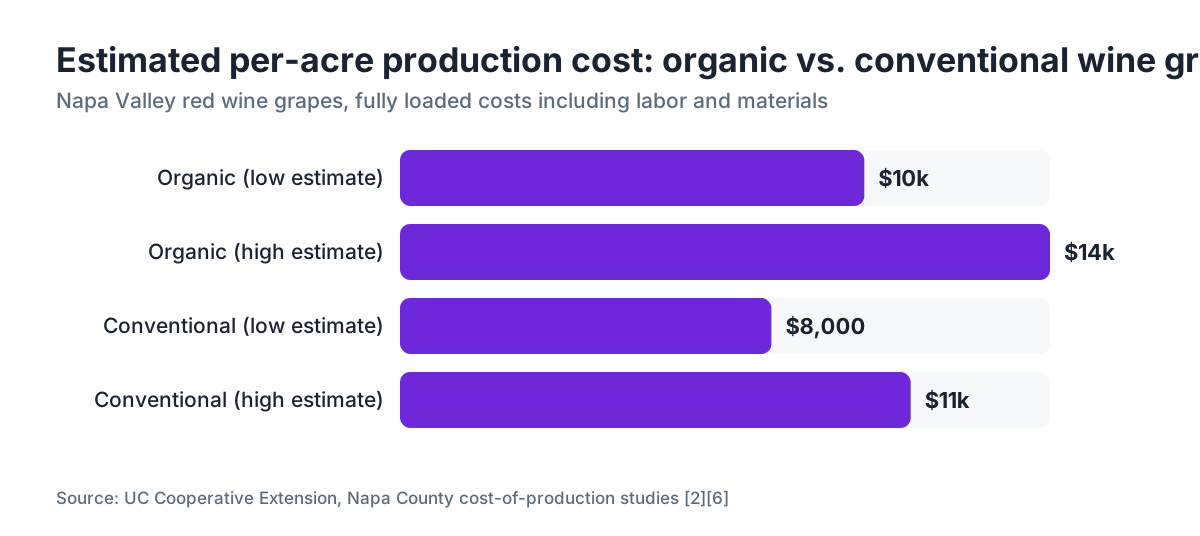
UC Cooperative Extension publishes cost-of-production studies for California wine grapes by region. Their Napa County work estimates certified organic red wine grape production at roughly $10,000 to $14,000 per acre in fully loaded costs, against $8,000 to $11,000 for conventional programs in the same area [6]. The spread is mostly labor (more spray passes, hand weeding) and materials (organic inputs cost more per pound of active ingredient). These numbers move with vintage and input prices, so treat them as order-of-magnitude guidance, not a budget.
In lower-pressure regions like parts of Paso Robles or eastern Washington, the differential narrows because you spray less regardless of organic or conventional status. Paso Robles wineries that have moved blocks to organic often report the gap drops under $1,000 per acre once the farm crew is trained.
On revenue, organic wine grape premiums vary by buyer. Certified organic grapes can command 10 to 40 percent over conventional prices in direct contracts, but spot-market premiums are inconsistent and shrinking as organic supply grows. The premium matters most in the first years after certification. After that, the real economic case is soil health, a better long-term input cost trajectory, and differentiation in DTC or premium tiers.
The certification fee itself is small. The USDA Organic Certification Cost Share program reimburses up to 75 percent of certification costs, capped at $750 per certification scope per year [7]. That doesn't move total program costs much, but it's free money and too many growers never file for it.
What worker protection requirements apply to organic vineyard spray programs?
Organic does not mean unregulated on worker safety. The EPA Worker Protection Standard (WPS), codified at 40 CFR Part 170 and substantially revised in 2015, applies to every pesticide application in agriculture, including OMRI-listed materials [8]. Sulfur, copper, and neem oil all trigger WPS compliance: central posting of application information, restricted-entry intervals (REIs), access to personal protective equipment, and decontamination supplies.
Elemental sulfur carries a 24-hour REI under most registrations. Copper hydroxide products run 24 to 48-hour REIs depending on formulation. Some growers assume "natural" materials skip the WPS. That assumption has cost people money and, worse, injured workers. The EPA is explicit that all pesticides registered under FIFRA are subject to WPS requirements whether they're conventional, biopesticide, or organic [8].
The WPS also requires agricultural employers to train workers and handlers on pesticide safety before they enter treated areas or handle pesticides. Annual training is the standard. Spanish-language training materials are required when your workforce mainly speaks Spanish, and the EPA offers free compliant materials through its worker safety resources [8].
Your organic certifier may also want you to document REI compliance inside your OSP. That means your spray records need to capture application time, REI duration, and re-entry dates, more than product names and rates. Field records that catch all of this in one system are worth building early, before an audit or an injury forces the issue.
How do you manage weeds organically in a vineyard?
Weed management is one of the biggest practical headaches in organic viticulture. You lose glyphosate, which conventional growers lean on hard in the vine row. In its place you get mechanical cultivation, under-vine mowing or string trimming, midrow cover crops managed for competitive suppression, and sometimes flame weeding.
Under-vine cultivation with a finger weeder, torsion weeder, or oscillating hoe is the most common approach. It works, but it's slow, it damages vines on young blocks, and it needs soil conditions you don't always get in the wet season. A wet spring can cost organic growers several weeks of cultivation windows that a conventional grower covers with one herbicide pass.
Kaolin clay as a physical barrier and propane flamers work on small annual weeds but don't touch established perennials like bermudagrass or field bindweed. Inherit a conventionally farmed block with a serious perennial weed problem, and the first 2 to 3 years of transition will run disproportionately expensive on weed control alone.
Corn gluten meal gets cited as a pre-emergent organic herbicide. The vineyard evidence is weak. The closest studies, mostly from turfgrass research, show inconsistent results at rates far too high to pencil out across large blocks. I wouldn't spend the money.
The best long game is to build the midrow cover crop thick enough, and mow it often enough, that it outcompetes the weeds you care about, then pour your mechanical cultivation energy into the vine row only. That's reachable in most climates with a 2 to 3 year investment in the cover crop program.
How does organic certification affect your spray records and compliance paperwork?
Your spray records under organic certification carry more weight than they do in a conventional operation. They're more than WPS documents or state pesticide use report data. They're the primary evidence your certifier uses to verify that you applied only allowed materials, at allowed rates, with nothing prohibited co-applied.
Every application record has to capture the date and time, the field block, the material name and EPA registration number (yes, OMRI-listed pesticides still hold FIFRA registrations), the rate, the equipment, and the applicator's name. You also need records of everything going into the soil and the vine: fertilizers, soil amendments, foliar programs. That's a mountain of paperwork on paper.
State pesticide use reporting adds another layer. California requires Pesticide Use Reports (PURs) filed monthly with your county agricultural commissioner for any restricted-use pesticide and for all commercial applications. Even some OMRI-listed copper products fall under this requirement [9]. Oregon and Washington run their own agricultural pesticide reporting systems with different thresholds and timing.
This is where software built for vineyard compliance earns its keep. VitiScribe's organic farm records module links input records to field blocks, flags materials missing from the NOP National List, and generates certifier-ready reports without reformatting. A spreadsheet per block per year works right up until you're running 10 blocks and 14 spray events a season.
One deficiency certifiers flag over and over: growers with compliant inputs but no written justification for why they used each one. Your OSP should spell out decision criteria, like what threshold triggers a sulfur pass, more than a list of allowed materials. Build that documentation habit early.
What cover crops work best in organic vineyards?
Cover crop selection is region-specific, and there's no universal right answer. A few principles hold across most wine regions anyway.
In irrigated desert or semi-arid climates (Paso Robles, eastern Washington, Lodi), water competition from cover crops is a real concern. Growers there often run permanent cover only in the midrow and keep the vine row clean, or they terminate the cover crop by late spring before peak vine water demand. Shallow-rooted annuals like annual ryegrass or mustard compete less than deep-rooted perennials like chicory.
In cooler, higher-rainfall regions (Willamette Valley, Finger Lakes, Sonoma Coast), erosion control and nitrogen contribution matter more than water competition. Hairy vetch mixed with cereal rye is a workhorse pairing: the rye establishes fast and holds soil through winter, the vetch fixes nitrogen and lays down biomass when incorporated or mowed in spring. Cornell's extension program has trial data on this combination in New York vineyards going back to the 1990s [3].
For an established organic vineyard, a perennial sod midrow of fine fescues or creeping red fescue with a white clover component maintains soil biology between cultivation events, suppresses annual weeds through competition, and gives equipment traction on wet soils. The tradeoff is that it fixes less nitrogen than an annual legume program, so your compost has to carry more of the fertility load.
A practical tip: order cover crop seed by early August for fall planting. Organic-approved seed (or untreated seed when organic isn't commercially available, which the NOP allows) runs tight on supply. Order in October and you'll pay more and wait longer.
Are there organic vineyard certifications beyond the USDA NOP?
Yes, and a few of them matter more than the USDA seal in certain markets.
Demeter-certified Biodynamic is the most recognized beyond-organic standard. Biodynamic farming follows the 500 and 501 preparations (fermented manure applied to soil, silica sprayed on plants), farm-as-organism principles, and planting calendar guidance drawn from Rudolf Steiner's agricultural lectures. Biodynamic wines earn real price premiums in fine wine markets, especially in Europe. The certification requires NOP compliance as a baseline plus Demeter's added practices [10].
California Certified Organic Farmers (CCOF) and Oregon Tilth Certified Organic (OTCO) are accredited certifying agents, not separate standards. They certify to the NOP standard but bring regional field staff who know wine grape production.
Sustainable certifications like CSWA (California Sustainable Winegrowing Alliance) Certified Sustainable, Lodi Rules, and LIVE (Low Input Viticulture and Enology) in the Pacific Northwest are not organic certifications. They allow synthetic inputs under restrictions. Growers sometimes pursue these alongside NOP certification, or use them during transition when they can't yet sell as certified organic. The vineyard operations overlap a lot, but the compliance requirements are distinct.
Fair trade certification for farmworkers is a separate layer, run through Fair Trade USA. Some California and Oregon wineries stack it onto organic certification to address labor equity in their supply chain. It requires minimum pricing, social premium payments, and worker committee oversight.
How do you transition an existing vineyard block to organic certification?
Transition planning is mostly sequencing and cash flow. Here's what a realistic 4-year plan looks like on the ground.
Year 0 (the year before the transition clock starts): get baseline soil tests done (micronutrient panel, Haney soil health test, or equivalent), pick your certifier and request an OSP template, review your input history to fix the last date of prohibited substance application, and map your blocks against neighboring operations for buffer zones. If a neighboring conventional vineyard drifts herbicide onto your block, it can create a certification complication even though you never applied it. Documented buffer zones and drift-incident logs protect you.
Year 1 (transition begins): file your OSP, apply only allowed inputs, and start your spray and soil amendment records under organic documentation standards. Expect higher weed pressure than you had conventionally. The soil seedbank hasn't been drawn down yet.
Years 2 and 3: refine your spray program against the real disease pressure in your blocks. Adjust the cover crop mix. Build compost volumes toward your target rate. These are the years to learn which sulfur timing windows matter most and which organic inputs actually earn their cost in your microclimate.
Year 4 (first certified harvest): apply for certification in January or February. Your certifier inspects before the season, reviews your records from the prior 36 months, and issues the certificate. Keep every receipt, every input label, every application record. The paper trail is your certification.
Budget conservatively for the transition years. Growers underestimate the time and money gap all the time. University extension cost-of-production budgets from UC Davis, Cornell, and WSU are your best regional benchmarks [2][3][5].
Frequently asked questions
How long does it take to get USDA certified organic for a vineyard?
The NOP requires a 3-year transition period during which no prohibited substances touch the land. The clock starts from the last date a prohibited substance was used, not from when you apply. After 3 years you apply through an accredited certifier, undergo an inspection, and if your records are clean, receive certification in time for that year's harvest. Plan for 3 to 4 years from decision to first certified crop.
Can you use copper sulfate in an organic vineyard?
Yes. Copper fungicides including copper sulfate and copper hydroxide are allowed under the NOP, with a hard cap of 1 lb of elemental copper per acre per year. That limit gets tight in high downy mildew years. Cornell Extension recommends tracking cumulative copper starting at budbreak so you don't exhaust the annual budget by midsummer, when late-season pressure often peaks.
What is OMRI and why does it matter for organic spray programs?
OMRI is the Organic Materials Review Institute, a nonprofit that evaluates commercial products against USDA NOP standards. An OMRI-listed label on a pesticide or fertilizer means the product has been reviewed and found allowable for certified organic production. It's not a government certification, but it's the fastest way to confirm a product is likely NOP-compliant. Still check that your certifier accepts OMRI as sufficient. Most do.
Does going organic actually improve wine grape quality?
The evidence is genuinely mixed. Some studies show higher flavonoid and phenolic concentrations in fruit from organic vineyards, possibly tied to mild biotic stress from lighter fungicide coverage or better soil biology. A 2016 study in the Journal of Wine Economics found California organic and biodynamic wines scored modestly higher on average in expert ratings, though the effect was small and confounded by producer quality. Nobody has proved causation. Better soil health is real; whether it reliably makes better fruit is still an open question.
What is the biggest mistake growers make when starting an organic vineyard program?
Underestimating sulfur timing. Powdery mildew in organic programs is controlled preventively, not curatively. Most first-year organic growers wait until they see symptoms, then learn that sulfur won't stop an active infection the way a systemic fungicide does. You have to spray ahead of infection periods, every 7 to 10 days through the high-risk window, at full label rates. Stretching intervals to save money in year one usually ends in a mildew crisis that costs far more to fix.
Are organic vineyard inputs more expensive than conventional inputs?
Per pound of active ingredient, yes, most organic inputs cost more. Elemental sulfur is the exception and is cheap at scale. The bigger driver is application frequency: organic programs often need 2 to 3 times the spray passes for disease management as conventional programs in humid climates. UC Cooperative Extension estimates organic wine grape production in Napa Valley runs roughly $2,000 to $3,000 more per acre per year than conventional, mostly in labor.
How do you control weeds under the vine row without herbicides?
Mechanical cultivation with finger weeders, torsion weeders, or oscillating hoes is the primary method. Propane flamers handle small annual weeds on young growth. Mulching with wood chips or straw suppresses germination and holds moisture but can harbor disease inoculum and is labor-intensive to apply. No organic material matches glyphosate's efficiency in the vine row, so plan on spending more time and money under-vine than you did conventionally.
Do organic vineyards need to comply with the EPA Worker Protection Standard?
Yes, fully. The WPS at 40 CFR Part 170 applies to all pesticide applications covered by FIFRA, including OMRI-listed organic inputs like sulfur, copper, and neem oil. Employers must post application information, enforce restricted-entry intervals, provide PPE, and train workers and handlers annually. The EPA is clear that organic status does not exempt growers from WPS. Non-compliance penalties apply equally to organic and conventional operations.
What's the difference between organic and biodynamic vineyard certification?
Organic certification (USDA NOP) bars synthetic inputs and requires a 3-year transition and annual certifier audits. Biodynamic certification from Demeter requires everything NOP requires plus a specific farming system: the 500 and 501 preparations, a farm-as-organism philosophy, and planting calendar alignment. Biodynamic is harder to obtain and carries stronger premiums in fine wine markets, especially in Europe. Every biodynamic vineyard must meet NOP standards, but not every organic vineyard meets Demeter's added requirements.
Can I sell grapes as organic during the transition period?
No. During the 3-year transition you must farm to organic standards but you cannot sell the fruit as certified organic. You can market it as 'transitional' in some contexts, and some buyers will pay a small premium for transitional fruit. USDA doesn't regulate the 'transitional' label the way it regulates 'certified organic,' so disclosure practices vary. Check with your certifier and buyer before making any transitional claim.
Are there government cost-share programs to help cover organic certification fees?
Yes. The USDA Organic Certification Cost Share program reimburses up to 75 percent of certification costs, capped at $750 per certification scope per year. Applications run through your local USDA Farm Service Agency office and funding is annual. The dollar amounts are modest against total organic production costs, but the application is simple and you should take it.
How do organic spray records differ from conventional pesticide records?
The required fields are similar (date, field, material, rate, applicator), but organic records carry extra burdens. You document the justification for each application in your organic system plan, retain input labels and receipts to prove material identity, and show every applied product sits on the NOP National List. Certifiers want proof your system would catch an accidental prohibited-substance application, more than log the compliant ones. Electronic records with input databases make this far less painful.
What cover crops work best for nitrogen fixation in organic vineyards?
Hairy vetch is the most reliable legume for nitrogen fixation in most wine regions, with credits of 80 to 120 lb of actual N per acre when incorporated before flowering. Bell beans perform similarly in milder climates. Crimson clover is a lower-biomass option that establishes faster. All legume cover crops need adequate phosphorus and Rhizobium inoculant to fix nitrogen well. Mix with a grass companion like cereal rye for erosion control and biomass structure.
Sources
- USDA Agricultural Marketing Service, National Organic Program, 7 CFR Part 205: NOP rules require 3-year land transition, prohibit synthetic pesticides and fertilizers, and cap copper at 1 lb elemental copper per acre per year on the National List
- UC Cooperative Extension, Organic Viticulture resources and cost-of-production studies: Organic vineyards in California typically spray 10 to 16 times per season for fungal disease; organic Napa production costs roughly $10,000 to $14,000 per acre
- Cornell Cooperative Extension, viticulture and organic grape programs (New York): Cornell publishes copper budgeting worksheets and long-running trial data on hairy vetch plus cereal rye cover crop combinations in New York vineyards
- Washington State University Extension, tree fruit and vineyard pest management publications: WSU documented spinosad resistance in leafrollers after 5 to 7 years of heavy use
- Washington State University Extension, organic and sustainable viticulture program: WSU Extension recommends legume-grass cover crop mixes for Pacific Northwest organic vineyards to balance nitrogen fixation with erosion control
- UC Cooperative Extension, Napa County cost-of-production studies for wine grapes: UC Cooperative Extension estimates organic red wine grape production in Napa Valley at roughly $10,000 to $14,000 per acre versus $8,000 to $11,000 for conventional programs
- USDA Farm Service Agency, Organic Certification Cost Share Program: USDA reimburses up to 75 percent of organic certification costs, capped at $750 per certification scope per year
- EPA, Agricultural Worker Protection Standard, 40 CFR Part 170: WPS applies to all FIFRA-covered pesticide applications including OMRI-listed organic inputs; organic status does not exempt growers; employers must train workers annually and post application information
- California Department of Pesticide Regulation, Pesticide Use Reporting program: California requires monthly Pesticide Use Reports filed with county agricultural commissioners for all commercial pesticide applications including certain copper-based organic materials
- Demeter Association, Biodynamic farm and processing standards: Demeter Biodynamic certification requires NOP compliance as a baseline plus the 500/501 preparations and farm-as-organism practices
- USDA AMS, National List of Allowed and Prohibited Substances, 7 CFR 205.601: The NOP National List specifies all allowed synthetic and prohibited natural substances for certified organic crop production including vineyard inputs
Last updated 2026-07-09