Annual copper accumulation tracking for organic vineyard certification

TL;DR
- The NOP allows copper-based fungicides in organic production but caps applications at 6 pounds of metallic copper per acre per year.
- Tracking that number year over year matters because copper persists in soil and certifiers want to see a trend, more than a single season total.
- You need product labels, application records, and a simple running ledger to stay compliant and keep your certification.
Why does copper accumulation matter for organic certification?
Copper is one of the few effective fungicides allowed under certified organic rules, and it's the backbone of powdery mildew and downy mildew programs in most wine regions. The catch is that copper doesn't break down or leach out of soil the way organic carbon does. It builds up. In vineyards that have used copper for decades, soil levels can reach concentrations that affect earthworm populations and vine root health, and European regulators have been fighting over this problem for years.
The National Organic Program regulates this through 7 CFR 205.601(i)(2), which lists copper-based materials as allowed with the restriction that they be "used in a manner that minimizes accumulation of copper in the soil." [1] The rule doesn't give a bright-line soil concentration limit. What it does is point certifiers and growers toward application rate limits as the practical proxy for accumulation control.
Your certifier needs evidence that you're actually watching the number, more than hoping for the best. That means keeping annual records of how many pounds of metallic copper you applied per acre, understanding how those numbers stack across seasons, and being ready to show that trend at your annual renewal. A grower who walks in with a clean running total and product records from the past three to five years is a grower who sails through audit. A grower who can't produce those numbers may get a corrective action notice even if they technically stayed under the annual cap.
What is the copper limit for organic vineyards?
The hard number most certifiers work from is 6 pounds of metallic copper per acre per year. This figure comes from the USDA National Organic Program's guidance and is referenced in the NOP Handbook, and OMRI and many accredited certifiers use the same ceiling. [1] Some certifiers are stricter. Oregon Tilth and CCOF, for example, have historically pushed growers toward 4 to 5 lb/acre/year as a target, and a few have adopted the European Union's limit of roughly 4.4 lb/acre/year (equivalent to the EU's 28 kg/hectare over 7 years) as a best-practice benchmark. [2]
The regulation at 7 CFR 205.601 says copper materials are permitted for plant disease control, but the NOP's interpretive guidance makes clear the 6 lb cap is the operational standard most accredited certifiers enforce. [1] If your certifier has a stricter internal policy, that policy governs, regardless of what the federal rule says on its own.
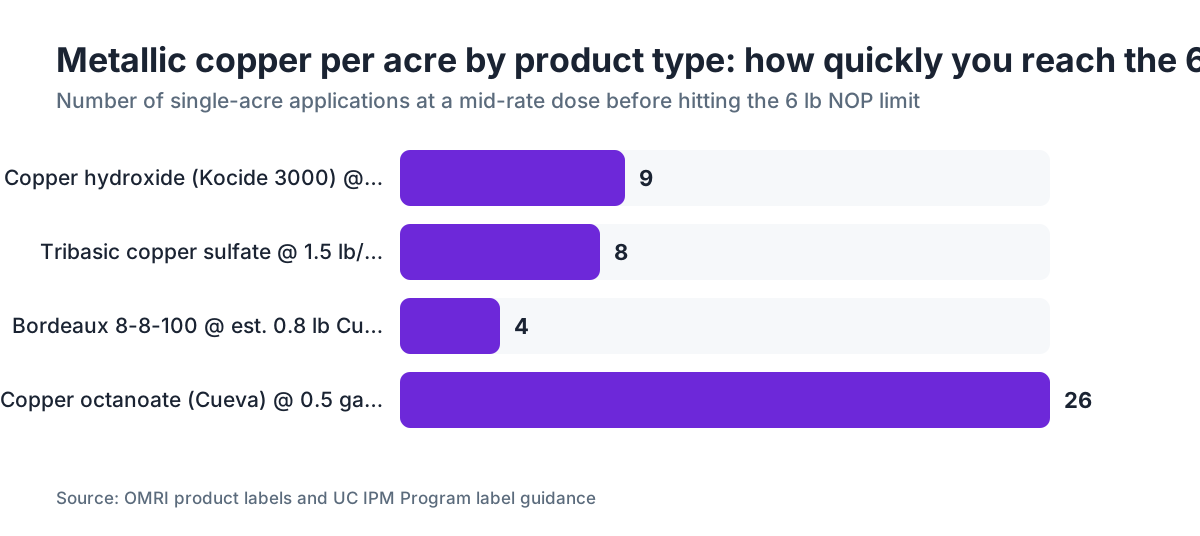
One thing growers get wrong: the limit is on metallic copper, not on the product weight. Copper hydroxide (Kocide 3000) is about 37.5% metallic copper by weight. Bordeaux mixture varies. Copper sulfate basic runs around 50%. You have to convert every product you use to its metallic copper equivalent before you can track accumulation honestly. [3] The math isn't hard, but skipping it is how growers blow past the limit without knowing it.
| Product | Typical metallic Cu % | Lbs of product to apply 1 lb metallic Cu |
|---|---|---|
| Copper hydroxide (Kocide 3000) | 37.5% | 2.67 |
| Copper sulfate basic (Cueva) | ~10% (liquid, varies) | see label oz/acre |
| Tribasic copper sulfate | ~50-53% | ~1.9 |
| Bordeaux mixture (8-8-100) | ~0.8 lb Cu per gallon | see mixing ratio |
| Copper octanoate (Cueva) | 10% copper octanoate, ~1.8% metallic Cu | see label |
Always verify the metallic copper percentage on the specific product label or SDS. Formulations change, and label math beats table estimates every time.
How do you calculate metallic copper applied per acre?
The conversion formula is simple: pounds of metallic copper applied per acre equals (product rate in lb/acre) multiplied by (percent metallic copper on the label, expressed as a decimal). [3]
Say you're using Kocide 3000 at 1.75 lb/acre. The label lists 37.5% metallic copper. Multiply 1.75 by 0.375 and you get 0.656 lb of metallic copper per acre per application. Run that spray eight times in a season, and you've put down about 5.25 lb/acre for the year. Still under 6, but close enough that a late-season emergency application could tip you over.
For liquid products like Cueva, the label gives you a fluid ounce rate per acre. You need to convert that to ounces of metallic copper using the label's copper concentration, then divide by 16 to get pounds. It's a few more steps but the same concept.
Keep a running tally after every spray. Don't wait until December to add it all up. The growers who get into trouble are the ones doing retroactive math and realizing in November that they're already at 5.8 lb/acre with two more applications planned. If you catch that problem in July, you can shift to a different mode of action or reduce rates for the rest of the season. Catching it in November means you're writing a corrective action plan for your certifier.
WSU Extension's organic viticulture resources emphasize that "application records must include the product name, EPA registration number, rate applied, acres treated, and date" as the minimum documentation certifiers expect. [4] Metallic copper conversion is your job to do on top of that standard spray record, because no label lists it in ready-to-tally form.
What records do organic certifiers actually want to see?
Most accredited certifiers auditing an organic vineyard will ask for the following, and the audit goes faster when these are organized before the inspector shows up.
First, your Organic System Plan should describe your copper management strategy: which products you use, what your target rate is per application, your seasonal maximum, and what you'll do if pressure is severe. A plan that mentions 6 lb/acre as your ceiling and names the products you rotate with is better than a plan that says "we use copper per label directions."
Second, spray records for each application. These need the date, block or field ID, product name, EPA registration number, application rate (product per acre), total acres treated, applicator name, and equipment used. The EPA Worker Protection Standard also requires keeping these records for two years and making them available to workers on request. [5]
Third, your running metallic copper tally for the season. This doesn't have to be elaborate. A column in a spreadsheet that sums metallic copper per acre by block, updated after each application, is exactly what certifiers want to see. It shows you're managing the number in real time, not reconstructing it retrospectively.
Fourth, if your certifier asks for it, soil test results showing copper concentrations. Not all certifiers require this every year, but if your soil is already high in copper from pre-organic history, some certifiers will ask for baseline testing and periodic monitoring. CCOF's guidance documents recommend growers in long-farmed vineyards test soil copper every three to five years. [2]
VitiScribe was built partly to solve the record-keeping side of this problem. The spray log automatically converts product rates to metallic copper and keeps a running seasonal total by block, so you're not doing that math manually after every application.
One thing certifiers notice quickly: inconsistent block acreages between your farm map and your spray records. Make sure the acreage you're dividing by is the actual planted block area, not your total parcel or a rounded estimate.
How does copper accumulation affect soil health over time?
This is where the compliance question becomes an agronomic one. Copper at elevated soil concentrations is genuinely toxic to earthworms, and earthworm activity is one of the clearest proxies for soil biological health. A 2010 study in the journal Environmental Pollution found that earthworm abundance declined significantly in vineyard soils with total copper above roughly 100 mg/kg, a threshold many long-farmed European vineyards had already crossed. [6]
In California, UC Cooperative Extension work in the North Coast has documented copper accumulation in conventionally and organically managed vineyards alike, with some blocks accumulating 200 to 400 mg/kg in the top 6 inches of soil after decades of annual copper applications. [7] Whether that level causes a measurable yield or quality problem for the vine itself is less clear. Vines tolerate higher copper than most crops. But soil fungi and bacteria sensitive to copper are impaired well below the levels that harm vines directly.
For organic certification purposes, the soil health argument backs up the regulatory argument for keeping annual application rates low. Lower annual inputs mean slower accumulation. The practical best practice, as Cornell's organic viticulture guidance describes it, is to apply the minimum effective rate rather than the full labeled maximum, to alternate with non-copper fungicides wherever organic options allow, and to use cover crops and compost to buffer copper toxicity to soil organisms. [8]
Some growers try to manage through timing, concentrating copper applications at the highest-risk disease windows (bloom and early fruit set for powdery mildew, post-rain for downy mildew) and cutting copper entirely during low-risk periods. That's sound practice. It keeps annual totals lower without accepting unacceptable disease risk.
What happens if you exceed the copper limit in one season?
Going over 6 lb/acre in a year doesn't automatically strip your certification. Certifiers are required to issue a Notice of Noncompliance, and you'll need to file a written response explaining what happened and what you'll do differently. [1] If you respond adequately and demonstrate a genuine corrective action plan, most certifiers will keep your certification in place for that season while flagging the issue for closer monitoring in the following year.
Repeated violations are a different story. A second exceedance in three years, or a pattern of record-keeping problems, can lead to suspension. And falsifying records is grounds for immediate decertification and potential civil penalties, since organic fraud is a federal offense under 7 USC 6519. [9]
The practical advice: if you can see midseason that you're trending toward the limit, call your certifier proactively. Disclose the situation before the end-of-season audit. Certifiers respond much better to growers who self-report and come with a plan than to growers where they discover the problem on their own. This is true across every major certifier program.
Also worth knowing: exceeding the annual copper limit in one bad disease year is not a marker that follows your vineyard permanently. Your soil, your certification status, and your relationship with your certifier all reset in ways that a proactive response and a clean subsequent season can recover. Losing sleep over one tough year isn't useful. Making a plan for the next season is.
Are there copper alternatives allowed under organic certification?
Yes, and you should be using them. Relying entirely on copper for disease management is agronomically sloppy and leaves you exposed when pressure is severe and your copper budget is almost spent.
Sulfur is the most widely used organic fungicide in wine grapes. It's very effective against powdery mildew and has no accumulation concern at typical rates. It doesn't touch downy mildew. For downy mildew, copper still dominates the organic toolkit, but fixed-copper rates can often be reduced when you spray on a tight schedule based on disease models rather than calendar intervals.
Potassium bicarbonate products like Kaligreen and Milstop are OMRI-listed and have shown meaningful efficacy against powdery mildew in university trials, though they're less effective than sulfur in high-pressure situations. [8] They're best used as part of a rotation, not as the primary mode of action in a bad year.
Neem-based products (azadirachtin), mineral oils, and certain plant-extract fungicides are also on the OMRI list. The honest assessment from Cornell and WSU extension is that their efficacy in commercial wine grape production is lower than copper and sulfur, and they're most useful at very low disease pressure as a supplemental tool, not a replacement.
The bottom line is a program built on sulfur for powdery mildew, copper applied judiciously for downy mildew and other copper-responsive diseases, and alternatives woven in to reduce total copper load is both agronomically defensible and much easier to keep within the 6 lb cap.
How do you build a multi-year copper tracking system?
Annual tracking is the floor, not the ceiling. Smart growers keep a multi-year ledger because soil copper accumulation is a long-term problem, and knowing your five-year average tells you much more than knowing just this year's number.
A simple system looks like this: one spreadsheet with a row per application, columns for date, block ID, product, product rate (lb or oz/acre), acres treated, metallic copper percentage, and calculated metallic copper per acre. Sum that last column by block and by year at the bottom. Add a separate tab that shows each block's total by year for the past five to ten seasons. If you inherited a vineyard with no prior records, use your best estimate based on whatever labels or purchase receipts exist, note the uncertainty, and begin clean records from the year you took over.
Block-level tracking matters more than farm-level averages. Different blocks often get different disease pressure and different spray coverage, and knowing that your Chardonnay block on the valley floor has averaged 5.2 lb/acre for three years while your Cabernet on the hillside has averaged 2.9 lb/acre tells you where to focus reduction efforts. [4]
Soil testing adds another dimension. If you test the same blocks every few years, you can see whether your annual application rates are producing a measurable increase in soil copper concentration. In heavy clay soils, copper binds tightly and surface concentrations can rise steeply even with applications that seem moderate. In coarser, well-drained soils, the relationship is less linear.
For growers who want the record-keeping automated, VitiScribe's spray log handles the metallic copper math by block, flags when a block is approaching the seasonal cap, and exports the format most certifiers want at audit time. That's useful if you're managing multiple blocks across a large ranch and tracking it manually is genuinely taking hours.
What do UC Davis, Cornell, and WSU say about copper management in organic vineyards?
These three programs produce the most practically useful guidance for U.S. wine grape growers, and they're fairly consistent with each other.
UC Davis Cooperative Extension and the UC IPM program recommend growers use disease-forecasting models (UC's own Decision Support Systems, or commercial models from services like Fruition Sciences or METOS) to time copper applications rather than spraying on a fixed calendar schedule. Fewer applications at the right moment means lower annual copper totals without sacrificing disease control. [7]
Cornell Cooperative Extension's organic viticulture program recommends "using copper products at the lower end of labeled rates when disease pressure is moderate" and "rotating copper with sulfur and potassium bicarbonate to reduce total copper inputs per season." [8] Their program notes that the 6 lb/acre limit was never intended to be a target rate but rather an absolute ceiling, and that most Cornell-monitored organic vineyards in the Finger Lakes aim for 3 to 4 lb/acre annually.
WSU Extension's guidance for Pacific Northwest organic growers covers both Washington and Oregon conditions, where higher rainfall makes downy mildew pressure more severe and copper programs harder to reduce. WSU materials note that application records must be complete enough to reconstruct the season's total copper application at any point during or after the growing season, which is a practical argument for in-season tracking rather than end-of-year reconstruction. [4]
All three programs agree that reducing copper inputs is both a regulatory obligation and a long-term agronomic interest. None of them treats the 6 lb cap as a comfort zone. They treat it as the limit you stay well under whenever disease conditions permit.
How do you handle copper records when buying or selling a vineyard?
Copper history is a real asset or liability in a vineyard transaction. If you're buying a vineyard that has been organically certified for ten years, ask for spray records going back as far as available. Calculate the historical annual copper inputs by block. If records don't exist, ask whether soil testing has been done and request those results.
A vineyard with a documented history of staying at or below 3 lb/acre annually is in a better position agronomically and from a certification standpoint than one where records show years of applications at or near the cap. The soil copper concentration in the top 12 inches is a physical fact that doesn't reset when ownership changes.
If you're selling, having clean multi-year copper records is a genuine selling point for organic vineyards. Buyers who want to maintain certification will want to see that the certification is clean and that accumulation is not a looming problem.
For properties where records are incomplete, UC Cooperative Extension offices in most California wine regions can help you interpret a soil copper test relative to baseline soil copper levels in your area. The baseline matters because some soils have naturally elevated copper levels that have nothing to do with fungicide history. [7]
Does the EPA Worker Protection Standard affect copper spray records?
Yes, and it layers on top of NOP certification requirements rather than replacing them. The EPA Worker Protection Standard (40 CFR Part 170, revised 2015) requires that all pesticide application records, including OMRI-listed copper products, be kept for two years and include product name, EPA registration number, active ingredient, quantity applied, location of application, date and time, and applicator name. [5]
Copper-based fungicides are still pesticides under federal law even when they're OMRI-listed and NOP-compliant. The label is a legal document. The record requirements under WPS apply regardless of the organic status of the product.
Central Posting requirements under WPS also mean that application information must be posted at a central location accessible to workers during the restricted-entry interval after copper applications. Most copper products have REIs between 24 and 48 hours. [5] That information needs to go up before workers re-enter treated areas, and the posting has to include the product name, active ingredient, and the REI end date and time.
For organic certification audits, WPS-compliant records are generally sufficient as the application record base. You're building the metallic copper tally on top of what you're already required to keep, so the additional record-keeping burden is genuinely small if you have a WPS-compliant spray log already.
Frequently asked questions
What is the annual copper limit for certified organic vineyards in the US?
The USDA National Organic Program allows copper-based fungicides up to 6 pounds of metallic copper per acre per year, per NOP guidance under 7 CFR 205.601(i)(2). Some accredited certifiers set stricter internal caps of 4 to 5 lb/acre/year. Always check your specific certifier's program requirements, because their policy governs if it's more restrictive than the federal standard.
How do I convert product weight to metallic copper pounds per acre?
Multiply your product application rate (in lb/acre) by the metallic copper percentage listed on the product label, expressed as a decimal. For example, Kocide 3000 at 1.75 lb/acre times 0.375 (37.5% metallic Cu) equals 0.656 lb metallic copper per acre per application. Do this calculation for each application and keep a running seasonal total by block.
How often should I test soil copper levels in an organic vineyard?
CCOF guidance recommends testing every three to five years for vineyards with a long history of copper use. If your blocks show elevated baseline levels or you're receiving corrective action guidance from your certifier, annual testing for a few years gives you a clearer trend. Use the top 6 to 12 inches of soil as your sampling depth, since that's where copper concentrates.
What happens to my organic certification if I accidentally exceed 6 lb/acre of copper?
Your certifier will issue a Notice of Noncompliance. You'll need to submit a written corrective action response. A single exceedance with a solid response rarely causes decertification. Repeated exceedances or falsified records are a different matter entirely. If you can see midseason that you're approaching the limit, contact your certifier proactively before the end-of-season audit.
Can I use copper fungicides during the restricted-entry interval (REI) if I'm the certified farmer-operator?
Farmer-operators are partially exempt from some WPS restrictions, but early-entry provisions still apply and the REI is a label requirement, more than a WPS requirement. The label is law. Most copper products list REIs of 24 to 48 hours. Check your product label specifically. The EPA WPS (40 CFR Part 170) governs the posting and worker-notification requirements even for owner-operators.
What records do I need to keep for each copper application under organic certification?
At minimum: date, block or field ID, product name, EPA registration number, application rate (product per acre), total acres treated, applicator name, and equipment. On top of that, your certifier expects a metallic copper conversion showing the lb/acre of metallic copper from each application. WSU Extension specifies that records must be complete enough to reconstruct the season's total at any point during the year.
Are there organic-approved alternatives to copper for downy mildew in vineyards?
Copper still dominates the organic toolkit for downy mildew because no other OMRI-listed product matches its efficacy. Sulfur doesn't cover downy mildew at all. Some phosphonate products are being evaluated, but most aren't NOP-compliant without certifier review. The practical strategy is to reduce copper rates and improve spray timing using disease forecasting models rather than eliminating copper entirely.
Does copper accumulate differently in clay versus sandy vineyard soils?
Yes, significantly. Copper binds tightly to organic matter and clay particles, so heavy clay soils accumulate higher surface concentrations from the same application history. Coarser, well-drained soils show less extreme accumulation in the top layer, though leaching into groundwater is a greater concern there. Soil testing is the only way to know your actual baseline, because texture and organic matter both affect the relationship between inputs and concentrations.
What is the EU copper limit for organic vineyards, and does it apply to US certified growers?
The EU adopted a 28 kg/hectare limit applied over a 7-year rolling average, which equals approximately 4.4 lb/acre/year on average. This EU limit does not apply to US-certified organic operations, but it's a useful benchmark. Some US certifiers reference it as best practice guidance. If you export to EU markets under equivalency agreements, check whether your importer or certifier has adopted EU standards.
How do I handle copper tracking when I take over a vineyard with incomplete prior records?
Reconstruct what you can from purchase receipts, old labels, or the previous owner's tax records showing pesticide purchases. Note the gaps honestly in your Organic System Plan. Then start a clean record from your first season of management. Baseline soil copper testing at takeover gives you a starting point for tracking accumulation going forward. Your certifier would rather see acknowledged uncertainty than fabricated records.
Can I carry over unused copper budget from one season to the next?
No. The NOP's 6 lb/acre limit is an annual cap, not a rolling average. Each calendar year or crop year (depending on how your certifier defines it) starts fresh. A season where you only applied 3 lb/acre does not give you 9 lb/acre the following year. This is worth confirming with your certifier, because a few programs define the year differently, but the standard interpretation is calendar-year or single-season cap.
How does OMRI listing relate to NOP certification for copper products?
OMRI (Organic Materials Review Institute) listing means the product has been independently reviewed for compliance with NOP standards. OMRI listing is not a legal requirement, but certifiers routinely accept OMRI-listed products without further review. Using a non-OMRI copper product isn't automatically prohibited, but you'll need your certifier's pre-approval. The NOP is the governing standard; OMRI listing is a shortcut to demonstrating compliance.
What disease forecasting tools help reduce copper applications in organic vineyards?
UC IPM's online Decision Support System models for grape downy mildew and powdery mildew are free and widely used in California. Cornell's NEWA network covers eastern and Pacific Northwest wine regions. Commercial options include Fruition Sciences and METOS systems. All of these help you time applications to actual infection risk rather than fixed calendar intervals, which meaningfully reduces total applications and annual copper totals.
Sources
- USDA NOP, 7 CFR 205.601 National List of Allowed and Prohibited Substances: Copper-based materials are allowed for plant disease control in organic production but must be used in a manner that minimizes accumulation in the soil; the NOP's operational standard is 6 lb metallic copper per acre per year.
- CCOF, Organic Certification Program Materials: CCOF guidance recommends growers in long-farmed vineyards conduct soil copper testing every three to five years, and some certifiers target 4 to 5 lb/acre/year as a best-practice ceiling.
- OMRI (Organic Materials Review Institute), Product Search and Label Guidance: Metallic copper percentages vary by product formulation (e.g., copper hydroxide ~37.5%, tribasic copper sulfate ~50-53%) and must be read from the specific product label to calculate per-acre metallic copper applied.
- WSU Extension, Organic Viticulture and Pest Management Resources: WSU Extension specifies that application records must include product name, EPA registration number, rate applied, acres treated, and date, and must be complete enough to reconstruct the seasonal copper total at any point during or after the growing season.
- EPA, Agricultural Worker Protection Standard (40 CFR Part 170): The EPA Worker Protection Standard requires pesticide application records be kept for two years and include product name, EPA registration number, active ingredient, quantity applied, location, date and time, and applicator name; central posting and REIs of 24 to 48 hours apply to copper products.
- Environmental Pollution, Copper toxicity to earthworms in vineyard soils (Elsevier): A 2010 study found earthworm abundance declined significantly in vineyard soils with total copper concentrations above approximately 100 mg/kg.
- UC IPM Program, UC Davis, Integrated Pest Management for Grapes: UC Cooperative Extension work in the North Coast has documented copper accumulation of 200 to 400 mg/kg in the top 6 inches of soil in some long-farmed California vineyard blocks; UC recommends disease-forecasting models to time copper applications and reduce annual totals.
- Cornell Cooperative Extension, Organic Viticulture Program: Cornell's organic viticulture program recommends applying copper at the lower end of labeled rates when disease pressure is moderate, rotating with sulfur and potassium bicarbonate, and aiming for 3 to 4 lb metallic copper per acre annually rather than treating 6 lb as a target rate.
- Organic Foods Production Act, 7 USC 6519 (enforcement and penalties): Falsifying organic records is a federal offense under 7 USC 6519, grounds for decertification and civil penalties.
- European Commission, Regulation (EU) 2018/1981, copper compounds in organic farming: The EU adopted a limit of 28 kg of copper per hectare over 7 years (approximately 4.4 lb/acre/year on average) for organic production, a stricter standard than the current US NOP annual cap.
- USDA Agricultural Marketing Service, National Organic Program: The NOP Handbook provides certifier guidance on copper use, including the 6 lb/acre/year operational limit referenced by accredited certifiers.
Last updated 2026-07-09