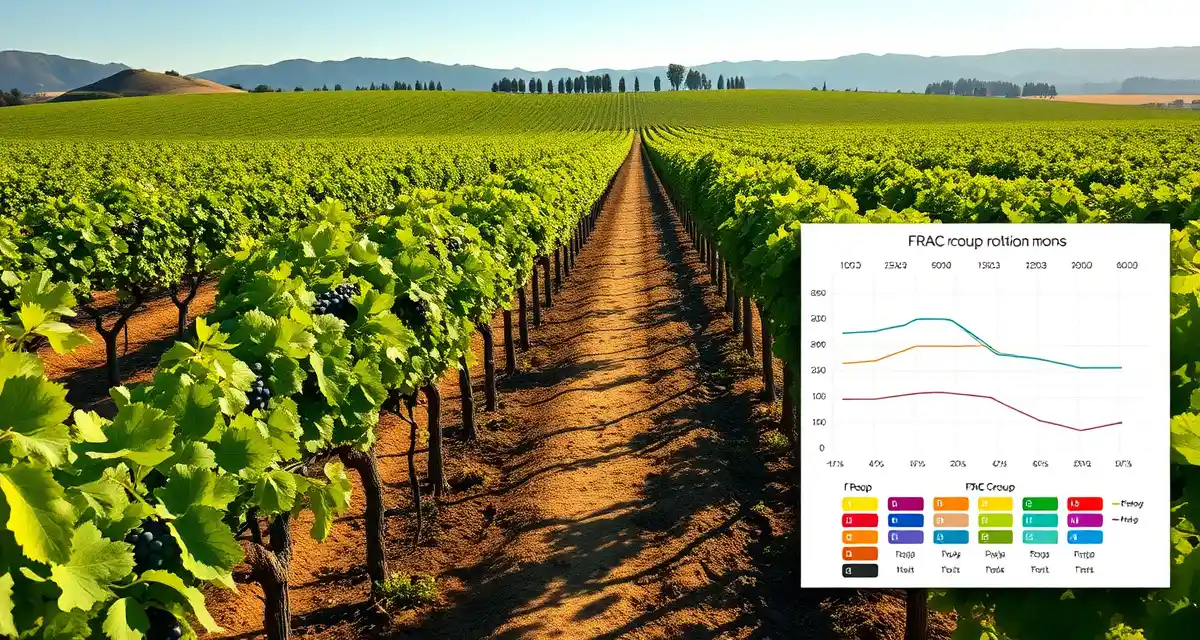
Vineyard Pesticide Resistance Rotation Planner
QoI fungicide resistance in powdery mildew is widespread in California vineyards. It didn't happen overnight, it's the result of years of heavy reliance on a single FRAC group (Group 11) without adequate rotation. That's what pesticide resistance looks like in practice: a class of chemistry that worked well stops working, often in the middle of a season when you need it most.
VitiScribe tracks FRAC and IRAC groups across all spray records for resistance management. This planner explains how FRAC/IRAC rotation works, which groups are at highest risk, and how to build a rotation that protects your program long-term.
TL;DR
- QoI (FRAC Group 11) resistance in powdery mildew is already widespread in California -- programs that haven't rotated away from strobilurins are managing a resistant population, and increased application rates won't recover efficacy once resistance is established
- Botrytis resistance to FRAC Group 1 (benzimidazoles) and FRAC Group 9 (anilinopyrimidines) is well-documented in commercial vineyards -- pre-harvest botrytis programs that rely on either group without rotation should be evaluated for efficacy history
- The most common rotation failure is a plan made in January that isn't tracked through August -- a FRAC rotation on paper that shows proper diversity can still result in Group 11 overuse if group tracking stops during the busy summer season
- No more than 2 consecutive applications from the same FRAC group and no more than 2-3 total applications from any single FRAC group per season are the practical rotation thresholds that resistance management programs build around
- Multi-site materials (FRAC M) -- sulfur, copper, captan, mancozeb -- have very low resistance risk because mutations at multiple target sites are required simultaneously; these are the rotation anchors that should appear between every 1-2 applications of site-specific materials
- IRAC rotation follows the same principle as FRAC: IRAC Group 28 diamide resistance has been confirmed in grape berry moth populations in some eastern US regions where chlorantraniliprole has been applied heavily without rotation
What Is FRAC Group Rotation and Why Does It Matter for Vineyards?
FRAC stands for Fungicide Resistance Action Committee. The FRAC system classifies fungicides by their mode of action, how they kill or inhibit fungi. Materials within the same FRAC group work the same way, which means fungi that develop resistance to one product in a group are typically resistant to all products in that group.
The principle behind FRAC rotation: if you alternate between different FRAC groups, resistance to one group doesn't eliminate your entire program. You're never selecting exclusively for resistance to a single mode of action.
This matters for vineyard managers because powdery mildew, botrytis, and downy mildew are all capable of developing fungicide resistance under selection pressure. QoI (FRAC 11) resistance in powdery mildew is already widespread. Botrytis resistance to FRAC 1 (benzimidazoles) and FRAC 9 (anilinopyrimidines) is well-documented in commercial vineyards.
For the full FRAC group breakdown by disease target and resistance risk, see the fungicide FRAC groups vineyard guide.
IRAC Rotation: The Same Principle for Insecticides
IRAC stands for Insecticide Resistance Action Committee. The same rotation logic applies to insecticides. Repeated use of the same IRAC group for grape berry moth or leafhoppers can drive resistance in local pest populations.
Key IRAC groups used in vineyards:
- IRAC 1B (organophosphates): Phosmet, chlorpyrifos (where still registered)
- IRAC 3A (pyrethroids): Bifenthrin, esfenvalerate, note: pyrethroids can cause mite flares
- IRAC 5 (spinosyns): Spinosad, widely used for grape berry moth; lower resistance risk but rotate
- IRAC 28 (diamides): Chlorantraniliprole, cyantraniliprole, effective for moth larvae; excellent safety profile
For the full IRAC group framework and resistance management for vineyard insect programs, see the vineyard insecticide IRAC groups guide.
Key FRAC Groups Used in Vineyard Programs
Powdery Mildew
| FRAC Group | Mode of Action | Examples | Resistance Risk |
|---|---|---|---|
| 3 | DMI (triazoles, etc.) | Tebuconazole, myclobutanil | Moderate, some isolates with reduced sensitivity |
| 7 | SDHI | Boscalid, fluxapyroxad | Increasing, newer group with some resistance reports |
| 11 | QoI (strobilurins) | Azoxystrobin, trifloxystrobin | High, widespread resistance in CA |
| 13 | Quinoxyfen | Quintec | Moderate, use in rotation, not as primary |
| U6 | Cyflufenamid | Torino | Low, newer mode of action |
| M | Multi-site | Sulfur, copper | Very low, mutations at multiple targets required |
Botrytis
| FRAC Group | Mode of Action | Examples | Resistance Risk |
|---|---|---|---|
| 1 | MBC (benzimidazoles) | Thiophanate-methyl | High, widespread resistance |
| 7 | SDHI | Boscalid, fluopyram | Moderate, growing resistance reports |
| 9 | Anilinopyrimidines | Cyprodinil, pyrimethanil | Moderate, some resistance in treated vineyards |
| 17 | Hydroxyanilides | Fenhexamid | Moderate |
| M | Multi-site | Captan | Low |
Downy Mildew
| FRAC Group | Mode of Action | Examples | Resistance Risk |
|---|---|---|---|
| 4 | Phenylamides | Metalaxyl-M (mefenoxam) | High, widespread resistance where overused |
| 40 | Carboxylic acids | Benthiavalicarb | Moderate |
| 45 | Amino-acids | Mandipropamid | Moderate |
| 49 | CMC inhibitors | Oxathiapiprolin | Lower, newer mode of action |
| M | Multi-site | Copper, mancozeb | Low |
How to Build a Resistance-Smart Rotation
Step 1: List your materials. Write out every fungicide or insecticide you're currently using in your vineyard program. Look up the FRAC or IRAC group for each.
Step 2: Map your seasonal applications. For each application in your season, record which FRAC/IRAC group was used. Are you applying the same group more than twice in sequence? That's a resistance risk.
Step 3: Identify problem sequences. The most common rotation mistakes:
- Using a QoI (FRAC 11) product every other application because it's effective early-season
- Applying the same botrytis material (e.g., fenhexamid) every pre-harvest application
- Using the same insecticide group for all leafhopper applications through summer
Step 4: Build in FRAC/IRAC diversity. As a rule of thumb:
- No more than 2 consecutive applications from the same FRAC group
- No more than 2-3 total applications from any single FRAC group per season
- Always rotate high-resistance-risk groups with lower-risk materials (including multi-site FRAC M materials)
Step 5: Track it through the season. This is where many rotation plans fall apart, the plan is made in January but not tracked through August. VitiScribe tracks FRAC and IRAC groups in every spray record, so you can see your rotation history in real time and catch repeated-group situations before they become a problem.
For your powdery mildew resistance management program specifically, see the powdery mildew resistance management guide. For your broader IPM program, see the complete vineyard IPM guide.
FAQ
What is FRAC group rotation and why does it matter for vineyards?
FRAC (Fungicide Resistance Action Committee) groups classify fungicides by their mode of action, how they kill fungi. Fungi that develop resistance to one product in a group are typically resistant to all products in that group. Rotating between different FRAC groups means that resistance to one group doesn't compromise your entire program. QoI resistance (FRAC 11) is now widespread in California powdery mildew populations, a direct result of heavy, unrotated use of strobilurin fungicides.
How do I build a resistance management rotation for vineyard fungicides?
List all the fungicides in your program and their FRAC groups. Map out your seasonal applications and check for consecutive applications within the same FRAC group (more than 2 in a row is high risk). Identify alternatives from different FRAC groups for each disease target, and plan your seasonal rotation before the season starts. Limit any single FRAC group to 2-3 applications per season and always include multi-site FRAC M materials (sulfur, copper) as rotation anchors with very low resistance risk.
Does VitiScribe track FRAC groups in spray records automatically?
Yes. VitiScribe tracks FRAC and IRAC group designations for every pesticide product logged in a spray record. When you add a product to a spray log entry, VitiScribe automatically records the FRAC or IRAC group from its product database. You can view your current season's FRAC group usage by block to see whether any group is being applied too frequently, and your rotation history is available across seasons for long-term resistance management planning.
What is Vineyard Pesticide Resistance Rotation Planner?
[FAQ_ANSWER_PLACEHOLDER: This answer needs to be generated by AI with specific data, examples, and actionable advice relevant to Vineyard Pesticide Resistance Rotation Planner. Target 50-150 words.]
How much does Vineyard Pesticide Resistance Rotation Planner cost?
[FAQ_ANSWER_PLACEHOLDER: This answer needs to be generated by AI with specific data, examples, and actionable advice relevant to Vineyard Pesticide Resistance Rotation Planner. Target 50-150 words.]
How does Vineyard Pesticide Resistance Rotation Planner work?
[FAQ_ANSWER_PLACEHOLDER: This answer needs to be generated by AI with specific data, examples, and actionable advice relevant to Vineyard Pesticide Resistance Rotation Planner. Target 50-150 words.]
What are the benefits of Vineyard Pesticide Resistance Rotation Planner?
[FAQ_ANSWER_PLACEHOLDER: This answer needs to be generated by AI with specific data, examples, and actionable advice relevant to Vineyard Pesticide Resistance Rotation Planner. Target 50-150 words.]
Who needs Vineyard Pesticide Resistance Rotation Planner?
[FAQ_ANSWER_PLACEHOLDER: This answer needs to be generated by AI with specific data, examples, and actionable advice relevant to Vineyard Pesticide Resistance Rotation Planner. Target 50-150 words.]
When Resistance Is Already Present
If you're seeing unexpected disease control failures, powdery mildew breaking through at rates and timing that worked in previous seasons, resistance may already be established in your vineyard.
Practical steps when resistance is suspected:
- Stop applying materials from the suspected group
- Switch to materials with different modes of action
- Increase multi-site material use (sulfur, copper, captan) as reliable rotation anchors
- Confirm with your local UC Extension, OSU Extension, or WSU Extension whether resistance to specific groups has been confirmed in your area
Resistance management is substantially easier than resistance remediation after the fact. Building rotation into your program now is the most practical protection against losing effective chemistry in the future.
How should FRAC rotation records be organized to demonstrate resistance management compliance for a third-party sustainability certification?
Sustainability certifications like Lodi Rules and CSWA (California Sustainable Winegrowing Alliance) require evidence that FRAC rotation principles are applied in your program -- not just a plan on paper, but records showing what was actually applied and in what order. For audit purposes, what matters is a seasonal record that shows FRAC group by application, by block, by date -- so an auditor can verify that no single FRAC group dominates consecutive applications. VitiScribe's FRAC rotation report generates exactly this view: application date, product, FRAC group, block, showing the actual rotation sequence through the season. That report answers the auditor's question without requiring manual reconstruction.
If QoI resistance is already confirmed in my vineyard, is there any point in including Group 11 materials in my rotation program?
The short answer is: usually no, at least not as a primary efficacy material. In a vineyard with confirmed QoI resistance in the powdery mildew population, applying Group 11 materials doesn't provide meaningful disease control and still counts against your seasonal Group 11 application total, consuming a slot that could be used for an effective material. Group 11 materials may retain some utility in tank mixes with effective partners -- the group doesn't lose all activity to every isolate simultaneously -- but relying on Group 11 for primary disease control in a resistant population isn't sound practice. UC Cooperative Extension recommends removing Group 11 from primary rotation in operations with confirmed resistance and treating it as a potential tank-mix partner (at reduced reliance) rather than a standalone application choice.
Sources
- Fungicide Resistance Action Committee (FRAC)
- Insecticide Resistance Action Committee (IRAC)
- UC Cooperative Extension Viticulture
- American Vineyard Foundation
- Wine Institute
Get Started with VitiScribe
Resistance management rotation requires tracking FRAC and IRAC groups across every spray event through the entire season -- a plan made in January that isn't actively tracked through August produces the same resistance outcomes as no plan at all. VitiScribe records FRAC and IRAC group designations automatically from the product database for every logged application, generates real-time rotation history by block, and alerts you when the same group is being applied too frequently so you can adjust before resistance selection pressure accumulates. Try VitiScribe free and review your first season's FRAC rotation history today.