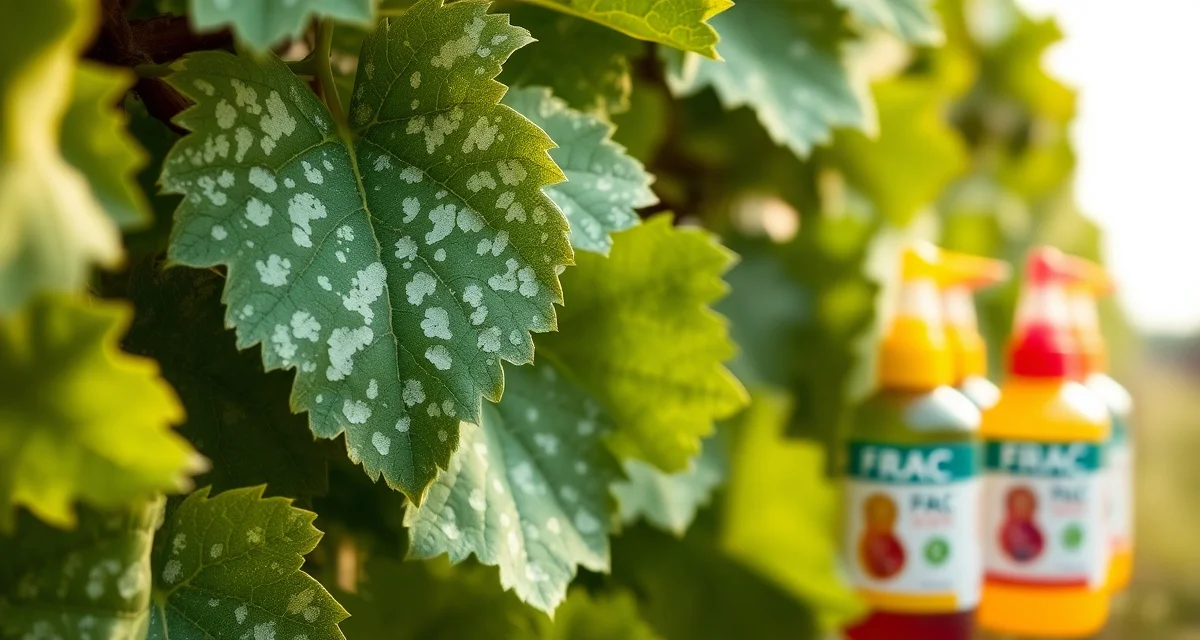
FRAC Groups for Vineyard Fungicides Explained
QoI (Group 11) resistance is confirmed in powdery mildew in most US wine regions. That sentence should reshape how you think about building your powdery mildew spray program, because it means one of the most widely used fungicide classes in US vineyards has limited effectiveness in many blocks where growers are still applying it on a regular rotation.
TL;DR
- FRAC group numbers identify fungicides that share the same mode of action -- resistance to one product within a group typically confers resistance to all others in the same group (cross-resistance)
- QoI (Group 11) resistance in powdery mildew is confirmed in California, Oregon, Washington, New York, and other major wine states -- limit Group 11 applications to 2 per season maximum or eliminate from blocks where breakthrough disease has occurred
- Phenylamide (Group 4) resistance in downy mildew is documented in multiple US wine regions; use only in premixture with contact materials, never as a standalone systemic, and limit to 2-3 applications per season
- Group 17 (fenhexamid -- Elevate) resistance in botrytis is documented in high-use California and Pacific Northwest vineyards; Group 1 (MBC) and Group 2 (dicarboximide) resistance in botrytis is widespread
- Sulfur (Group M2) has no known resistance mechanism in powdery mildew and should anchor every conventional and organic spray program as a rotation backbone
- VitiScribe tracks FRAC groups in spray records and displays rotation history by block so consecutive same-group applications are visible before resistance pressure compounds
VitiScribe tracks FRAC groups in spray records to flag consecutive-mode-of-action applications before resistance pressure compounds. Understanding FRAC groups is the foundation for using that tracking meaningfully.
What a FRAC Group Is
FRAC stands for Fungicide Resistance Action Committee. The committee assigns a numerical code to each distinct fungicide mode of action -- the mechanism by which the fungicide kills or inhibits fungal pathogens. Fungicides with the same FRAC group number kill fungi the same way.
Why this matters: when a fungal population develops resistance to one fungicide in a FRAC group, it often has resistance to all others in the same group. This is called cross-resistance. A powdery mildew population resistant to azoxystrobin (Abound) -- a QoI fungicide -- will also be resistant to trifloxystrobin (Flint), kresoxim-methyl (Sovran), and pyraclostrobin (the strobilurin component of Pristine). Different brands, same FRAC group, same resistance.
The solution is rotating among different FRAC groups so that no single mode of action is used repeatedly enough to drive population-level resistance selection.
Key FRAC Groups for Vineyard Powdery Mildew
FRAC Group M2 (Inorganic, Multi-site) -- Sulfur:
Sulfur has been used for over 150 years against powdery mildew. Because it disrupts multiple cellular processes simultaneously (multi-site activity), resistance development is extremely slow. Sulfur is still as effective as it was a century ago. Use it as your backbone contact material and rotate your systemics through the numbered groups.
FRAC Group 3 (DMI Fungicides -- Sterol Demethylation Inhibitors):
Common products: Rally (myclobutanil), Elite (tebuconazole), Tebuzol, Absolute (trifloxystrobin + tebuconazole). These work by inhibiting ergosterol biosynthesis in fungal cell membranes. They have both protective and eradicant activity. Some shifts in sensitivity have been documented in some US wine regions, but Group 3 generally remains highly effective. Apply no more than 2-3 consecutive applications before rotating to a different group.
FRAC Group 7 (SDHI Fungicides -- Succinate Dehydrogenase Inhibitors):
Common products: Luna Privilege (fluopyram), Luna Sensation (fluopyram + trifloxystrobin), Sercadis (fluxapyroxad), Miravis Prime (adepidyn + fludioxonil). SDHI fungicides inhibit mitochondrial respiration by blocking the succinate dehydrogenase enzyme. Excellent powdery mildew efficacy. Also has activity against botrytis (some SDHI products). The 0-day PHI for most Luna and Sercadis products makes them useful late in the season.
FRAC Group 11 (QoI Fungicides -- Quinone Outside Inhibitors):
Common products: Abound (azoxystrobin), Flint (trifloxystrobin), Sovran (kresoxim-methyl), Flint Extra. Also appears as a component in combination products: Pristine (boscalid + pyraclostrobin), Luna Sensation (fluopyram + trifloxystrobin), Absolute (trifloxystrobin + tebuconazole).
Critical point: QoI resistance in powdery mildew is confirmed in California, Oregon, Washington, New York, and other major wine states. If you've been using Group 11 products routinely for powdery mildew and seeing breakthrough disease, resistance is likely. Limit Group 11 applications to 2 per season maximum, always apply in combination (not as sole active ingredient in the mix), and consider eliminating Group 11 entirely from blocks where you've documented breakthrough.
FRAC Group 13 (Quinoxyfen -- Quinoline Fungicides):
Product: Quintec (quinoxyfen). Excellent efficacy, particularly good during bloom. 14-day PHI limits use very close to harvest. No known cross-resistance with other major powdery mildew FRAC groups. A key rotation partner in programs where Group 11 is excluded due to resistance concerns.
FRAC Group U8 (Metrafenone -- Benzophenone Fungicides):
Product: Vivando (metrafenone). Unique mode of action with no known cross-resistance to any other fungicide class. Excellent powdery mildew efficacy. 0-day PHI makes it usable late in the season. Use as a rotation partner to avoid depleting other FRAC groups, not as a primary material applied every application.
FRAC Group 45 (Potassium Bicarbonate -- Inorganic):
Products: Kaligreen, MilStop, Armicarb. OMRI-listed for organic programs. Contact eradicant activity against powdery mildew. 0-day PHI. Works best when applied to early-stage infections before heavy sporulation.
FRAC Group P5 (Reynoutria sachalinensis Extract):
Product: Regalia. Induces plant resistance rather than directly killing the pathogen. 0-day PHI. OMRI-listed. Best used as a rotation supplement in programs rather than primary reliance.
Key FRAC Groups for Vineyard Botrytis
FRAC Group 1 (MBC Fungicides -- Benzimidazoles):
Products: Topsin-M (thiophanate-methyl). Historically important but widespread resistance in botrytis limits current utility in high-use vineyards. If included, use in combination with another mode of action.
FRAC Group 2 (Dicarboximides):
Products: Rovral AQ (iprodione). Widespread resistance in botrytis limits utility in many programs. Use with caution and monitor for efficacy.
FRAC Group 7 (SDHI):
Products: Luna Privilege, Luna Experience, Miravis Prime. High botrytis efficacy, particularly products containing fluopyram. 0-day PHI on most.
FRAC Group 9 (Anilinopyrimidines):
Products: Scala (pyrimethanil), Vangard (cyprodinil), and as a component in Switch (cyprodinil + fludioxonil). 7-day PHI. Resistance emerging in some regions with high use history.
FRAC Group 12 (Phenylpyrroles):
Products: Fludioxonil as a component in Switch and Miravis Prime. Contact activity against botrytis, low resistance risk when used in combination.
FRAC Group 17 (Hydroxyanilides):
Products: Elevate 50WDG (fenhexamid). 0-day PHI. High efficacy, but Group 17 resistance in botrytis is documented in high-use California and Pacific Northwest vineyards.
Key FRAC Groups for Vineyard Downy Mildew
FRAC Group 4 (Phenylamides):
Products: Ridomil Gold (metalaxyl-M). Historically important, but phenylamide resistance in downy mildew is documented in many US wine regions. Use only in premixture with contact materials, not as a standalone systemic. Limit to 2-3 applications per season.
FRAC Group 40 (Mandipropamid):
Products: Revus (mandipropamid), Revus Top (mandipropamid + difenoconazole). Excellent downy mildew efficacy, no cross-resistance with phenylamides. 7-day PHI.
FRAC Group 43 (Fluopicolide):
Products: Presidio (fluopicolide). Excellent efficacy. No known cross-resistance with Group 4 or Group 40. 7-day PHI.
FRAC Group 45 (Ametoctradin):
Products: Zampro (ametoctradin + dimethomorph). 7-day PHI. Combination product with two modes of action.
Building Your FRAC Rotation
A practical FRAC rotation for powdery mildew in a California Cabernet Sauvignon program:
- Sulfur (M2) -- early budbreak contact application
- Rally or Elite (Group 3) -- shoot elongation systemic
- Quintec (Group 13) -- pre-bloom/bloom window
- Luna Privilege or Sercadis (Group 7) -- post-bloom
- Vivando (Group U8) -- mid-season
- Potassium bicarbonate (Group 45) -- with sulfur tank mix, late season
- Pristine (Groups 7+11) -- late season (0-day PHI), limiting Group 11 to this one use
No more than 2 consecutive applications from the same group. VitiScribe tracks FRAC groups in your spray records and displays rotation history by block so you can see the sequence across the season. See FRAC rotation planning in VitiScribe.
See the downy mildew resistance management guide for FRAC rotation recommendations specific to Plasmopara viticola programs.
Frequently Asked Questions
What is a FRAC group for vineyard fungicides?
A FRAC group is a numerical classification assigned by the Fungicide Resistance Action Committee to fungicides that share the same mode of action -- the same mechanism for killing or inhibiting fungal pathogens. Fungicides within the same FRAC group have cross-resistance: if a fungal population develops resistance to one product in the group, it's often resistant to all others in the same group. Understanding FRAC groups allows you to rotate among different modes of action so no single mechanism is applied repeatedly enough to drive population-level resistance.
Which FRAC groups are at highest risk for resistance in US vineyards?
QoI (Group 11) resistance in powdery mildew is confirmed in most US wine regions, making this the highest-priority resistance concern for vineyard fungicide programs. Phenylamide (Group 4) resistance in downy mildew is documented in several US wine regions including parts of the Finger Lakes and Lake Erie areas. Anilinopyrimidine (Group 9) and hydroxyanilide (Group 17) resistance in botrytis is documented in high-use California and Pacific Northwest vineyards. MBC (Group 1) and dicarboximide (Group 2) resistance in botrytis is widespread. Plan your programs around these confirmed resistance situations rather than waiting for breakthrough disease in your own vineyard.
How do I build a FRAC rotation for my vineyard spray program?
Start by listing the FRAC groups of all fungicides in your program. Then ensure: (1) no more than 2 consecutive applications from the same FRAC group for any target disease; (2) limit Group 11 (QoI) applications to 2 per season maximum for powdery mildew, or eliminate them entirely in blocks where resistance is suspected; (3) always tank mix systemic fungicides with a contact material (sulfur, copper, potassium bicarbonate) to add a different mode of action with low resistance risk; (4) use single-mode-of-action products rather than combination products when building a rotation, so each application can be assigned to a specific group. VitiScribe tracks FRAC groups automatically for every spray record.
How do combination products (like Pristine or Luna Sensation) affect FRAC rotation counting?
Combination products contain two or more active ingredients from different FRAC groups. When you apply Pristine (boscalid, Group 7 + pyraclostrobin, Group 11), that single application counts as one use of Group 7 and one use of Group 11 simultaneously. This is a key point for rotation planning: if you're limiting Group 11 to 2 applications per season, applying Pristine twice means you've used your Group 11 allocation on those two applications -- even though Pristine is often considered primarily a botrytis tool. VitiScribe's FRAC rotation report logs each active ingredient in a combination product separately, so both group allocations are tracked from the same spray record without requiring manual splitting.
Should I share my FRAC rotation plan with my custom crush winery or buyers?
Some winery buyers and sustainable certification programs now ask for FRAC rotation documentation as part of their annual grower review. A rotation record that shows deliberate group alternation -- no more than 2 consecutive applications of the same mode, Group 11 limited to 2 uses per season, sulfur as a consistent backbone -- demonstrates resistance-conscious management rather than calendar-based spraying. For growers supplying premium wineries or sustainability-certified programs, having a printable FRAC rotation report by block tells a defensible story. VitiScribe generates this report by block for any date range, making it straightforward to include in a winery buyer or certifier package.
What is FRAC Groups for Vineyard Fungicides Explained?
[FAQ_ANSWER_PLACEHOLDER: This answer needs to be generated by AI with specific data, examples, and actionable advice relevant to FRAC Groups for Vineyard Fungicides Explained. Target 50-150 words.]
How much does FRAC Groups for Vineyard Fungicides Explained cost?
[FAQ_ANSWER_PLACEHOLDER: This answer needs to be generated by AI with specific data, examples, and actionable advice relevant to FRAC Groups for Vineyard Fungicides Explained. Target 50-150 words.]
How does FRAC Groups for Vineyard Fungicides Explained work?
[FAQ_ANSWER_PLACEHOLDER: This answer needs to be generated by AI with specific data, examples, and actionable advice relevant to FRAC Groups for Vineyard Fungicides Explained. Target 50-150 words.]
What are the benefits of FRAC Groups for Vineyard Fungicides Explained?
[FAQ_ANSWER_PLACEHOLDER: This answer needs to be generated by AI with specific data, examples, and actionable advice relevant to FRAC Groups for Vineyard Fungicides Explained. Target 50-150 words.]
Who needs FRAC Groups for Vineyard Fungicides Explained?
[FAQ_ANSWER_PLACEHOLDER: This answer needs to be generated by AI with specific data, examples, and actionable advice relevant to FRAC Groups for Vineyard Fungicides Explained. Target 50-150 words.]
How long does FRAC Groups for Vineyard Fungicides Explained take?
[FAQ_ANSWER_PLACEHOLDER: This answer needs to be generated by AI with specific data, examples, and actionable advice relevant to FRAC Groups for Vineyard Fungicides Explained. Target 50-150 words.]
Related Articles
Sources
- UC Cooperative Extension Viticulture
- American Vineyard Foundation
- American Society for Enology and Viticulture (ASEV)
- Wine Institute
Get Started with VitiScribe
FRAC rotation tracking requires visibility across your entire spray program -- powdery mildew, botrytis, and downy mildew programs in the same block may each be drawing from overlapping FRAC groups without that being obvious when you look at each disease program in isolation. VitiScribe's FRAC rotation report shows group sequence by block and by disease target simultaneously, so cross-program resistance pressure is visible before it becomes a breakthrough disease problem. Try VitiScribe free and review your FRAC rotation history from your first spray record forward.