Tracking and Managing Phylloxera in Your Vineyard
Phylloxera is the reason most commercial wine grapes in the world grow on grafted rootstocks. Grape phylloxera (Daktulosphaira vitifoliae) is a root-feeding aphid-like insect native to North America that is lethal to own-rooted Vitis vinifera over time. The history of 19th century European viticulture and the subsequent global adoption of grafting onto resistant American rootstocks is one of the defining stories in wine production. For modern vineyard managers, phylloxera management means detection, mapping, replant planning, and rootstock selection, because treatment of an infested own-rooted vineyard is not a realistic option.
Phylloxera Biology
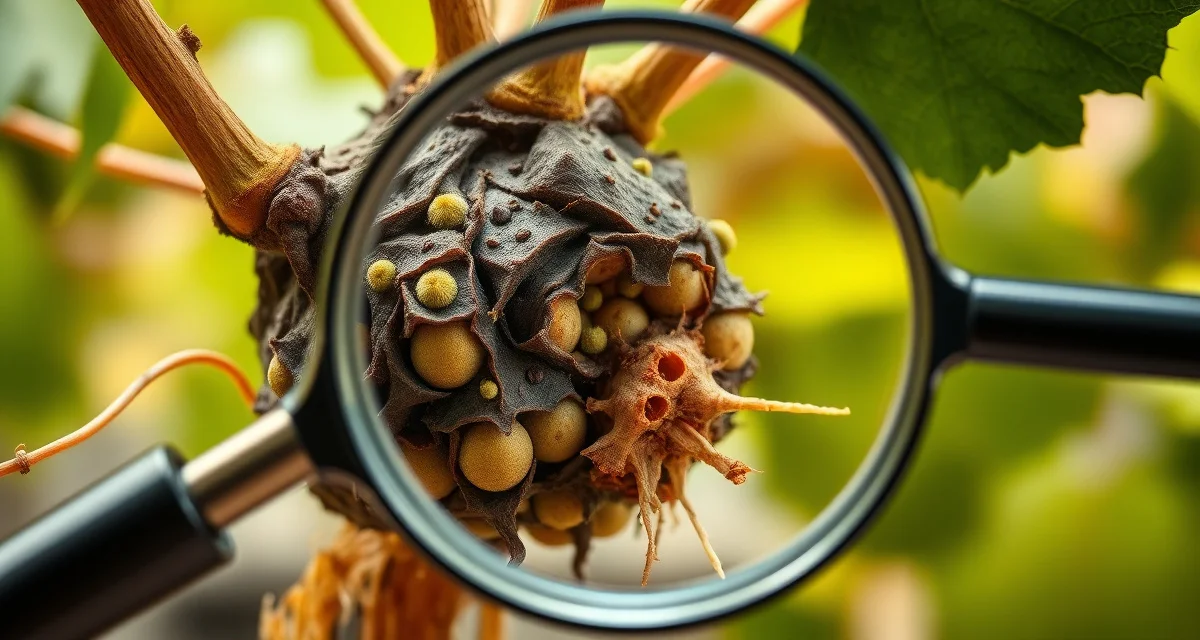
The root-feeding form (radicicolae) causes the damage that matters economically in wine grape production. These insects pierce root tissue and feed on phloem sap, forming characteristic hook-shaped galls called nodosities on young feeder roots. On older, suberized roots, they form swellings called tuberosities. The feeding wounds become infection sites for Fusarium and other fungi that accelerate root tissue death. Over several seasons, this cumulative damage reduces the vine's ability to absorb water and nutrients, leading to progressive decline visible above ground.
The leaf-galling form (foliicolae) creates small, hollow bumps on the undersides of leaves of susceptible varieties. Leaf galling on its own is not economically damaging in most production contexts. Many American grape species and hybrids are resistant or tolerant of leaf galling. Vitis vinifera is susceptible to both forms, though leaf galling appears more frequently in humid eastern regions.
Phylloxera moves between vineyards primarily on soil, water, equipment, plant material, and footwear. Quarantine measures in California, Oregon, and other states are designed to slow spread but cannot prevent it once populations are established in a region.
Identifying Root Galls vs. Leaf Galls
Root gall identification requires examining feeder roots. Dig carefully around a symptomatic or suspect vine to expose the upper 12 to 18 inches of root system, focusing on the young feeder roots. Fresh nodosities are yellow-green, hook-shaped, and firm. Older galls are brown and decaying. A 10x hand lens is adequate to see them clearly once you know the morphology. The UC IPM website and Oregon State Extension both provide clear photographic references.
Leaf galls are round, greenish protrusions on the upper leaf surface and hollow chambers on the underside. They're typically visible starting in May or June on susceptible varieties. To confirm leaf phylloxera, open a fresh gall and look for the insects inside.
Above-ground decline symptoms, yellowing, reduced vigor, small shoots, early leaf color in fall, are not diagnostic for phylloxera. Several other problems cause the same appearance. Root examination is necessary to confirm phylloxera as the cause of decline.
Monitoring Protocol
Annual monitoring for phylloxera in susceptible blocks should include systematic vine vigor ratings by row. Walk every row at or near harvest, when deficiency symptoms and vigor differences are most visible. Flag vines showing unusual chlorosis, reduced shoot growth, or small berry size for root sampling in fall after harvest when young roots are still active.
In regions where phylloxera is established, proactive root sampling in own-rooted blocks is warranted every two to three years regardless of visible symptoms, because decline can begin below-ground well before it's apparent above-ground.
Vineyard Mapping of Infestations
Every confirmed phylloxera detection belongs in your block records with GPS coordinates or vine number, the date of confirmation, severity rating, and any information about likely spread vectors (equipment that moved between this block and others, or proximity to recently removed blocks). Track this information year over year.
Understanding the expansion rate and pattern of an infestation changes your replant timeline decisions. Phylloxera that has been in the same corner of a block for five years with slow expansion changes the economic calculus differently than a rapidly expanding infestation that doubled in affected area in two seasons. VitisScribe's block-level records give you the documented history to make this assessment with data rather than recollection.
Rootstock Selection for Replanting
Replanting in phylloxera-infested or phylloxera-exposed soil requires a resistant rootstock. The commonly available options in California and the Pacific Northwest each have different performance characteristics.
3309 Couderc (3309C) produces moderate vigor, good phylloxera and nematode resistance, and performs well in cool climates with heavier soils. It's the dominant rootstock in Willamette Valley Pinot Noir programs and is widely used in Burgundy. It may be insufficiently drought-tolerant for dry, shallow soils in hot climates.
101-14 Mgt (101-14) is lower vigor than 3309C, performs well in moderate to fertile soils in cool to moderate climates, and has strong phylloxera resistance. It's also widely used in the Willamette Valley and in premium Pinot Noir production in Carneros and Anderson Valley.
5BB Kober is high vigor, widely planted in Europe, and tolerates alkaline soils and moderate drought. It's less commonly used in coastal California or Oregon but has a place in more vigorous sites or heavier soils.
110 Richter (110R) is drought-adapted and high vigor, suited for deep, well-drained soils in hot climates like Paso Robles or the Yakima Valley interior blocks. Using 110R in cool, fertile, moist soils produces excessive vigor that creates serious management problems.
Rootstock selection should be made in consultation with your local farm adviser or UC/OSU Cooperative Extension viticulture specialist, accounting for your soil type, depth, drainage, climate, variety, and production goals. No single rootstock is optimal for all situations.
Replanting Decisions
The economic analysis for replanting a phylloxera-affected block involves comparing the cost of continuing to farm declining vines with declining revenue against the upfront cost of removal, replant, and the four to six years until full production. This calculation requires block-level yield and revenue history.
A block that was already at the bottom of your quality and yield range before phylloxera accelerated its decline makes a stronger case for prompt replant. A high-performing block with early-stage infestation may warrant a different timeline. VitisScribe's per-block production records give you the documented production history to make this analysis with real numbers rather than approximations.
For more on block-level record keeping that supports replanting decisions, see our guide on block-level vineyard management and our article on vineyard establishment and IPM planning.
FAQ
What is Tracking and Managing Phylloxera in Your Vineyard?
[FAQ_ANSWER_PLACEHOLDER: This answer needs to be generated by AI with specific data, examples, and actionable advice relevant to Tracking and Managing Phylloxera in Your Vineyard. Target 50-150 words.]
How much does Tracking and Managing Phylloxera in Your Vineyard cost?
[FAQ_ANSWER_PLACEHOLDER: This answer needs to be generated by AI with specific data, examples, and actionable advice relevant to Tracking and Managing Phylloxera in Your Vineyard. Target 50-150 words.]
How does Tracking and Managing Phylloxera in Your Vineyard work?
[FAQ_ANSWER_PLACEHOLDER: This answer needs to be generated by AI with specific data, examples, and actionable advice relevant to Tracking and Managing Phylloxera in Your Vineyard. Target 50-150 words.]
What are the benefits of Tracking and Managing Phylloxera in Your Vineyard?
[FAQ_ANSWER_PLACEHOLDER: This answer needs to be generated by AI with specific data, examples, and actionable advice relevant to Tracking and Managing Phylloxera in Your Vineyard. Target 50-150 words.]
Who needs Tracking and Managing Phylloxera in Your Vineyard?
[FAQ_ANSWER_PLACEHOLDER: This answer needs to be generated by AI with specific data, examples, and actionable advice relevant to Tracking and Managing Phylloxera in Your Vineyard. Target 50-150 words.]
How long does Tracking and Managing Phylloxera in Your Vineyard take?
[FAQ_ANSWER_PLACEHOLDER: This answer needs to be generated by AI with specific data, examples, and actionable advice relevant to Tracking and Managing Phylloxera in Your Vineyard. Target 50-150 words.]
What should I look for when choosing Tracking and Managing Phylloxera in Your Vineyard?
[FAQ_ANSWER_PLACEHOLDER: This answer needs to be generated by AI with specific data, examples, and actionable advice relevant to Tracking and Managing Phylloxera in Your Vineyard. Target 50-150 words.]
Is Tracking and Managing Phylloxera in Your Vineyard worth it?
[FAQ_ANSWER_PLACEHOLDER: This answer needs to be generated by AI with specific data, examples, and actionable advice relevant to Tracking and Managing Phylloxera in Your Vineyard. Target 50-150 words.]