Re-entry interval signage requirements at vineyard block entrances
TL;DR
- Under EPA's Worker Protection Standard (40 CFR Part 170), growers must post warning signs at every usual entry point to a treated block before or during any pesticide application with a re-entry interval over 4 hours, and keep them up until the REI expires.
- Signs need bilingual DANGER/PELIGRO text, the EPA symbol, and the exact expiration time.
- Posting wrong is a federal violation and can trigger a full records audit.
What federal law actually requires for REI signage
The rule is the EPA's Worker Protection Standard, the WPS, at 40 CFR Part 170. EPA rewrote it in 2015. Most of the new provisions took effect January 2, 2017. [1] It applies to any agricultural establishment where pesticides with an agricultural use pattern are applied, and that covers commercial vineyards of every size. A two-acre estate block is not exempt.
The posting requirement lives in 40 CFR 170.409. You post a warning sign at every usual point of entry to a treated block before or during application, and you keep it there until the REI has fully run out. The regulation reads: "a warning sign must be posted at each usual point of entry to a treated area." [1] Read that carefully. It means every point workers or other people normally use to reach that block, more than the main road gate.
For REIs of 4 hours or less, the WPS skips posted signs but still requires oral warnings to workers. For any REI over 4 hours, signs are mandatory. Most vineyard fungicides and insecticides carry 12-hour, 24-hour, or 48-hour REIs, so you are almost always in sign territory. [2]
Signs do not replace worker notification. The WPS makes the handler or the agricultural employer tell workers already in the area at the time of application. That oral notice stands alongside the posted sign. You owe both.
What information must appear on an REI warning sign?
A compliant sign carries five things, and an inspector will check for every one. The 2015 revision standardized this content across all states. [1]
- The words "DANGER" and "PELIGRO." Both languages, always.
- The EPA pesticide symbol, the icon of a person with an arm extended and an X through a circle, printed in black on a white or yellow background.
- "DO NOT ENTER" and "NO ENTRE." Both languages again.
- The specific date and time the REI expires, so a worker can read it and know when the block is safe.
- The name and phone number of the agricultural employer or the handler.
Before 2015, plenty of growers ran older signs that just said "Do Not Enter, Pesticides Applied" with no expiration date and no contact. Those are dead. If a stack of them is sitting in your barn, they will get you cited.
Sign size is a practical question with a fuzzy legal answer. The WPS sets no minimum overall size in inches. What it demands is that the text and symbol stay legible from the distance a worker would meet the sign before entering. Most state agencies expect the DANGER/PELIGRO line to read from about 25 feet, which in practice means bold lettering and a sign no smaller than 8.5 by 11 inches at eye level. WSU Extension recommends a minimum of 11 by 17 inches for field use, where wind and dust chew up anything smaller. [3]
Where exactly do signs need to be posted at a vineyard block?
Signs go at every usual point of entry, which is any place a worker would reasonably walk or drive into the block during normal work. The WPS says "usual point of entry," not "all entry points." That sounds like a break for growers. Regulators read it broadly, so do not count on the distinction saving you. [1]
In a vineyard, usual entry points usually mean:
- The access road or dirt track that comes off the main ranch road
- Any gate or gap in a perimeter trellis row that crews use during pruning, leaf pulling, or harvest staging
- The end of any row that opens onto a road or an adjacent block where workers gather
Say your Cabernet block has three tractor entrances, and the crew also walks in from the end of row 40 because it sits closest to the equipment shed. All four points need signs during a restricted-entry period.
Here is a test that works. Wherever you would station a person to physically turn workers away, that spot needs a sign. If you can't station someone at every entry and you're relying on signs alone (which the WPS allows), you need more signs than you think.
Contiguous blocks treated the same day with the same product and the same REI can share a single sign, but only if that sign is clearly visible from all usual entry points and its language covers the whole area. Posting one sign at the far end of a quarter-mile block while workers approach from the near end does not fly. [1]
How long do signs have to stay posted?
For an open vineyard block, the rule is short: signs stay up until the REI clock runs out. The WPS also ties removal to ventilation and safety data delivery, but ventilation applies to enclosed spaces, not rows of vines under open sky. So for field blocks, watch the REI clock.
That clock starts when the application finishes, not when it starts. Spray a block from 7 a.m. to 11 a.m. under a 48-hour REI, and the REI expires at 11 a.m. two days later. Not 7 a.m. [2] Your sign has to show that expiration date and time, and it stays posted until that minute.
Pulling signs early is one of the most common WPS violations the California Department of Pesticide Regulation (CDPR) finds on audit. The pull is tempting. The sprayer finished yesterday, the block looks fine, and you need crews in there for shoot-thinning. But if the label says 24 hours and you take the sign down at 20 hours, you are in violation. Doesn't matter whether a single worker actually walked in.
Once the REI expires, take signs down promptly. Signs left up past expiration teach workers to distrust every posted sign, and they muddy your records if an inspector asks exactly when the REI ended.
Do state rules add requirements on top of federal WPS?
Yes, and in the big wine states those add-ons matter. Comply with the WPS and you have cleared the floor, not the ceiling.
California is the strictest. Under California Code of Regulations Title 3, Section 6770, the sign must also carry the common name or trade name of the pesticide, the EPA registration number, and the date and time of application (on top of the REI expiration). [4] California also wants signs posted within one hour of the start of application, not merely before workers enter. CDPR enforces this actively, issuing formal notices of violation to vineyard operations for missing sign elements.
Washington, under WAC 16-228, tracks the federal WPS but adds a documentation duty: growers must keep records showing signs were posted, including where and when. WSU Extension's Pesticide Safety Education Program publishes a checklist you can use to document it. [3]
New York follows the federal WPS with minor additions, enforced through the DEC and the Department of Agriculture and Markets. Cornell Cooperative Extension's Pesticide Safety Program suggests New York growers add a Spanish-language emergency contact number, a best practice past the strict federal minimum. [5]
Oregon and Washington require that if the label is a "restricted use" product, the sign notes that restriction. Most commercial pesticides in Pacific Northwest vineyards fall in that bucket, so you add one line.
Check your state's pesticide regulations every time on top of the federal WPS. WPS compliance alone is necessary. It is not always enough.
What do REI warning signs need to look like physically?
The WPS says signs must display the required information clearly and legibly and must use the EPA-approved pesticide symbol. [1] EPA publishes a free standardized sign template through its WPS resources page. Printed with the correct colors, it meets the federal content rules out of the box.
Durability is common sense plus state guidance, not federal law. An inkjet paper sign in a plastic sleeve will fade, curl, and go illegible within a few days of Central Coast summer sun or a Yakima Valley wind. UC Cooperative Extension farm advisors recommend weatherproof stock, at minimum 14 mil laminate or direct printing on polypropylene, for any sign expected to stay out longer than 24 hours. [6]
Height matters too. Post signs at roughly eye level for someone on foot, or where a tractor driver reads them at normal approach speed. A sign lying on the ground or tacked to a vine stake 12 inches up does not count.
On color: the standard EPA symbol runs a black figure and red prohibition circle on white, and the DANGER/PELIGRO text is conventionally red or black on white or yellow. The text colors have some flexibility. The symbol has to be reproduced accurately.
Many operations run reusable aluminum frames with a dry-erase or chalkboard panel for the variable data (expiration date and time, applicator contact). That works well, as long as the fixed elements (DANGER/PELIGRO, DO NOT ENTER/NO ENTRE, the symbol) are permanently printed and stay legible.
REI sign requirements comparison across common vineyard pesticide categories
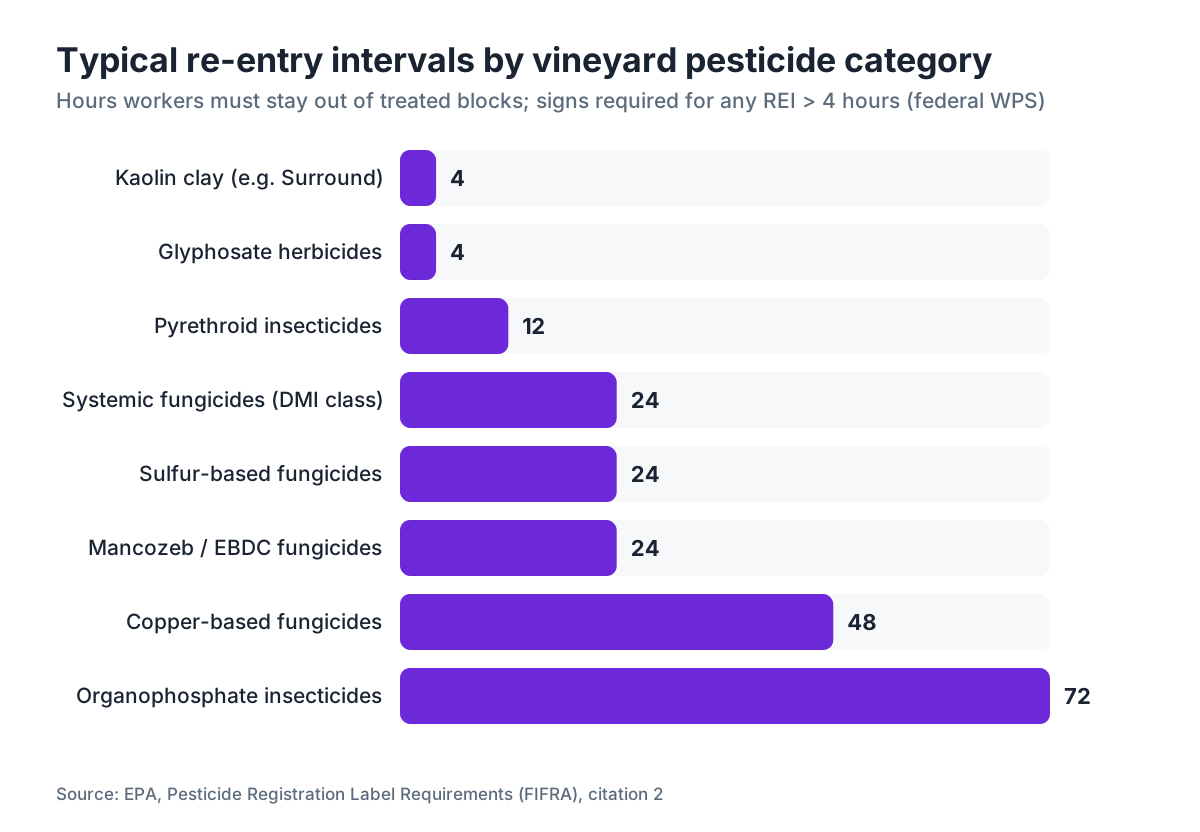
REI duration drives how long your signs stay posted, and it comes straight off the label. The label is the law on REI, fixed under EPA's requirements through FIFRA. [2] The table below shows common REIs for pesticide categories used in vineyards. Always read the specific product label, because REIs vary within a class.
| Pesticide Category | Typical REI | Signage Required? | Common Vineyard Examples |
|---|---|---|---|
| Sulfur-based fungicides | 24 hours | Yes | Wettable sulfur, lime sulfur |
| Copper-based fungicides | 24-48 hours | Yes | Copper hydroxide, Bordeaux |
| Systemic fungicides (DMI class) | 12-24 hours | Yes | Myclobutanil, tebuconazole |
| Mancozeb / EBDC fungicides | 24 hours | Yes | Manzate, Dithane |
| Organophosphate insecticides | 24-48 hours (some 72h) | Yes | Malathion, chlorpyrifos* |
| Pyrethroid insecticides | 12 hours | Yes | Permethrin, bifenthrin |
| Kaolin clay (Surround) | 4 hours or less | No (oral notice) | Surround WP |
| Glyphosate herbicides | 4 hours | No (oral notice) | Roundup, Touchdown |
*Chlorpyrifos use is banned or severely restricted in California, New York, and Hawaii as of 2021-2023. Check your state rules. [4]
For products at a 4-hour REI or less, you still owe oral notification to workers in the area before application starts. The sign exemption is narrow. It does not erase the worker notification duty.
What records do you need to keep about REI sign posting?
Federal WPS makes you keep pesticide application records for two years. [1] Those records carry the product name, EPA registration number, active ingredient, application date, location treated, and the REI. The WPS doesn't spell out a sign-posting log. State agencies increasingly do.
California requires a Pesticide Use Report (PUR) for every restricted-use and general-use agricultural application, filed with the county agricultural commissioner within 30 days. [4] On a CDPR or county audit, inspectors routinely ask you to prove signs went up. A timestamped phone photo of each sign at each entry point, shot before workers enter, is the most defensible thing you can hand them.
Washington's rules under WAC 16-228 go further. The record has to show who was notified, how (oral or posted sign), and where the signs were posted. [7]
This is the kind of task vineyard management software handles cleanly. Tools like VitiScribe let you attach timestamped photos to a spray event and log posted sign locations right next to the application data, which builds an audit-ready trail without a second pile of paper. Software or paper binder, the goal is identical: when an inspector asks you to prove signs were posted at block 12's east entrance on June 15 at 7:30 a.m., you can show it in a minute.
Keep your sign-posting logs with your spray records, not filed apart. Inspectors pull both at once.
What are the penalties for incorrect or missing REI signage?
WPS violations are enforced by EPA and by state lead agencies (SLAs), usually the state department of agriculture or environmental protection. Penalties run per violation, per day, per application event. That math adds up fast.
Federal civil penalties under FIFRA can reach up to $19,107 per day per violation for commercial agricultural operations as of the 2023 inflation adjustment. [8] In practice, EPA often works through the state SLAs, and first-time signage or documentation errors frequently draw formal warnings or reduced penalties under EPA's gravity-based penalty policy, especially when the grower shows corrective action.
California hits harder. CDPR can assess civil penalties up to $5,000 per violation per day under Food and Agricultural Code Section 12999, and repeat violations can suspend a pest control operator's license. County agricultural commissioners hold independent enforcement authority and can refer cases to the district attorney for criminal prosecution where worker exposure is involved. [4]
One missing sign rarely stays one problem. Inspectors who find a signage violation often pull every PUR and spray record for the prior two years. A single correctable error turns into a full audit.
Then there is civil liability. A worker injury or illness claim with no posted REI sign can dwarf any regulatory fine. Workers' compensation claims and personal injury suits in California have settled well into six figures where required signs were missing. Those are public court records, but the numbers vary too much to reduce to one figure.
How do you handle REI signage during harvest when workers are constantly entering blocks?
This is the hardest scheduling problem on the vineyard calendar. During harvest, pickers, bin crews, and equipment operators cross multiple blocks every hour. Apply any pesticide with an REI over 4 hours and you have shut that block down for the crew.
The compliant move is to not apply REI-bearing products to blocks lined up for imminent harvest, or to stagger applications across blocks so crews always stand in an REI-expired block. The pre-harvest interval (PHI) on the label runs parallel and separate. Even if the REI clears in 24 hours, you cannot use the fruit until the PHI clears too. Most late-season fungicides carry PHIs of 0 to 14 days, though some materials run longer and pinch your timing further. [2]
For a block you must spray during harvest for disease pressure (botrytis is the usual driver), talk to your picking crew supervisor before harvest assignments go out. Post signs the moment application finishes, flag the block as restricted on your harvest scheduling board, and never assume workers will read the signs without hearing it out loud too. The WPS wants both.
Some operations link GPS block mapping to spray records so scheduling software flags restricted blocks on its own. That earns its keep once you run 20 or more blocks. For a smaller place, a whiteboard in the equipment bay showing each block's REI expiration, updated every morning, is what a lot of experienced farm managers actually use. It works.
Where can you get compliant sign templates and training resources?
Start with EPA. It publishes official WPS resources, including a free downloadable warning sign template, through its Agricultural Worker Protection Standard program page. [1] The template meets all federal content requirements and comes in multiple file formats.
UC Agriculture and Natural Resources (UC ANR) has a WPS compliance guide built for California growers, covering sign requirements, record-keeping templates, and county-by-county contacts for local agricultural commissioners. [6] For California vineyard operators, it is probably the single most useful document you can print.
WSU Extension's Pesticide Safety Education Program (PSEP) runs both online and in-person WPS training, with specific modules on posting and record-keeping. [3] The WSU training satisfies the WPS requirement that handlers get pesticide safety training. Cornell Cooperative Extension runs a parallel program for New York growers. [5]
For Spanish-language signs, many county agricultural commissioners hand out free print-ready templates on request, and CDPR keeps a library of bilingual pesticide safety materials. [4] Do not translate signs yourself with a general translation app. Agricultural terms follow specific conventions, and a mistranslation on a safety sign is a liability you don't need.
Want a full WPS check beyond signs? The National Agricultural Safety Database (NASD), hosted through the CDC, keeps a searchable library of extension publications on WPS topics by state. [9] It is free and university extension programs update it regularly.
For ongoing management across spray records, block maps, and sign-posting documentation, VitiScribe's spray record module ties application events straight to block maps and logs REI expirations against your harvest schedule, so nothing slips when you are juggling multiple blocks and multiple applicators at once.
Frequently asked questions
Do I need an REI sign if the re-entry interval is 4 hours or less?
No, federal WPS does not require a posted sign for REIs of 4 hours or less. You do still have to give oral notification to any workers in or near the treated area before application begins. Several states, including California, require you to document that oral notification. Check your specific state rules, because some add requirements even for short REIs.
Can I use the same sign for multiple blocks treated on the same day?
Only if the sign is clearly visible from all usual entry points to the combined treated area and it accurately describes the full area under restriction. For separate vineyard blocks with separate entry points, you need a separate sign at each block's entry. One sign at the ranch gate is not sufficient when workers would normally enter individual blocks from internal roads.
Does the sign have to be in both English and Spanish?
Yes. Federal WPS explicitly requires both "DANGER" and "PELIGRO," plus both "DO NOT ENTER" and "NO ENTRE" on the sign. This is not optional even if your workforce is primarily English-speaking. The bilingual requirement has been in place since the 2017 WPS revision and is one of the most commonly cited violations during federal and state inspections.
What happens if rain washes out my sign during the REI period?
You are responsible for keeping legible, posted signs up for the full REI. If rain, wind, or vandalism destroys a sign before the REI expires, replace it immediately. This is exactly why durable, weatherproof signs matter, and why paper signs in a vineyard are a compliance liability. Keep spare blank signs and a permanent marker in your spray rig so you can post a replacement on the spot.
Does the REI sign requirement apply to organic vineyards?
Yes. If you apply any pesticide registered for organic production that carries an REI over 4 hours, WPS posting requirements apply. Copper sulfate, for example, commonly carries a 24-hour REI. Organic certification does not exempt you from WPS. EPA's WPS applies based on how a pesticide is labeled for agricultural use, not on the certification status of your operation.
How do I calculate the REI expiration time if my application crosses midnight?
The REI starts the moment the application is complete, not when it began. Finish spraying at 11:45 p.m. under a 24-hour REI and the REI expires at 11:45 p.m. the following day. Your sign must show that specific date and time. California additionally requires you to note the application start time on the sign, on top of the REI expiration.
Can I post a digital or electronic sign instead of a physical one?
No. EPA's WPS requires physical warning signs posted at the entry points. Electronic displays or app-based notifications do not satisfy the posting requirement. Physical signs must be present in the field at the treated block's entry for the full REI. Digital tools are useful for internal scheduling and record-keeping, but they cannot replace the physical sign at the block entrance.
Who is legally responsible for posting signs, the grower or the pesticide applicator?
Under WPS, the agricultural employer (the grower) is responsible for making sure signs are posted and maintained. If you hire a licensed pest control operator (PCO) or pest control adviser (PCA) for the application, the posting duty can be shared by contract, but the grower stays the responsible party for the treated establishment. Get it in writing if you expect your PCO to post signs.
Does an REI sign need to show the name of the pesticide that was applied?
Federal WPS does not require the pesticide name on the sign. California does: CDPR regulations require the product name or common chemical name and the EPA registration number on the sign. If you grow in California, include the product name. If you operate in multiple states, using California's fuller format everywhere is a simple way to stay compliant across all of them.
How far from the block entrance does the sign need to be visible?
WPS does not set an exact visibility distance in feet. The practical standard, used by most state inspectors, is that the sign must be legible before a person on foot would enter the treated area. Most extension guidance treats 25 feet as a reasonable minimum. Post signs at the entry point itself, at about eye level, not 100 feet away from where workers actually cross into the block.
What records do I need to keep to prove signs were posted?
Federal WPS requires two-year retention of pesticide application records, including location, product, and REI. It does not explicitly mandate a sign-posting log. California and Washington state rules require documentation that signs were posted, including location and time. Best practice everywhere is a timestamped photo of each sign at each entry point, taken before workers re-enter, stored with the matching spray application record.
Are there WPS sign requirements for tasting room or winery visitors who might walk through vineyard blocks?
WPS covers workers and handlers, defined as employees doing agricultural tasks. It does not directly cover tasting room visitors. But if visitors walk through vineyard rows during an REI, you face liability under general-duty public safety standards and potentially OSHA rules. The practical answer is simple: keep visitors out of any block during an active REI, and post your WPS signs as usual regardless of who might approach.
Sources
- EPA, Agricultural Worker Protection Standard (40 CFR Part 170): WPS requires warning signs at every usual point of entry to treated areas before or during application, for REIs greater than 4 hours, with bilingual DANGER/PELIGRO text, DO NOT ENTER/NO ENTRE, EPA symbol, expiration date/time, and employer contact.
- EPA, Pesticide Registration and Label Requirements (FIFRA): Pesticide labels are legally binding under FIFRA; REI durations on labels range from 4 hours to 72+ hours depending on pesticide class, and the REI clock begins at application completion.
- Washington State University Extension, Pesticide Safety Education Program: WSU Extension recommends a minimum 11 by 17 inch sign for field use and publishes a checklist growers can use to document sign posting compliance.
- California Department of Pesticide Regulation, Worker Safety Regulations: California CCR Title 3 Section 6770 requires REI signs to include pesticide product name, EPA registration number, and application start date/time, and signs must be posted within one hour of application start.
- Cornell Cooperative Extension, Pesticide Safety Program: Cornell's Pesticide Safety Program recommends New York growers include a Spanish-language emergency contact number on REI signs as a best practice beyond federal requirements.
- UC Agriculture and Natural Resources, WPS Compliance Guide for California Growers: UC ANR recommends weatherproof polypropylene or 14 mil laminate for field-posted REI signs expected to remain in place more than 24 hours.
- Washington State Department of Agriculture, Pesticide Regulations (WAC 16-228): WAC 16-228 requires Washington growers to document who was notified of pesticide applications, how notification was given, and the location of posted warning signs.
- EPA, FIFRA Civil Penalty Policy and 2023 Inflation Adjustments: Federal civil penalties under FIFRA for commercial agricultural WPS violations can reach up to $19,107 per violation per day as of the 2023 inflation adjustment.
- National Agricultural Safety Database (NASD), hosted through the CDC: The National Agricultural Safety Database maintains a free, searchable library of university extension publications covering WPS topics by state.
- EPA, Revised Worker Protection Standard Final Rule (80 FR 67495, November 2, 2015): The 2015 WPS revision standardized sign content requirements nationwide and set January 2, 2017 as the effective date for most provisions including the bilingual posting requirement.
Last updated 2026-07-09