How to record restricted entry interval compliance in vineyard spray logs

TL;DR
- Every pesticide application that triggers a restricted entry interval has to be documented under EPA's Worker Protection Standard (40 CFR Part 170).
- Your spray log needs the product name, EPA registration number, application date and time, REI end time, treated area, and how you notified workers.
- Miss any of those fields and a state ag inspector can cite you for it.
What is a restricted entry interval and why does it go in your spray log?
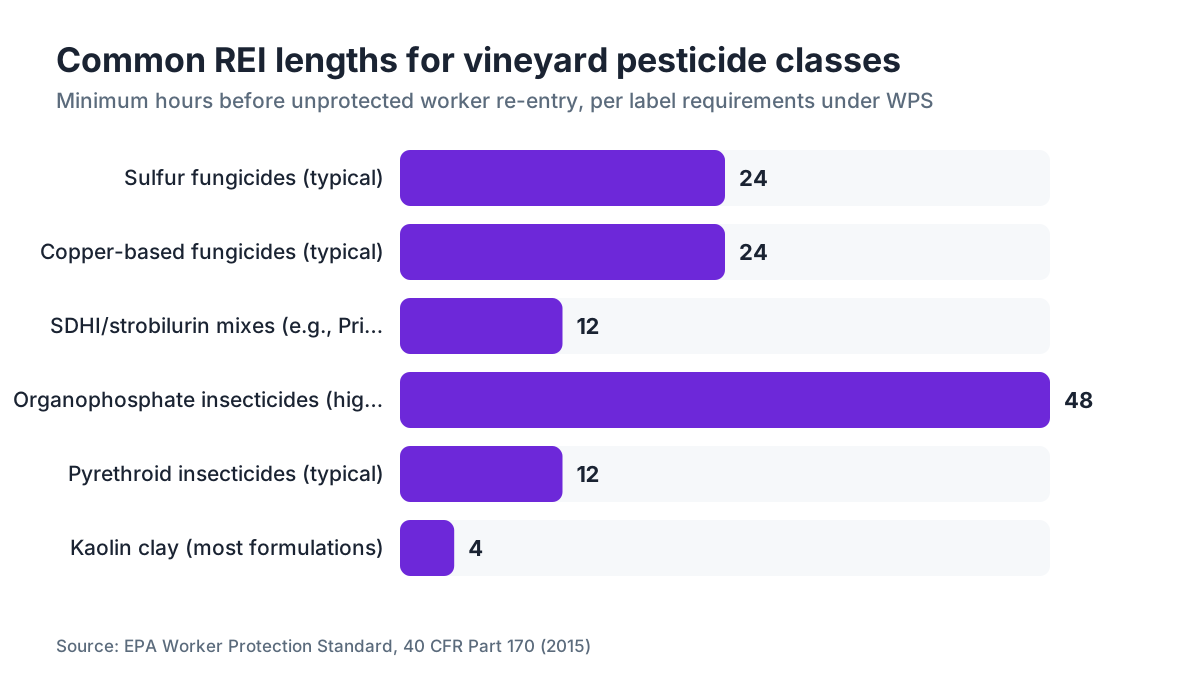
A restricted entry interval (REI) is the minimum time that has to pass after a pesticide application before unprotected workers can go back into the treated area. The REI is printed on every federally registered pesticide label, and the label is the law, full stop. REIs for common vineyard materials run from 4 hours for some kaolin and sulfur products to 48 hours for certain systemic fungicides and organophosphate insecticides, and a handful of materials carry REIs as long as 5 days [1].
The spray log is your proof. It shows you knew the REI, communicated it, and enforced it. Without a log entry that documents all of that, you have no defense when a Cal/OSHA investigator or state ag department auditor shows up. EPA's revised Worker Protection Standard (WPS), finalized in 2015 and effective January 2017, made spray log requirements explicit instead of implied [2]. Small operations sometimes treat the log as an afterthought. That's a mistake that can run $1,000 to nearly $20,000 per violation in federal civil penalties, before any state fine lands on top [3].
The log also earns its keep on days when no auditor is anywhere near your gate. Six months out, you look at a block and wonder why re-entry got pushed. A complete log tells you exactly what went out, at what rate, when the last pass finished, and when the crew was legally clear to return. That's crew safety and harvest timing in one column.
What information does EPA's Worker Protection Standard require in a spray log?
EPA's Worker Protection Standard at 40 CFR Part 170.309 requires agricultural employers to keep pesticide application and hazard information on file. Here's the minimum for each application that generates an REI [2]:
- Product name (trade name exactly as it appears on the label)
- EPA registration number
- Active ingredient(s)
- Location and description of the treated area
- Date and time the application started
- Date and time the application ended
- The REI for that specific product (in hours)
- The date and time the REI expires (calculated from application end)
- The name of the certified pesticide applicator or the applicator's license number
States pile on from there. California mandates the grower license number, county permit number, target pest, application method, equipment type, acres treated, and total product used, all under the California Food and Agricultural Code sections 11701 to 11737 and the associated DPR regulations [4]. Washington requires the applicator certification number and the unit of measure for the product applied under WAC 16-228 [5]. When state rules go past the federal floor, you follow the state.
The field small vineyards blow most often is the REI expiration timestamp. Writing "REI: 24 hours" doesn't cut it. You need the actual date and clock time when workers may re-enter: "REI expires: 06/15/2025 at 14:30." That's the timestamp your supervisor posts at the block entry point, and it's what the auditor checks against your employee entry records.
What does a compliant vineyard spray log entry look like?
Here's a template row that passes a WPS audit in most states. Column order doesn't matter. Every field has to be there.
| Field | Example entry |
|---|---|
| Application date | 06/14/2025 |
| Application start time | 06:15 |
| Application end time | 08:45 |
| Block / field ID | Block 7, Cab Sauv, NE corner |
| Acres treated | 3.2 |
| Product name | Pristine WG |
| EPA Reg. No. | 7969-188 |
| Active ingredient(s) | Boscalid + pyraclostrobin |
| Rate applied | 10.5 oz / acre |
| Target pest | Botrytis bunch rot |
| Application method | Airblast sprayer |
| REI (hours) | 12 |
| REI expiration | 06/14/2025 at 20:45 |
| Applicator name / cert. no. | J. Hernandez / CA-12345 |
| Worker notification method | Posted signs at all block entries |
| Supervisor signature | ____________ |
Auditors pull hard on the worker notification field. Under the 2015 WPS revision, agricultural employers have to post warning signs at treated area entry points AND add an oral or written notification when the REI runs over 30 days, or when workers will be in the area during the REI under specific exemptions [2]. For standard vineyard work with REIs under 48 hours, posted signs are usually the primary mechanism, but your log has to say so in plain words.
If a PCA or crop adviser writes your spray recommendations, keep those written recommendations on file and cross-reference them to the log entry. California DPR requires the written recommendation to be available at the site during application [4].
How do you calculate and document the REI expiration time correctly?
REI expiration starts at the end of the application, not the start. People trip on this constantly. Start spraying at 6:15 AM, finish at 8:45 AM, product carries a 12-hour REI, and the REI expires at 8:45 PM that night. Not 6:15 PM [1].
For longer REIs, track across days. A 48-hour REI that ends at 8:45 AM on June 14 expires at 8:45 AM on June 16. Write the full date and time. "Two days" is not a log entry.
Tank mix two products and the REI in your log follows the longest one in the tank. Product A has a 4-hour REI, Product B has a 24-hour REI, and your log documents 24 hours for that application. Cornell's Pesticide Safety Education Program recommends highlighting the governing REI in tank-mix situations so it's obvious during a field check [6].
Heat and field conditions matter too. Several organophosphate and carbamate labels carry early-entry exception language tied to heat. If you're applying under those conditions, note in your log that you reviewed and followed the label's early-entry language. That notation takes 30 seconds and closes a potential violation.
One trick that works: set the REI expiration alarm on your phone the second you log the application end time. Then copy that timestamp into three places. The spray log. The posted field sign. The crew notification. Same time, three spots, done.
How do posted field signs connect to your spray log records?
Under 40 CFR Part 170.411, agricultural employers have to post warning signs at each entry point to a treated area during the REI [2]. The signs carry the international no-entry symbol (the red circle with a slash over a figure entering a door), the words "DANGER" or "WARNING," and the words "PESTICIDES" and "DO NOT ENTER" in English and in any language common to a majority of workers at that establishment [2].
Your spray log should note when signs went up and when they came down, tied straight to the REI expiration timestamp. Auditors sometimes check whether signs were actually posted during the REI by talking to field workers. If your log says the REI expired at 8:45 PM but a worker tells the inspector signs didn't go up until noon, you have a problem.
Washington State University Extension recommends keeping a sign log separate from the spray log but cross-referenced by block ID and application date, so any discrepancy shows up right away instead of hiding in the file [7]. That's good advice. A simple pair of columns reading "Signs posted at" and "Signs removed at" (both with times) adds maybe two minutes per application and builds a clean audit trail.
Sign removal timing counts too. Pulling signs before the REI expires is itself a WPS violation. If you're not sure when the crew plans to take signs down, print or write the REI expiration time right on the posted sign.
What are the early-entry exceptions and how do you document them in the log?
The WPS lets workers enter a treated area during the REI under specific early-entry exceptions at 40 CFR Part 170.603. The ones that matter for vineyard work [10]:
- Short-term task exception: workers may enter for tasks lasting no more than one hour in any 24-hour period, in treated areas with REIs of 4 hours or less, wearing the PPE listed on the product label.
- Irrigation equipment exception: entering to operate irrigation equipment for no more than one hour, with the label PPE, where the REI is 4 hours or less.
- Environmental monitoring or emergency exception: with full label PPE and the early-entry limits followed.
Invoke an early-entry exception and your log has to document it. At minimum: the specific exception, the PPE each worker wore, the worker's name, and how long they were in the treated area. The WPS text requires agricultural employers to "assure" the early-entry requirements are met, which regulators read as requiring written documentation [10].
In a vineyard, the most common legitimate early entry is when harvest timing overlaps a recent spray. Somebody has to check berry condition during an active REI. That takes real log documentation, not a phone call. Write down the product, the REI, the exception, the PPE, time in the field, and who made the call to allow entry.
How long do you have to keep spray log records?
The federal baseline under 40 CFR Part 170.309 is 2 years from the date of application for standard pesticide application records [11]. Records must stay available on the establishment for review by workers and their designated representatives. Certain high-hazard materials carry longer retention obligations, so check the specific product and program.
States commonly stretch that. California DPR requires pesticide use records to be submitted monthly to the county agricultural commissioner and kept on file for 3 years [4]. Washington requires 2 years under WAC 16-228 [5]. Oregon requires 2 years under ORS Chapter 634.
For practical vineyard work, treat 3 years as your default no matter where you farm. Pesticide exposure lawsuits and workers' comp claims surface well after the application date, and spray logs get subpoenaed. Store paper logs somewhere dry and secure. Keep digital logs backed up off-site or in cloud storage.
If you want these records organized without building a spreadsheet system from scratch, tools like VitiScribe are built around WPS field documentation and generate compliant log exports for audits. That said, a well-kept paper binder works fine if you're consistent about it.
What happens if your spray log is incomplete during a WPS inspection?
Incomplete records are one of the most commonly cited WPS deficiencies, and they turn up in field inspections triggered by worker complaints, chemical illness reports, or routine audits [3]. EPA and state ag departments both run this monitoring.
Civil penalties under FIFRA Section 14(a) can reach $19,636 per violation per day for commercial applicators. The figure adjusts for inflation each year, so check the current EPA FIFRA penalty policy before you quote it to anyone [3]. Agricultural employers who aren't commercial applicators face a lower ceiling, but it still stings. California DPR fines start at $500 per violation and climb fast for repeat offenses or violations that expose workers.
Auditors work off a checklist. UC Cooperative Extension has documented that the most frequently cited WPS deficiencies in California vineyards are missing REI notification records, incomplete PPE documentation for early-entry workers, and failure to produce pesticide safety training records alongside application records [8].
A missing REI expiration timestamp isn't a technicality. It's evidence you may not have known when it was legally safe for workers to go back in, which is the exact thing WPS exists to prevent. Fill in that field every single time.
How do digital spray log apps compare to paper logs for REI compliance?
Paper logs are legally fine, and plenty of operators prefer them because they distrust software or work where connectivity drops out. The compliance bar is the same either way: all required fields present, legible, and retained for the required period.
Digital systems earn their keep on a few things. A well-built app auto-calculates the REI expiration timestamp from the application end time and the label REI, which kills arithmetic errors. Some send push notifications to field supervisors when an REI is about to expire, which heads off the sign-still-up-after-expiration problem. Searchable records also make a county commissioner data request go a lot faster.
The downsides are real. Batteries die and connectivity fails in the field. Data can get locked into one platform if you switch. And the software costs money. A solid paper system with a pre-printed template that carries every WPS field costs almost nothing.
WSU Extension recommends that whatever system you run, someone other than the person filling it out should audit it at least once per season, to catch systematic gaps before an official inspection does [7]. That holds whether you're on a legal pad or a cloud database.
For mid-sized operations running five or more blocks and several spray events a week, VitiScribe is worth a look for its REI timestamp automation and audit-ready export. The trial is free. Test it against your state's specific field requirements before you commit.
What are state-specific spray log requirements that go beyond EPA minimums?
EPA's WPS sets the floor. States go higher, and often. Here's how three major wine-producing states plus Oregon stack up:
| Requirement | EPA WPS (federal) | California (DPR) | Washington (WSDA) | Oregon (ODA) |
|---|---|---|---|---|
| Submission to agency | Not required | Monthly to county ag commissioner | Not required (available on request) | Annual summary |
| Retention period | 2 years | 3 years | 2 years | 2 years |
| Written recommendation required | No | Yes (PCA recommendation) | No | Yes (if used) |
| Permit / license number in log | Applicator cert. no. | County permit + grower license | Applicator cert. no. | Applicator cert. no. |
| REI expiration timestamp | Yes | Yes | Yes | Yes |
| Acres treated | Yes | Yes (to 0.1 acre) | Yes | Yes |
| Application method | No | Yes | Yes | No |
| Target pest | No | Yes | No | No |
Sources: EPA 40 CFR Part 170 [2], California DPR [4], WSU Extension [7], WSDA WAC 16-228 [5].
If you farm in California, the monthly submission requirement is the biggest gap between state and federal law. You can file electronically through DPR's county agricultural commissioner network for most counties [12]. Missing a monthly submission deadline is a separate violation from having an incomplete log, so run the two obligations on their own schedules.
New York has its own set under 6 NYCRR Part 325, which Cornell Cooperative Extension documents in its pesticide safety series, including specific record-keeping for restricted-use pesticides [9]. Farm east of the Rockies and your state extension service is the fastest route to a definitive list of your state's add-on requirements.
How do you train crew and supervisors to record REI compliance correctly?
Training is itself a WPS requirement. The standard at 40 CFR Part 170.501 requires agricultural workers and pesticide handlers to receive pesticide safety training before working in areas where pesticides are applied or stored [2]. Training and the log reinforce each other. A worker who understands why REIs exist is far more likely to flag a sign that never went up or an expiration time that looks wrong.
For the supervisors filling out the log, a 30-minute walkthrough of the template at the start of each season usually does it. Cover where to find the REI on the label (it's in the "Directions for Use" section or in a boxed "Restricted Entry Interval" notice), how to calculate the expiration timestamp, the sign posting requirement, and what an early-entry exception entry looks like.
UC Cooperative Extension publishes worker protection training materials in English and Spanish, including label-reading guides that walk through the REI section of a pesticide label [8]. They're free and peer-reviewed. Use them instead of writing your own from scratch.
One thing that works in practice: laminate the log template, post it next to the spray equipment, and pin a step-by-step checklist beside it. Applicators fill in the log right after the application ends, while the time is still accurate, not from memory that afternoon. Late or reconstructed entries are a common audit finding, and they're hard to defend.
How do you handle REI records when a contract applicator does the spraying?
Hire a custom application company or a contract spray crew and the legal duties split between you and them. Your spray log obligation does not go away.
Under the WPS, the agricultural employer (you, the grower or vineyard manager) is responsible for worker safety in treated areas, which means informing workers of REIs, posting warning signs, and keeping records available [2]. The contract applicator is responsible for their own application records, which they also have to retain. Both parties need documentation.
Ask for a copy of the applicator's spray record for every application event and attach it to your vineyard log. Their record should carry the product name, EPA reg number, application date and time, and the REI. You then add the REI expiration timestamp, worker notification method, and sign posting confirmation to your own log. Neither record alone covers your WPS obligations.
Get the arrangement in writing before the season starts. Spell out that they will hand over a spray record within 24 hours of each application. Some operators require the applicator to call or text the application end time on the spot, so the REI expiration gets calculated and signs go up without delay. That's a fair operational ask, and it makes your log accurate instead of approximate.
Frequently asked questions
Does the spray log REI entry need to be completed before workers re-enter the field?
Ideally yes. Fill in the log at the time of application so the REI expiration timestamp is documented before anyone gets near the treated area. WPS doesn't state that the log must be complete before re-entry, but an incomplete log at the time of an inspection is a citable violation regardless of when entry happened. Fill it in at application end. Don't reconstruct it later.
What counts as proper worker notification of an REI in a spray log?
For most vineyard applications, posting warning signs at all entry points to the treated area is the required notification method under 40 CFR Part 170.411. Your log should record the method used (e.g., "signs posted at all block entry points"), the time signs went up, and the time they came down after REI expiration. Oral notification alone isn't enough for standard agricultural operations unless the REI is 4 hours or less and no workers will be in the area.
Can I use a spreadsheet or app instead of paper spray logs?
Yes. EPA and all states accept electronic records as long as they contain all required fields, stay legible, and can be printed or accessed for inspection. If you use an app or spreadsheet, back it up regularly off-device. The burden is on you to produce records during an inspection. A phone with a dead battery or a deleted spreadsheet doesn't satisfy the retention requirement.
What REI applies when I tank-mix two products with different REIs?
The longest REI in the mix governs. Mix a product with a 4-hour REI and one with a 24-hour REI, and your log records 24 hours for that application. Note the governing product explicitly so it's clear why you chose that REI. Cornell Extension and UC Cooperative Extension both confirm this reading and recommend logging all products and their individual REIs alongside the governing one.
Do I need to record REI compliance for general-use pesticides as well as restricted-use ones?
Yes. The WPS record-keeping requirement applies to any pesticide with an REI on the label, whether it's a restricted-use pesticide or a general-use product. Plenty of common vineyard fungicides and insecticides are general-use but still carry REIs. The label is the law. If the label lists an REI, you document compliance with it in your spray log.
How do I record an REI when a pesticide was applied by aerial application?
Same fields apply: product name, EPA reg number, active ingredients, treated area, application start and end time, REI in hours, and REI expiration timestamp. For aerial applications, also document the aerial applicator's license number, the aircraft registration number if your state requires it, and the buffer zones observed. California DPR requires additional aerial application fields in the use report submitted to the county.
What if my county agricultural commissioner asks for spray logs and I didn't keep complete REI records?
Cooperate fully and fix the deficiency going forward. In California, incomplete monthly pesticide use reports can bring a notice of violation and fines starting at $500 per violation. If the missing records relate to a worker exposure incident, penalties climb and may involve DPR, Cal/OSHA, and civil liability. There's no retroactive fix. Focus on compliance from the point of discovery forward.
Is there a federal form I'm supposed to use for spray log record-keeping?
No. EPA doesn't provide a mandatory federal form for WPS pesticide application records. Use any format (paper log book, spreadsheet, app-generated record) as long as every required field under 40 CFR Part 170.309 is present. Several university extension programs, including UC Davis and Cornell, publish free printable templates that carry all required WPS fields. Those are a reliable starting point.
Do REI records need to be in the language of my field workers?
The WPS requires warning signs to display the no-entry symbol and the word "Pesticides" in English and in any other language common to a majority of workers at the establishment. The spray log itself has no language requirement for the record-keeping fields, but EPA guidance strongly encourages making pesticide safety information, including REI information, available in workers' primary language as part of the required training.
What's the most common REI compliance mistake found during vineyard inspections?
According to UC Cooperative Extension documentation of California WPS inspection findings, the most common REI-related deficiency is missing or incomplete notification records, specifically the failure to document the REI expiration time and the method used to notify workers. Missing sign-posting records and failure to record governing REIs in tank-mix situations get cited often too. These are paperwork errors that have nothing to do with whether workers were actually protected.
How does the WPS worker re-entry exemption for hand labor in vineyards work?
Hand labor isn't automatically exempt from REI requirements. The WPS early-entry exceptions allow workers into treated areas for specific short-duration tasks (generally under one hour for REIs of 4 hours or less) with full label-specified PPE. Any early entry by hand labor workers during an active REI has to be documented in the spray log or a supplemental early-entry record, including the workers' names, tasks performed, PPE used, and duration of entry.
Can I access spray log records if I use multiple vineyards or lease blocks in different counties?
Yes, but each treated location has to appear in the records, and in California, records for each county go to that county's agricultural commissioner separately. Farm blocks in Napa and Sonoma counties and you file with both. Keep your log organized by location and county from the start of the season. Cross-county record management is one of the clearest operational arguments for a centralized digital log system.
Do I need to record REI compliance for sulfur and copper applications in organic vineyards?
Yes. Sulfur and copper-based materials are federally registered pesticides with EPA registration numbers, and they carry REIs on their labels. Sulfur REIs typically run 24 hours; copper-based products vary by formulation. USDA organic certification doesn't exempt you from WPS or state pesticide use reporting. Keep spray logs for all registered pesticide applications, including OMRI-listed materials.
Sources
- EPA, Pesticide Worker Safety: REIs range from 4 hours to 5 days depending on product; the label specifies the minimum interval before unprotected workers may re-enter treated areas.
- EPA, Agricultural Worker Protection Standard (WPS), 40 CFR Part 170 (2015 revision): WPS requires documentation of REI, application timing, treated area, applicator identity, and worker notification method; sign posting required at all entry points during REI under 40 CFR Part 170.411.
- EPA, Pesticide Enforcement: Civil penalties for FIFRA/WPS violations can reach $19,636 per violation per day for commercial applicators; incomplete records are among the most commonly cited deficiencies.
- California Department of Pesticide Regulation, Pesticide Use Reporting: California requires monthly submission of pesticide use records to the county agricultural commissioner and 3-year retention; the written PCA recommendation must be on-site during application.
- Washington State Department of Agriculture, Pesticides (Pesticide Regulations WAC 16-228): Washington State requires applicator certification number and unit of measure in pesticide application records, with 2-year retention.
- Cornell Cooperative Extension, Pesticide Safety Education Program: Cornell PSEP guidance recommends highlighting the governing (longest) REI in tank-mix situations to make the controlling interval clear during field checks and inspections.
- Washington State University Extension: WSU Extension recommends a separate sign log cross-referenced by block ID and application date, and an internal audit of log records by a second party at least once per season.
- University of California Agriculture and Natural Resources (UC Cooperative Extension), Worker Protection Standard Resources: UC Cooperative Extension documents that missing REI notification records, incomplete PPE documentation for early-entry workers, and absent training records are the top WPS deficiencies found in California vineyard inspections.
- Cornell Cooperative Extension, Pesticide Safety Education Program (New York 6 NYCRR Part 325 record-keeping): New York requires specific record-keeping for restricted-use pesticides under 6 NYCRR Part 325, documented in the Cornell PSEP pesticide safety series.
- EPA, Agricultural Worker Protection Standard (WPS) Early-Entry Requirements, 40 CFR Part 170.603: Early-entry exceptions under 40 CFR Part 170.603 allow entry during REIs of 4 hours or less for tasks under one hour with full label PPE; employers must document the exception, PPE used, and worker identity.
- EPA, WPS Application and Hazard Information Requirements, 40 CFR Part 170.309: 40 CFR Part 170.309 sets baseline pesticide application record-keeping requirements with a minimum 2-year retention period for standard application records.
- California Department of Pesticide Regulation, County Agricultural Commissioners: California growers submit monthly pesticide use reports through the county agricultural commissioner network; missing a monthly submission is a separate violation from having an incomplete log.
Last updated 2026-07-09