How to set up block-by-block spray records for a multi-varietal vineyard

TL;DR
- Block-by-block spray records need a unique block ID, product name and EPA registration number, application rate, date, target pest, applicator name, REI, and PHI for every application.
- Federal law (EPA Worker Protection Standard, 40 CFR Part 170) requires application information posted for 30 days and records kept 2 years.
- Most states add their own retention and detail rules on top.
Why does block-by-block record-keeping matter more than farm-level records?
Farm-level logs hide the one thing you actually need to know: which vines got what, and when. A single entry that reads 'Vineyard A, 40 acres, sulfur, 5 lbs/ac' tells you almost nothing when block 7 flares with powdery mildew in August, or when you're inside the pre-harvest interval on your Chardonnay but not your Cabernet, or when you need to prove the block next to your neighbor's organic ground got the product you think it did.
Multi-varietal vineyards make this worse. Merlot and Riesling don't share disease pressure, canopy density, or spray intervals. You might treat four blocks with a systemic fungicide and skip two, or drop to half rate in a young block. A farm-level record can't hold that. A block record can.
There's a regulatory side too. The EPA Worker Protection Standard (40 CFR Part 170) requires pesticide application information to be posted at a central location and kept available to workers and handlers [1]. When an inspector asks which blocks got a restricted-entry product on a given date, 'the whole farm' is the wrong answer if the records could have said otherwise. UC Cooperative Extension recommends block-level records for exactly this reason, both for compliance reviews and for tracking cost of production [2].
What fields does every block spray record legally need to include?
Federal law sets the floor. State law raises it. Under the EPA Worker Protection Standard and the FIFRA recordkeeping rules for restricted-use pesticides (40 CFR Part 170 and 7 U.S.C. 136i), here's the federal minimum [1][3]:
- Crop and location (a block ID satisfies 'location')
- Product name
- EPA registration number
- Total amount of product applied
- Application date
- Applicator's name and, for restricted-use pesticides, their certification number
States stack more on top. California's Department of Pesticide Regulation requires a Notice of Intent before applying any pesticide to 50 or more acres of the same crop on the same day, plus a Pesticide Use Report filed with the county agricultural commissioner within seven days of application [4]. Washington requires licensed applicators to keep records for two years and to record the target pest or disease [5]. Cornell's Extension viticulture program recommends also logging growth stage (BBCH scale), wind speed and direction, temperature, and equipment used. Those notes are what turn a compliant record into a diagnostic one [6].
A complete block spray record entry has these fields:
| Field | Required by Federal law | Recommended by Extension |
|---|---|---|
| Block ID | Yes (as location) | Yes |
| Application date | Yes | Yes |
| Product trade name | Yes | Yes |
| EPA registration number | Yes | Yes |
| Active ingredient | No | Yes |
| Target pest/disease | No (most states: Yes) | Yes |
| Rate (per acre) | Yes (total amount) | Yes |
| Total acres treated | Yes | Yes |
| Total product used | Yes | Yes |
| Applicator name | Yes | Yes |
| Applicator cert number (RUPs) | Yes | Yes |
| REI | No | Yes |
| PHI | No | Yes |
| Growth stage (BBCH) | No | Yes |
| Temp, wind, humidity | No | Yes |
| Equipment / nozzle type | No | Yes |
| Water volume (gal/ac) | No | Yes |
The REI and PHI columns aren't legally required in the record itself. They're what you need to manage worker re-entry and to know when each block clears for harvest. Leave them out and you're pulling the label every single time a question comes up.
How should you define and number your vineyard blocks?
This is where people get sloppy, and it haunts them for years. A block is a unit you manage as one spray decision. That usually means a single variety, a single rootstock, a contiguous parcel with similar canopy, and similar disease or pest history. If you spray it differently, it's a different block.
Block IDs should be short, memorable, and stable. Lot 1A, North Cab, Block 7. Any of those work as long as they match everything else in your system: your water report, your harvest log, your spray invoices. Renaming blocks mid-season because you added acreage is a compliance risk. Pick a system before the season starts and hold it.
A naming convention that scales: a two-part code like a ranch initial plus a number (R1, R2, R3) or a direction plus variety abbreviation (NCS for North Cabernet Sauvignon, EPN for East Pinot Noir). Whatever you choose, draw it on a map. A hand-drawn block map stapled to the front of your spray binder beats a perfect digital setup you never open.
For vineyards over roughly 20 acres, WSU Extension recommends a block register, a master document listing every block ID, variety, rootstock, year planted, acres, row orientation, and irrigation type [7]. That register becomes the spine of your spray records, your vine health logs, and your cost-of-production work later.
What's the simplest record-keeping format that still holds up to an inspection?
Paper works fine. Don't let anyone tell you otherwise. A three-ring binder, one tabbed section per block, a pre-printed form for each application, is legal, auditable, and free. Print all the fields from the table above as blank lines. Fill them in during or right after the application, not from memory on Friday afternoon.
Spreadsheets work too, and they sort and filter. A Google Sheet or Excel file with one row per application event and one column per field lets you pull 'all applications to Block 3 this season' or 'all PHI-sensitive products applied in the last 30 days' in seconds. The catch: a spreadsheet lives on a device, and a dead device with no backup is a bad day during an inspection.
Two things are non-negotiable in any format. The record has to exist at the time of the application (or within 24 hours), and it has to be legible to someone who didn't write it. Inspectors from the California Department of Food and Agriculture or the Washington State Department of Agriculture can review your records on-site, and 'I know what I meant' doesn't clear that bar [4][5].
For multi-block operations with more than one applicator in the field, build in a sign-off. Each applicator signs for what they applied. That's a compliance safeguard and a check against crossed wires.
If you want purpose-built software, VitiScribe (vitiscribe.com) structures block-level spray records with the required fields pre-loaded and exports a compliant PDF for any block or date range in one click. Useful when an auditor shows up, or when you're assembling a wine production report.
How do you handle spray records when the same product goes on some blocks but not others?
This is the core problem in a multi-varietal operation, and it's where block-level records earn their keep.
The clean approach: one record entry per block per application event. Spray sulfur on blocks 1, 2, and 4 but skip 3 and 5, and you create three records that day. Skipped blocks don't need a record, but some managers note 'no application, reason: not at threshold' in the block log anyway. That note pays off when you're trying to explain why block 5 had worse disease later.
Rate variations follow the same rule. Block 7 got 3 lbs/ac and block 8 got 2 lbs/ac because of different growth stages? Two entries, two rates, two total-product calculations. Averaging them into one entry is inaccurate and can be non-compliant.
Partial-block applications get handled the same way. Say you only sprayed the low-lying rows carrying more botrytis pressure. Record the acres actually treated, not the block's total acreage. This drives the total-amount-applied figure, a required field under FIFRA restricted-use recordkeeping [3].
Keep a running PHI tracker column somewhere you'll see it. Four weeks out from your expected Chardonnay harvest, you want to glance at one place and know which products in those blocks still carry active PHI restrictions. That's genuinely easier at the block level than the farm level.
What are the EPA Worker Protection Standard posting requirements for spray records?
The 2015 revision to the Worker Protection Standard, fully in effect by January 2018, tightened posting and access rules a lot [1]. Here's the shape of it.
Application information has to be posted at a central location on the establishment within 24 hours of an application beginning. It stays up for 30 days after the restricted-entry interval expires. The posted notice includes the product name, EPA registration number, active ingredient, location and description of the treated area, application date, time the REI begins, and time the REI ends.
The regulation says workers and handlers must be able to access this information "without having to ask for it" [1]. So it lives at the central location, not in your truck and not in the office filing cabinet. A laminated card holder mounted near the time clock or break area is the low-tech fix most small operations land on.
The 30-day posting period is separate from the two-year record retention rule. After 30 days post-REI you can pull the notice off the board, but the full record stays in your files for at least two years from the application date [1]. Some states go longer. California's pesticide use reports are held by the county well past that, so check your own state [4].
One thing trips people up. The posting requirement covers agricultural pesticides used in producing agricultural plants, which is basically every spray you put on a vineyard. Minimum-risk 25(b) products are exempt from WPS, but they still answer to label requirements and possibly state registration rules.
How do you track pre-harvest intervals across multiple blocks and varieties?
Pre-harvest intervals are where messy records turn into real legal and quality risk. Picking a block before its PHI expires is a FIFRA violation, can trigger a stop-sale order, and can contaminate an entire batch if the product shows up in residue testing.
The fix is a harvest-window table. At the start of the season, list your expected harvest dates by block and update them as things develop. Every time you apply a product with a PHI, log the product, the block, the application date, and the earliest legal harvest date (application date plus PHI in days). When a block's actual harvest date firms up, check every PHI entry for that block.
A simple format:
| Block | Product | Application Date | PHI (days) | Earliest Harvest Date | Planned Harvest | Cleared? |
|---|---|---|---|---|---|---|
| Block 3 (Chard) | Captan 80WDG | 2025-07-15 | 7 | 2025-07-22 | 2025-09-10 | Yes |
| Block 5 (Merlot) | Luna Sensation | 2025-08-01 | 7 | 2025-08-08 | 2025-10-05 | Yes |
| Block 5 (Merlot) | Elevate 50WDG | 2025-08-20 | 1 | 2025-08-21 | 2025-10-05 | Yes |
The PHI for every product is on the label. It's also in the National Pesticide Information Center's product database [8]. For operations juggling many products, WSU's pesticide management resources include interval guides by crop [7].
When a block has several applications of different products, the controlling PHI is the longest one still active. Update the 'Earliest Harvest Date' column every time you add an application. On harvest day, the vineyard manager signs off that the PHI table is clear for every block being picked.
How should spray records connect to your cost-of-production and crop plan?
The record exists first for compliance. But there's real money in using it for operations. A block-level spray log with rate and product data lets you calculate actual pesticide cost per ton or per acre by variety at season end. That number can change how you think about your whole spray program.
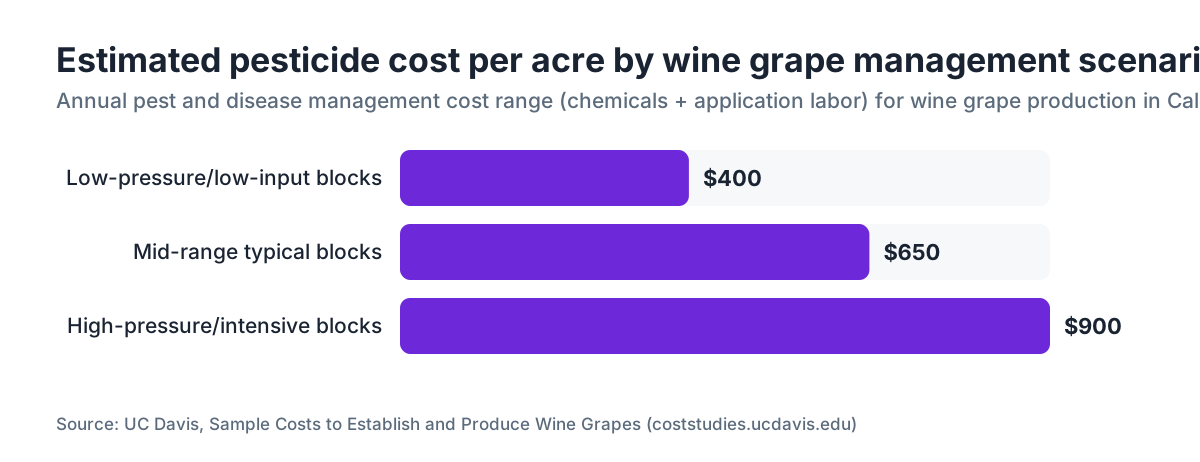
UC Davis's cost-of-production studies for wine grapes put pest and disease management (chemicals plus application labor) at roughly $400 to $900 per acre, depending on variety, region, and disease pressure [9]. That's not a small line, and it swings hard by block. If your Chardonnay blocks run $750/ac and your Cabernet blocks run $480/ac, you want to know that, and you want to know why.
To make it work, your records need product cost per unit at time of purchase, or you keep a separate product cost sheet and join it to the spray records. The math is simple: applications per block times product cost per gallon or pound times quantity used, plus labor hours times your loaded labor rate.
The cost-per-block view sharpens decisions. When you can see a block took six fungicide applications and still underperformed on fruit quality, that's a fact that might change your management or your development plan.
Track it consistently and the block spray record doubles as organic certification documentation if you're transitioning blocks. Certifiers want three full years of records showing no prohibited substances.
What record-keeping mistakes are most common and how do you avoid them?
Extension programs in California, Washington, and New York describe the same compliance failures over and over. A few patterns stand out.
The biggest: records filled in after the fact, days or weeks later. Memory rots. You will not remember whether block 6 got 3 lbs/ac or 3.5 lbs/ac three weeks on. Fill in the record during or immediately after the application. If you're spraying yourself, keep a laminated field card in the tractor for the key numbers, then move them to the formal record the same day.
Second: no EPA registration number. It's on every label, every time. Write it down. An inspector can't verify the product without it.
Third: confusing 'product applied' with 'product purchased'. Your record reflects what actually hit the vines, not what you bought. Mix 5 gallons of concentrate, put 3 on the blocks, return 2 to the container, and your record shows 3 gallons applied. The distinction drives the total-product figure, a required field for restricted-use pesticides [3].
Fourth: no backup. Paper records should be scanned or copied and stored somewhere other than the original binder. A barn fire or flood erases years of records in an afternoon. Digital records need automatic cloud backup. Two years of required retention doesn't survive a lost file.
Fifth: product nicknames. 'Blue stuff' and 'the copper we always use' are not identifiers. Full trade name and EPA number, every time. Your crew may not know what 'the copper we always use' means, and an inspector two years out definitely won't.
How do you train employees and contract applicators to maintain compliant records?
The WPS requires annual pesticide safety training for all agricultural workers and handlers before they work in treated areas or handle pesticides [1]. That training covers safety, not record-keeping. Record-keeping is a separate skill you have to build into the team.
For your own crew, the thing that works is a one-page written procedure, laminated, listing what to record and when. Walk every new hire through it before they make a single application. Have them run one supervised application cycle and check their record before they leave the field.
For licensed pest control advisors or contract applicators: get their records. They're required to keep them under state licensing rules. In California, the PCA has to give the grower a copy of the pesticide use record [4]. Don't assume it's happening. Ask for it, file it, reconcile it against your own block records.
For organic-certified or transitioning blocks, everyone who touches those blocks needs to understand that an accidental application of a prohibited material is more than a paperwork problem. It can restart the three-year transition clock. Label those blocks in the field, more than in the records.
Cornell Cooperative Extension's integrated pest management resources include worker training materials on pesticide records you can adapt [6]. UC ANR's statewide IPM program has similar materials in Spanish and English, which matters across most California wine regions [10].
VitiScribe's mobile field app lets applicators log from the tractor cab in real time, with the block map and a pre-populated product list to cut data-entry errors. That's the direct answer to the retroactive fill-in problem.
How long do you actually need to keep vineyard spray records?
The federal minimum for restricted-use pesticide records is two years from the application date, under 7 U.S.C. 136i [3]. The WPS requires application information posted for 30 days after REI expiration and retained for two years [1].
States go longer. California's pesticide use report system means the county ag commissioner's office holds those records for three years, and plenty of California growers keep their own copies indefinitely because of the detail a compliance defense demands [4]. Washington sets a two-year minimum [5]. New York's Department of Environmental Conservation requires three years for most applications [11].
Beyond compliance, keep them longer for practical reasons. Organic certification needs three years of documentation showing no prohibited materials. In a neighbor complaint or drift liability fight, records from three to five years back can decide it. Wine fraud investigations (rare, but real) have gone back five years or more in vineyard records.
The honest advice: keep them five years. Paper in a fireproof cabinet or scanned files on a backed-up drive costs you nearly nothing. Two years is the legal minimum, not the smart target.
Frequently asked questions
What is the minimum information required on a vineyard pesticide application record under federal law?
For restricted-use pesticides, federal law (7 U.S.C. 136i and 40 CFR Part 170) requires: product name, EPA registration number, total amount of product applied, application date, application location, and the certified applicator's name and certification number. The EPA Worker Protection Standard also requires the treated area location, REI start and end times, and active ingredient to be posted at a central location within 24 hours of application.
Do spray records need to be kept separately for each vineyard block?
Federal law requires a location description, which a block ID satisfies, but doesn't mandate block-level separation. State rules, especially in California and Washington, effectively require it because pesticide use reports must identify the treated acreage precisely. More practically, block-level records are what let you manage PHI, diagnose disease patterns, and prove compliance when only some blocks got a product on a given day.
How do I track pre-harvest intervals for multiple blocks with different harvest dates?
Build a PHI tracker table separate from your application log: columns for block, product, application date, PHI in days, and earliest legal harvest date. Update it after every application. When harvest dates firm up, compare your planned date against the latest earliest-harvest-date entry for that block. The longest active PHI controls. Sign off on PHI clearance for each block before harvest crew entry, and keep that sign-off in your records.
Can I keep vineyard spray records on paper, or do I need software?
Paper is fully legal and accepted by every regulatory agency. The legal requirement is that records be accurate, complete, and available for inspection, not that they be digital. The real risk with paper is illegibility, missing fields, and no backup copy. If you use paper, scan or copy the records regularly and store copies off-site. Software adds convenience for sorting and searching but adds no compliance value paper doesn't already have.
What does the EPA Worker Protection Standard require me to post about spray applications?
Under 40 CFR Part 170, agricultural employers must post pesticide application information at a central location within 24 hours of application start. The posting must include: product name, EPA registration number, active ingredient(s), treated area location and description, application date, REI start time, and REI end time. The posting stays up for 30 days after the REI expires, and workers must be able to access it without having to ask.
How do I handle spray records when I hire a contract applicator or PCA?
In California, a licensed PCA must give the grower a copy of the pesticide use record for every application they recommend or supervise. In other states the obligation varies, but as the property owner you should always request a copy. File contractor records in the same block-level system as your own applications. You stay responsible for what goes on your land regardless of who applies it, so don't rely on the contractor's file alone.
How long should I keep my vineyard spray records?
Federal law requires two years for restricted-use pesticide records. California requires pesticide use reports be available for three years. New York requires three years. Organic certification requires three full years of records showing no prohibited inputs. Practically, keep records for at least five years. Drift complaints, neighbor disputes, and residue tracing can reach back further than the legal minimum, and storage costs are negligible.
What block information should I record beyond the spray event itself?
WSU and Cornell Extension both recommend recording growth stage (BBCH scale) at application, temperature, wind speed and direction, relative humidity, water volume in gallons per acre, nozzle type and pressure, and equipment ID. These details turn a compliant record into a useful one. They let you correlate spray timing with canopy development, explain coverage variation, and defend application decisions if a disease or drift issue is later questioned.
How do I handle organic transition blocks versus conventionally managed blocks in the same vineyard?
Keep organic-transition and conventional block records completely separate, with clear block IDs, and physically label the transition blocks in the field to prevent accidental application of prohibited materials. Your certifying agent needs three consecutive years of records showing no prohibited inputs on transition blocks. Any prohibited application restarts the three-year clock. List approved and prohibited products for each block in your product register so any applicator can check before loading.
What's the best way to organize a spray binder for a vineyard with 10 or more blocks?
Use a tabbed three-ring binder with one tab per block. At the front, put your block map, block register (ID, variety, rootstock, acres, year planted), and current season PHI tracker. Behind each tab, file application records in date order. Keep a running product inventory sheet as a separate section. At season end, file the closed binder in permanent records and start fresh. Label the spine with property name, season year, and 'Spray Records' clearly.
Do I need separate spray records if the same product goes on multiple blocks in the same day?
Yes, unless the rate, area, and all other details are identical. If you apply the same product at the same rate to blocks 1, 2, and 3 in one continuous pass, many operations record it as a single entry listing all three blocks with combined acreage and total product used, which is acceptable as long as the location field identifies each block. If rates or areas differ between blocks, use separate entries. When in doubt, separate entries are easier to defend.
How does California's pesticide use reporting requirement affect my spray records?
California requires a Pesticide Use Report filed with the county agricultural commissioner within seven days of any pesticide application, covering the product, amount, location, crop, and acreage. This applies to essentially all vineyard pesticides, well beyond restricted-use products. Your block-level records feed directly into it. Failure to file is a civil violation. The county ag commissioner can audit your records against the use reports you've filed, so your records and reports must agree.
What should I do if I discover a spray record error or omission after the fact?
Correct it with a dated correction note, not by erasing or overwriting the original entry. Draw a single line through the error, write the correction next to it, and initial and date it. This is standard practice in regulated record-keeping: the original entry stays legible. Digital systems log edits automatically. Never delete an original entry. A corrected record is acceptable. A suspiciously clean record with no corrections sometimes draws more scrutiny, not less.
Are there free templates for vineyard block spray records I can use?
Yes. UC Cooperative Extension, WSU Extension, and Cornell Cooperative Extension all offer free downloadable spray record templates formatted for wine grape operations. Search each university's extension site directly. The EPA also provides WPS-compliant application information templates on its worker protection pages. These are solid starting points. Add your block-specific fields (BBCH stage, water volume, equipment) to any of them.
Sources
- U.S. EPA, Worker Protection Standard (40 CFR Part 170): WPS requires pesticide application information posted at central location within 24 hours, retained 30 days post-REI, and records kept two years; workers must access information without asking.
- UC Cooperative Extension, Vineyard Record Keeping Resources: UC Cooperative Extension recommends block-level records to support compliance reviews and cost-of-production accounting in wine grape operations.
- U.S. EPA, Restricted Use Pesticide Recordkeeping (7 U.S.C. 136i / FIFRA): Federal law requires restricted-use pesticide records including product, EPA registration number, total amount applied, date, location, and certified applicator name and number; records retained two years.
- California Department of Pesticide Regulation, Pesticide Use Reporting: California requires a Pesticide Use Report filed with the county agricultural commissioner within seven days of application; PCA must provide grower a copy of application records.
- Washington State Department of Agriculture, Pesticide Licensing and Recordkeeping: Washington State requires licensed pesticide applicators to retain application records for two years and to record the target pest or disease.
- Cornell Cooperative Extension, New York State Integrated Pest Management: Cornell Extension recommends recording BBCH growth stage, wind speed and direction, temperature, and equipment used at time of pesticide application.
- Washington State University Extension, Viticulture and Enology Program: WSU Extension recommends maintaining a block register listing block ID, variety, rootstock, year planted, acres, row orientation, and irrigation type as backbone for spray and vine health records.
- National Pesticide Information Center, Pesticide Product Information: NPIC provides PHI and REI information for registered pesticide products by EPA registration number.
- UC Davis, Sample Costs to Establish and Produce Wine Grapes (coststudies.ucdavis.edu): UC Davis cost-of-production studies show pest and disease management costs for wine grapes run between $400 and $900 per acre depending on variety, region, and disease pressure.
- UC ANR Statewide Integrated Pest Management Program: UC ANR IPM program provides bilingual (English and Spanish) training materials for farm workers on pesticide records applicable to California wine regions.
- New York State Department of Environmental Conservation, Pesticide Regulation: New York's Department of Environmental Conservation requires pesticide application records to be retained for three years.
Last updated 2026-07-09