Vineyard Soil Sampling Records: What to Track and Why
Soil data gets collected once and forgotten. A lab report ends up in a file drawer, a consultant references it in a report that gets emailed and archived, and three seasons later no one can find it when a rootstock replant decision comes up. That's a waste of expensive information.
Soil records in VitiScribe link with block mapping for complete block-level data. When your soil pH, organic matter, and nutrient levels are attached to the same block record as your spray history and scouting observations, that information becomes part of your ongoing management picture, not a one-time snapshot.
TL;DR
- Soil pH below 6.0 can increase phylloxera activity in certain rootstock combinations -- a direct connection between soil chemistry and pest management decisions that is invisible if soil data lives in a separate folder from spray and scouting records
- Standard recommendation is to sample every 3-4 years for established vineyards; pre-plant sampling should occur 6-12 months before new block establishment to allow time for pH amendment before planting
- Sample from GPS-recorded consistent locations within each block -- inconsistent sampling locations make year-over-year comparison nearly meaningless because you can't separate site variability from actual change
- Record depth alongside every result -- a pH of 6.2 at 0-12 inches is very different from a pH of 6.2 at 24-36 inches and drives different amendment decisions
- Boron deficiency affects berry set in ways that alter bunch architecture and botrytis risk -- soil chemistry connects to disease susceptibility in ways that require integrated records to see
- Every lime, gypsum, and compost application should be recorded as an input linked to the block and date -- the management response to soil data belongs in the same record as the data that drove it
Why Soil Data Belongs in Your Vineyard Records System
Soil pH below 6.0 can increase phylloxera activity in certain rootstock combinations. That's one example of a direct connection between soil chemistry and pest management decisions. Soil type, drainage class, cation exchange capacity, these all influence vine behavior and, indirectly, how you manage pests, disease, and nutrition.
If your soil data lives in a separate folder from your spray and scouting records, you can't see those connections without manually pulling files together. Integrated records let you query across data types: which blocks have low pH, and how does that correlate with my phylloxera scouting observations?
Soil Sampling Protocols
When to Sample
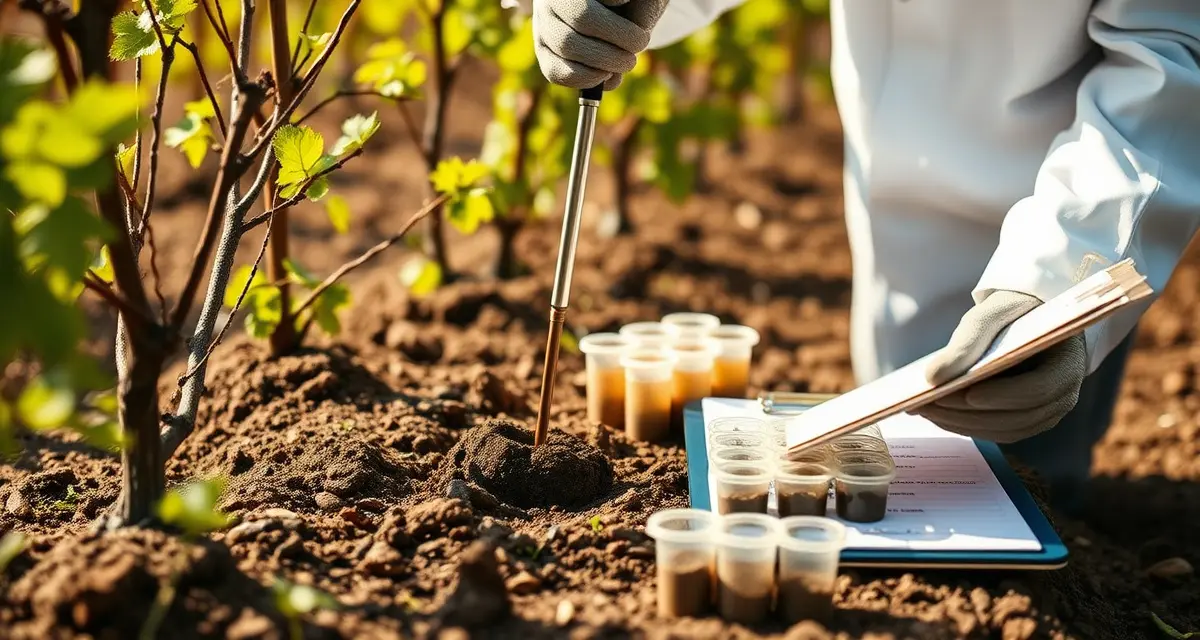
Most guidelines recommend sampling every 3-4 years for established vineyards. Pre-plant sampling before new block establishment should happen at least 6-12 months ahead of planting to allow time for pH amendment if needed.
Within-season sampling is less common for standard nutrient panels but relevant for nitrogen management, petiole sampling at bloom and veraison gives you in-season nutrient status that soil tests don't capture.
Where to Sample
For GPS-linked block records, sample from consistent locations within each block. Mark your sampling points, literally flag them or record GPS coordinates, so future samples come from the same spots. Inconsistent sampling locations make year-over-year comparison nearly meaningless.
Standard practice is composite sampling: 10-15 cores per block, mixed and subsampled. For blocks with known variability (different soil types, drainage differences, yield variation), consider sampling sub-zones separately.
How Deep to Sample
Surface samples (0-12 inches) capture the active root zone and are most relevant for pH, organic matter, and most nutrients. Deeper samples (12-24 inches or 24-36 inches) matter for subsoil pH, calcium-to-magnesium ratios in some soils, and drainage assessment.
Record the depth sampled alongside every result, a pH of 6.2 at 0-12 inches is very different from a pH of 6.2 at 24-36 inches.
What to Record for Each Soil Sample
Lab Results by Block
Record the complete panel for each block sampled: pH, organic matter, available phosphorus, potassium, calcium, magnesium, sodium, boron, zinc, iron, manganese. Include the lab name, sample date, and lab accession number so you can retrieve the original report if needed.
In VitiScribe, enter results by block with the sampling date and depth, and attach the original PDF report. Future searches pull up all soil data for a block chronologically.
Soil Texture and Classification
If you've done a physical soil assessment or have NRCS data, record texture class (clay loam, sandy loam, etc.) and drainage class. This doesn't change season to season but belongs in the permanent block record.
Amendment Records
Every lime application, gypsum application, compost addition, or fertility amendment should be recorded with date, block, product, and rate. This is the management response to your soil data, the two belong together.
Sample Point Coordinates
If you're sampling consistent locations within blocks, record the GPS coordinates of each sampling point. This makes repeat sampling accurate and helps with spatial interpolation if you're moving toward precision nutrition management.
Connecting Soil Records to IPM and Fertility Programs
Soil Data and Pest Risk
Beyond phylloxera, soil factors affect vine nutrition and vine nutrition affects pest and disease susceptibility. Calcium-deficient vines show increased susceptibility to some bacterial diseases. Boron deficiency affects berry set in ways that alter bunch architecture and botrytis risk.
When you're reviewing your vineyard IPM program and looking for non-chemical explanations for disease patterns, soil chemistry is part of the picture. For the block mapping structure that integrates soil data with spray and scouting records, see the block mapping GPS guide.
Linking Soil to Spray Decisions
A block with chronically low pH and resulting nutrient imbalances may require different spray program management than a block with optimal soil chemistry. If you're seeing persistent disease pressure in one block that doesn't respond to your standard program, soil data is part of the diagnostic workup.
Block-Level Fertility Planning
Soil test results link directly to fertilizer recommendations. When those recommendations are in the same system as your spray records, you can see the full input picture for each block, not just pesticides, but fertilizers, soil amendments, and the underlying chemistry driving those decisions.
Setting Up Soil Records in VitiScribe
Step 1: Create a Soil Sample Record Type
In VitiScribe, create a soil sampling activity type with fields for sample date, depth, lab, and accession number. This becomes a recurring record tied to each block.
Step 2: Enter Historical Data First
If you have past soil test results, enter them by block with the date. Historical data in the system is immediately useful, you can see trend lines in pH or organic matter across years.
Step 3: Attach Lab Reports as Documents
Scan or photograph lab reports and attach them to the corresponding block soil record. The data entry gives you searchable fields; the attachment preserves the full lab context.
Step 4: Record Amendment Applications as Spray-Adjacent Records
Lime, gypsum, and compost applications go into VitiScribe as material applications linked to the block and date. These aren't pesticide records, but they're inputs that affect vine health and belong in the block management history.
Step 5: Review Soil Data Before Replant Decisions
When you're considering a block replant, pull the full soil history in VitiScribe. pH trends, organic matter trajectory, persistent nutrient imbalances, all of it informs rootstock selection, amendment programs, and expected vine performance.
Related Articles
- Vineyard Spray Logs and Soil Health Records: Connecting Pesticide Use to Soil Biology
- Biological Control Records in Vineyard IPM: Tracking Beneficial Insects
- Vineyard Spray Records in Colorado: CDA Requirements for Grand Valley Wine Growers
FAQ
What soil data should vineyard managers record and track over time?
At minimum, record pH, organic matter, and macro and micronutrient levels from laboratory analysis, with the sampling date, depth, and block location. Also record any soil amendments applied in response to soil data, including lime, gypsum, and compost. Over time, tracking these results by block lets you see whether your amendments are achieving the intended effect and whether nutrient levels are trending toward or away from target ranges.
How do soil sampling records connect to vineyard IPM and fertility programs?
Soil chemistry directly influences vine nutrition, which affects pest and disease susceptibility. Low pH blocks may have different pest dynamics than well-buffered blocks. Nutrient imbalances, particularly calcium and boron, affect bunch architecture in ways that influence botrytis risk. When your soil records and your IPM records are in the same system, you can query across both to identify correlations that inform your management decisions.
Can VitiScribe track soil sampling results alongside spray and scouting records?
Yes. VitiScribe allows you to record soil sampling results as block-level data in the same system as your spray logs, scouting observations, and canopy management records. You can attach PDF lab reports to the digital record, set up recurring reminders for re-sampling schedules, and view complete block histories that include soil data alongside all other management records.
How should a vineyard manager document a soil amendment program in records to demonstrate that application rates were based on laboratory analysis recommendations rather than a fixed annual schedule?
The documentation structure should link the soil test result to the amendment application in a cause-and-effect sequence. The soil test record should include the pH or nutrient result, the sampling date, and the laboratory recommendation (e.g., "apply 1.5 tons agricultural lime per acre to raise pH from 5.7 to 6.3"). The amendment application record should reference the soil test date and the result that drove the recommendation, along with the product, rate, date, and block. This linkage demonstrates that the amendment rate was derived from soil data, not applied on a fixed schedule. For SIP Certified or organic certification review, this documentation converts a fertilizer record from a compliance entry into a documented management decision with scientific justification.
What sampling approach should a Sierra Foothills vineyard manager use for blocks with steep elevation gradients and variable soil types within a single block?
For blocks with documented soil variability -- different textures, drainage characteristics, or yield zones within the same block -- sub-zone sampling is more informative than a single composite sample for the full block. Divide the block into management zones based on observed variability (soil color, drainage, vine performance history), sample each zone separately, and record the GPS coordinates for each zone's sampling points. Record the sub-zone designation alongside each result in VitiScribe. This approach gives you zone-specific pH and nutrient data that allows zone-specific amendments, rather than averaging across a block where conditions differ meaningfully by elevation or soil type.
What is Vineyard Soil Sampling Records: What to Track and Why?
[FAQ_ANSWER_PLACEHOLDER: This answer needs to be generated by AI with specific data, examples, and actionable advice relevant to Vineyard Soil Sampling Records: What to Track and Why. Target 50-150 words.]
How much does Vineyard Soil Sampling Records: What to Track and Why cost?
[FAQ_ANSWER_PLACEHOLDER: This answer needs to be generated by AI with specific data, examples, and actionable advice relevant to Vineyard Soil Sampling Records: What to Track and Why. Target 50-150 words.]
How does Vineyard Soil Sampling Records: What to Track and Why work?
[FAQ_ANSWER_PLACEHOLDER: This answer needs to be generated by AI with specific data, examples, and actionable advice relevant to Vineyard Soil Sampling Records: What to Track and Why. Target 50-150 words.]
Sources
- UC Cooperative Extension Viticulture
- USDA Natural Resources Conservation Service (NRCS)
- UC Davis Department of Viticulture and Enology
- American Vineyard Foundation
- Wine Institute
Get Started with VitiScribe
Soil data that lives in a separate folder from spray and scouting records can't be queried against pest pressure observations, can't be linked to amendment application records, and can't inform replant decisions without manual file consolidation that often doesn't happen. VitiScribe stores soil test results at the block level alongside spray history and scouting observations, attaches PDF lab reports to each record, and supports amendment application entries that reference the soil test driving the recommendation. Try VitiScribe free and enter your first block's soil history today.