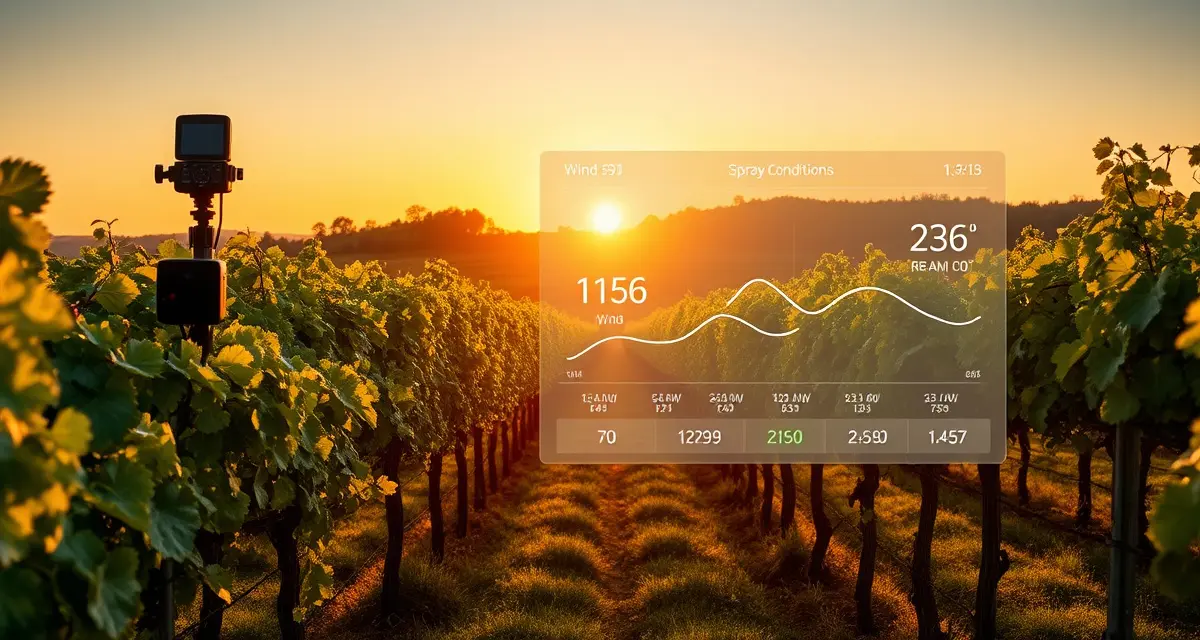
Spray Window Alerts: Never Miss a Treatment Window Due to Weather
Spraying outside label wind speed limits voids pesticide registration and creates legal liability. That's not a risk most growers consciously take, it happens when you're watching the weather from the house, it looks calm, you drive to the block, conditions have picked up, and you spray anyway because you've already made the trip and the window is closing.
No competitor sends block-level spray window alerts. Most rely on county weather stations miles away, which can be 15°F different in temperature and 8 mph different in wind speed from your actual vineyard location. Alerts that pull from county weather miss the conditions that matter for your specific blocks.
TL;DR
- Applying outside label wind speed, temperature, or inversion conditions is an off-label use that voids registration and creates civil liability -- not a citation risk, a full label compliance failure
- County weather station data can be 15 degrees F and 8 mph different from conditions at your actual vineyard location; spray window decisions made from county data are decisions made without adequate information
- VitiScribe integrates with CIMIS for California (140-plus stations across wine regions), AgriMet and WSU AgWeatherNet for Oregon and Washington, and directly with on-site weather stations for operations that have them
- Temperature inversions, which form at dusk and trap spray droplets horizontally, are incorporated into spray window assessments -- most labels prohibit application during inversions and VitiScribe flags inversion risk as a separate factor
- When a timestamped alert confirms in-label conditions before an application and a spray record logs contemporaneous weather data, that combination creates a defensible documentation trail if a neighbor files a drift complaint
- Custom thresholds can be set more restrictively than the label for blocks near sensitive receptor areas -- the conservative threshold appears in application records, documenting the extra margin maintained
Why County Weather Data Isn't Good Enough
Your vineyard sits in a specific topographic position, maybe a hillside with afternoon exposure, a valley floor with cold air drainage at night, or a ridge location with consistent afternoon marine influence. None of those site-specific conditions show up in county weather station data.
The practical result: you receive a spray window alert based on conditions 12 miles away. You drive to the block. Conditions don't match. You either spray in conditions outside label limits (a violation) or go home without spraying (a missed window).
VitiScribe pulls from on-site weather stations or the nearest CIMIS station for California vineyards. CIMIS (California Irrigation Management Information System) has over 140 stations across California wine grape regions, positioned close enough to most vineyard locations to be substantially more accurate than county airport weather. For operations with their own on-site stations, VitiScribe connects directly to that data feed.
What Weather Conditions Are Required Before Spraying?
Label requirements govern spray conditions. These aren't suggestions, applying outside label conditions is an off-label use, which voids registration and creates civil liability.
Wind speed: Most pesticide labels require applications below 10-15 mph, with many fungicide labels specifying 10 mph maximum. Some materials carry stricter requirements. VitiScribe's alert system uses the specific label wind limit for each product in your program, not a generic threshold.
Temperature: Upper temperature limits matter for several reasons. Sulfur has a phytotoxicity threshold at 95°F. Some herbicides volatilize at high temperatures, creating drift risk. Organophosphates may have temperature-dependent toxicity. Lower temperature limits affect spray efficacy, many fungicides perform poorly below 50°F.
Humidity: High humidity improves coverage and reduces evaporation of spray droplets, which is generally favorable. Very high humidity can create drift conditions if it combines with temperature inversions. Some product labels specify maximum or minimum humidity.
Temperature inversion risk: Temperature inversions trap spray droplets near the ground and allow them to drift horizontally over long distances without settling. Inversions typically form at dusk and persist through the night. Most labels prohibit application during inversions, VitiScribe incorporates inversion risk into spray window assessments.
Rainfall forecast: Most protectant fungicides need 2-4 hours to dry before rain washes residues. If a 40% rain probability is forecast within 4 hours, that's not a spray window even if current conditions look fine.
How VitiScribe Pulls Weather Data for Your Vineyard Location
CIMIS Integration (California)
For California vineyards, VitiScribe integrates with CIMIS to pull real-time and forecast data for the nearest station to your vineyard GPS coordinates. The integration shows current conditions and a 24-hour forecast, so your spray window assessment covers not just right now, but whether conditions will remain stable through your planned spray duration.
You see: current wind speed (2m and 10m heights), temperature, relative humidity, evapotranspiration rate, and any precipitation in the past 24 hours.
On-Site Weather Station Integration
For operations with on-site weather stations, Davis, Onset HOBO, Campbell Scientific, or other SCADA-compatible systems, VitiScribe connects directly to your station data. This is the most accurate option: real conditions at your exact location, not a proxy measurement from a nearby station.
The integration also allows VitiScribe to log weather conditions automatically with each spray event. When a spray record is created, current conditions from your station attach to the record automatically. That automated weather record is useful in drift complaint investigations and audit defense.
Regional Network Integration (Oregon and Washington)
For Oregon and Washington vineyards, VitiScribe integrates with the AgriMet network (USBR's Pacific Northwest weather network) and the Washington State University AgWeatherNet for block-specific condition data.
Can You Set Custom Spray Window Thresholds?
Yes. VitiScribe's default alert thresholds use label requirements for each product in your program. You can customize thresholds beyond label minimums, for example, setting a personal wind limit of 7 mph even when the label allows 10 mph, or requiring a lower minimum temperature for cold-sensitive materials.
Custom thresholds can be:
- Applied to all products in your program
- Set per product for product-specific restrictions
- Set per block for blocks near sensitive areas (neighbor gardens, waterways, organic operations) where extra buffer is appropriate
When you set a threshold more restrictive than the label, VitiScribe uses your custom threshold for alerts. This is good practice for blocks near sensitive receptor sites where drift risk has operational or legal consequences.
Spray Window Alerts and Spray Drift Documentation
There's a connection between spray window alerts and drift defense that's worth understanding. If you receive an alert showing conditions within label limits, log the application using those alert-verified conditions, and a neighbor later files a drift complaint, your records show that you had real-time weather verification before spraying.
A timestamped alert, followed by a spray record with contemporaneous weather data, is substantively different from a spray record with manually entered weather data that you can't verify. The alert-and-record combination creates a defensible audit trail for spray drift investigations.
See the spray program management guide for how spray window alerts integrate with your seasonal program, and the tank mix planning guide for verifying product compatibility before using that spray window.
Related Articles
- Using Weather Data for Vineyard Spray Windows
- Weather Data in Vineyard Spray Records: What You Must Capture and Why
FAQ
What weather conditions are required before spraying a vineyard?
Label requirements govern spray conditions, applying outside label conditions is an off-label application. Most pesticide labels require wind speeds below 10-15 mph (check your specific product's label). Temperature requirements vary: sulfur has a phytotoxicity ceiling at 95°F, and many fungicides perform poorly below 50°F. Labels also typically prohibit application during temperature inversions (which cause horizontal drift) and within timeframes that would expose the application to rain before adequate dry time. Check each product's label for its specific environmental application requirements.
How does VitiScribe pull weather data for my vineyard location?
VitiScribe integrates with CIMIS (California Irrigation Management Information System) for California vineyards, pulling real-time and forecast data from the nearest CIMIS station to your vineyard GPS coordinates. For Oregon and Washington vineyards, VitiScribe integrates with the AgriMet and WSU AgWeatherNet stations. For operations with on-site weather stations, VitiScribe connects directly to your station's data feed, providing the most accurate conditions for your exact location. Weather conditions log automatically with each spray event record.
Can I set custom spray window thresholds in VitiScribe?
Yes. Default alert thresholds use the label requirements for each product in your program. You can set custom thresholds that are more conservative than the label, for example, a lower wind speed limit for blocks adjacent to sensitive receptor areas. Custom thresholds can be applied vineyard-wide, per product, or per block. When your custom threshold is more restrictive than the label, VitiScribe uses your threshold for alerts and records it in the application documentation so your conservative standard is visible to auditors and neighbors if questions arise.
For a vineyard block adjacent to a certified organic operation, how should spray window alerts and weather documentation be configured to protect against drift complaints?
For blocks adjacent to organic operations, custom wind threshold settings should be applied at the block level, not just the operation level. Setting the wind speed alert threshold to a more conservative limit (5-7 mph rather than the label maximum of 10 mph) creates a documented conservative standard that appears on every application record for that block. Direction matters as much as speed: configuring the alert to flag wind directions blowing toward the organic block adds a directional component to the spray window assessment. When the application is logged, the wind speed and direction from the CIMIS or on-site station record at time of application shows that both the conservative custom threshold and the directional criterion were met. If the organic certifier or neighbor later questions whether drift occurred, the application records showing sub-7 mph winds directed away from the organic block are substantively more defensible than records showing 9 mph winds just under the label maximum.
What is Spray Window Alerts: Never Miss a Treatment Window Due to Weather?
[FAQ_ANSWER_PLACEHOLDER: This answer needs to be generated by AI with specific data, examples, and actionable advice relevant to Spray Window Alerts: Never Miss a Treatment Window Due to Weather. Target 50-150 words.]
How much does Spray Window Alerts: Never Miss a Treatment Window Due to Weather cost?
[FAQ_ANSWER_PLACEHOLDER: This answer needs to be generated by AI with specific data, examples, and actionable advice relevant to Spray Window Alerts: Never Miss a Treatment Window Due to Weather. Target 50-150 words.]
How does Spray Window Alerts: Never Miss a Treatment Window Due to Weather work?
[FAQ_ANSWER_PLACEHOLDER: This answer needs to be generated by AI with specific data, examples, and actionable advice relevant to Spray Window Alerts: Never Miss a Treatment Window Due to Weather. Target 50-150 words.]
What are the benefits of Spray Window Alerts: Never Miss a Treatment Window Due to Weather?
[FAQ_ANSWER_PLACEHOLDER: This answer needs to be generated by AI with specific data, examples, and actionable advice relevant to Spray Window Alerts: Never Miss a Treatment Window Due to Weather. Target 50-150 words.]
Sources
- California Department of Pesticide Regulation (CDPR)
- CIMIS (California Irrigation Management Information System)
- WSU AgWeatherNet
- USBR AgriMet
- UC Cooperative Extension Viticulture
Get Started with VitiScribe
County weather station data 12 miles from your vineyard can be 15 degrees off and 8 mph off from conditions at your actual blocks -- spray window decisions made from that data are incomplete, and applications outside label conditions create legal liability regardless of how the weather looked from the house. VitiScribe integrates with CIMIS for California and AgriMet/AgWeatherNet for Oregon and Washington, logs weather conditions automatically with each spray record, and sends block-level alerts when conditions meet your custom thresholds. Try VitiScribe free and configure your first block's spray window alert today.